Japan Window Control Systems Market Size & Growth Rate
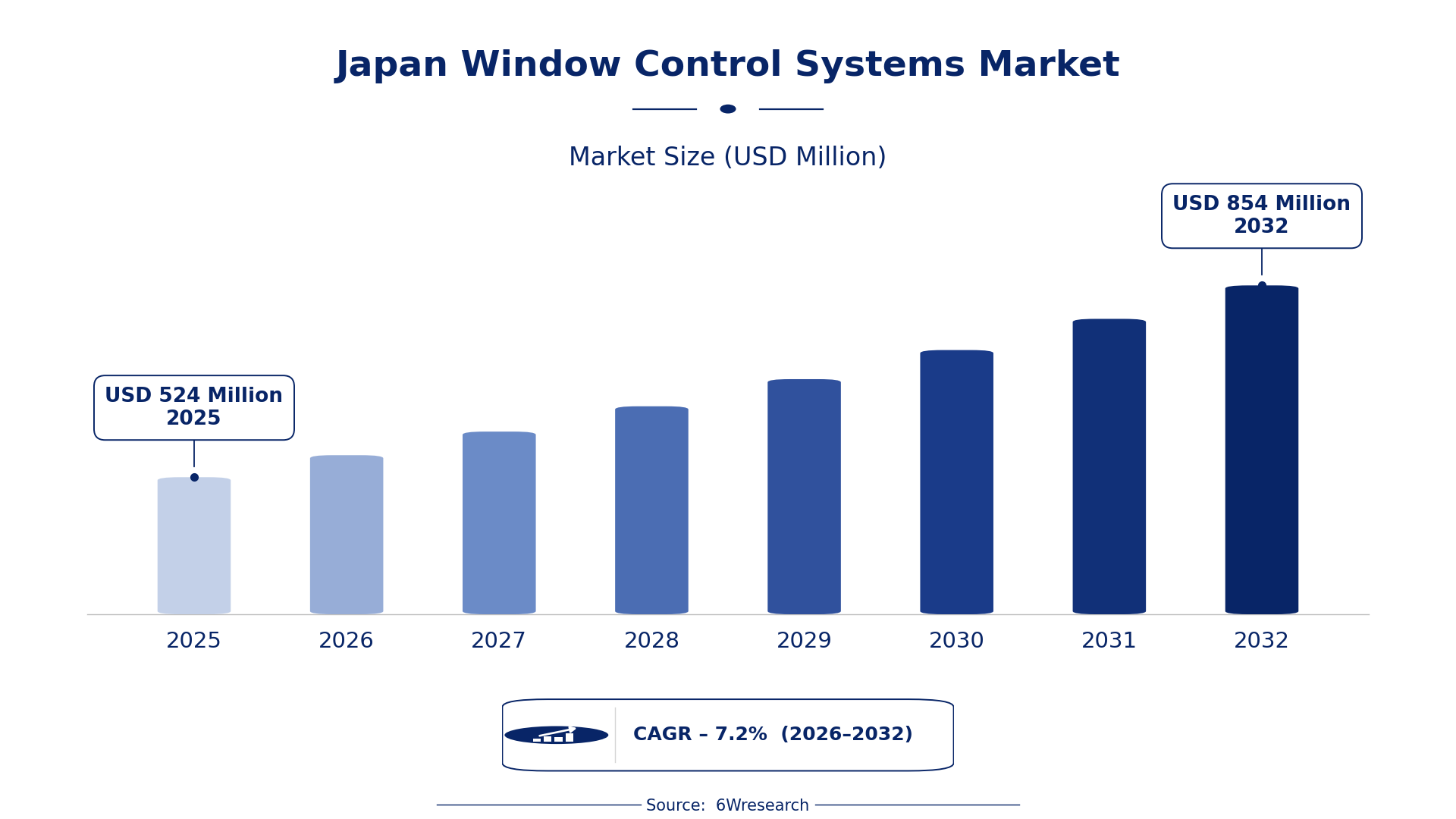
According to 6Wresearch internal database and industry insights, the Japan Window Control Systems Market was valued at USD 524 Million in 2025 and is projected to reach USD 854 Million by 2032, growing at a CAGR of approximately 7.2% during 2026–2032.
Japan Window Control Systems Market Highlights
| Report Metric | Details |
| Report Name | Japan Window Control Systems Market (2026-2032) |
| Market Size 2025 | USD 524 Million |
| Market Size 2032 | USD 854 Million |
| Absolute Growth 2025–2032 | USD 330 Million |
| CAGR 2026–2032 | 7.2% |
| Peak Annual Growth | 9.6% in 2026 |
| Forecast Period | 2026–2032 |
| Historical Data | 2022–2025 |
| Base Year | 2025 |
| Leading Control Type, 2025 | Automated Systems (36% share) |
| Leading Technology Type, 2025 | Electronic (37% share) |
| Leading Installation Type, 2025 | New Construction (46% share) |
| Leading End User, 2025 | Building Owners (37% share) |
| Fastest-Growing Control Type | Remote Controlled (9.9% CAGR) |
| Fastest-Growing Technology Type | Wireless IoT (10.5% CAGR) |
| Fastest-Growing Installation Type | Retrofit (10.1% CAGR) |
| Fastest-Growing End User | Smart Homes (9.1% CAGR) |
| Growing Sector | Energy-efficient building technologies |
| Key End Users | Building Owners, Facility Managers, Smart Homes, High-End Homes |
Japan Window Control Systems Market Year-wise Growth Rate and Key Drivers (2022–2032)
This graph illustrates the annual growth rates of the market from 2022 to 2032, highlighting a steady upward trajectory and projected market expansion over the forecast period.
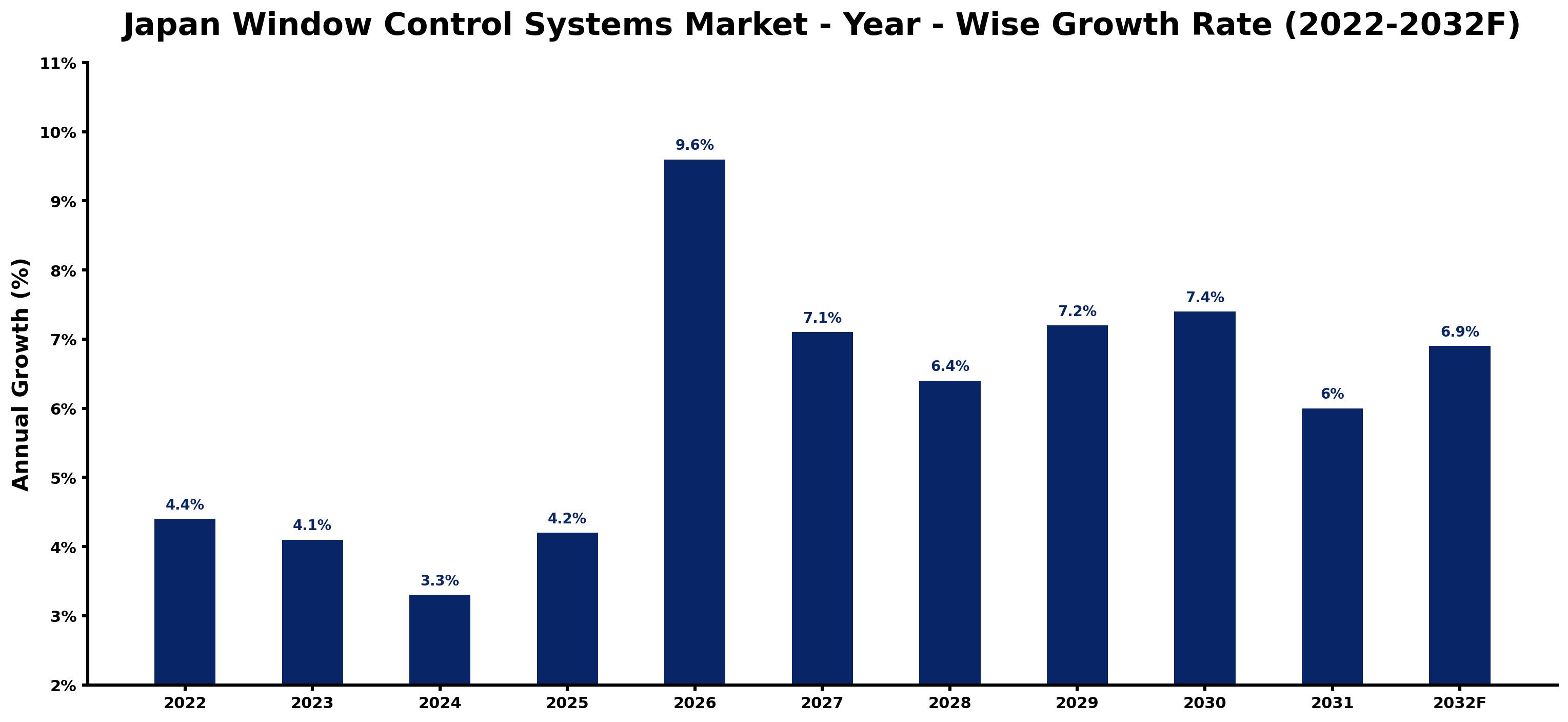
The following figures match every annual growth estimate with the main market development of that year, giving the reasoning behind each rise or slowdown.
| Year | Estimated Annual Growth (%) | Market Rationale |
| 2022 | 4.4 | The market experienced solid growth due to rising energy efficiency awareness. |
| 2023 | 4.1 | Growth slowed as the market adjusted to previous peaks in demand. |
| 2024 | 3.3 | Continued slow growth reflected a stabilisation in smart technology adoption. |
| 2025 | 4.2 | Demand increased as new construction projects incorporated advanced systems. |
| 2026 | 9.6 | Rapid growth will be driven by heightened investments in smart building technologies. |
| 2027 | 7.1 | Growth is projected to slow as market maturity begins to take effect. |
| 2028 | 6.4 | Slightly slower growth is anticipated as a shift towards more sustainable solutions occurs. |
| 2029 | 7.2 | Demand is expected to surge again as retrofitting becomes a priority for many buildings. |
| 2030 | 7.4 | Growth will continue as more buildings adopt energy-efficient technologies. |
| 2031 | 6.0 | The market is projected to see slower growth as new installations begin to stabilise. |
| 2032 | 6.9 | Demand will increase again as energy efficiency targets prompt upgrades. |
Note: Market size estimations and growth projections presented in this report are based on 6Wresearch's proprietary forecasting methodology, utilizing the latest available industry data, government publications, and primary research inputs.
Japan Window Control Systems Market Synopsis
Window control systems regulate the opening and closing of windows, improving energy efficiency and comfort in buildings. The Japan Window Control Systems Market is expanding, driven by the increasing adoption of smart home technologies and energy-efficient building practices. Investment in automated window systems is rising, supported by government initiatives promoting energy-efficient technologies, particularly in urban areas like Tokyo. The smart home market is projected to reach 1.5 million units by 2025, reflecting the demand for integrated solutions.
Market Dynamics Impact Analysis (2026–2032)
| Factor | Type | Impact | Primary Segment Affected |
| Increasing adoption of automated systems for energy efficiency | Driver | High | Automated Systems |
| Rising number of smart homes driving demand for integrated technologies | Driver | High | Smart Homes |
| Growing need for energy-efficient retrofitting in aging buildings | Opportunity | High | Retrofit |
| Investment in new construction projects incorporating smart technologies | Opportunity | High | New Construction |
| High costs associated with advanced technology integration | Restraint | Medium | Automated Systems |
| Limited awareness of the benefits of smart technologies among consumers | Restraint | Medium | Building Owners |
| Challenges in sourcing high-quality materials for production | Challenge | Medium | Electronic |
| Competition from alternative energy-efficient solutions | Challenge | Medium | Smart Homes |
Evaluation of Drivers in Japan Window Control Systems Market (2026–2032)
Demand rests on the following drivers, each shown with the segment it touches most.
| Drivers | Primary Segment Affected | Why It Matters (Evidence) |
| Investment in smart building technologies | Smart Homes | Tokyo's smart home market is projected to reach 1.5 million units by 2025, driving demand for integrated window control systems. |
| Government initiatives promoting energy efficiency | Automated Systems | The Ministry of Land, Infrastructure, Transport and Tourism supports energy-efficient technologies, increasing installation rates. |
| Rising energy costs influencing consumer choices | Retrofit | The average household spends approximately 20% of energy on heating and cooling, prompting retrofitting of existing buildings. |
| Growing urban population increasing housing demand | New Construction | Japan's population is expected to reach 125 million by 2025, driving new housing developments with smart technologies. |
| Integration of IoT technologies in building management | Wireless IoT | Wireless IoT technologies are anticipated to grow by 20% annually, improving window control systems in smart buildings. |
Buyers are adding capacity as investments in smart building technologies rise, particularly in urban areas like Tokyo, where the smart home market is projected to reach 1.5 million units by 2025. Rising energy costs influence consumer choices, with households spending about 20% of their energy on heating and cooling, prompting retrofitting of existing buildings. Population growth is increasing housing demand, leading to new construction projects that incorporate advanced technologies. The integration of IoT technologies is also significant, with wireless IoT expected to grow by 20% annually, improving window control capabilities in smart buildings.
Evaluation of Restraints in Japan Window Control Systems Market
These are the pressures that could keep growth below its potential.
| Market Restraint | Primary Segment Affected | Why It Matters (Evidence) |
| High costs associated with advanced technology integration | Automated Systems | The installation of automated systems can reduce energy costs by up to 15%, but initial costs remain a barrier. |
| Limited awareness of the benefits of smart technologies among consumers | Building Owners | Many building owners are unaware of the energy savings and comfort improvements offered by smart window control systems. |
| Challenges in sourcing high-quality materials for production | Electronic | Producers face difficulties in obtaining materials that meet JIS standards, affecting production timelines. |
| Competition from alternative energy-efficient solutions | Smart Homes | Emerging technologies may divert attention from window control systems, impacting market share. |
| Regulatory compliance costs for new installations | New Construction | Compliance with the Building Energy Efficiency Act adds financial burdens to new construction projects. |
Japan Window Control Systems Market Challenges
In Japan, producers face a skills gap, which delays project timelines and raises costs for developers, impacting their ability to meet the demand for smart technologies in over 200,000 smart homes. Importers encounter fierce competition in the smart home market, projected to reach 1.5 million units by 2025, forcing them to lower prices and squeeze their profit margins. Regulatory challenges arise from JIS standards governing quality and safety, leading to potential delays in product approvals that increase costs for buyers. Buyers must invest in energy-efficient upgrades due to government mandates, which can strain budgets, especially for older buildings.
Trends in the Japan Window Control Systems Market
The shifts below are changing how Japan Window Control Systems Market products are bought and supplied.
- Shift towards Smart Home Integration: Building owners are increasingly adopting smart home technologies, with over 60% of new residential buildings equipped with such features. This trend is reshaping the window control systems market, as demand for automation rises.
- Transition from Manual to Automated Systems: Tokyo has seen a shift from manual window controls to automated systems, driven by energy efficiency goals. This change is evidenced by the growing adoption of automated systems, which are expected to dominate the market.
- Emergence of Wireless IoT Technologies: Wireless IoT technologies are becoming prevalent in smart buildings, with a projected annual growth rate of 20%. This trend reflects the increasing demand for interconnected systems that improve building management and energy efficiency.
- Focus on Energy-Efficient Retrofitting: The demand for retrofitting existing buildings is on the rise, particularly due to aging infrastructure. In 2022, the Japanese government allocated ¥100 billion for energy-efficient building retrofits, highlighting this growing focus.
Investment Opportunities in the Japan Window Control Systems Market
The opportunities below stand out in the Japan Window Control Systems Market for new entrants and existing suppliers.
- Urban Areas Driving Demand for Retrofitting: Tokyo's aging infrastructure presents an opportunity for retrofitting, with the demand for energy-efficient solutions growing. The government allocated ¥100 billion in 2022 for building retrofits, indicating a clear investment path.
- Partnerships for Smart Building Solutions: Local partnerships can facilitate market entry for suppliers of window control systems. Collaborating with facility managers overseeing approximately 50,000 commercial buildings can provide access to new projects.
- Building Owners Seeking Energy Efficiency: With a growing focus on energy efficiency, building owners are increasingly looking for advanced window control solutions. Suppliers can tap into this demand by offering automated systems that align with energy standards.
- Investment in New Construction Projects: The projected population growth in Japan indicates a need for new housing developments. Suppliers should target new construction projects, where smart technologies are becoming standard.
Government Initiatives in the Japan Window Control Systems Market
The Building Energy Efficiency Act, amended in 2022, mandates that all new buildings meet energy standards from April 2025. This law compels producers to ensure their window control systems comply with these standards, promoting energy-efficient technologies in the market. The Electrical Appliance and Material Safety Act regulates the safety of electrical appliances, ensuring that window control systems meet safety requirements before reaching consumers.
The Ministry of Economy, Trade and Industry plays a key role in promoting energy-efficient technologies. It funds various initiatives and approves projects aimed at improving building energy efficiency. The ministry's support for R&D in AI-enabled building technologies through subsidies encourages innovation in window control systems.
Future Insight of the Japan Window Control Systems Market
A policy-driven shift towards energy-efficient technologies will transform the market by 2032, as the government aims for a 30% reduction in energy consumption by 2030. Suppliers will adapt by focusing on retrofitting existing structures to accommodate buyers with aging infrastructure. The Tokyo Metropolitan Government's green building initiative will drive the adoption of advanced practices in urban settings. The integration of smart systems will gain momentum, benefiting buyers seeking enhanced efficiency while suppliers align with new standards.
Market Segmentation Analysis
Japan Window Control Systems Market report covers a detailed analysis of the following market segments:
By Control Type – Automated Systems Lead, Remote Controlled Expected to Grow Fastest
According to Saurav Kr Singh, Senior Research Analyst at 6Wresearch, with 36% of control type revenue in 2025, Automated Systems was the largest category. Automated systems dominate the market due to their prevalent use in enhancing energy efficiency across various buildings. For instance, the integration of these systems in over 60% of new residential constructions illustrates a strong preference among property developers. Over 2026–2032, Remote Controlled is expected to post the fastest growth, at a CAGR of 9.9%. The remote controlled segment is witnessing rapid growth, primarily due to its increasing application in smart homes, projected to reach 1.5 million units by 2025. This trend reflects a shift towards more convenient and efficient window management solutions. Suppliers must focus on developing advanced automated features to meet the rising demand for energy-efficient window control systems.
By Technology Type – Electronic Leads, Wireless IoT Expected to Grow Fastest
In 2025, Electronic led the technology type split with a 37% share. Electronic technology holds the largest share as it is extensively implemented in modern installations, ensuring reliability and efficiency. This is particularly evident in the numerous smart buildings emerging in urban areas like Tokyo, which prioritise advanced systems. The quickest growth will come from Wireless IoT, forecast to expand at a CAGR of 10.5% between 2026 and 2032. Wireless IoT technology is rapidly gaining traction, especially in smart building applications where seamless connectivity is essential. This growth is supported by government initiatives promoting the integration of IoT in building management. Buyers should consider investing in wireless IoT technologies to maintain competitive and efficient building systems.
By Installation Type – New Construction Leads, Retrofit Expected to Grow Fastest
New Construction accounted for 46% of the market by installation type in 2025. New construction is the leading installation type, as it is standard in modern developments that prioritise energy efficiency and smart technologies. This trend is particularly strong in urban centres where building regulations favour advanced systems. Retrofit is projected to grow fastest, at a CAGR of 10.1% during 2026–2032. The retrofit segment is growing quickly, driven by the increasing demand for upgrading existing buildings to meet contemporary energy standards. This reflects a broader trend of improving aging infrastructure across Japan. Suppliers must adapt their offerings to cater to the retrofit market, ensuring compatibility with older structures.
By End User – Building Owners Lead, Smart Homes Expected to Grow Fastest
Building Owners held 37% of the Japan Window Control Systems Market by end user in 2025. Building owners represent the largest market segment as they are the primary decision-makers for installations in both commercial and residential developments. Their focus on energy efficiency and comfort significantly drives the demand for sophisticated window control systems. Smart Homes are set to record the highest CAGR in this split, 9.1% over 2026–2032. Smart homes are the fastest-growing end user segment, reflecting a trend towards integrated living solutions that enhance convenience and operational efficiency. The rise of smart technologies in over 200,000 homes in Tokyo underscores this shift. Suppliers should target smart home developers to capitalise on the increasing integration of window control systems in contemporary residences.
Key Attractiveness of the Report
- 10 Years of Market Numbers
- Historical Data Starting from 2022 to 2025
- Base Year 2025
- Forecast Data until 2032
- Key Performance Indicators Impacting the Market
- Major Upcoming Developments and Projects
Key Highlights of the Report:
- Japan Window Control Systems Market Outlook
- Market Size of Japan Window Control Systems Market, 2025
- Forecast of Japan Window Control Systems Market, 2032
- Historical Data and Forecast of Japan Window Control Systems Revenues & Volume for the Period 2022-2032F
- Japan Window Control Systems Market Trend Evolution
- Japan Window Control Systems Market Drivers and Challenges
- Japan Window Control Systems Price Trends
- Japan Window Control Systems Porter's Five Forces
- Japan Window Control Systems Industry Life Cycle
- Historical Data and Forecast of Japan Window Control Systems Market Revenues & Volume By Control Type for the Period 2022-2032F
- Historical Data and Forecast of Japan Window Control Systems Market Revenues & Volume By Manual Controls for the Period 2022-2032F
- Historical Data and Forecast of Japan Window Control Systems Market Revenues & Volume By Automated Systems for the Period 2022-2032F
- Historical Data and Forecast of Japan Window Control Systems Market Revenues & Volume By Remote Controlled for the Period 2022-2032F
- Historical Data and Forecast of Japan Window Control Systems Market Revenues & Volume By Voice-Activated for the Period 2022-2032F
- Historical Data and Forecast of Japan Window Control Systems Market Revenues & Volume By Technology Type for the Period 2022-2032F
- Historical Data and Forecast of Japan Window Control Systems Market Revenues & Volume By Mechanical for the Period 2022-2032F
- Historical Data and Forecast of Japan Window Control Systems Market Revenues & Volume By Electronic for the Period 2022-2032F
- Historical Data and Forecast of Japan Window Control Systems Market Revenues & Volume By Wireless IoT for the Period 2022-2032F
- Historical Data and Forecast of Japan Window Control Systems Market Revenues & Volume By AI-Enabled for the Period 2022-2032F
- Historical Data and Forecast of Japan Window Control Systems Market Revenues & Volume By Installation Type for the Period 2022-2032F
- Historical Data and Forecast of Japan Window Control Systems Market Revenues & Volume By Retrofit for the Period 2022-2032F
- Historical Data and Forecast of Japan Window Control Systems Market Revenues & Volume By New Construction for the Period 2022-2032F
- Historical Data and Forecast of Japan Window Control Systems Market Revenues & Volume By Integrated for the Period 2022-2032F
- Historical Data and Forecast of Japan Window Control Systems Market Revenues & Volume By Home Automation for the Period 2022-2032F
- Historical Data and Forecast of Japan Window Control Systems Market Revenues & Volume By End User for the Period 2022-2032F
- Historical Data and Forecast of Japan Window Control Systems Market Revenues & Volume By Building Owners for the Period 2022-2032F
- Historical Data and Forecast of Japan Window Control Systems Market Revenues & Volume By Smart Homes for the Period 2022-2032F
- Historical Data and Forecast of Japan Window Control Systems Market Revenues & Volume By Facility Managers for the Period 2022-2032F
- Historical Data and Forecast of Japan Window Control Systems Market Revenues & Volume By High-End Homes for the Period 2022-2032F
- Japan Window Control Systems Import Export Trade Statistics
- Market Opportunity Assessment By Control Type
- Market Opportunity Assessment By Technology Type
- Market Opportunity Assessment By Installation Type
- Market Opportunity Assessment By End User
- Japan Window Control Systems Top Companies Market Share
- Japan Window Control Systems Competitive Benchmarking By Technical and Operational Parameters
- Japan Window Control Systems Company Profiles
- Japan Window Control Systems Key Strategic Recommendations
Market Covered
Coverage by segment is as follows.
By Control Type
- Manual Controls
- Automated Systems
- Remote Controlled
- Voice-Activated
By Technology Type
- Mechanical
- Electronic
- Wireless IoT
- AI-Enabled
By Installation Type
- Retrofit
- New Construction
- Integrated
- Home Automation
By End User
- Building Owners
- Smart Homes
- Facility Managers
- High-End Homes































