Japan Window Furnishing Market Size & Growth Rate
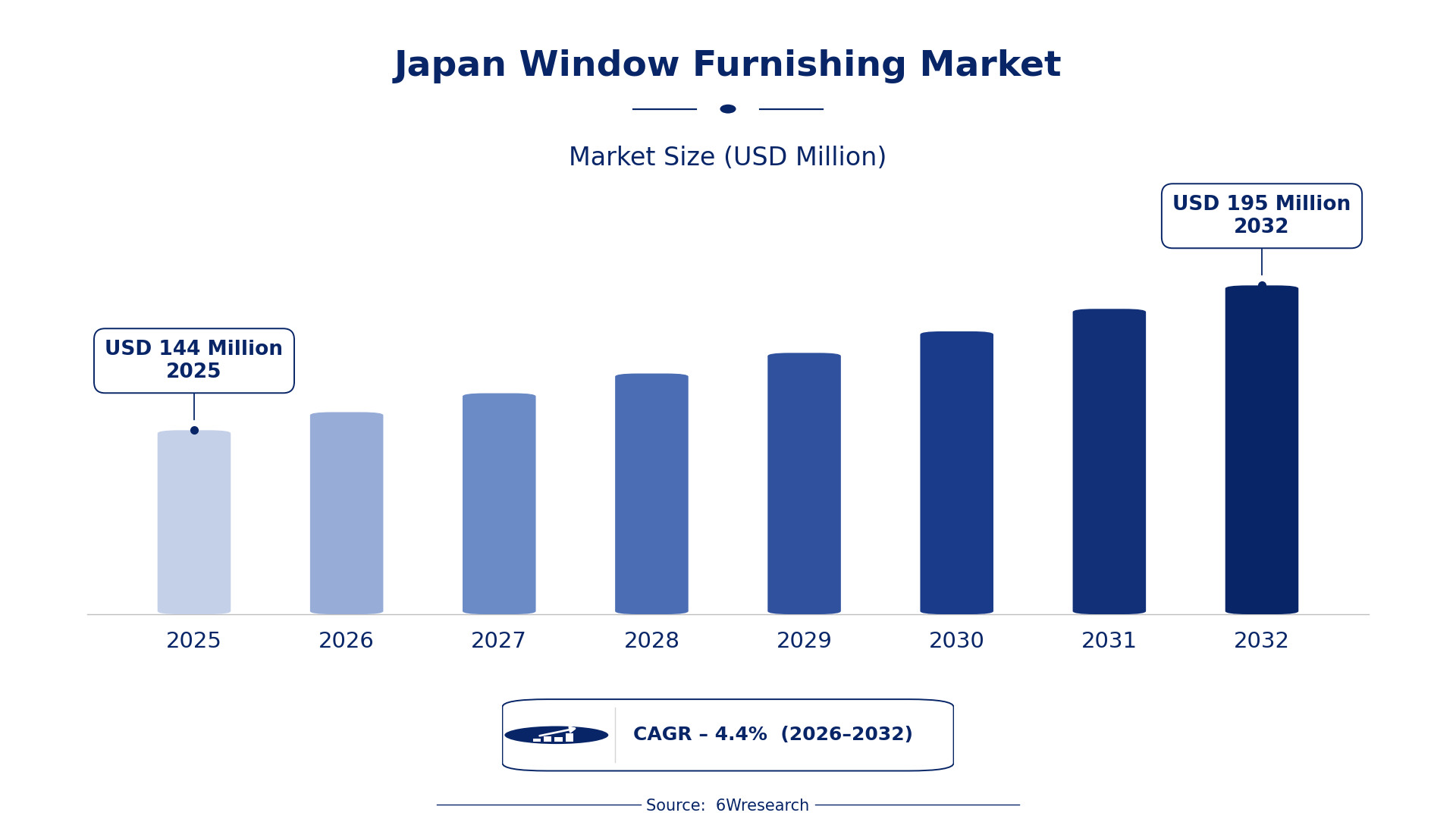
According to 6Wresearch internal database and industry insights, the Japan Window Furnishing Market was valued at USD 144 Million in 2025 and is projected to reach USD 195 Million by 2032, growing at a CAGR of approximately 4.4% during 2026–2032.
Japan Window Furnishing Market Highlights
| Report Metric | Details |
| Report Name | Japan Window Furnishing Market (2026-2032) |
| Market Size 2025 | USD 144 Million |
| Market Size 2032 | USD 195 Million |
| Absolute Growth 2025–2032 | USD 51 Million |
| CAGR 2026–2032 | 4.4% |
| Peak Annual Growth | 5.9% in 2028 |
| Forecast Period | 2026–2032 |
| Historical Data | 2022–2025 |
| Base Year | 2025 |
| Leading Product Type, 2025 | Curtains (43% share) |
| Leading Fabric Type, 2025 | Cotton/Polyester (42% share) |
| Leading Sales Channel, 2025 | Home Decor Stores (42% share) |
| Leading End User, 2025 | Residential Buyers (48% share) |
| Fastest-Growing Product Type | Blinds (6.1% CAGR) |
| Fastest-Growing Fabric Type | Synthetic (6.4% CAGR) |
| Fastest-Growing Sales Channel | Online Retailers (5.6% CAGR) |
| Fastest-Growing End User | Office Managers (5.7% CAGR) |
| Growing Sector | Residential window furnishings |
| Key End Users | Residential Buyers, Office Managers, Decorators |
Japan Window Furnishing Market Year-wise Growth Rate and Key Drivers (2022–2032)
This graph illustrates the annual growth rates of the market from 2022 to 2032, highlighting a steady upward trajectory and projected market expansion over the forecast period.
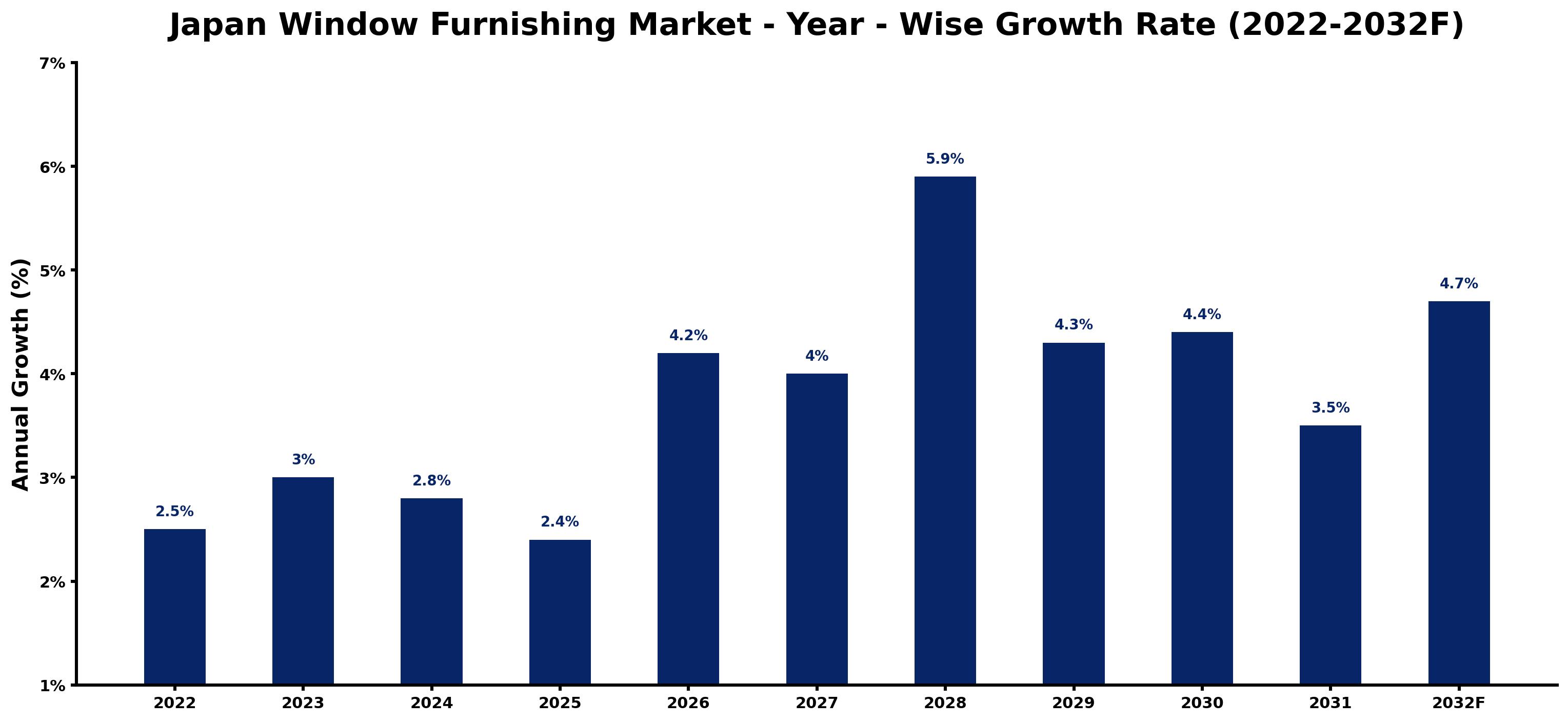
Year by year, the estimates below pair each growth rate with the development that shaped it.
| Year | Estimated Annual Growth (%) | Market Rationale |
| 2022 | 2.5 | The market experienced steady growth as consumers invested in home decor. |
| 2023 | 3.0 | Demand increased due to urban development and rising household incomes. |
| 2024 | 2.8 | Growth slowed as market saturation began to affect purchasing patterns. |
| 2025 | 2.4 | Consumer spending on home decor remained stable, leading to continued growth. |
| 2026 | 4.2 | Investment in energy-efficient upgrades is expected to spur higher demand for window furnishings. |
| 2027 | 4.0 | Growth is projected to slow slightly as competition intensifies in the retail sector. |
| 2028 | 5.9 | The market is expected to peak as eco-friendly materials gain popularity among buyers. |
| 2029 | 4.3 | Economic uncertainties may lead to cautious consumer spending patterns. |
| 2030 | 4.4 | Investment in interior design projects is projected to increase, driving demand for furnishings. |
| 2031 | 3.5 | Growth is expected to slow as the market adjusts to changing consumer preferences. |
| 2032 | 4.7 | Demand will rise again as urban centres expand and home renovations increase. |
Note: Market size estimations and growth projections presented in this report are based on 6Wresearch's proprietary forecasting methodology, utilizing the latest available industry data, government publications, and primary research inputs.
Japan Window Furnishing Market Synopsis
Window furnishings in Japan include a variety of products such as curtains, blinds, shades, and drapes, primarily crafted from materials like cotton, polyester, and synthetics. The Japan Window Furnishing Market is growing due to urbanisation in major cities like Tokyo and Osaka, where the interior design industry is valued at around 2 trillion JPY. Increased consumer spending on home decor, estimated at 5% of household budgets, along with a rising preference for energy-efficient products, is driving demand in both residential and commercial sectors.
Market Dynamics Impact Analysis (2026–2032)
| Factor | Type | Impact | Primary Segment Affected |
| Urbanisation in Tokyo and Osaka drives demand for stylish window furnishings. | Driver | High | Curtains |
| Rising household incomes lead to increased spending on home decor. | Driver | High | Blinds |
| Demand for eco-friendly products is rising among environmentally conscious consumers. | Opportunity | High | Shades |
| The growth of online retail channels offers convenience for consumers. | Opportunity | Medium | Drapes |
| Market saturation in urban areas may limit growth potential. | Restraint | High | Curtains |
| High competition among retailers can drive down profit margins. | Restraint | Medium | Blinds |
| Economic uncertainties can affect consumer spending patterns. | Challenge | High | Shades |
| Supply chain disruptions may delay product availability. | Challenge | Medium | Drapes |
Evaluation of Drivers in Japan Window Furnishing Market (2026–2032)
Demand rests on the following drivers, each shown with the segment it touches most.
| Drivers | Primary Segment Affected | Why It Matters (Evidence) |
| Urbanisation in major cities increases the need for window furnishings. | Curtains | Tokyo and Osaka's growing populations drive demand for stylish options, with urban centres expanding rapidly. |
| Rising disposable incomes enable consumers to invest in home decor. | Blinds | As household budgets grow, consumers are more willing to spend on quality furnishings. |
| Increased focus on energy efficiency boosts demand for specific products. | Shades | The popularity of light-filtering shades reflects consumer interest in energy savings, with demand increasing in urban areas. |
| Online retail growth provides consumers with more purchasing options. | Drapes | Online sales channels have expanded by 15% annually, increasing access to diverse products. |
| Government support for local textile manufacturers enhances supply. | Curtains | Subsidies for local producers improve product availability and quality in the market. |
Spending rises as urbanisation in Tokyo and Osaka fuels demand for stylish window furnishings, with the interior design industry valued at around 2 trillion JPY. Higher disposable incomes enable consumers to allocate about 5% of their budgets to home decor, increasing their purchasing capacity. The emphasis on energy efficiency stimulates demand for specific products, particularly light-filtering shades, which have gained notable popularity. The expansion of online retail channels, which have grown by 15% annually since 2020, offers consumers greater access to a range of products, further encouraging purchases.
Evaluation of Restraints in Japan Window Furnishing Market
These are the pressures that could keep growth below its potential.
| Market Restraint | Primary Segment Affected | Why It Matters (Evidence) |
| Market saturation in urban areas may limit growth potential. | Curtains | As more consumers purchase window furnishings, the market may reach a point of saturation, slowing growth. |
| High competition among retailers can drive down profit margins. | Blinds | Increased competition in the retail sector may lead to price wars, affecting profitability. |
| Economic uncertainties can affect consumer spending patterns. | Shades | Fluctuations in the economy may lead consumers to prioritise essential purchases over decor. |
| Supply chain disruptions may delay product availability. | Drapes | Ongoing global supply chain issues can hinder timely access to materials and finished products. |
| Consumer preferences may shift towards alternative home decor solutions. | Curtains | As trends evolve, consumers might explore other options, impacting demand for traditional furnishings. |
Japan Window Furnishing Market Challenges
A primary obstacle for producers is the stringent JIS standards governing textile quality, necessitating costly compliance measures that can inflate production expenses by up to 15%. Supply chain disruptions arise from reliance on imported materials, resulting in production delays that may extend lead times for buyers by three months. Local manufacturers face intense competition from low-cost imports, compelling them to reduce prices, which erodes profit margins and hampers innovation. Buyers encounter rising costs, with average household spending on home decor projected to increase by 5% over the next year, straining their budgets.
Trends in the Japan Window Furnishing Market
Buyers and suppliers in the Japan Window Furnishing Market are adjusting to the following trends.
- Increase in Demand for Light-Filtering Shades: Demand for light-filtering shades has surged by 15% in urban areas, reflecting a growing focus on energy efficiency. This shift indicates consumers' desire for natural light management while maintaining privacy.
- Shift to Online Retail for Home Furnishings: Online retail for home furnishings has grown by 15% annually since 2020, making it a preferred channel for consumers seeking convenience and variety. This trend highlights the need for suppliers to improve their online presence.
- Emergence of Eco-Friendly Materials: In 2023, a government initiative supported eco-friendly materials in home decor, influencing consumer choices. This trend encourages manufacturers to adopt sustainable practices in their product offerings.
- Luxury Homes Featuring Custom Window Furnishings: Luxury home developments in Japan often feature custom window furnishings, catering to high-end buyers. This trend indicates a growing market segment focused on unique and tailored interior solutions.
Investment Opportunities in the Japan Window Furnishing Market
The openings below show where demand in the Japan Window Furnishing Market is visible and how suppliers can enter.
- Invest in Partnerships with Local Manufacturers: Now is an ideal time to invest in partnerships with local textile manufacturers, as the Japanese government supports local production through subsidies. This collaboration can improve product availability and quality for residential buyers.
- Expand Online Retail Channels: Investing in online retail platforms is timely, as the channel has seen a 15% annual growth. Targeting urban consumers through e-commerce can boost sales and reach a wider audience.
- Develop Eco-Friendly Product Lines: The current emphasis on sustainability presents an opportunity to create eco-friendly window furnishings. Engaging with interior design associations can help align products with consumer preferences for sustainable options.
- Create Custom Solutions for Luxury Homes: With the rise of luxury home developments, there is a growing need for custom window furnishings. Collaborating with decorators can facilitate entry into this niche market.
Government Initiatives in the Japan Window Furnishing Market
The Industrial Standardization Act governs the quality of textiles used in window furnishings, ensuring compliance with JIS standards. This regulation impacts producers by mandating rigorous testing and certification processes, which improve product quality and consumer trust. The government also supports local textile manufacturers through subsidies, enhancing their competitiveness in the market.
The Digital Agency oversees the implementation of digital transformation initiatives, approving funding for projects that promote innovation in the textile industry. This support encourages manufacturers to adopt new technologies and improve operational efficiency, ultimately benefiting buyers through better product offerings.
Future Insight of the Japan Window Furnishing Market
The Japanese government will drive a transition towards sustainable materials, prompting suppliers to adopt eco-friendly practices in textile production. The Tokyo Metropolitan Government's energy-efficient home upgrade programme will create opportunities for advanced window furnishing solutions. As online retail for home furnishings continues to grow by 15% annually, buyers will increasingly favour convenient purchasing options. With the textile industry employing over 300,000 people, suppliers must align their offerings with consumer preferences for quality and sustainability.
Market Segmentation Analysis
Japan Window Furnishing Market report covers a detailed analysis of the following market segments:
By Product Type – Curtains Lead, Blinds Expected to Grow Fastest
According to Saurav Kr Singh, Senior Research Analyst at 6Wresearch, the largest product type category in 2025 was Curtains, at 43% of revenue. Curtains dominate the market as they are widely used for decoration and privacy in Japanese homes. Their popularity is particularly pronounced in urban centres like Tokyo and Osaka, where they serve as a staple in interior design. Blinds are projected to grow fastest, at a CAGR of 6.1% during 2026–2032. Blinds are experiencing rapid growth due to their essential function in light control and aesthetic appeal in modern interiors. The notable 20% increase in demand for light-filtering shades in urban areas further supports the expansion of the blinds segment. Suppliers should focus on enhancing their blinds product lines to meet the rising consumer demand for effective light control solutions.
By Fabric Type – Cotton/Polyester Leads, Synthetic Expected to Grow Fastest
In 2025, Cotton/Polyester led the fabric type split with a 42% share. Cotton and polyester dominate the market as they are the preferred fabric choices for their durability and cost-effectiveness. These materials are particularly popular among consumers in the residential sector, where practicality and aesthetic appeal are key considerations. Over 2026–2032, Synthetic is expected to post the fastest growth, at a CAGR of 6.4%. Synthetic fabrics are rapidly gaining traction because they offer versatility and ease of maintenance, which appeals to modern consumers. The recent government initiatives promoting eco-friendly materials are also contributing to the growth of this segment. Manufacturers should consider increasing their range of synthetic fabric options to cater to the shifting consumer preferences towards maintenance-friendly materials.
By Sales Channel – Home Decor Stores Lead, Online Retailers Expected to Grow Fastest
With 42% of sales channel revenue in 2025, Home Decor Stores was the largest category. Home decor stores lead the sales channel as they provide a comprehensive range of window furnishings tailored to consumer preferences. Their prominence is especially evident in urban areas where high foot traffic drives sales. The quickest growth will come from Online Retailers, forecast to expand at a CAGR of 5.6% between 2026 and 2032. Online retailers are growing swiftly, offering convenience and a broader selection that appeals to a wider consumer base. The 15% annual growth in online retail since 2020 highlights the increasing shift towards digital shopping. Retailers must strengthen their online strategies to successfully engage the growing number of consumers preferring digital shopping.
By End User – Residential Buyers Lead, Office Managers Expected to Grow Fastest
Residential Buyers accounted for 48% of the market by end user in 2025. Residential buyers represent the largest end user segment, driven by the high demand for window furnishings in homes across Japan. This is particularly noticeable in urban areas where the population density increases the need for privacy and decor. Office Managers are set to record the highest CAGR in this split, 5.7% over 2026–2032. Office managers are increasingly purchasing window furnishings to create functional and aesthetically pleasing office environments. The growth in urban office spaces is contributing to the rising demand in this segment. Suppliers should tailor their products to meet the specific needs of office environments to tap into this expanding market.
Key Attractiveness of the Report
- 10 Years of Market Numbers
- Historical Data Starting from 2022 to 2025
- Base Year 2025
- Forecast Data until 2032
- Key Performance Indicators Impacting the Market
- Major Upcoming Developments and Projects
Key Highlights of the Report:
- Japan Window Furnishing Market Outlook
- Market Size of Japan Window Furnishing Market, 2025
- Forecast of Japan Window Furnishing Market, 2032
- Historical Data and Forecast of Japan Window Furnishing Revenues & Volume for the Period 2022-2032F
- Japan Window Furnishing Market Trend Evolution
- Japan Window Furnishing Market Drivers and Challenges
- Japan Window Furnishing Price Trends
- Japan Window Furnishing Porter's Five Forces
- Japan Window Furnishing Industry Life Cycle
- Historical Data and Forecast of Japan Window Furnishing Market Revenues & Volume By Product Type for the Period 2022-2032F
- Historical Data and Forecast of Japan Window Furnishing Market Revenues & Volume By Curtains for the Period 2022-2032F
- Historical Data and Forecast of Japan Window Furnishing Market Revenues & Volume By Blinds for the Period 2022-2032F
- Historical Data and Forecast of Japan Window Furnishing Market Revenues & Volume By Shades for the Period 2022-2032F
- Historical Data and Forecast of Japan Window Furnishing Market Revenues & Volume By Drapes for the Period 2022-2032F
- Historical Data and Forecast of Japan Window Furnishing Market Revenues & Volume By Fabric Type for the Period 2022-2032F
- Historical Data and Forecast of Japan Window Furnishing Market Revenues & Volume By Cotton/Polyester for the Period 2022-2032F
- Historical Data and Forecast of Japan Window Furnishing Market Revenues & Volume By Synthetic for the Period 2022-2032F
- Historical Data and Forecast of Japan Window Furnishing Market Revenues & Volume By Light-filtering for the Period 2022-2032F
- Historical Data and Forecast of Japan Window Furnishing Market Revenues & Volume By Velvet/Silk for the Period 2022-2032F
- Historical Data and Forecast of Japan Window Furnishing Market Revenues & Volume By Sales Channel for the Period 2022-2032F
- Historical Data and Forecast of Japan Window Furnishing Market Revenues & Volume By Home Decor Stores for the Period 2022-2032F
- Historical Data and Forecast of Japan Window Furnishing Market Revenues & Volume By Online Retailers for the Period 2022-2032F
- Historical Data and Forecast of Japan Window Furnishing Market Revenues & Volume By Interior Boutiques for the Period 2022-2032F
- Historical Data and Forecast of Japan Window Furnishing Market Revenues & Volume By Furniture Chains for the Period 2022-2032F
- Historical Data and Forecast of Japan Window Furnishing Market Revenues & Volume By End User for the Period 2022-2032F
- Historical Data and Forecast of Japan Window Furnishing Market Revenues & Volume By Residential Buyers for the Period 2022-2032F
- Historical Data and Forecast of Japan Window Furnishing Market Revenues & Volume By Office Managers for the Period 2022-2032F
- Historical Data and Forecast of Japan Window Furnishing Market Revenues & Volume By Decorators for the Period 2022-2032F
- Historical Data and Forecast of Japan Window Furnishing Market Revenues & Volume By Luxury Homes for the Period 2022-2032F
- Japan Window Furnishing Import Export Trade Statistics
- Market Opportunity Assessment By Product Type
- Market Opportunity Assessment By Fabric Type
- Market Opportunity Assessment By Sales Channel
- Market Opportunity Assessment By End User
- Japan Window Furnishing Top Companies Market Share
- Japan Window Furnishing Competitive Benchmarking By Technical and Operational Parameters
- Japan Window Furnishing Company Profiles
- Japan Window Furnishing Key Strategic Recommendations
Market Covered
The following segment groups are covered in the report.
By Product Type
- Curtains
- Blinds
- Shades
- Drapes
By Fabric Type
- Cotton/Polyester
- Synthetic
- Light-filtering
- Velvet/Silk
By Sales Channel
- Home Decor Stores
- Online Retailers
- Interior Boutiques
- Furniture Chains
By End User
- Residential Buyers
- Office Managers
- Decorators
- Luxury Homes































