Japan Wine Feed Market Size & Growth Rate
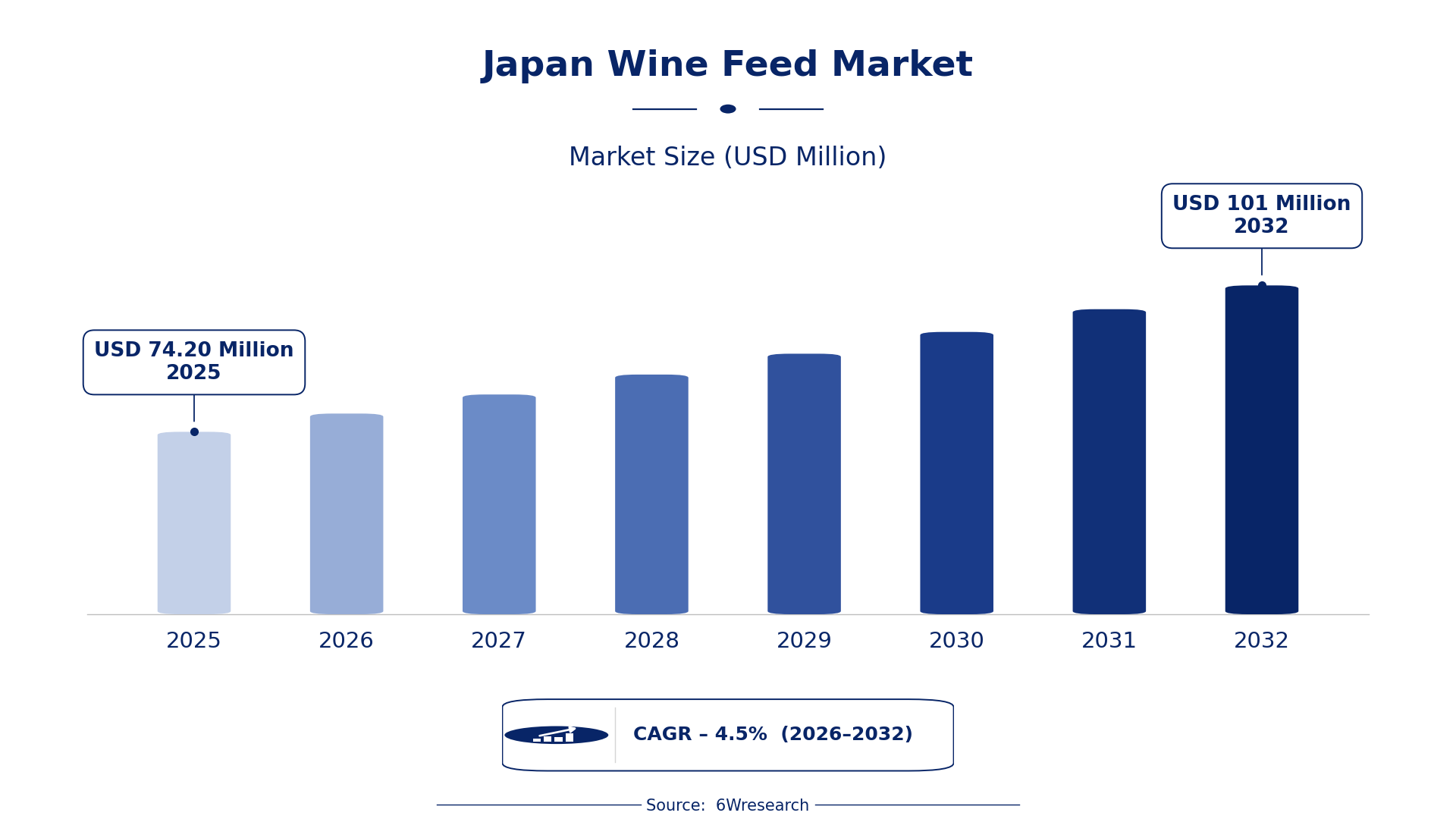
According to 6Wresearch internal database and industry insights, the Japan Wine Feed Market was valued at USD 74.20 Million in 2025 and is projected to reach USD 101 Million by 2032, growing at a CAGR of approximately 4.5% during 2026–2032.
Japan Wine Feed Market Highlights
| Report Metric | Details |
| Report Name | Japan Wine Feed Market (2026-2032) |
| Market Size 2025 | USD 74.20 Million |
| Market Size 2032 | USD 101 Million |
| Absolute Growth 2025–2032 | USD 26.80 Million |
| CAGR 2026–2032 | 4.5% |
| Peak Annual Growth | 5.4% in 2028 |
| Forecast Period | 2026–2032 |
| Historical Data | 2022–2025 |
| Base Year | 2025 |
| Leading Feed Type, 2025 | Grape Pomace Feed (49% share) |
| Leading Source, 2025 | Winery By-products (49% share) |
| Leading Application, 2025 | Animal Nutrition (45% share) |
| Leading Sales Channel, 2025 | Direct Supply (40% share) |
| Leading End User, 2025 | Livestock Farms (49% share) |
| Fastest-Growing Feed Type | Organic Wine Feed (6.6% CAGR) |
| Fastest-Growing Source | Dried Pomace (6.3% CAGR) |
| Fastest-Growing Application | Sustainable Farming (6.8% CAGR) |
| Fastest-Growing Sales Channel | Agri Suppliers (5.7% CAGR) |
| Fastest-Growing End User | Organic Farmers (6.1% CAGR) |
| Growing Sector | Animal Nutrition |
| Key End Users | Livestock Farms, Dairy Farms, Ranchers |
Japan Wine Feed Market Year-wise Growth Rate and Key Drivers (2022–2032)
This graph illustrates the annual growth rates of the market from 2022 to 2032, highlighting a steady upward trajectory and projected market expansion over the forecast period.
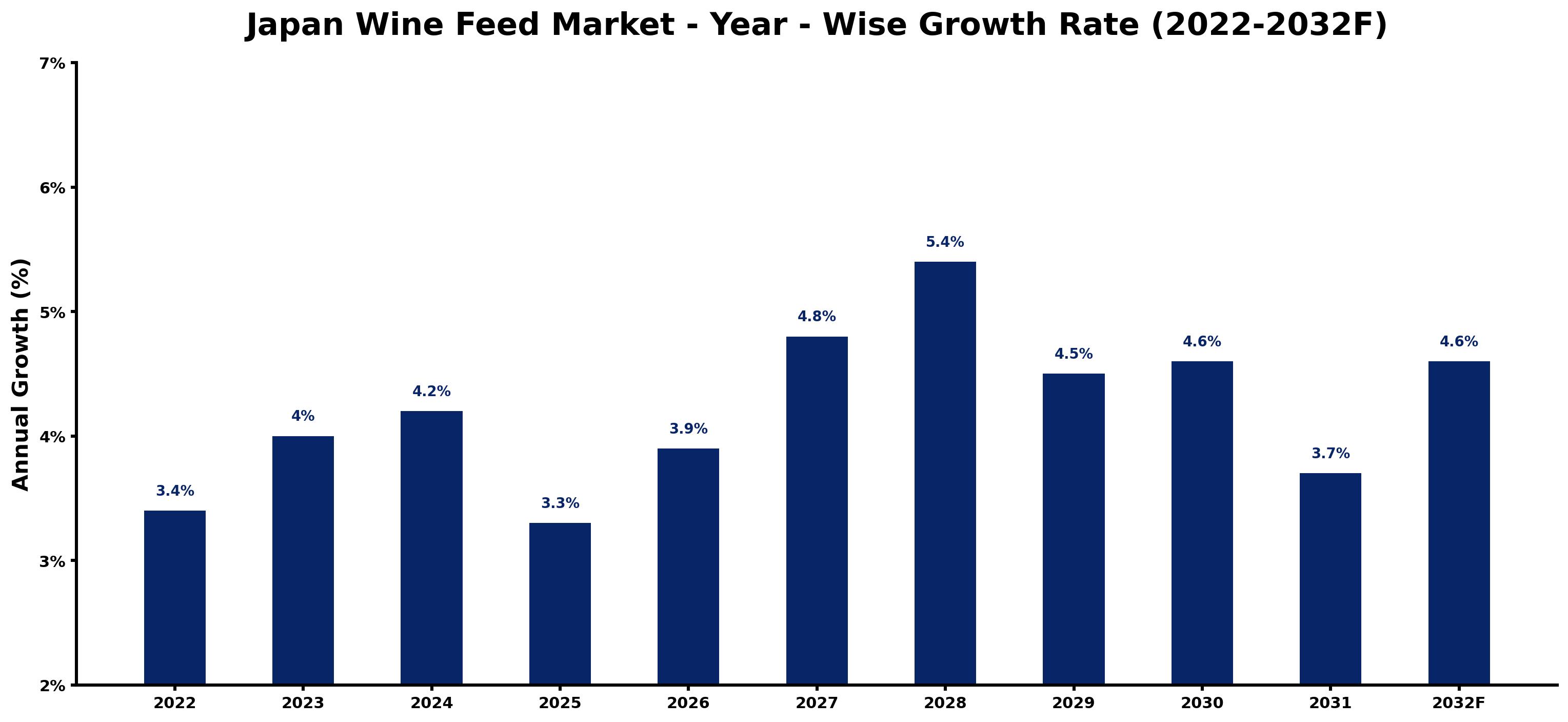
The table below sets out the estimated growth rate for each year and the main factor behind it.
| Year | Estimated Annual Growth (%) | Market Rationale |
| 2022 | 3.4 | The market showed steady growth due to increased awareness of sustainable farming practices. |
| 2023 | 4.0 | Demand for wine feed rose as livestock farms sought more nutritious feed options. |
| 2024 | 4.2 | The market continued to expand as wineries increased production, generating more by-products. |
| 2025 | 3.3 | Growth slowed as some farms faced challenges in sourcing sufficient wine feed. |
| 2026 | 3.9 | The market is expected to rebound with rising investments in livestock nutrition and sustainable practices. |
| 2027 | 4.8 | Increased livestock population and better feed conversion ratios will support growth. |
| 2028 | 5.4 | Demand is projected to peak as wineries adopt more environmentally friendly practices and standards. |
| 2029 | 4.5 | Growth is expected to slow slightly as market saturation begins to affect new purchases. |
| 2030 | 4.6 | The market will see renewed interest with new initiatives promoting winery by-products. |
| 2031 | 3.7 | A slowdown is projected as competition increases among feed suppliers. |
| 2032 | 4.6 | Growth is expected to resume as livestock farms increasingly adopt wine feed for better nutrition. |
Note: Market size estimations and growth projections presented in this report are based on 6Wresearch's proprietary forecasting methodology, utilizing the latest available industry data, government publications, and primary research inputs.
Japan Wine Feed Market Synopsis
Wine feed is a by-product from winemaking, primarily composed of grape pomace, which includes skins, seeds, and stems. It is mainly used in animal nutrition, particularly for livestock, promoting sustainable farming. The Japan Wine Feed Market is expanding due to a livestock population of approximately 4 million, increased awareness of sustainable practices, and government support for utilising winery by-products. With over 1,000 registered livestock farms, the demand for nutritious feed options is driving market growth.
Market Dynamics Impact Analysis (2026–2032)
| Factor | Type | Impact | Primary Segment Affected |
| Growing livestock population and demand for sustainable feed options | Driver | High | Animal Nutrition |
| Increased adoption of sustainable farming practices | Driver | High | Sustainable Farming |
| Rising interest in organic farming and by-product utilization | Opportunity | Medium | Organic Wine Feed |
| Expansion of livestock farms seeking cost-effective feed solutions | Opportunity | Medium | Cattle Feed |
| Limited awareness of wine feed benefits among some farmers | Restraint | Medium | Grape Pomace Feed |
| Competition from alternative feed sources affecting market share | Restraint | High | Fermented Feed |
| Challenges in consistent supply of high-quality wine feed | Challenge | High | Processed Feed |
| Regulatory compliance costs for feed producers | Challenge | Medium | Winery By-products |
Evaluation of Drivers in Japan Wine Feed Market (2026–2032)
Demand rests on the following drivers, each shown with the segment it touches most.
| Drivers | Primary Segment Affected | Why It Matters (Evidence) |
| Increased livestock population | Animal Nutrition | Japan's livestock population is approximately 4 million, driving demand for nutritious feed. |
| Support for sustainable farming practices | Sustainable Farming | The Japanese government promotes sustainable farming through subsidies, encouraging feed innovation. |
| Rising production of winery by-products | Grape Pomace Feed | Japan produced approximately 500,000 liters of wine in 2022, generating more feed materials. |
| Growing focus on nutritional value in livestock diets | Fermented Feed | Farmers seek better feed solutions, leading to increased purchases of fortified feed products. |
| Expansion of livestock farms | Cattle Feed | With over 1,000 registered livestock farms, the demand for effective feed solutions is rising. |
Several shifts outside the market lift sales. The livestock population in Japan is approximately 4 million, prompting farms to seek nutritious feed options. In 2022, Japan produced around 500,000 litres of wine, increasing the supply of grape pomace. The expansion of livestock farms further drives demand for effective cattle feed solutions, as farmers focus on nutritional value.
Evaluation of Restraints in Japan Wine Feed Market
The key brakes on demand, and where they bite hardest, are shown below.
| Market Restraint | Primary Segment Affected | Why It Matters (Evidence) |
| Limited awareness of wine feed benefits among farmers | Grape Pomace Feed | Some farmers remain unaware of the nutritional advantages of wine feed, limiting its adoption. |
| Competition from alternative feed sources | Fermented Feed | Alternative feeds may offer lower costs, affecting the market share of wine feed products. |
| Challenges in maintaining consistent quality of wine feed | Processed Feed | Variability in winery by-product quality can impact the effectiveness of wine feed. |
| Regulatory compliance costs for feed producers | Winery By-products | Producers face costs associated with adhering to food safety regulations, affecting pricing. |
| Limited use of organic wine feed in farming | Organic Wine Feed | Organic farming accounts for only 2% of total agricultural land in Japan, restricting demand. |
Japan Wine Feed Market Challenges
Producers in the Yamagata region face intense competition from other agricultural by-products, which drives down prices and squeezes profit margins for wine feed suppliers. Technological constraints in processing wine feed limit efficiency, resulting in delivery delays to livestock farms and escalating operational costs. The average cost of wine feed has surged by 15% this year, affecting over 1,000 livestock farms that depend on affordable nutrition. Supply chain disruptions due to regulatory changes can delay access to essential materials, forcing farmers to seek alternative feed sources and potentially jeopardising the health of Japan's 4 million livestock.
Trends in the Japan Wine Feed Market
The shifts below are changing how Japan Wine Feed Market products are bought and supplied.
- Shift in Livestock Feeding Practices: Livestock farms are increasingly adopting wine feed for its nutritional benefits, with over 1,000 registered farms in Japan. This shift reflects a growing trend towards sustainable farming practices.
- Transition to Sustainable Feed Sources: Since 2023, farms have begun prioritising winery by-products for livestock nutrition, with the Japanese government promoting such practices through various subsidies.
- Emergence of Fermented Feed Products: Fermented feed is gaining traction among livestock farms, improving nutritional value and digestibility. This trend is clear as farmers seek better feed solutions for their livestock.
- Growing Adoption of Organic Wine Feed: Organic farmers are increasingly exploring wine feed options, with a projected CAGR of 6.6% for the organic segment, reflecting a rising trend in sustainable agriculture.
Investment Opportunities in the Japan Wine Feed Market
Below are the investment opportunities with the strongest case in the Japan Wine Feed Market.
- Supply of Grape Pomace Feed: With the livestock population at approximately 4 million, there is a pressing need for grape pomace feed. Livestock farms are looking for sustainable feed options to improve nutrition.
- Investment in Sustainable Farming Practices: The Japanese government promotes sustainable farming, creating opportunities for suppliers of organic wine feed. This is particularly relevant as organic farming accounts for 2% of total agricultural land.
- Expansion into Fermented Feed Market: The growing focus on livestock nutrition presents an opportunity for suppliers of fermented feed. Livestock farms are increasingly seeking effective feed solutions to improve animal health.
- Development of Processed Feed Solutions: As competition increases, there is a need for processed feed that improves digestibility. Livestock farms are looking for effective solutions to enhance feed efficiency.
Government Initiatives in the Japan Wine Feed Market
The Food Sanitation Act amendment of 2018 mandates HACCP-based hygiene management for food businesses, impacting wine feed producers by requiring stringent safety protocols. This regulation ensures that wine feed meets health standards, benefiting buyers by providing safer products.
The Ministry of Agriculture, Forestry and Fisheries supports the use of winery by-products through funding and initiatives. This assistance helps livestock farms access quality wine feed, improving their nutrition and sustainability practices.
Future Insight of the Japan Wine Feed Market
Investment in processing facilities will create new demand for wine feed, driven by government support for programmes that utilise winery by-products. By 2032, the focus on sustainable farming will encourage suppliers to develop diverse product offerings. The launch of initiatives to improve livestock nutrition will enhance farm productivity and animal health. Adoption of ISO 14001 will further standardise environmental management practices, aligning with the growing emphasis on sustainability in agriculture.
Market Segmentation Analysis
Japan Wine Feed Market report covers a detailed analysis of the following market segments:
By Feed Type – Grape Pomace Feed Leads, Organic Wine Feed Expected to Grow Fastest
According to Prakhar Dixit, Senior Research Analyst at 6Wresearch, in 2025, Grape Pomace Feed led the feed type split with a 49% share. Grape Pomace Feed commands the largest share due to its direct use as a primary feed source for livestock, particularly in the Yamagata region known for grape pomace production. The substantial quantities produced from Japan's wine industry support its widespread application in animal nutrition. Organic Wine Feed is set to record the highest CAGR in this split, 6.6% over 2026–2032. Organic Wine Feed is growing rapidly as more farmers embrace sustainable practices, with the Japanese government promoting organic farming on 2% of total agricultural land. This trend is expected to persist as the demand for eco-friendly farming solutions increases. Suppliers should focus on expanding organic offerings to cater to the rising demand from environmentally conscious farmers.
By Source – Winery By-products Lead, Dried Pomace Expected to Grow Fastest
Winery By-products held 49% of the Japan Wine Feed Market by source in 2025. Winery By-products lead the market as they are the primary source of raw materials for wine feed production, capitalising on the significant quantities generated by Japan's wine industry. Support from the Ministry of Agriculture, Forestry and Fisheries further solidifies this segment's dominant position. The quickest growth will come from Dried Pomace, forecast to expand at a CAGR of 6.3% between 2026 and 2032. Dried Pomace is experiencing the fastest growth due to its high fibre content, making it an appealing option for livestock feed. Increased awareness among farmers of the nutritional advantages of fibre-rich feed is propelling demand for this specific by-product. Suppliers must ensure a reliable supply of dried pomace to take advantage of the increasing interest in fibre-rich feed solutions.
By Application – Animal Nutrition Leads, Sustainable Farming Expected to Grow Fastest
With 45% of application revenue in 2025, Animal Nutrition was the largest category. Animal Nutrition is the leading application for wine feed, addressing the nutritional requirements of livestock across over 1,000 registered farms in Japan. The established role of wine feed in this sector highlights its vital importance in livestock management. Sustainable Farming is projected to grow fastest, at a CAGR of 6.8% during 2026–2032. Sustainable Farming is rapidly gaining popularity as more farmers pursue eco-friendly practices, supported by government initiatives that encourage the use of winery by-products. This shift reflects a broader trend towards sustainability in agriculture that is likely to continue. Suppliers should align their products with sustainable practices to attract farmers aiming to enhance their eco-friendly credentials.
By Sales Channel – Direct Supply Leads, Agri Suppliers Expected to Grow Fastest
Direct Supply took 40% of sales channel revenue in 2025, more than any other category. Direct Supply is the predominant channel for delivering wine feed to farms, ensuring livestock producers have immediate access to essential nutrients. This direct approach fosters strong relationships between suppliers and livestock farms, enhancing trust and reliability. Over 2026–2032, Agri Suppliers are expected to post the fastest growth, at a CAGR of 5.7%. Agri Suppliers are witnessing the fastest growth as they serve various agricultural sectors, broadening their reach beyond traditional livestock farms. The increasing diversification of agricultural needs is driving this trend, indicating a shift in market dynamics. Suppliers should explore partnerships with agri suppliers to expand their market reach and improve distribution capabilities.
By End User – Livestock Farms Lead, Organic Farmers Expected to Grow Fastest
The largest end user category in 2025 was Livestock Farms, at 49% of revenue. Livestock Farms represent the largest end user of wine feed, utilising it to support the nutritional needs of approximately 4 million livestock in Japan. This substantial user base highlights the critical role of wine feed in the livestock sector and its importance to food production. Organic Farmers are set to record the highest CAGR in this split, 6.1% over 2026–2032. Organic Farmers are the fastest-growing segment as they increasingly incorporate wine feed into their sustainable practices, albeit less commonly. The rise in organic farming initiatives and consumer demand for organic products is encouraging this shift in usage. Suppliers should focus on developing tailored products for organic farmers to capture this emerging market segment.
Key Attractiveness of the Report
- 10 Years of Market Numbers
- Historical Data Starting from 2022 to 2025
- Base Year 2025
- Forecast Data until 2032
- Key Performance Indicators Impacting the Market
- Major Upcoming Developments and Projects
Key Highlights of the Report:
- Japan Wine Feed Market Outlook
- Market Size of Japan Wine Feed Market, 2025
- Forecast of Japan Wine Feed Market, 2032
- Historical Data and Forecast of Japan Wine Feed Market Revenues & Volume for the Period 2022-2032F
- Japan Wine Feed Market Trend Evolution
- Japan Wine Feed Market Drivers and Challenges
- Japan Wine Feed Market Price Trends
- Japan Wine Feed Market Porter's Five Forces
- Japan Wine Feed Market Industry Life Cycle
- Historical Data and Forecast of Japan Wine Feed Market Revenues & Volume By Feed Type for the Period 2022-2032F
- Historical Data and Forecast of Japan Wine Feed Market Revenues & Volume By Grape Pomace Feed for the Period 2022-2032F
- Historical Data and Forecast of Japan Wine Feed Market Revenues & Volume By Fermented Feed for the Period 2022-2032F
- Historical Data and Forecast of Japan Wine Feed Market Revenues & Volume By Organic Wine Feed for the Period 2022-2032F
- Historical Data and Forecast of Japan Wine Feed Market Revenues & Volume By Processed Feed for the Period 2022-2032F
- Historical Data and Forecast of Japan Wine Feed Market Revenues & Volume By Source for the Period 2022-2032F
- Historical Data and Forecast of Japan Wine Feed Market Revenues & Volume By Winery By-products for the Period 2022-2032F
- Historical Data and Forecast of Japan Wine Feed Market Revenues & Volume By Wine Residues for the Period 2022-2032F
- Historical Data and Forecast of Japan Wine Feed Market Revenues & Volume By Natural Waste for the Period 2022-2032F
- Historical Data and Forecast of Japan Wine Feed Market Revenues & Volume By Dried Pomace for the Period 2022-2032F
- Historical Data and Forecast of Japan Wine Feed Market Revenues & Volume By Application for the Period 2022-2032F
- Historical Data and Forecast of Japan Wine Feed Market Revenues & Volume By Animal Nutrition for the Period 2022-2032F
- Historical Data and Forecast of Japan Wine Feed Market Revenues & Volume By Feed Supplements for the Period 2022-2032F
- Historical Data and Forecast of Japan Wine Feed Market Revenues & Volume By Sustainable Farming for the Period 2022-2032F
- Historical Data and Forecast of Japan Wine Feed Market Revenues & Volume By Cattle Feed for the Period 2022-2032F
- Historical Data and Forecast of Japan Wine Feed Market Revenues & Volume By Sales Channel for the Period 2022-2032F
- Historical Data and Forecast of Japan Wine Feed Market Revenues & Volume By Direct Supply for the Period 2022-2032F
- Historical Data and Forecast of Japan Wine Feed Market Revenues & Volume By Distributors for the Period 2022-2032F
- Historical Data and Forecast of Japan Wine Feed Market Revenues & Volume By Cooperatives for the Period 2022-2032F
- Historical Data and Forecast of Japan Wine Feed Market Revenues & Volume By Agri Suppliers for the Period 2022-2032F
- Historical Data and Forecast of Japan Wine Feed Market Revenues & Volume By End User for the Period 2022-2032F
- Historical Data and Forecast of Japan Wine Feed Market Revenues & Volume By Livestock Farms for the Period 2022-2032F
- Historical Data and Forecast of Japan Wine Feed Market Revenues & Volume By Dairy Farms for the Period 2022-2032F
- Historical Data and Forecast of Japan Wine Feed Market Revenues & Volume By Organic Farmers for the Period 2022-2032F
- Historical Data and Forecast of Japan Wine Feed Market Revenues & Volume By Ranchers for the Period 2022-2032F
- Japan Wine Feed Market Import Export Trade Statistics
- Market Opportunity Assessment By Feed Type
- Market Opportunity Assessment By Source
- Market Opportunity Assessment By Application
- Market Opportunity Assessment By Sales Channel
- Market Opportunity Assessment By End User
- Japan Wine Feed Market Top Companies Market Share
- Japan Wine Feed Market Competitive Benchmarking By Technical and Operational Parameters
- Japan Wine Feed Market Company Profiles
- Japan Wine Feed Market Key Strategic Recommendations
Market Covered
The report covers the following segments.
By Feed Type
- Grape Pomace Feed
- Fermented Feed
- Organic Wine Feed
- Processed Feed
By Source
- Winery By-products
- Wine Residues
- Natural Waste
- Dried Pomace
By Application
- Animal Nutrition
- Feed Supplements
- Sustainable Farming
- Cattle Feed
By Sales Channel
- Direct Supply
- Distributors
- Cooperatives
- Agri Suppliers
By End User
- Livestock Farms
- Dairy Farms
- Organic Farmers
- Ranchers






































