Japan Wireless Broadband Market Size & Growth Rate
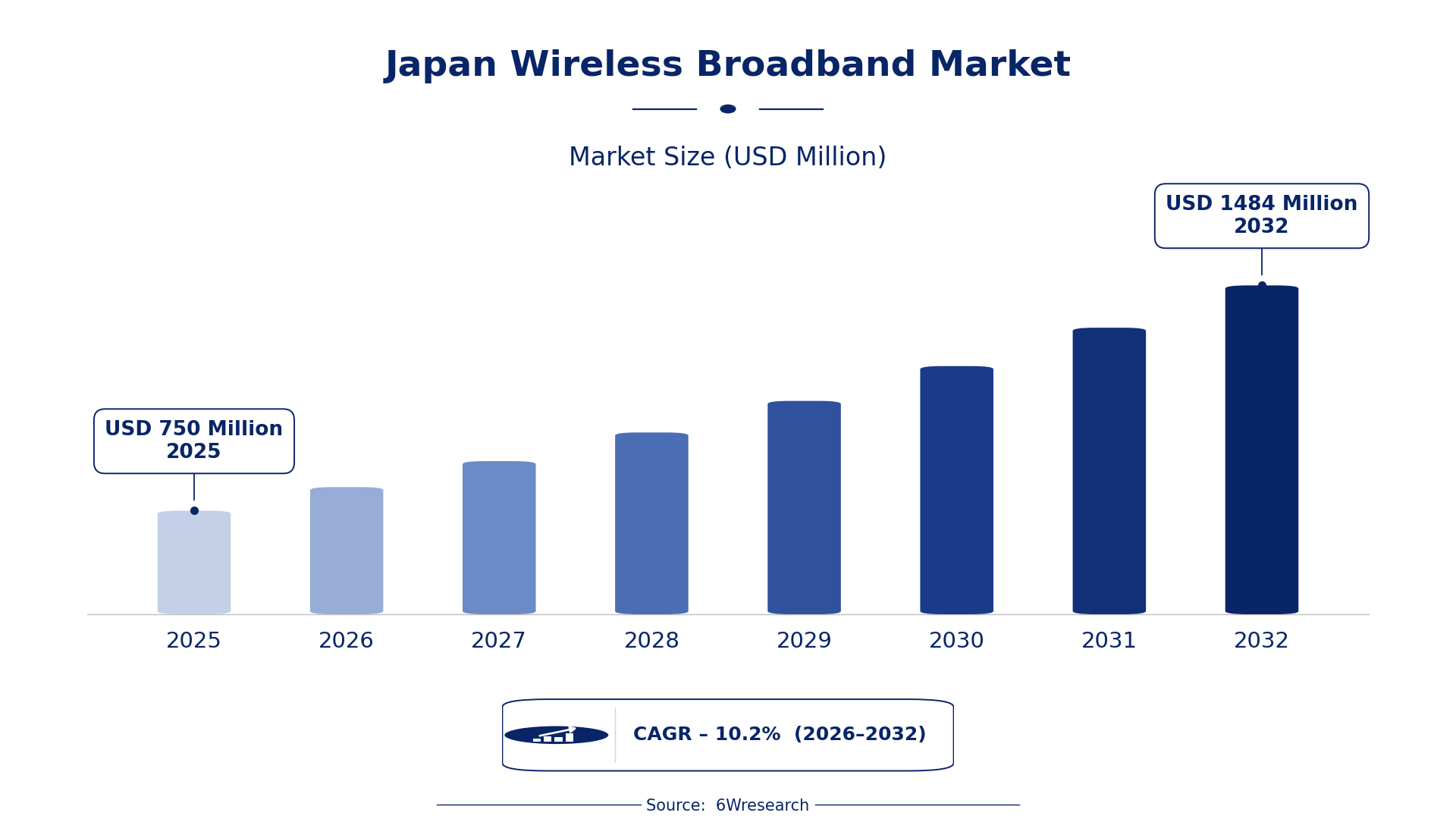
According to 6Wresearch internal database and industry insights, the Japan Wireless Broadband Market was valued at USD 750 Million in 2025 and is projected to reach USD 1,484 Million by 2032, growing at a CAGR of approximately 10.2% during 2026–2032.
Japan Wireless Broadband Market Highlights
| Report Metric | Details |
| Report Name | Japan Wireless Broadband Market (2026-2032) |
| Market Size 2025 | USD 750 Million |
| Market Size 2032 | USD 1,484 Million |
| Absolute Growth 2025–2032 | USD 734 Million |
| CAGR 2026–2032 | 10.2% |
| Peak Annual Growth | 11.1% in 2032 |
| Forecast Period | 2026–2032 |
| Historical Data | 2022–2025 |
| Base Year | 2025 |
| Leading Broadband Type, 2025 | Fixed Wireless Access (44% share) |
| Leading Frequency Band, 2025 | mmWave (50% share) |
| Leading Application Area, 2025 | Rural Connectivity (36% share) |
| Leading End User, 2025 | ISPs (52% share) |
| Fastest-Growing Broadband Type | Mobile Wireless (15.2% CAGR) |
| Fastest-Growing Frequency Band | Sub-6 GHz (13.3% CAGR) |
| Fastest-Growing Application Area | Urban Internet (12.1% CAGR) |
| Fastest-Growing End User | Telecom Operators (13.0% CAGR) |
| Growing Sector | Telecommunications |
| Key End Users | Telecom Operators, ISPs, Government Bodies |
Japan Wireless Broadband Market Year-wise Growth Rate and Key Drivers (2022–2032)
This graph illustrates the annual growth rates of the market from 2022 to 2032, highlighting a steady upward trajectory and projected market expansion over the forecast period.
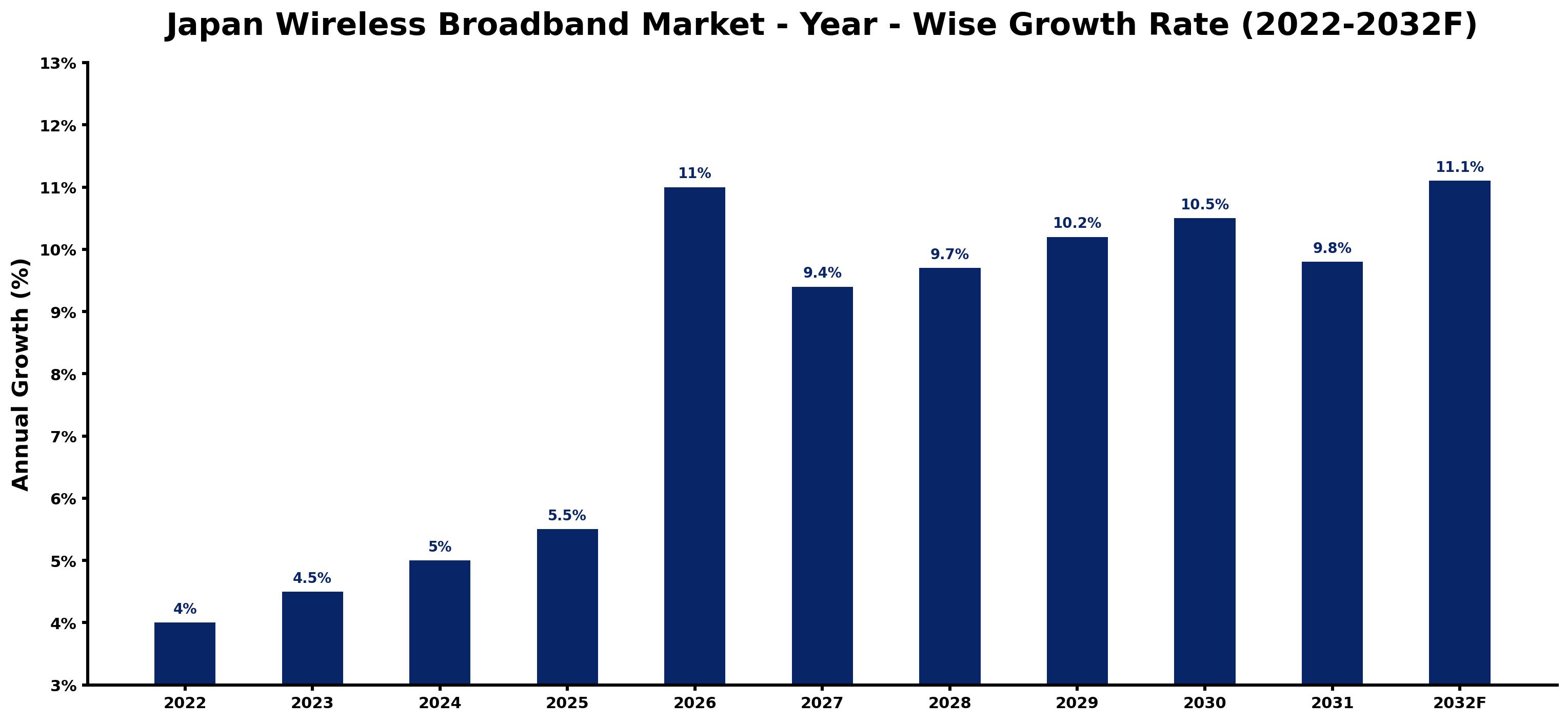
For each year, the table pairs the estimated growth rate with the leading influence on demand, showing how the drivers changed across the period.
| Year | Estimated Annual Growth (%) | Market Rationale |
| 2022 | 4.0 | The market showed steady growth with increasing broadband subscriptions and urban internet access. |
| 2023 | 4.5 | Growth accelerated due to heightened demand for reliable internet services in urban areas. |
| 2024 | 5.0 | Demand continued to rise as more households adopted fixed wireless access solutions. |
| 2025 | 5.5 | The market reached its historical peak, driven by government initiatives for rural connectivity. |
| 2026 | 11.0 | Growth surged as mobile wireless adoption expanded across urban and rural regions. |
| 2027 | 9.4 | Growth slowed slightly as the market adjusted to previous rapid expansions in infrastructure. |
| 2028 | 9.7 | Demand increased again as urban internet services continued to evolve and expand. |
| 2029 | 10.2 | The market maintained upward momentum with further investments in mobile wireless technologies. |
| 2030 | 10.5 | Growth continued as telecom operators improved their service offerings and infrastructure. |
| 2031 | 9.8 | A slight slowdown occurred as market saturation began to influence growth rates. |
| 2032 | 11.1 | The market peaked as demand for high-speed internet reached new heights driven by 5G expansion. |
Note: Market size estimations and growth projections presented in this report are based on 6Wresearch's proprietary forecasting methodology, utilizing the latest available industry data, government publications, and primary research inputs.
Japan Wireless Broadband Market Synopsis
Wireless broadband in Japan encompasses high-speed internet access through various technologies, including fixed and mobile solutions. The Japan Wireless Broadband Market is expanding due to rising broadband subscriptions, government initiatives promoting rural connectivity, and substantial investments from telecom operators. With over 100 million broadband subscriptions and a target for 100% coverage by 2025, the demand for reliable internet services is driving growth across urban and rural areas.
Market Dynamics Impact Analysis (2026–2032)
| Factor | Type | Impact | Primary Segment Affected |
| Increasing broadband subscriptions and urban penetration | Driver | High | Urban Internet |
| Government initiatives for rural connectivity | Driver | High | Rural Connectivity |
| Expansion of public Wi-Fi networks in municipalities | Opportunity | Medium | Public Wi-Fi |
| Growing demand for mobile wireless solutions in urban areas | Opportunity | High | Mobile Wireless |
| Infrastructure investment limitations in rural regions | Restraint | High | Fixed Wireless Access |
| Market saturation affecting new subscriber growth | Restraint | Medium | Urban Internet |
| High competition among telecom operators | Challenge | High | Mobile Wireless |
| Regulatory compliance costs for new technologies | Challenge | Medium | Public Wi-Fi |
Evaluation of Drivers in Japan Wireless Broadband Market (2026–2032)
Key forces behind demand, with the segment each one moves most, are listed below.
| Drivers | Primary Segment Affected | Why It Matters (Evidence) |
| High broadband penetration in urban areas | Urban Internet | Urban areas have a broadband penetration rate of 95%, leading to increased demand for high-speed services. |
| Government support for rural broadband initiatives | Rural Connectivity | Rural broadband initiatives are critical for 30% of rural households, promoting service expansion. |
| Telecom operators' infrastructure investments | Mobile Wireless | Telecom operators invested ¥1 trillion in infrastructure in 2023, boosting mobile service availability. |
| Adoption of mmWave technology in urban environments | mmWave | mmWave technology supports high-speed connections, improving service quality in densely populated areas. |
| Public Wi-Fi expansion in municipalities | Public Wi-Fi | Public Wi-Fi networks are available in over 1,000 municipalities, increasing access to internet services. |
Several shifts outside the market lift sales. Urban areas are experiencing a broadband penetration rate of 95%, which drives demand for high-speed internet in metropolitan regions. Telecom operators invested ¥1 trillion in infrastructure in 2023, boosting mobile wireless service availability. The adoption of mmWave technology in urban settings supports high-speed connections, improving service quality. Public Wi-Fi networks across Japan provide widespread access, catering to diverse user needs and boosting overall market growth.
Evaluation of Restraints in Japan Wireless Broadband Market
These are the pressures that could keep growth below its potential.
| Market Restraint | Primary Segment Affected | Why It Matters (Evidence) |
| Infrastructure investment limitations in rural regions | Fixed Wireless Access | Limited infrastructure investment hampers the expansion of fixed wireless access, affecting service availability in rural areas. |
| Market saturation affecting new subscriber growth | Urban Internet | High penetration rates in urban areas lead to market saturation, limiting new subscriber growth opportunities. |
| Intense competition among telecom operators | Mobile Wireless | Intense competition among telecom operators can lead to price wars, affecting profitability and investment. |
| Regulatory compliance costs for new technologies | Public Wi-Fi | Compliance with regulations incurs costs for public Wi-Fi providers, impacting service expansion and pricing. |
| Limited awareness of available services in remote areas | Rural Connectivity | Low awareness of wireless broadband options in rural areas restricts subscriber growth and service uptake. |
Japan Wireless Broadband Market Challenges
Competition among telecom operators leads to aggressive pricing strategies, compelling suppliers to reduce their margins and potentially affecting service quality for urban users. Regulatory challenges stemming from the Telecommunications Business Act complicate compliance for suppliers, which may delay service rollouts by as much as six months. Rural buyers face limited connectivity options, with 30% relying on Fixed Wireless Access, which constrains their internet choices. Rising infrastructure costs, with ¥1 trillion invested in 2023, place pressure on suppliers' resources and could lead to higher consumer prices.
Trends in the Japan Wireless Broadband Market
The shifts below are changing how Japan Wireless Broadband Market products are bought and supplied.
- Shift towards mmWave technology for urban connectivity: The adoption of mmWave technology is increasing in urban areas, allowing telecom operators to meet growing demand. In 2023, mmWave accounted for 50% of broadband connections, improving high-speed internet access.
- Expansion of public Wi-Fi networks in municipalities: Public Wi-Fi networks are rapidly expanding across Japan, with over 1,000 municipalities offering access points. This initiative supports the Smart City movement, improving connectivity for residents and visitors.
- Increased focus on rural broadband initiatives: Rural broadband initiatives gained momentum with government backing, aiming for 100% coverage by 2025. This push is vital for connecting underserved areas and improving overall digital inclusion.
- Growth of mobile wireless solutions in urban areas: Mobile wireless solutions are becoming increasingly popular, particularly in urban settings. The market for mobile wireless is projected to grow at a CAGR of 15.2% from 2026 to 2032, driven by demand for on-the-go connectivity.
Investment Opportunities in the Japan Wireless Broadband Market
Below are the investment opportunities with the strongest case in the Japan Wireless Broadband Market.
- Investment in rural broadband infrastructure: With the government aiming for 100% broadband coverage by 2025, there is a chance to invest in rural broadband infrastructure. Telecom operators can collaborate with local governments to enhance connectivity.
- Expansion of public access points in urban areas: Urban regions are experiencing a rising demand for public access points, spurred by Smart City initiatives. Investing in public Wi-Fi solutions can address this need and strengthen community connectivity.
- Development of mobile wireless services: The growing demand for mobile wireless solutions presents an opportunity for telecom operators to broaden their offerings. Partnering with local municipalities can extend service reach and encourage adoption.
- Adoption of mmWave technology for urban connectivity: The transition towards mmWave technology opens avenues for investment in high-speed urban connectivity solutions. Collaborating with municipalities can aid in the rollout of advanced broadband services.
Government Initiatives in the Japan Wireless Broadband Market
The GX Basic Policy, adopted in 2023, targets approximately JPY 150 trillion in public-private decarbonisation investment over the next decade, enhancing broadband infrastructure. This policy builds upon existing regulations like the Electrical Appliance and Material Safety Act, ensuring safety and compliance in broadband technologies.
In 2023, ¥50 billion was allocated for rural connectivity projects managed by the Ministry of Internal Affairs and Communications. This funding supports the expansion of broadband access in underserved regions, ensuring adherence to the Industrial Standardization Act.
Future Insight of the Japan Wireless Broadband Market
A policy-driven shift towards 100% broadband coverage will transform connectivity in Japan by 2032, particularly benefiting rural areas. The expansion of 5G networks will generate demand for improved services, encouraging suppliers to innovate their offerings. Urban Smart City initiatives will incorporate public access points, enhancing connectivity for residents. Investments in next-generation wireless technologies will guarantee that even remote areas receive reliable internet access, addressing diverse user requirements.
Market Segmentation Analysis
Japan Wireless Broadband Market report covers a detailed analysis of the following market segments:
By Broadband Type – Fixed Wireless Access Leads, Mobile Wireless Expected to Grow Fastest
According to Saurav Kr Singh, Senior Research Analyst at 6Wresearch, Fixed Wireless Access held 44% of the Japan Wireless Broadband Market by broadband type in 2025. Fixed Wireless Access holds the largest share due to its critical role in providing internet services to areas without wired infrastructure, particularly in rural regions. It is essential for 30% of rural households, demonstrating its significance in ensuring connectivity. Over 2026–2032, Mobile Wireless is expected to post the fastest growth, at a CAGR of 15.2%. Mobile Wireless is experiencing rapid growth driven by the increasing demand for mobile internet access across both urban and rural areas. The rise in mobile broadband subscriptions plays a crucial role in this expanding trend. Suppliers need to focus on mobile solutions to effectively meet the growing market demand in various environments.
By Frequency Band – mmWave Leads, Sub-6 GHz Expected to Grow Fastest
The largest frequency band category in 2025 was mmWave, at 50% of revenue. mmWave technology leads the market as it enables high-speed connections in densely populated urban areas, making it suitable for high-demand applications. Its deployment in major cities ensures superior broadband experiences for users. The quickest growth will come from Sub-6 GHz, forecast to expand at a CAGR of 13.3% between 2026 and 2032. Sub-6 GHz frequencies are growing quickly due to their widespread use in both mobile and fixed wireless services, which are vital for maintaining connectivity. This frequency band is increasingly preferred by telecom operators to meet user needs. Buyers should prioritise solutions that utilise Sub-6 GHz frequencies to ensure reliable connectivity across different settings.
By Application Area – Rural Connectivity Leads, Urban Internet Expected to Grow Fastest
Rural Connectivity accounted for 36% of the market by application area in 2025. Rural Connectivity is the leading application area as it is vital for providing internet access to underserved regions, aligning with government initiatives for broadband expansion. The goal of achieving 100% broadband coverage by 2025 underscores its significance. Urban Internet is projected to grow fastest, at a CAGR of 12.1% during 2026–2032. Urban Internet is growing swiftly due to a high penetration rate of 95% in urban areas, which drives the demand for advanced high-speed internet services. The increasing urban population further accelerates this growth. Suppliers must emphasise urban solutions to address the rising demand for high-speed internet in densely populated locations.
By End User – ISPs Lead, Telecom Operators Expected to Grow Fastest
ISPs took 52% of end user revenue in 2025, more than any other category. ISPs dominate the market as the primary providers of wireless broadband services, catering to a large customer base throughout Japan. Their established infrastructure and service offerings are essential for promoting broadband adoption. Telecom Operators are set to record the highest CAGR in this split, 13.0% over 2026–2032. Telecom Operators are experiencing the fastest growth as they enhance their mobile and fixed wireless solutions to meet the rising demand for connectivity. Their significant investments in infrastructure are a key factor in this trend. Suppliers should align their strategies with telecom operators to take advantage of the expanding market opportunities.
Key Attractiveness of the Report
- 10 Years of Market Numbers
- Historical Data Starting from 2022 to 2025
- Base Year 2025
- Forecast Data until 2032
- Key Performance Indicators Impacting the Market
- Major Upcoming Developments and Projects
Key Highlights of the Report:
- Japan Wireless Broadband Market Outlook
- Market Size of Japan Wireless Broadband Market, 2025
- Forecast of Japan Wireless Broadband Market, 2032
- Historical Data and Forecast of Japan Wireless Broadband Revenues & Volume for the Period 2022-2032F
- Japan Wireless Broadband Market Trend Evolution
- Japan Wireless Broadband Market Drivers and Challenges
- Japan Wireless Broadband Price Trends
- Japan Wireless Broadband Porter's Five Forces
- Japan Wireless Broadband Industry Life Cycle
- Historical Data and Forecast of Japan Wireless Broadband Market Revenues & Volume By Broadband Type for the Period 2022-2032F
- Historical Data and Forecast of Japan Wireless Broadband Market Revenues & Volume By Fixed Wireless Access for the Period 2022-2032F
- Historical Data and Forecast of Japan Wireless Broadband Market Revenues & Volume By Mobile Wireless for the Period 2022-2032F
- Historical Data and Forecast of Japan Wireless Broadband Market Revenues & Volume By Satellite Broadband for the Period 2022-2032F
- Historical Data and Forecast of Japan Wireless Broadband Market Revenues & Volume By Public Wi-Fi for the Period 2022-2032F
- Historical Data and Forecast of Japan Wireless Broadband Market Revenues & Volume By Frequency Band for the Period 2022-2032F
- Historical Data and Forecast of Japan Wireless Broadband Market Revenues & Volume By mmWave for the Period 2022-2032F
- Historical Data and Forecast of Japan Wireless Broadband Market Revenues & Volume By Sub-6 GHz for the Period 2022-2032F
- Historical Data and Forecast of Japan Wireless Broadband Market Revenues & Volume By Ku/Ka Band for the Period 2022-2032F
- Historical Data and Forecast of Japan Wireless Broadband Market Revenues & Volume By 2.4 GHz for the Period 2022-2032F
- Historical Data and Forecast of Japan Wireless Broadband Market Revenues & Volume By Application Area for the Period 2022-2032F
- Historical Data and Forecast of Japan Wireless Broadband Market Revenues & Volume By Rural Connectivity for the Period 2022-2032F
- Historical Data and Forecast of Japan Wireless Broadband Market Revenues & Volume By Urban Internet for the Period 2022-2032F
- Historical Data and Forecast of Japan Wireless Broadband Market Revenues & Volume By Remote Locations for the Period 2022-2032F
- Historical Data and Forecast of Japan Wireless Broadband Market Revenues & Volume By Public Access Points for the Period 2022-2032F
- Historical Data and Forecast of Japan Wireless Broadband Market Revenues & Volume By End User for the Period 2022-2032F
- Historical Data and Forecast of Japan Wireless Broadband Market Revenues & Volume By ISPs for the Period 2022-2032F
- Historical Data and Forecast of Japan Wireless Broadband Market Revenues & Volume By Telecom Operators for the Period 2022-2032F
- Historical Data and Forecast of Japan Wireless Broadband Market Revenues & Volume By Government Bodies for the Period 2022-2032F
- Historical Data and Forecast of Japan Wireless Broadband Market Revenues & Volume By Municipal Services for the Period 2022-2032F
- Japan Wireless Broadband Import Export Trade Statistics
- Market Opportunity Assessment By Broadband Type
- Market Opportunity Assessment By Frequency Band
- Market Opportunity Assessment By Application Area
- Market Opportunity Assessment By End User
- Japan Wireless Broadband Top Companies Market Share
- Japan Wireless Broadband Competitive Benchmarking By Technical and Operational Parameters
- Japan Wireless Broadband Company Profiles
- Japan Wireless Broadband Key Strategic Recommendations
Market Covered
The study includes the following segmentation.
By Broadband Type
- Fixed Wireless Access
- Mobile Wireless
- Satellite Broadband
- Public Wi-Fi
By Frequency Band
- mmWave
- Sub-6 GHz
- Ku/Ka Band
- 2.4 GHz
By Application Area
- Rural Connectivity
- Urban Internet
- Remote Locations
- Public Access Points
By End User
- ISPs
- Telecom Operators
- Government Bodies
- Municipal Services































