Japan Wireless Communication Technology Market Size & Growth Rate
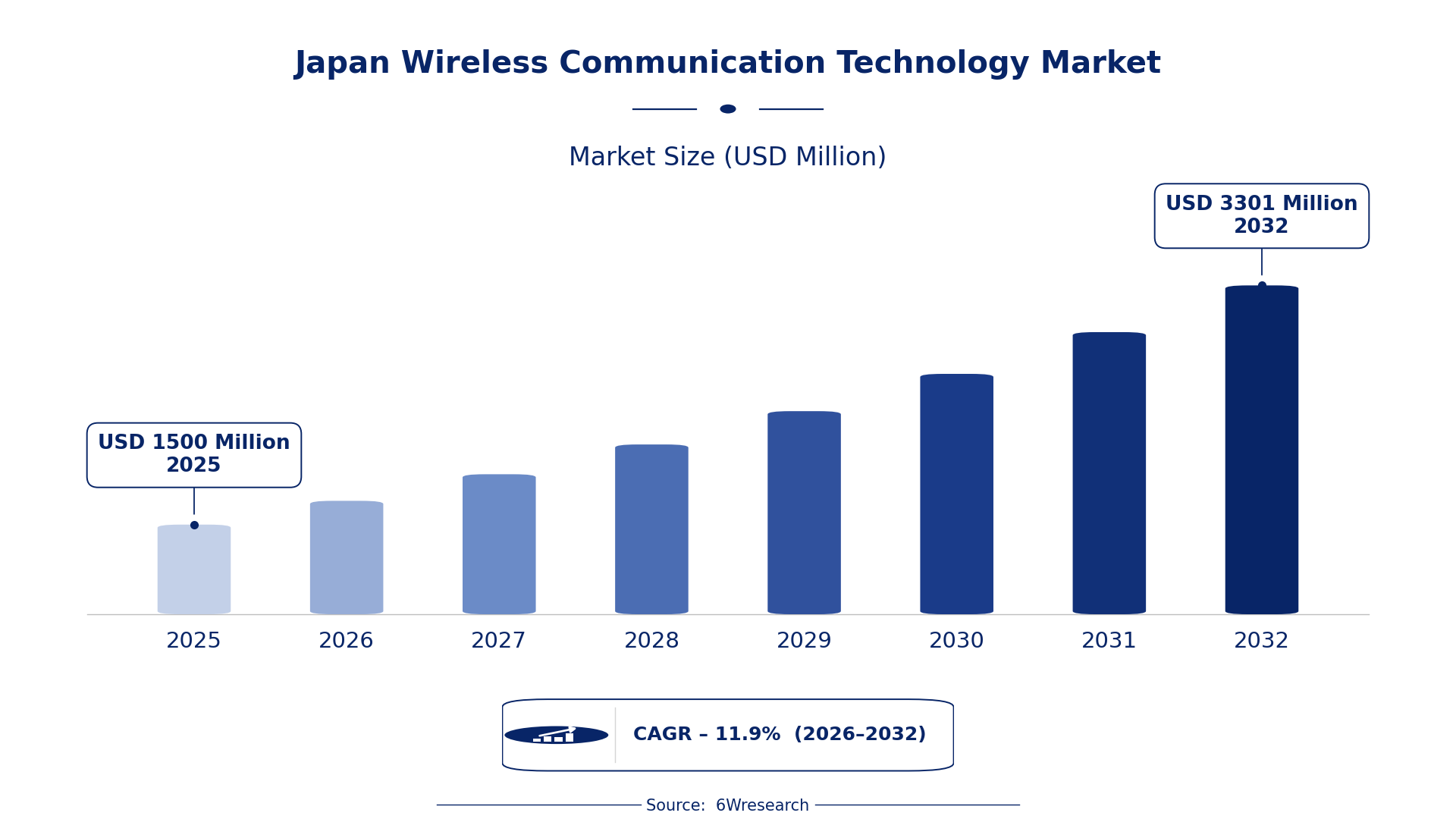
According to 6Wresearch internal database and industry insights, the Japan Wireless Communication Technology Market was valued at USD 1,500 Million in 2025 and is projected to reach USD 3,301 Million by 2032, growing at a CAGR of approximately 11.9% during 2026–2032.
Japan Wireless Communication Technology Market Highlights
| Report Metric | Details |
| Report Name | Japan Wireless Communication Technology Market (2026-2032) |
| Market Size 2025 | USD 1,500 Million |
| Market Size 2032 | USD 3,301 Million |
| Absolute Growth 2025–2032 | USD 1,801 Million |
| CAGR 2026–2032 | 11.9% |
| Peak Annual Growth | 12.6% in 2032 |
| Forecast Period | 2026–2032 |
| Historical Data | 2022–2025 |
| Base Year | 2025 |
| Leading Technology Type, 2025 | Wi-Fi 6 (47% share) |
| Leading Range Type, 2025 | Short-Range (42% share) |
| Leading Application Area, 2025 | Indoor Networks (56% share) |
| Leading End User, 2025 | Enterprises (51% share) |
| Fastest-Growing Technology Type | 5G NR (17.0% CAGR) |
| Fastest-Growing Range Type | Mid to Long-Range (16.5% CAGR) |
| Fastest-Growing Application Area | Cellular Networks (15.0% CAGR) |
| Fastest-Growing End User | Telecom Operators (16.1% CAGR) |
| Growing Sector | Cellular Networks |
| Key End Users | Indoor Networks, Cellular Networks, Smart Agriculture, Smart Homes |
Japan Wireless Communication Technology Market Year-wise Growth Rate and Key Drivers (2022–2032)
This graph illustrates the annual growth rates of the market from 2022 to 2032, highlighting a steady upward trajectory and projected market expansion over the forecast period.
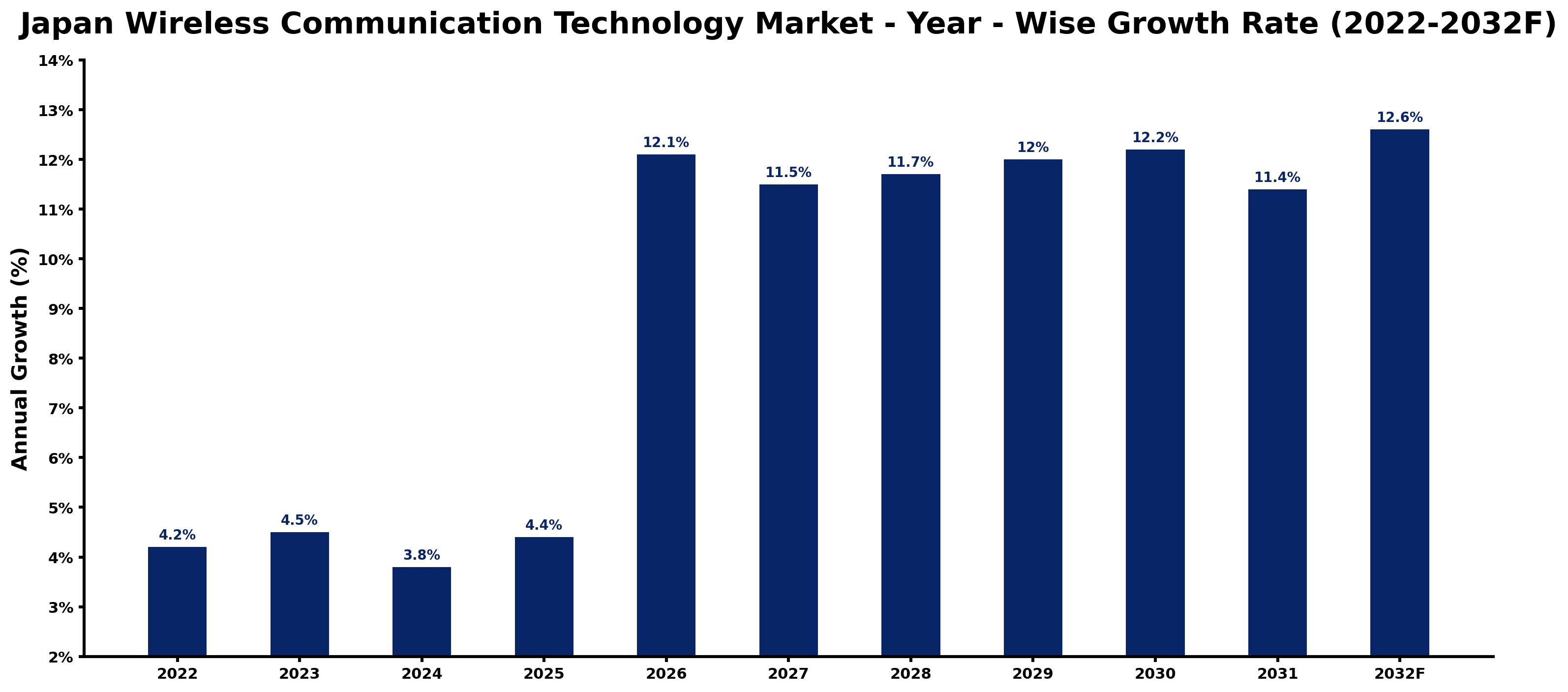
The yearly estimates that follow link every growth rate to its principal driver, so readers can see why the pace changed in each period.
| Year | Estimated Annual Growth (%) | Market Rationale |
| 2022 | 4.2 | The market experienced steady growth due to increasing urban connectivity needs. |
| 2023 | 4.5 | Demand rose as telecom operators expanded their 5G infrastructure. |
| 2024 | 3.8 | Growth slowed as investments stabilised after a period of rapid expansion. |
| 2025 | 4.4 | The market picked up again, driven by the adoption of Wi-Fi 6 in new buildings. |
| 2026 | 12.1 | Demand is expected to surge with the rollout of 5G networks across major urban areas. |
| 2027 | 11.5 | Growth is projected to slow slightly as the market adjusts to the rapid expansion of 5G. |
| 2028 | 11.7 | The market is expected to rebound, supported by increased investments in cellular networks. |
| 2029 | 12.0 | Demand will continue to rise as more enterprises adopt advanced wireless technologies. |
| 2030 | 12.2 | Growth is projected to accelerate as the government pushes for more 5G base stations. |
| 2031 | 11.4 | The market is expected to see a slowdown as saturation begins in urban wireless coverage. |
| 2032 | 12.6 | Demand will peak with the completion of major 5G infrastructure projects. |
Note: Market size estimations and growth projections presented in this report are based on 6Wresearch's proprietary forecasting methodology, utilizing the latest available industry data, government publications, and primary research inputs.
Japan Wireless Communication Technology Market Synopsis
Wireless Communication Technology encompasses systems that enable devices to communicate wirelessly, improving connectivity in urban areas and supporting IoT applications. The Japan Wireless Communication Technology Market is growing due to the deployment of 5G networks in cities like Tokyo and Osaka. Investments from telecom operators, expected to exceed 1 trillion yen by 2025, alongside a national strategy targeting 10 million connected devices by 2025, are driving demand for advanced wireless technologies.
Market Dynamics Impact Analysis (2026–2032)
| Factor | Type | Impact | Primary Segment Affected |
| Increasing urban population driving connectivity needs | Driver | High | Cellular Networks |
| Expansion of 5G infrastructure in urban areas | Driver | High | 5G NR |
| Growing demand for smart home devices | Opportunity | Medium | Smart Homes |
| Rising interest in IoT applications among enterprises | Opportunity | Medium | Enterprises |
| High costs associated with infrastructure development | Restraint | High | 5G NR |
| Regulatory compliance requirements for wireless technologies | Restraint | Medium | Wi-Fi 6 |
| Competition from alternative communication technologies | Challenge | High | Short-Range |
| Rapid technological advancements leading to obsolescence | Challenge | Medium | Indoor Networks |
Evaluation of Drivers in Japan Wireless Communication Technology Market (2026–2032)
Demand rests on the following drivers, each shown with the segment it touches most.
| Drivers | Primary Segment Affected | Why It Matters (Evidence) |
| Expansion of urban 5G networks | 5G NR | Telecom operators are investing over 1 trillion yen in infrastructure, increasing demand for 5G services. |
| Adoption of Wi-Fi 6 technology | Wi-Fi 6 | Over 30% of new commercial buildings are now equipped with Wi-Fi 6, enhancing connectivity. |
| Growth in smart home technology | Smart Homes | With over 5 million Zigbee devices installed, demand for smart home solutions is rising. |
| Increased investment in IoT applications | Indoor Networks | The national strategy aims for 10 million connected devices by 2025, boosting demand. |
| Rising enterprise connectivity needs | Enterprises | The urban population of approximately 125 million drives demand for enhanced wireless communication. |
Buyers are adding capacity as urban areas expand, with telecom operators investing over 1 trillion yen in 5G infrastructure, which increases demand for advanced communication services. The rollout of new cellular networks is driving enterprises to upgrade their systems. With a population of approximately 125 million, urban connectivity needs push businesses to invest in wireless technologies. The increasing installation of smart home devices further fuels demand for reliable wireless communication.
Evaluation of Restraints in Japan Wireless Communication Technology Market
These are the pressures that could keep growth below its potential.
| Market Restraint | Primary Segment Affected | Why It Matters (Evidence) |
| Delays in Wi-Fi 6 technology adoption | Wi-Fi 6 | Insufficient technical training for installers can extend project timelines by up to six months. |
| Supply chain disruptions | Indoor Networks | These disruptions lead to increased costs for buyers, with some reporting price hikes of 15% on essential hardware. |
| Compliance costs | 5G NR | Evolving regulations create additional burdens for producers, resulting in a 20% increase in compliance costs. |
| Skills shortages | Enterprises | Limited workforce in advanced wireless technologies causes project delays and affects demand fulfillment. |
| Market saturation | Cellular Networks | As urban wireless coverage saturates, growth opportunities diminish, impacting long-term investment. |
Japan Wireless Communication Technology Market Challenges
Wi-Fi 6 technology adoption in new commercial buildings is delayed due to a lack of technical training for installers, potentially extending project timelines by up to six months for producers. Supply chain disruptions affect the availability of critical components, leading to increased costs for buyers, with some reporting price hikes of 15% on essential hardware. Regulatory changes from the Ministry of Internal Affairs and Communications add burdens for producers, resulting in a 20% rise in compliance costs. A shortage of skilled technicians in advanced wireless technologies limits project execution, causing delays that hinder buyers from accessing timely upgrades.
Trends in the Japan Wireless Communication Technology Market
Buyers and suppliers in the Japan Wireless Communication Technology Market are adjusting to the following trends.
- Shift from Traditional to 5G Networks: The transition to 5G networks is speeding up, with over 1 trillion yen invested by telecom operators. This shift supports advanced applications in urban areas.
- Increase in Smart Home Technology Adoption: Smart home technology adoption is on the rise, with over 5 million Zigbee devices installed. This trend reflects growing consumer interest in connected home solutions.
- Growth of Indoor Network Solutions: Indoor networks are becoming crucial as urban areas expand, with high demand in commercial spaces. This trend is particularly noticeable in the Tokyo metropolitan area.
- Expansion of IoT Applications: The national strategy aims for 10 million connected devices by 2025, driving progress in IoT technologies and applications across various sectors.
Investment Opportunities in the Japan Wireless Communication Technology Market
The following areas offer the clearest openings for investors and suppliers in the Japan Wireless Communication Technology Market.
- Investment in 5G Infrastructure: Telecom operators are investing over 1 trillion yen by 2025, creating an opportunity to supply equipment and services for 5G infrastructure development.
- Growth in Smart Agriculture: As smart agriculture technologies gain traction, suppliers can target rural areas where demand for connectivity is rising, supported by government funding.
- Indoor Network Solutions Demand: The need for indoor networks is increasing, particularly in urban commercial spaces. Suppliers can take advantage of this by providing advanced solutions.
- Expansion of IoT Device Market: With a target of 10 million connected devices by 2025, there is a growing opportunity for companies to develop and supply IoT solutions.
Government Initiatives in the Japan Wireless Communication Technology Market
The Electrical Appliance and Material Safety Act (1961) regulates the safety of electrical appliances and materials sold in Japan, ensuring compliance among producers. The New Robot Strategy (2015) aims to expand robot use across various sectors, promoting progress in wireless technologies.
The Ministry of Internal Affairs and Communications oversees wireless technology regulations, ensuring adherence to established standards. The Japan Wireless Association supports the implementation of best practices and standards in wireless communication, facilitating smoother operations for buyers.
Future Insight of the Japan Wireless Communication Technology Market
The rollout of 5G base stations will increase, targeting 50,000 stations by 2025, improving connectivity for urban buyers. Expansion of smart agriculture technologies will take place, driven by government funding, enhancing productivity in rural areas. The national strategy for IoT aims to connect 10 million devices by 2025, encouraging innovation for suppliers. Adoption of advanced wireless technologies will rise, with a notable increase in installations anticipated in commercial spaces.
Market Segmentation Analysis
Japan Wireless Communication Technology Market report covers a detailed analysis of the following market segments:
By Technology Type – Wi-Fi 6 Leads, 5G NR Expected to Grow Fastest
According to Saurav Kr Singh, Senior Research Analyst at 6Wresearch, with 47% of technology type revenue in 2025, Wi-Fi 6 was the largest category. Wi-Fi 6 holds the largest share as it is widely used for high-speed internet access in homes and businesses, particularly in urban centres. Its adoption is prominent in areas like Tokyo, where connectivity needs are high. 5G NR is set to record the highest CAGR in this split, 17.0% over 2026–2032. The rapid growth of 5G NR is fuelled by telecom operators investing over 1 trillion yen in infrastructure by 2025. This technology is essential for next-generation mobile networks, which are increasingly sought after by consumers and businesses. Suppliers should prioritise the development of 5G solutions to meet the rising demand for advanced connectivity.
By Range Type – Short-Range Leads, Mid to Long-Range Expected to Grow Fastest
Short-Range accounted for 42% of the market by range type in 2025. Short-Range technology holds the largest share due to its essential role in local communications and device interconnectivity, particularly in urban settings. The increasing deployment of connected devices in commercial spaces underscores its importance. Over 2026–2032, Mid to Long-Range is expected to post the fastest growth, at a CAGR of 16.5%. Mid to Long-Range technology is growing rapidly, propelled by the need for broader coverage in urban areas as 5G networks are rolled out. This segment is critical for ensuring reliable connectivity over larger distances, which is becoming increasingly necessary. Buyers should consider investing in Mid to Long-Range solutions to ensure comprehensive coverage as urban connectivity demands rise.
By Application Area – Indoor Networks Lead, Cellular Networks Expected to Grow Fastest
In 2025, Indoor Networks led the application area split with a 56% share. Indoor Networks lead the market as they are vital for maintaining connectivity within buildings, especially in commercial environments where demand is high. The need for robust indoor connectivity is crucial for supporting various business operations effectively. The quickest growth will come from Cellular Networks, forecast to expand at a CAGR of 15.0% between 2026 and 2032. Cellular Networks are experiencing rapid growth as they form the backbone of mobile communication services, essential for the increasing number of mobile users. The ongoing push for 5G implementation further accelerates the demand for strong cellular infrastructure. Suppliers must prioritise solutions for Cellular Networks to meet the growing reliance on mobile communications.
By End User – Enterprises Lead, Telecom Operators Expected to Grow Fastest
Enterprises took 51% of end user revenue in 2025, more than any other category. Enterprises represent the largest end user group, as they depend heavily on wireless technology to improve operational efficiency. Their continuous demand for advanced connectivity solutions significantly propels market growth. Telecom Operators are projected to grow fastest, at a CAGR of 16.1% during 2026–2032. Telecom Operators are the fastest-growing end user segment, being the primary providers of wireless communication services and expanding their infrastructure to support new technologies. Their investments in 5G and other advancements are crucial for fulfilling consumer expectations. Suppliers should enhance partnerships with Telecom Operators to capitalise on the rising demand for wireless services.
Key Attractiveness of the Report
- 10 Years of Market Numbers
- Historical Data Starting from 2022 to 2025
- Base Year 2025
- Forecast Data until 2032
- Key Performance Indicators Impacting the Market
- Major Upcoming Developments and Projects
Key Highlights of the Report:
- Japan Wireless Communication Technology Market Outlook
- Market Size of Japan Wireless Communication Technology Market, 2025
- Forecast of Japan Wireless Communication Technology Market, 2032
- Historical Data and Forecast of Japan Wireless Communication Technology Revenues & Volume for the Period 2022-2032F
- Japan Wireless Communication Technology Market Trend Evolution
- Japan Wireless Communication Technology Market Drivers and Challenges
- Japan Wireless Communication Technology Price Trends
- Japan Wireless Communication Technology Porter's Five Forces
- Japan Wireless Communication Technology Industry Life Cycle
- Historical Data and Forecast of Japan Wireless Communication Technology Market Revenues & Volume By Technology Type for the Period 2022-2032F
- Historical Data and Forecast of Japan Wireless Communication Technology Market Revenues & Volume By Wi-Fi 6 for the Period 2022-2032F
- Historical Data and Forecast of Japan Wireless Communication Technology Market Revenues & Volume By 5G NR for the Period 2022-2032F
- Historical Data and Forecast of Japan Wireless Communication Technology Market Revenues & Volume By LoRa for the Period 2022-2032F
- Historical Data and Forecast of Japan Wireless Communication Technology Market Revenues & Volume By Zigbee for the Period 2022-2032F
- Historical Data and Forecast of Japan Wireless Communication Technology Market Revenues & Volume By Range Type for the Period 2022-2032F
- Historical Data and Forecast of Japan Wireless Communication Technology Market Revenues & Volume By Short-Range for the Period 2022-2032F
- Historical Data and Forecast of Japan Wireless Communication Technology Market Revenues & Volume By Mid to Long-Range for the Period 2022-2032F
- Historical Data and Forecast of Japan Wireless Communication Technology Market Revenues & Volume By Long-Range for the Period 2022-2032F
- Historical Data and Forecast of Japan Wireless Communication Technology Market Revenues & Volume By Short-Range for the Period 2022-2032F
- Historical Data and Forecast of Japan Wireless Communication Technology Market Revenues & Volume By Application Area for the Period 2022-2032F
- Historical Data and Forecast of Japan Wireless Communication Technology Market Revenues & Volume By Indoor Networks for the Period 2022-2032F
- Historical Data and Forecast of Japan Wireless Communication Technology Market Revenues & Volume By Cellular Networks for the Period 2022-2032F
- Historical Data and Forecast of Japan Wireless Communication Technology Market Revenues & Volume By Smart Agriculture for the Period 2022-2032F
- Historical Data and Forecast of Japan Wireless Communication Technology Market Revenues & Volume By Smart Homes for the Period 2022-2032F
- Historical Data and Forecast of Japan Wireless Communication Technology Market Revenues & Volume By End User for the Period 2022-2032F
- Historical Data and Forecast of Japan Wireless Communication Technology Market Revenues & Volume By Enterprises for the Period 2022-2032F
- Historical Data and Forecast of Japan Wireless Communication Technology Market Revenues & Volume By Telecom Operators for the Period 2022-2032F
- Historical Data and Forecast of Japan Wireless Communication Technology Market Revenues & Volume By AgriTech Startups for the Period 2022-2032F
- Historical Data and Forecast of Japan Wireless Communication Technology Market Revenues & Volume By Automation Firms for the Period 2022-2032F
- Japan Wireless Communication Technology Import Export Trade Statistics
- Market Opportunity Assessment By Technology Type
- Market Opportunity Assessment By Range Type
- Market Opportunity Assessment By Application Area
- Market Opportunity Assessment By End User
- Japan Wireless Communication Technology Top Companies Market Share
- Japan Wireless Communication Technology Competitive Benchmarking By Technical and Operational Parameters
- Japan Wireless Communication Technology Company Profiles
- Japan Wireless Communication Technology Key Strategic Recommendations
Market Covered
The following segment groups are covered in the report.
By Technology Type
- Wi-Fi 6
- 5G NR
- LoRa
- Zigbee
By Range Type
- Short-Range
- Mid to Long-Range
- Long-Range
By Application Area
- Indoor Networks
- Cellular Networks
- Smart Agriculture
- Smart Homes
By End User
- Enterprises
- Telecom Operators
- AgriTech Startups
- Automation Firms































