Japan Wireless Farm Sensor Networks Market Size & Growth Rate
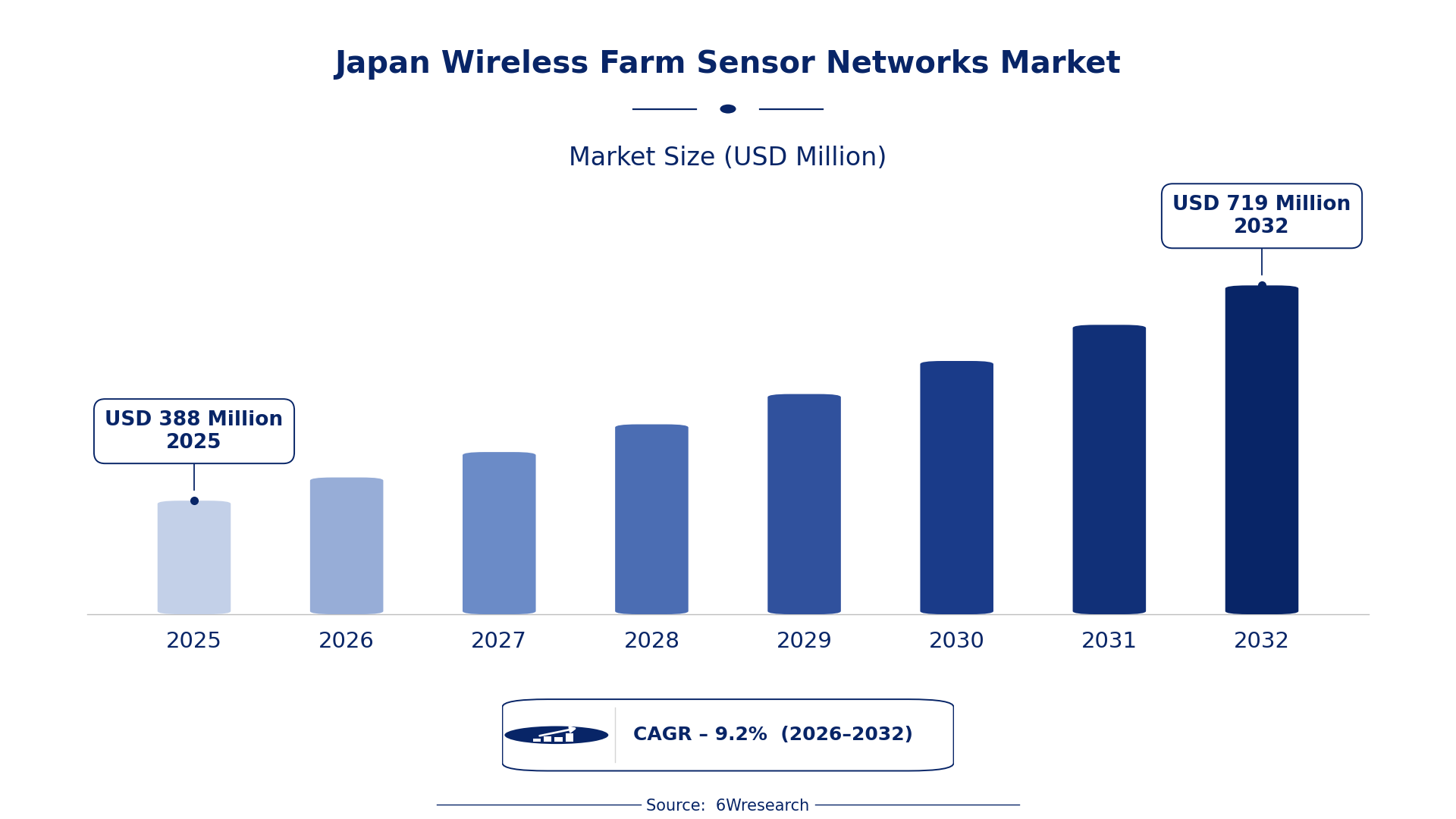
According to 6Wresearch internal database and industry insights, the Japan Wireless Farm Sensor Networks Market was valued at USD 388 Million in 2025 and is projected to reach USD 719 Million by 2032, growing at a CAGR of approximately 9.2% during 2026–2032.
Japan Wireless Farm Sensor Networks Market Highlights
| Report Metric | Details |
| Report Name | Japan Wireless Farm Sensor Networks Market (2026-2032) |
| Market Size 2025 | USD 388 Million |
| Market Size 2032 | USD 719 Million |
| Absolute Growth 2025–2032 | USD 331 Million |
| CAGR 2026–2032 | 9.2% |
| Peak Annual Growth | 10.5% in 2031 |
| Forecast Period | 2026–2032 |
| Historical Data | 2022–2025 |
| Base Year | 2025 |
| Leading Sensor Type, 2025 | Soil Moisture Sensors (38% share) |
| Leading Connectivity Type, 2025 | LoRaWAN (50% share) |
| Leading Application Area, 2025 | Irrigation Management (45% share) |
| Leading End User, 2025 | Farmers (43% share) |
| Fastest-Growing Sensor Type | Temperature Sensors (13.0% CAGR) |
| Fastest-Growing Connectivity Type | Zigbee (13.2% CAGR) |
| Fastest-Growing Application Area | Greenhouse Automation (11.7% CAGR) |
| Fastest-Growing End User | AgriTech Companies (12.0% CAGR) |
| Growing Sector | Greenhouse Automation |
| Key End Users | Irrigation Management, Greenhouse Automation, Crop Monitoring, Animal Health Monitoring |
Japan Wireless Farm Sensor Networks Market Year-wise Growth Rate and Key Drivers (2022–2032)
This graph illustrates the annual growth rates of the market from 2022 to 2032, highlighting a steady upward trajectory and projected market expansion over the forecast period.
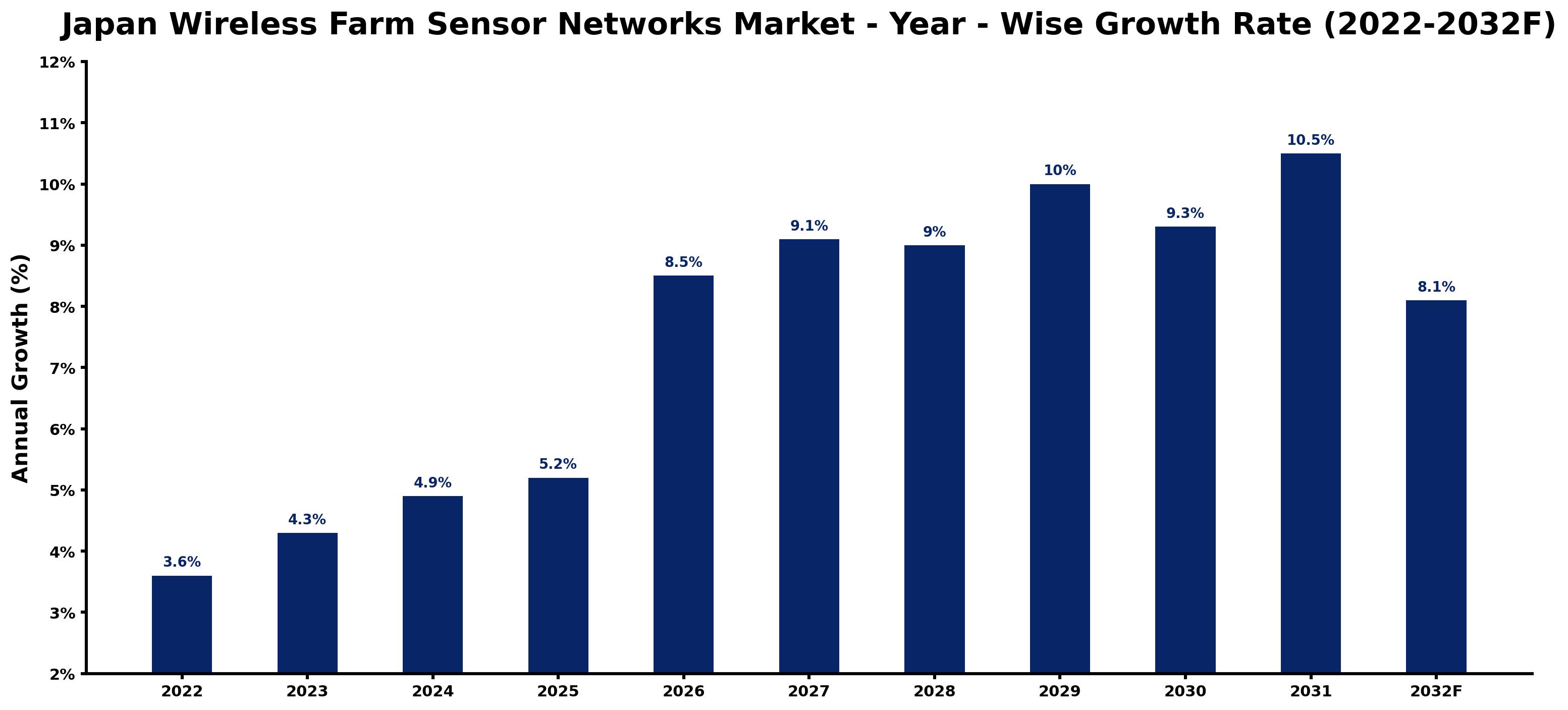
The table below sets out the estimated growth rate for each year and the main factor behind it.
| Year | Estimated Annual Growth (%) | Market Rationale |
| 2022 | 3.6 | The market showed steady growth as farmers began adopting new technologies. |
| 2023 | 4.3 | Interest in smart agriculture increased, resulting in faster growth compared to the previous year. |
| 2024 | 4.9 | Investments in agricultural technology rose, further accelerating market expansion. |
| 2025 | 5.2 | Growth continued as more farmers integrated sensor networks into their operations. |
| 2026 | 8.5 | The market is expected to experience a boost due to rising adoption of IoT technologies. |
| 2027 | 9.1 | Demand will surge as AgriTech companies expand their offerings and services. |
| 2028 | 9.0 | Growth is projected to slow slightly as the market stabilises after rapid expansion. |
| 2029 | 10.0 | Focus on precision farming will drive a resurgence in market growth. |
| 2030 | 9.3 | A slight slowdown is anticipated as the market adjusts to previous rapid increases. |
| 2031 | 10.5 | The market is expected to peak with heightened investment in advanced agricultural technologies. |
| 2032 | 8.1 | Growth will moderate as the market matures and adoption reaches saturation. |
Note: Market size estimations and growth projections presented in this report are based on 6Wresearch's proprietary forecasting methodology, utilizing the latest available industry data, government publications, and primary research inputs.
Japan Wireless Farm Sensor Networks Market Synopsis
Wireless farm sensor networks enable precision farming by monitoring agricultural conditions through IoT technology and wireless communication protocols. The Japan Wireless Farm Sensor Networks Market is growing as domestic farmers and AgriTech companies adopt these solutions. Growth is underpinned by rising investments in smart agriculture, with the government targeting a 30% increase in precision farming technology usage by 2025, alongside a projected market value of approximately 1 trillion yen in 2022.
Market Dynamics Impact Analysis (2026–2032)
| Factor | Type | Impact | Primary Segment Affected |
| Increasing adoption of IoT technologies in agriculture | Driver | High | Soil Moisture Sensors |
| Government initiatives promoting smart farming | Driver | High | Irrigation Management |
| Rising demand for sustainable farming practices | Opportunity | High | Crop Monitoring |
| Expansion of AgriTech companies integrating sensor networks | Opportunity | Medium | Temperature Sensors |
| High initial investment costs for sensor networks | Restraint | High | Livestock Tracking |
| Limited awareness among traditional farmers about technology benefits | Restraint | Medium | Pest Detection Sensors |
| Competition from alternative farming technologies | Challenge | High | Greenhouse Automation |
| Slow regulatory approvals for new technologies | Challenge | Medium | Animal Health Monitoring |
Evaluation of Drivers in Japan Wireless Farm Sensor Networks Market (2026–2032)
Demand rests on the following drivers, each shown with the segment it touches most.
| Drivers | Primary Segment Affected | Why It Matters (Evidence) |
| Rising investments in agricultural technology | Soil Moisture Sensors | In 2022, Japan's agricultural technology market was valued at approximately 1 trillion yen, prompting farmers to invest in moisture sensors for better irrigation management. |
| Government support for smart agriculture | Irrigation Management | The Ministry of Agriculture, Forestry and Fisheries promotes smart agriculture initiatives, increasing the adoption of irrigation management technologies. |
| Focus on sustainable farming practices | Crop Monitoring | The government aims to increase precision farming technology usage by 30% by 2025, driving demand for crop monitoring solutions. |
| Expansion of AgriTech companies | Temperature Sensors | AgriTech companies are projected to grow by 15% annually through 2025, leading to increased demand for temperature sensors in farming. |
| Awareness of precision farming benefits | Livestock Tracking | As farmers recognise the advantages of livestock tracking, demand for these solutions is expected to rise. |
A wider customer base explains much of the growth, as rising investments in agricultural technology are evident with Japan's agricultural technology market valued at approximately 1 trillion yen in 2022. The growth of AgriTech companies is projected at 15% annually through 2025, which will increase demand for temperature sensors. As awareness of precision farming benefits grows, demand for livestock tracking solutions is set to rise.
Evaluation of Restraints in Japan Wireless Farm Sensor Networks Market
Several factors work against faster growth; the main ones are summarised below.
| Market Restraint | Primary Segment Affected | Why It Matters (Evidence) |
| Increased compliance costs due to the JIS Q 9001 standard | Soil Moisture Sensors | Producers face increased compliance costs due to the JIS Q 9001 standard, raising operational expenses by up to 15%. |
| Intensified competition among suppliers | Temperature Sensors | Competition among suppliers escalates as the government promotes smart farming, resulting in price wars that can squeeze profit margins. |
| Supply chain disruptions from sensor technology reliance | Livestock Tracking | Supply chain disruptions occur due to reliance on specific sensor technologies, causing delays in project timelines. |
| Rising raw material costs | Irrigation Management | Rising costs of raw materials, influenced by inflation, can increase production expenses by approximately 10%. |
| Limited awareness of sensor benefits among some farmers | Crop Monitoring | Limited awareness of the benefits of sensor technologies can hinder adoption rates among certain farmer segments. |
Japan Wireless Farm Sensor Networks Market Challenges
Farmers encounter increased operational costs due to the JIS Q 9001 standard, which can elevate expenses by up to 15% for agricultural technology manufacturers. Regulatory changes from the Ministry of Agriculture, Forestry and Fisheries may cause delays in project approvals, affecting timelines for producers who depend on timely data for crop management. Competition intensifies as government initiatives promote smart farming, leading to price wars that compress profit margins for suppliers. Rising raw material costs, driven by inflation, can increase production expenses by approximately 10%, impacting pricing strategies for buyers.
Trends in the Japan Wireless Farm Sensor Networks Market
These developments are changing demand patterns in the Japan Wireless Farm Sensor Networks Market.
- Farmers Increasingly Embracing IoT Solutions: In 2023, farmers are increasingly adopting IoT solutions for precision agriculture, with a reported 30% increase in sensor usage in regions like Hokkaido.
- Shift Towards Sustainable Practices: Since 2021, there has been a notable shift towards sustainable farming practices, particularly in the Kanto region, where crop monitoring technologies have seen a 25% rise.
- Growth of AgriTech Innovations: The AgriTech sector is rapidly evolving, with new innovations emerging in 2023, resulting in a 15% increase in technology adoption among farmers.
- Expansion of Smart Farming Initiatives: Smart farming initiatives have expanded significantly since 2020, with the government allocating 5 billion yen for agricultural innovation projects.
Investment Opportunities in the Japan Wireless Farm Sensor Networks Market
Investors looking at the Japan Wireless Farm Sensor Networks Market should consider the following areas.
- Investment in Sensor Technologies: In rural areas, farmers are seeking advanced sensor technologies, with a notable increase in demand for soil moisture sensors expected in 2023.
- Collaborations with AgriTech Companies: Local firms should explore partnerships with AgriTech companies to strengthen sensor network offerings, particularly in the Kanto region.
- Focus on Irrigation Management Solutions: With the government promoting water conservation, there is a growing opportunity for suppliers of irrigation management solutions, especially in Hokkaido.
- Development of Livestock Tracking Systems: Dairy operators are increasingly looking for livestock tracking systems, creating opportunities for companies to enter this market through joint ventures.
Government Initiatives in the Japan Wireless Farm Sensor Networks Market
Producers of agricultural technology must comply with the Electrical Appliance and Material Safety Act of 1961, ensuring safety standards for electrical appliances used in farming. The Economic Security Promotion Act of 2022 supports supply-chain resilience for critical agricultural products, enhancing the operational capabilities of producers.
In 2023, the government allocated 5 billion yen for agricultural innovation projects, administered by the Ministry of Agriculture, Forestry and Fisheries, which funds the development of new technologies and solutions for farmers.
Future Insight of the Japan Wireless Farm Sensor Networks Market
Domestic farmers will adopt precision farming technologies at an accelerated pace by 2032, driven by government initiatives and a projected increase in technology adoption. IoT integration will improve data collection and decision-making processes for producers, enhancing efficiency. The government's investment of 5 billion yen in agricultural innovation projects will stimulate the development of advanced sensor technologies. AgriTech companies will expand their offerings, providing solutions that support sustainable farming practices.
Market Segmentation Analysis
Japan Wireless Farm Sensor Networks Market report covers a detailed analysis of the following market segments:
By Sensor Type – Soil Moisture Sensors Lead, Temperature Sensors Expected to Grow Fastest
According to Saurav Kr Singh, Senior Research Analyst at 6Wresearch, Soil Moisture Sensors accounted for 38% of the market by sensor type in 2025. Soil moisture sensors are essential for irrigation management, making them vital for over 1.5 million farmers in Japan. Their importance is particularly pronounced in Hokkaido and Tohoku, where accurate soil moisture data is crucial for successful rice cultivation. The quickest growth will come from Temperature Sensors, forecast to expand at a CAGR of 13.0% between 2026 and 2032. Temperature sensors are increasingly important for monitoring crop health, especially in greenhouse operations in the Kanto region. As controlled environment agriculture becomes more prevalent, the demand for these sensors is anticipated to rise significantly. Suppliers should prioritise the development of temperature sensor solutions to meet the growing needs of greenhouse operations.
By Connectivity Type – LoRaWAN Leads, Zigbee Expected to Grow Fastest
The largest connectivity type category in 2025 was LoRaWAN, at 50% of revenue. LoRaWAN is widely used for long-range communication, making it effective in rural areas where extensive sensor network coverage is required. Its ability to connect multiple devices efficiently aligns well with the operational demands of Japan's agricultural landscape. Zigbee is set to record the highest CAGR in this split, 13.2% over 2026–2032. Zigbee is rapidly gaining traction in localized sensor networks, which are crucial for targeted agricultural applications. As the market for precision farming technologies expands, Zigbee's role in enhancing connectivity is expected to increase. Buyers should consider the benefits of incorporating Zigbee technology to optimise the performance of localised sensor networks.
By Application Area – Irrigation Management Leads, Greenhouse Automation Expected to Grow Fastest
With 45% of application area revenue in 2025, Irrigation Management was the largest category. Irrigation management is a key application for water conservation, making it vital for farmers aiming to optimise resource use. This focus aligns with government initiatives promoting smart agriculture practices across Japan. Over 2026–2032, Greenhouse Automation is expected to post the fastest growth, at a CAGR of 11.7%. Greenhouse automation is becoming increasingly important for controlled environment agriculture, allowing for precise monitoring and management of conditions. The push towards sustainable practices will drive further growth in this area. Suppliers must prioritise solutions that support greenhouse automation to align with the industry's shift towards sustainable farming.
By End User – Farmers Lead, AgriTech Companies Expected to Grow Fastest
Farmers held 43% of the Japan Wireless Farm Sensor Networks Market by end user in 2025. Farmers are the primary end-users of wireless farm sensor networks, directly benefiting from improved agricultural practices. Their ongoing engagement in the agricultural sector ensures a steady demand for these technologies. AgriTech Companies are projected to grow fastest, at a CAGR of 12.0% during 2026–2032. AgriTech companies are quickly integrating sensor networks, reflecting a 15% annual growth rate attributed to technological advancements. Their crucial role in modernising agriculture will further accelerate the adoption of these solutions. Suppliers should focus on collaborating with AgriTech companies to enhance their market presence and drive innovation in agricultural practices.
Key Attractiveness of the Report
- 10 Years of Market Numbers
- Historical Data Starting from 2022 to 2025
- Base Year 2025
- Forecast Data until 2032
- Key Performance Indicators Impacting the Market
- Major Upcoming Developments and Projects
Key Highlights of the Report:
- Japan Wireless Farm Sensor Networks Market Outlook
- Market Size of Japan Wireless Farm Sensor Networks Market, 2025
- Forecast of Japan Wireless Farm Sensor Networks Market, 2032
- Historical Data and Forecast of Japan Wireless Farm Sensor Networks Revenues & Volume for the Period 2022-2032F
- Japan Wireless Farm Sensor Networks Market Trend Evolution
- Japan Wireless Farm Sensor Networks Market Drivers and Challenges
- Japan Wireless Farm Sensor Networks Price Trends
- Japan Wireless Farm Sensor Networks Porter's Five Forces
- Japan Wireless Farm Sensor Networks Industry Life Cycle
- Historical Data and Forecast of Japan Wireless Farm Sensor Networks Market Revenues & Volume By Sensor Type for the Period 2022-2032F
- Historical Data and Forecast of Japan Wireless Farm Sensor Networks Market Revenues & Volume By Soil Moisture Sensors for the Period 2022-2032F
- Historical Data and Forecast of Japan Wireless Farm Sensor Networks Market Revenues & Volume By Temperature Sensors for the Period 2022-2032F
- Historical Data and Forecast of Japan Wireless Farm Sensor Networks Market Revenues & Volume By Pest Detection Sensors for the Period 2022-2032F
- Historical Data and Forecast of Japan Wireless Farm Sensor Networks Market Revenues & Volume By Livestock Tracking for the Period 2022-2032F
- Historical Data and Forecast of Japan Wireless Farm Sensor Networks Market Revenues & Volume By Connectivity Type for the Period 2022-2032F
- Historical Data and Forecast of Japan Wireless Farm Sensor Networks Market Revenues & Volume By LoRaWAN for the Period 2022-2032F
- Historical Data and Forecast of Japan Wireless Farm Sensor Networks Market Revenues & Volume By Zigbee for the Period 2022-2032F
- Historical Data and Forecast of Japan Wireless Farm Sensor Networks Market Revenues & Volume By Bluetooth Low Energy for the Period 2022-2032F
- Historical Data and Forecast of Japan Wireless Farm Sensor Networks Market Revenues & Volume By NB-IoT for the Period 2022-2032F
- Historical Data and Forecast of Japan Wireless Farm Sensor Networks Market Revenues & Volume By Application Area for the Period 2022-2032F
- Historical Data and Forecast of Japan Wireless Farm Sensor Networks Market Revenues & Volume By Irrigation Management for the Period 2022-2032F
- Historical Data and Forecast of Japan Wireless Farm Sensor Networks Market Revenues & Volume By Greenhouse Automation for the Period 2022-2032F
- Historical Data and Forecast of Japan Wireless Farm Sensor Networks Market Revenues & Volume By Crop Monitoring for the Period 2022-2032F
- Historical Data and Forecast of Japan Wireless Farm Sensor Networks Market Revenues & Volume By Animal Health Monitoring for the Period 2022-2032F
- Historical Data and Forecast of Japan Wireless Farm Sensor Networks Market Revenues & Volume By End User for the Period 2022-2032F
- Historical Data and Forecast of Japan Wireless Farm Sensor Networks Market Revenues & Volume By Farmers for the Period 2022-2032F
- Historical Data and Forecast of Japan Wireless Farm Sensor Networks Market Revenues & Volume By AgriTech Companies for the Period 2022-2032F
- Historical Data and Forecast of Japan Wireless Farm Sensor Networks Market Revenues & Volume By Smart Farming Firms for the Period 2022-2032F
- Historical Data and Forecast of Japan Wireless Farm Sensor Networks Market Revenues & Volume By Dairy Operators for the Period 2022-2032F
- Japan Wireless Farm Sensor Networks Import Export Trade Statistics
- Market Opportunity Assessment By Sensor Type
- Market Opportunity Assessment By Connectivity Type
- Market Opportunity Assessment By Application Area
- Market Opportunity Assessment By End User
- Japan Wireless Farm Sensor Networks Top Companies Market Share
- Japan Wireless Farm Sensor Networks Competitive Benchmarking By Technical and Operational Parameters
- Japan Wireless Farm Sensor Networks Company Profiles
- Japan Wireless Farm Sensor Networks Key Strategic Recommendations
Market Covered
This report examines the market across the segments below.
By Sensor Type
- Soil Moisture Sensors
- Temperature Sensors
- Pest Detection Sensors
- Livestock Tracking
By Connectivity Type
- LoRaWAN
- Zigbee
- Bluetooth Low Energy
- NB-IoT
By Application Area
- Irrigation Management
- Greenhouse Automation
- Crop Monitoring
- Animal Health Monitoring
By End User
- Farmers
- AgriTech Companies
- Smart Farming Firms
- Dairy Operators































