Japan Wireless Lighting Market Size & Growth Rate
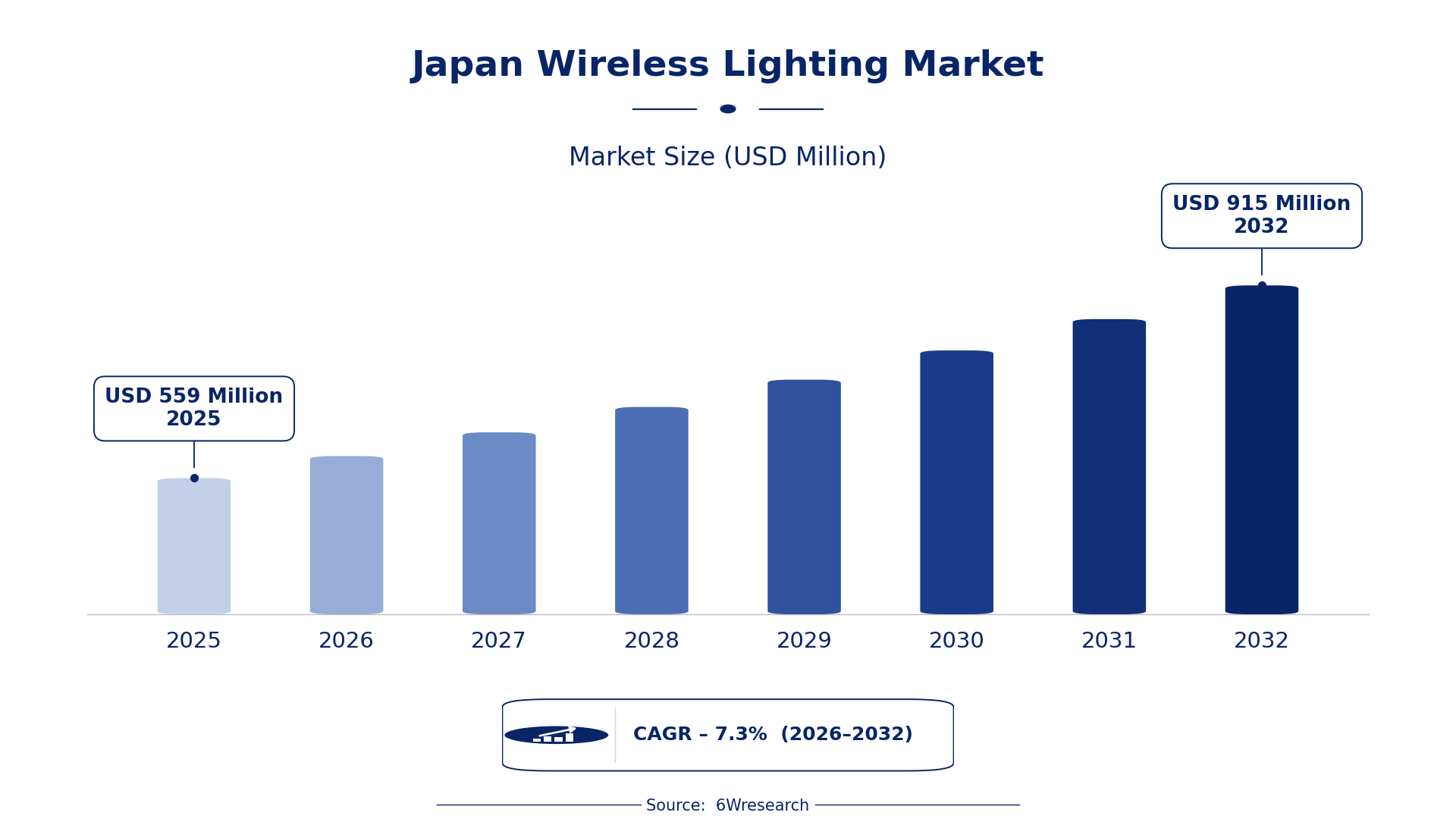
According to 6Wresearch internal database and industry insights, the Japan Wireless Lighting Market was valued at USD 559 Million in 2025 and is projected to reach USD 915 Million by 2032, growing at a CAGR of approximately 7.3% during 2026–2032.
Japan Wireless Lighting Market Highlights
| Report Metric | Details |
| Report Name | Japan Wireless Lighting Market (2026-2032) |
| Market Size 2025 | USD 559 Million |
| Market Size 2032 | USD 915 Million |
| Absolute Growth 2025–2032 | USD 356 Million |
| CAGR 2026–2032 | 7.3% |
| Peak Annual Growth | 8.3% in 2028 |
| Forecast Period | 2026–2032 |
| Historical Data | 2022–2025 |
| Base Year | 2025 |
| Leading Lighting Type, 2025 | Smart Bulbs (53% share) |
| Leading Connectivity Protocol, 2025 | Wi-Fi (35% share) |
| Leading Application Area, 2025 | Residential Lighting (49% share) |
| Leading End User, 2025 | Homeowners (40% share) |
| Fastest-Growing Lighting Type | LED Strip Lights (11.1% CAGR) |
| Fastest-Growing Connectivity Protocol | Zigbee (9.3% CAGR) |
| Fastest-Growing Application Area | Outdoor Lighting (8.6% CAGR) |
| Fastest-Growing End User | Facility Managers (9.2% CAGR) |
| Growing Sector | Residential Lighting |
| Key End Users | Homeowners, Commercial Properties, Facility Managers |
Japan Wireless Lighting Market Year-wise Growth Rate and Key Drivers (2022–2032)
This graph illustrates the annual growth rates of the market from 2022 to 2032, highlighting a steady upward trajectory and projected market expansion over the forecast period.
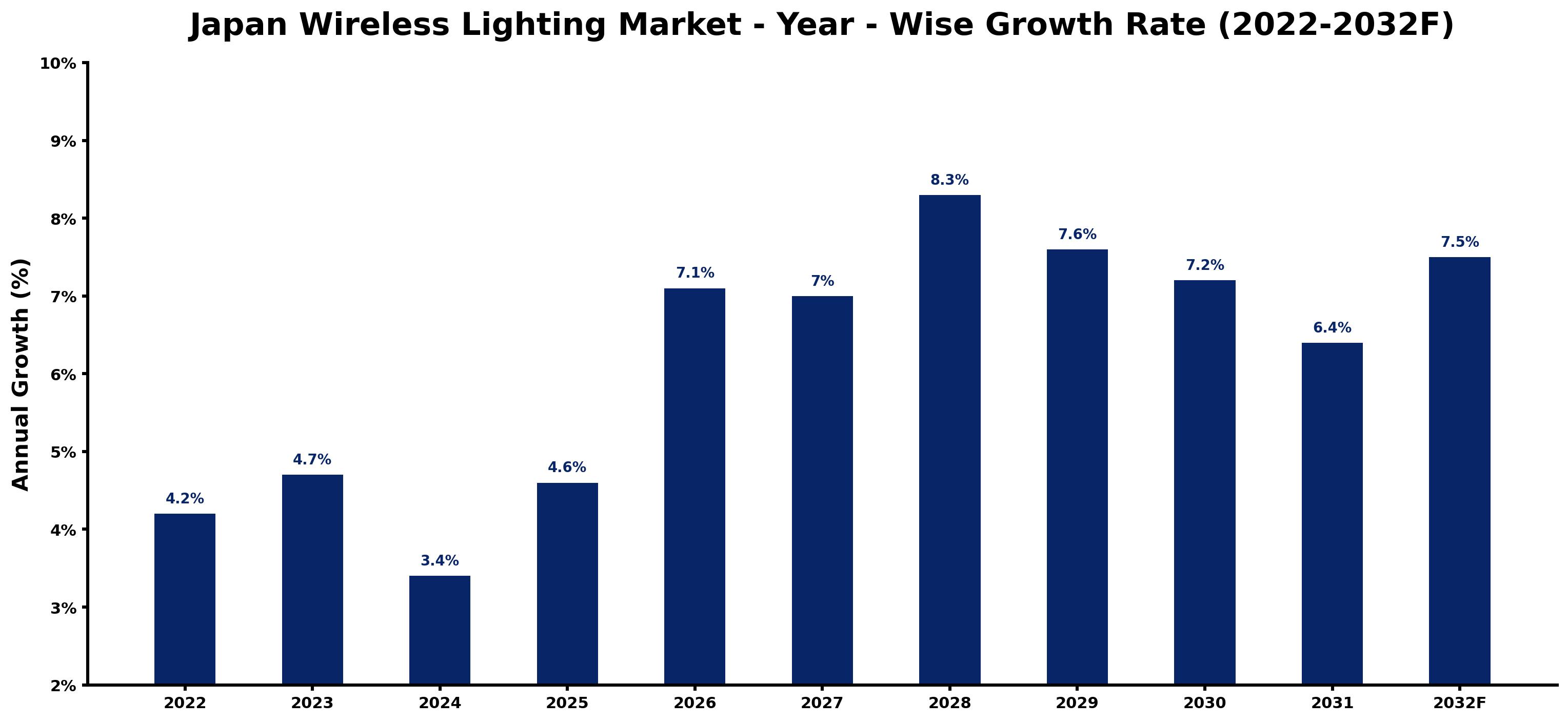
Below, each year's estimated growth is shown next to the factor that most influenced it.
| Year | Estimated Annual Growth (%) | Market Rationale |
| 2022 | 4.2 | The market experienced steady demand due to ongoing urban development and smart home trends. |
| 2023 | 4.7 | Growth was supported by increased adoption of smart home technologies and energy-efficient solutions. |
| 2024 | 3.4 | A slowdown occurred as consumers adjusted to previous spending patterns and economic conditions. |
| 2025 | 4.6 | Demand rose again as energy-efficient solutions gained popularity among homeowners and businesses. |
| 2026 | 7.1 | Growth is expected to accelerate with the rise of smart home integration and urban projects. |
| 2027 | 7.0 | A slight slowdown is projected as market saturation approaches for certain products. |
| 2028 | 8.3 | Peak growth will be reached with heightened interest in energy efficiency and smart technologies. |
| 2029 | 7.6 | Demand is expected to slow slightly as competition intensifies in the wireless lighting sector. |
| 2030 | 7.2 | The market will continue to grow, supported by ongoing urban initiatives and technological advancements. |
| 2031 | 6.4 | Growth is projected to decelerate as market maturity begins to set in across various segments. |
| 2032 | 7.5 | A resurgence in demand is expected as new technologies emerge and consumer preferences shift. |
Note: Market size estimations and growth projections presented in this report are based on 6Wresearch's proprietary forecasting methodology, utilizing the latest available industry data, government publications, and primary research inputs.
Japan Wireless Lighting Market Synopsis
Wireless lighting systems utilise LED technology integrated with wireless communication protocols for control and operation. In Japan, demand is particularly strong among residential users and commercial properties, especially in urban areas like Tokyo. The Japan Wireless Lighting Market is expanding due to a growing interest in smart home technologies and energy-efficient solutions, with government initiatives promoting these advancements. In 2023, the Ministry of the Environment launched a program to support energy-efficient lighting solutions, further stimulating market growth and investment.
Market Dynamics Impact Analysis (2026–2032)
| Factor | Type | Impact | Primary Segment Affected |
| Growing adoption of smart home technologies | Driver | High | Residential Lighting |
| Increased urban development projects | Driver | High | Commercial Properties |
| Expansion of smart home integration | Opportunity | High | Wi-Fi |
| Rising demand for energy-efficient solutions | Opportunity | High | LED Strip Lights |
| High initial costs of installation | Restraint | Medium | Smart Bulbs |
| Limited awareness of wireless lighting benefits | Restraint | Medium | Motion Sensor Lights |
| Challenges in meeting safety regulations | Challenge | High | Smart Bulbs |
| Supply chain disruptions affecting availability | Challenge | Medium | Smart Bulbs |
Evaluation of Drivers in Japan Wireless Lighting Market (2026–2032)
Demand rests on the following drivers, each shown with the segment it touches most.
| Drivers | Primary Segment Affected | Why It Matters (Evidence) |
| Increased consumer interest in smart home technologies | Residential Lighting | This interest drives homeowners to invest in wireless lighting solutions, with 3 million smart homes recorded in 2022. |
| Urban development projects in Tokyo | Commercial Properties | These initiatives create demand for modern lighting solutions, contributing to a rise in installations and upgrades. |
| Government initiatives promoting energy efficiency | LED Strip Lights | The 2023 program by the Ministry of the Environment encourages adoption, leading to higher sales and installations. |
| Integration of wireless lighting with home automation systems | Wi-Fi | This integration improves user experience, driving more purchases among tech-savvy consumers seeking convenience. |
| Growing popularity of decorative lighting | Decorative Use | Trends in interior design are pushing demand for aesthetic lighting solutions, particularly in urban settings. |
Spending rises because of the increasing consumer interest in smart home technologies, evidenced by 3 million smart homes in Japan by 2022. Urban development projects in Tokyo create demand for modern lighting solutions, contributing to more installations in commercial properties. The growing popularity of decorative lighting is driven by trends in interior design, particularly in urban areas, pushing demand for aesthetic lighting options that improve living spaces.
Evaluation of Restraints in Japan Wireless Lighting Market
The following restraints limit how fast demand can grow.
| Market Restraint | Primary Segment Affected | Why It Matters (Evidence) |
| High initial costs of installation | Smart Bulbs | The average cost of smart bulbs is around ¥3,000, which can deter some consumers from adopting new technologies. |
| Limited awareness of wireless lighting benefits | Motion Sensor Lights | Many consumers are unaware of the advantages of wireless lighting, hindering market penetration and growth. |
| Challenges in meeting safety regulations | LED Strip Lights | Compliance with the Electrical Appliance and Material Safety Act complicates product development and market entry. |
| Supply chain disruptions affecting availability | Smart Bulbs | Current global supply chain issues can delay product launches and increase costs for manufacturers and consumers. |
| Competition from traditional lighting solutions | Decorative Use | Established products still dominate the market, limiting growth opportunities for newer wireless technologies. |
Japan Wireless Lighting Market Challenges
Producers struggle with competition from traditional lighting options, which pressures pricing strategies and limits market share. Importers face supply chain delays due to component shortages, leading to longer lead times that affect product availability for distributors. Distributors must comply with JIS standards, increasing operational costs that can raise prices for retailers. Buyers confront high costs for energy-efficient upgrades, as the average price of ¥3,000 for smart bulbs can deter purchases, especially among cost-sensitive consumers.
Trends in the Japan Wireless Lighting Market
Buyers and suppliers in the Japan Wireless Lighting Market are adjusting to the following trends.
- Shift from Traditional to Smart Lighting: In Tokyo, the transition to smart lighting began in 2023, supported by urban development initiatives. This shift is reflected in the growing number of smart homes, reaching 3 million, indicating a strong market for wireless solutions.
- Emergence of Energy-Efficient Solutions: The Tokyo Smart City initiative, launched in 2023, focuses on implementing energy-efficient lighting in public spaces. This initiative supports the adoption of wireless lighting, with funding allocated for various urban projects.
- Growing Popularity of Decorative Lighting: The decorative lighting market is expanding, particularly in urban areas. Trends in interior design are driving demand, with LED strip lights becoming increasingly popular for aesthetic purposes and home enhancements.
- Increased Integration with Home Automation: Homeowners are increasingly integrating wireless lighting systems with automation technologies. This trend is supported by the rise of smart home devices, with 3 million smart homes recorded in Japan, enhancing user experience.
Investment Opportunities in the Japan Wireless Lighting Market
Investors looking at the Japan Wireless Lighting Market should consider the following areas.
- Tokyo Urban Development Projects: Tokyo's ongoing urban development projects present an opportunity for wireless lighting solutions, with the government allocating funding for energy-efficient lighting upgrades in 2023, creating demand for innovative products.
- Rising Demand for Energy-Efficient Solutions: With the average household using 30% of its electricity for lighting, there is a clear gap for energy-efficient products. Homeowners are increasingly looking for solutions that reduce energy consumption and costs.
- Partnerships with Local Authorities: Now is an ideal time for partnerships with local authorities to implement smart lighting solutions in public spaces, especially with the Tokyo Smart City initiative promoting such projects and funding available.
- Investment in Decorative Lighting: The decorative lighting market is expected to grow, driven by trends in interior design. Suppliers can target interior designers and homeowners looking for aesthetic improvements and innovative lighting solutions.
Government Initiatives in the Japan Wireless Lighting Market
The GX Basic Policy, adopted in 2023, aims for about JPY 150 trillion in public-private decarbonisation investment over the next decade. This policy builds on the framework established by the Electrical Appliance and Material Safety Act, which regulates safety standards for electrical appliances, ensuring that wireless lighting products meet necessary safety requirements and consumer expectations.
Subsidies for energy-efficient lighting upgrades in commercial buildings are part of the 2023 initiative. This scheme encourages the adoption of wireless lighting solutions, making them more accessible and affordable for consumers, with funding allocated for various projects aimed at enhancing energy efficiency in urban areas.
Future Insight of the Japan Wireless Lighting Market
A policy-driven shift towards energy-efficient solutions will reshape the market, prompting suppliers to adapt their products accordingly. By 2032, urban areas will witness increased integration of wireless lighting in public spaces, enhancing safety and aesthetics. The Tokyo Smart City initiative will accelerate the adoption of these systems, creating new avenues for suppliers. As the number of smart homes is projected to reach 6 million, buyers will enjoy greater energy savings and improved functionality in their lighting systems.
Market Segmentation Analysis
Japan Wireless Lighting Market report covers a detailed analysis of the following market segments:
By Lighting Type – Smart Bulbs Lead, LED Strip Lights Expected to Grow Fastest
According to Saurav Kr Singh, Senior Research Analyst at 6Wresearch, Smart Bulbs accounted for 53% of the market by lighting type in 2025. Smart bulbs dominate the market due to their widespread use among consumers seeking energy efficiency and convenience. For instance, the average household in Japan uses about 30% of its electricity for lighting, making smart bulbs an attractive option. LED Strip Lights are projected to grow fastest, at a CAGR of 11.1% during 2026–2032. The rapid growth of LED strip lights is driven by their popularity in decorative and ambient lighting applications, particularly in urban areas. In 2022, the total number of smart homes in Japan reached 3 million, further propelling this trend. Suppliers should focus on promoting the benefits of LED strip lights to capitalise on this growing demand.
By Connectivity Protocol – Wi-Fi Leads, Zigbee Expected to Grow Fastest
The largest connectivity protocol category in 2025 was Wi-Fi, at 35% of revenue. Wi-Fi holds the largest share because it is essential for integration with smart home systems, appealing to a diverse consumer base. The high adoption of wireless lighting in Tokyo showcases the effectiveness of Wi-Fi in enhancing user experience. Over 2026–2032, Zigbee is expected to post the fastest growth, at a CAGR of 9.3%. Zigbee is witnessing rapid growth as it is crucial for smart home ecosystems, particularly where low power consumption is needed. The Tokyo Smart City initiative is further driving the adoption of Zigbee in public lighting applications. Suppliers should enhance Wi-Fi capabilities in their offerings to meet the demands of the smart home sector.
By Application Area – Residential Lighting Leads, Outdoor Lighting Expected to Grow Fastest
Residential Lighting held 49% of the Japan Wireless Lighting Market by application area in 2025. Residential lighting dominates the market as it is the primary choice for consumers seeking energy-efficient solutions in their homes. Government initiatives promoting energy-efficient lighting solutions significantly support this segment's growth. The quickest growth will come from Outdoor Lighting, forecast to expand at a CAGR of 8.6% between 2026 and 2032. Outdoor lighting is growing quickly due to its importance in enhancing safety and aesthetics in public and private spaces. The 15% increase in motion sensor light usage in public areas highlights the rising demand for outdoor solutions. Suppliers need to focus on outdoor lighting advancements to meet the increasing needs of urban and suburban settings.
By End User – Homeowners Lead, Facility Managers Expected to Grow Fastest
With 40% of end user revenue in 2025, Homeowners was the largest category. Homeowners represent the largest user segment, driven by the need for energy-efficient and convenient lighting solutions in residential settings. The integration of wireless lighting with home automation systems is a key factor in attracting this demographic. Facility Managers are set to record the highest CAGR in this split, 9.2% over 2026–2032. Facility managers are rapidly adopting wireless lighting solutions as they are responsible for maintenance and upgrades in commercial settings. The government's funding for energy-efficient lighting projects in urban areas is encouraging this trend. Suppliers should tailor their offerings to meet the specific needs of facility managers in commercial environments.
Key Attractiveness of the Report
- 10 Years of Market Numbers
- Historical Data Starting from 2022 to 2025
- Base Year 2025
- Forecast Data until 2032
- Key Performance Indicators Impacting the Market
- Major Upcoming Developments and Projects
Key Highlights of the Report:
- Japan Wireless Lighting Market Outlook
- Market Size of Japan Wireless Lighting Market, 2025
- Forecast of Japan Wireless Lighting Market, 2032
- Historical Data and Forecast of Japan Wireless Lighting Revenues & Volume for the Period 2022-2032F
- Japan Wireless Lighting Market Trend Evolution
- Japan Wireless Lighting Market Drivers and Challenges
- Japan Wireless Lighting Price Trends
- Japan Wireless Lighting Porter's Five Forces
- Japan Wireless Lighting Industry Life Cycle
- Historical Data and Forecast of Japan Wireless Lighting Market Revenues & Volume By Lighting Type for the Period 2022-2032F
- Historical Data and Forecast of Japan Wireless Lighting Market Revenues & Volume By Smart Bulbs for the Period 2022-2032F
- Historical Data and Forecast of Japan Wireless Lighting Market Revenues & Volume By LED Strip Lights for the Period 2022-2032F
- Historical Data and Forecast of Japan Wireless Lighting Market Revenues & Volume By Motion Sensor Lights for the Period 2022-2032F
- Historical Data and Forecast of Japan Wireless Lighting Market Revenues & Volume By Solar Wireless Lamps for the Period 2022-2032F
- Historical Data and Forecast of Japan Wireless Lighting Market Revenues & Volume By Connectivity Protocol for the Period 2022-2032F
- Historical Data and Forecast of Japan Wireless Lighting Market Revenues & Volume By Wi-Fi for the Period 2022-2032F
- Historical Data and Forecast of Japan Wireless Lighting Market Revenues & Volume By Bluetooth for the Period 2022-2032F
- Historical Data and Forecast of Japan Wireless Lighting Market Revenues & Volume By Zigbee for the Period 2022-2032F
- Historical Data and Forecast of Japan Wireless Lighting Market Revenues & Volume By LoRa for the Period 2022-2032F
- Historical Data and Forecast of Japan Wireless Lighting Market Revenues & Volume By Application Area for the Period 2022-2032F
- Historical Data and Forecast of Japan Wireless Lighting Market Revenues & Volume By Residential Lighting for the Period 2022-2032F
- Historical Data and Forecast of Japan Wireless Lighting Market Revenues & Volume By Decorative Use for the Period 2022-2032F
- Historical Data and Forecast of Japan Wireless Lighting Market Revenues & Volume By Security Lighting for the Period 2022-2032F
- Historical Data and Forecast of Japan Wireless Lighting Market Revenues & Volume By Outdoor Lighting for the Period 2022-2032F
- Historical Data and Forecast of Japan Wireless Lighting Market Revenues & Volume By End User for the Period 2022-2032F
- Historical Data and Forecast of Japan Wireless Lighting Market Revenues & Volume By Homeowners for the Period 2022-2032F
- Historical Data and Forecast of Japan Wireless Lighting Market Revenues & Volume By Interior Designers for the Period 2022-2032F
- Historical Data and Forecast of Japan Wireless Lighting Market Revenues & Volume By Commercial Properties for the Period 2022-2032F
- Historical Data and Forecast of Japan Wireless Lighting Market Revenues & Volume By Facility Managers for the Period 2022-2032F
- Japan Wireless Lighting Import Export Trade Statistics
- Market Opportunity Assessment By Lighting Type
- Market Opportunity Assessment By Connectivity Protocol
- Market Opportunity Assessment By Application Area
- Market Opportunity Assessment By End User
- Japan Wireless Lighting Top Companies Market Share
- Japan Wireless Lighting Competitive Benchmarking By Technical and Operational Parameters
- Japan Wireless Lighting Company Profiles
- Japan Wireless Lighting Key Strategic Recommendations
Market Covered
Segments analysed in this report are listed below.
By Lighting Type
- Smart Bulbs
- LED Strip Lights
- Motion Sensor Lights
- Solar Wireless Lamps
By Connectivity Protocol
- Wi-Fi
- Bluetooth
- Zigbee
- LoRa
By Application Area
- Residential Lighting
- Decorative Use
- Security Lighting
- Outdoor Lighting
By End User
- Homeowners
- Interior Designers
- Commercial Properties
- Facility Managers































