Japan Workforce Optimization Software Market Size & Growth Rate
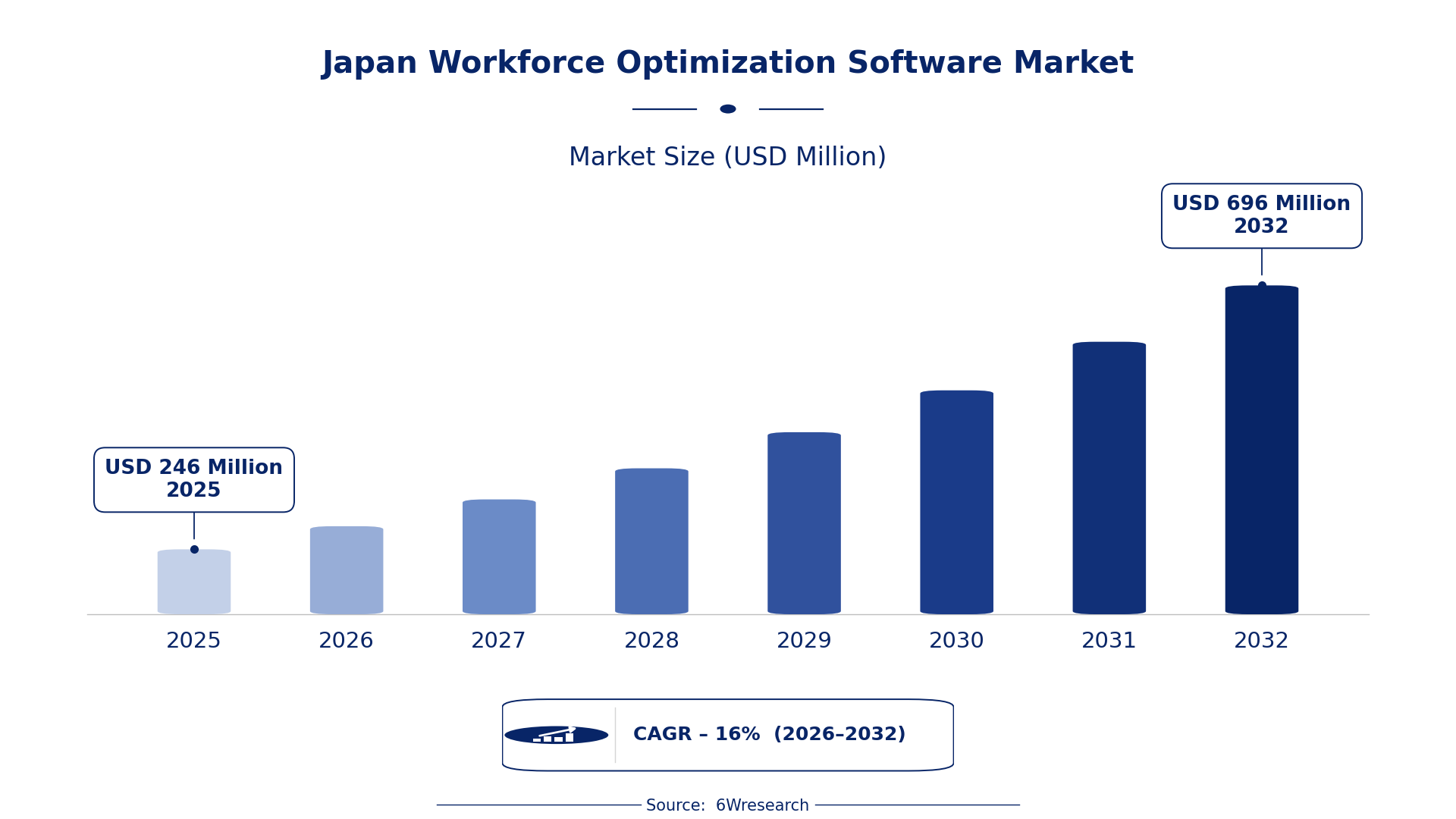
According to 6Wresearch internal database and industry insights, the Japan Workforce Optimization Software Market was valued at USD 246 Million in 2025 and is projected to reach USD 696 Million by 2032, growing at a CAGR of approximately 16% during 2026–2032.
Japan Workforce Optimization Software Market Highlights
| Report Metric | Details |
| Report Name | Japan Workforce Optimization Software Market (2026-2032) |
| Market Size 2025 | USD 246 Million |
| Market Size 2032 | USD 696 Million |
| Absolute Growth 2025–2032 | USD 450 Million |
| CAGR 2026–2032 | 16% |
| Peak Annual Growth | 17.6% in 2026 |
| Forecast Period | 2026–2032 |
| Historical Data | 2022–2025 |
| Base Year | 2025 |
| Leading Software Type, 2025 | Workforce Management (35% share) |
| Leading Deployment Mode, 2025 | Cloud-Based (49% share) |
| Leading Application Area, 2025 | Scheduling (39% share) |
| Leading End User, 2025 | Call Centers (40% share) |
| Fastest-Growing Software Type | Performance Analytics (17.5% CAGR) |
| Fastest-Growing Deployment Mode | On-Premises (17.1% CAGR) |
| Fastest-Growing Application Area | KPI Tracking (19.0% CAGR) |
| Fastest-Growing End User | Enterprises (20.4% CAGR) |
| Growing Sector | KPI Tracking |
| Key End Users | Scheduling, KPI Tracking, Customer Service Review, Demand Planning |
Japan Workforce Optimization Software Market Year-wise Growth Rate and Key Drivers (2022–2032)
This graph illustrates the annual growth rates of the market from 2022 to 2032, highlighting a steady upward trajectory and projected market expansion over the forecast period.
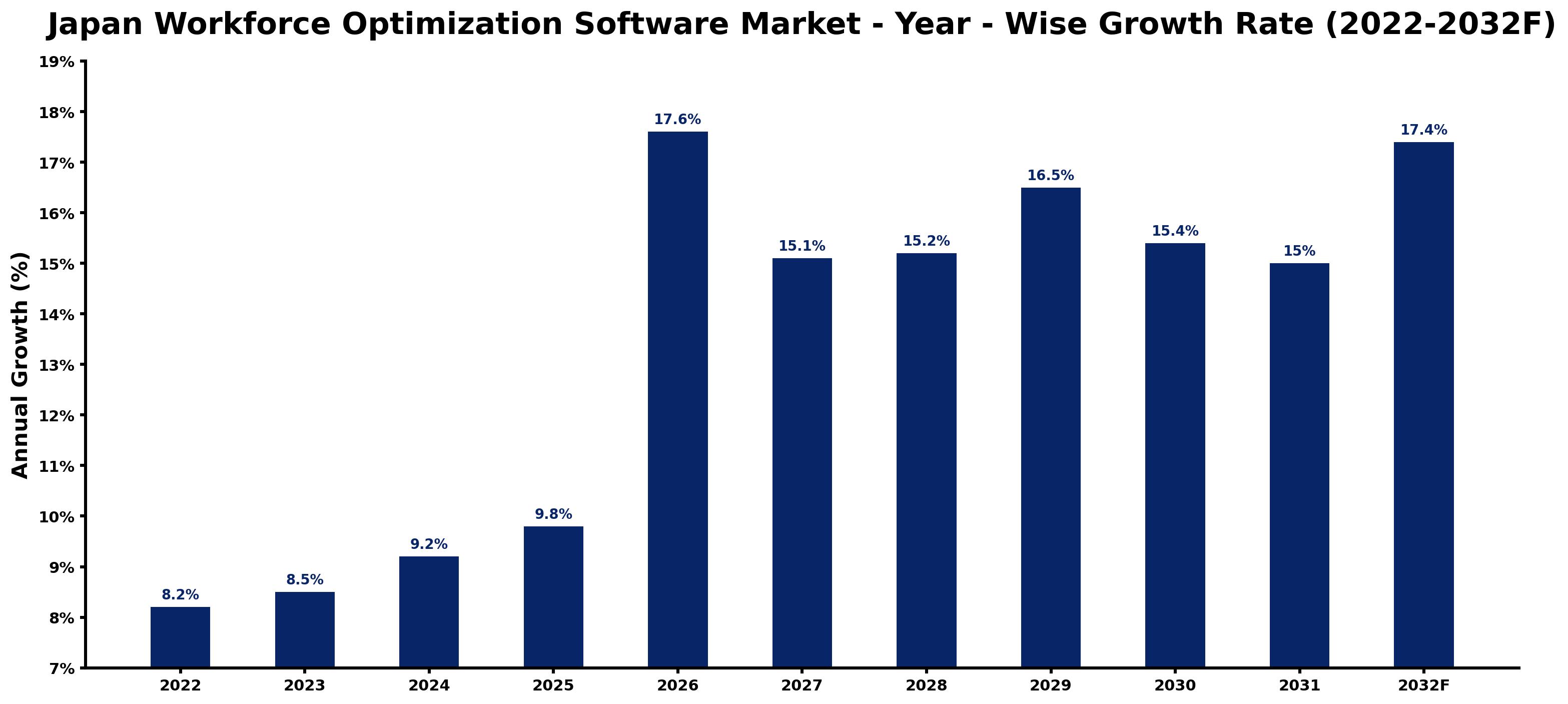
Year by year, the estimates below pair each growth rate with the development that shaped it.
| Year | Estimated Annual Growth (%) | Market Rationale |
| 2022 | 8.2 | The market was characterised by steady demand from BPOs and financial institutions. |
| 2023 | 8.5 | Growth accelerated as enterprises increasingly adopted optimization solutions for operational efficiency. |
| 2024 | 9.2 | The rise in minimum wage prompted more companies to invest in workforce management software. |
| 2025 | 9.8 | Demand surged as organisations sought to improve productivity in competitive sectors. |
| 2026 | 17.6 | The market is expected to peak due to widespread digital transformation initiatives across various industries. |
| 2027 | 15.1 | Growth is projected to slow as the market matures but will remain strong due to ongoing investments. |
| 2028 | 15.2 | Continued adoption of performance analytics tools is expected to drive demand higher once again. |
| 2029 | 16.5 | The increasing complexity of workforce management needs will lead to further software purchases. |
| 2030 | 15.4 | Growth is projected to decelerate as saturation in some sectors begins to limit new sales opportunities. |
| 2031 | 15.0 | A stable demand is expected to persist, driven by regulatory compliance and performance tracking needs. |
| 2032 | 17.4 | The market is projected to grow as digital transformation initiatives expand further. |
Note: Market size estimations and growth projections presented in this report are based on 6Wresearch's proprietary forecasting methodology, utilizing the latest available industry data, government publications, and primary research inputs.
Japan Workforce Optimization Software Market Synopsis
Workforce Optimization Software improves organisational efficiency by streamlining workforce management processes. In Japan, the Workforce Optimization Software Market is driven by strong demand from sectors like BPOs and financial institutions, which are increasingly adopting cloud-based solutions for flexibility. The average employee in a call centre uses this software daily, with Tokyo and Osaka leading in adoption. The government's push for digital transformation further fuels investment, as companies seek to improve productivity and ensure compliance with labour laws. The market is valued at approximately 200 billion yen in 2023, reflecting its importance in improving operational efficiency.
Market Dynamics Impact Analysis (2026–2032)
| Factor | Type | Impact | Primary Segment Affected |
| Growing demand for compliance software due to regulatory changes | Driver | High | Compliance Software |
| Increased adoption of cloud-based solutions for flexibility | Driver | High | Cloud-Based |
| Rising workforce in call centers creates a need for optimization tools | Opportunity | High | Call Centers |
| Investment in performance analytics tools by financial institutions | Opportunity | Medium | Performance Analytics |
| High costs associated with software implementation and maintenance | Restraint | High | Workforce Management |
| Complexity of integrating new software with existing systems | Restraint | Medium | Performance Analytics |
| Limited budget for technology upgrades in smaller enterprises | Challenge | High | Enterprises |
| Stricter compliance regulations increasing operational costs | Challenge | Medium | Compliance Software |
Evaluation of Drivers in Japan Workforce Optimization Software Market (2026–2032)
The main growth drivers and the segments they affect most are set out below.
| Drivers | Primary Segment Affected | Why It Matters (Evidence) |
| Rising minimum wage prompting investment in optimization software | Workforce Management | Japan's national weighted-average minimum wage rose to JPY 1,055 per hour in October 2024, leading companies to seek efficiency. |
| Increased focus on performance metrics in financial institutions | Performance Analytics | Financial institutions are adopting performance analytics tools to improve operational efficiency and meet compliance standards. |
| High demand for scheduling solutions in call centers | Scheduling | With approximately 10,000 call centers in Japan, the need for effective scheduling software is critical for managing customer interactions. |
| Government initiatives promoting digital transformation | Cloud-Based | The Japanese government launched a program in 2023 to encourage enterprises to adopt digital solutions, boosting cloud-based software demand. |
| Growing need for KPI tracking in enterprises | KPI Tracking | KPI tracking is essential for 80% of enterprises to measure success and improve operational performance. |
Behind the steady rise in orders sits a marked increase in the national minimum wage, which rose to JPY 1,055 per hour in October 2024, pushing companies to invest in workforce optimization software. The total population of Japan, around 125 million, drives demand for effective scheduling and compliance solutions, particularly in call centers, where over 1 million customer interactions are handled monthly. In 2023, there were over 300,000 HR departments utilizing optimization software, reflecting the growing need for performance analytics tools in various sectors.
Evaluation of Restraints in Japan Workforce Optimization Software Market
The table below lists the restraints and the evidence behind each.
| Market Restraint | Primary Segment Affected | Why It Matters (Evidence) |
| Rising costs due to outdated technology | Workforce Management | Many companies face increased operational expenses as they rely on outdated systems that are less efficient. |
| Shortage of skilled personnel | Performance Analytics | Producers struggle with a lack of qualified workers, delaying software development and implementation. |
| Regulatory compliance challenges | Compliance Software | The need to adhere to labor laws complicates software updates, leading to potential fines for HR departments. |
| Supply chain disruptions in software distribution | Cloud-Based | Delays in accessing critical updates force buyers to operate with outdated systems, impacting productivity. |
| Resistance to change from traditional practices | Scheduling | Some enterprises are hesitant to adopt new technologies, limiting the market's growth potential. |
Japan Workforce Optimization Software Market Challenges
Producers in the workforce optimization software market face rising costs due to outdated technology, which can inflate operational expenses by 30% for buyers. Skills shortages hinder the development and implementation of new solutions, causing delays of up to 6 months for producers. Regulatory compliance complicates software updates, risking fines for over 50% of HR departments that must adhere to labour laws. Supply chain disruptions in software distribution can delay access to critical updates, forcing buyers to operate with outdated systems and impacting productivity by as much as 20%.
Trends in the Japan Workforce Optimization Software Market
The following changes are redrawing the Japan Workforce Optimization Software Market.
- Shift from On-Premises to Cloud-Based Solutions: Many enterprises are transitioning from on-premises systems to cloud-based solutions, reflecting the need for flexibility. In 2023, 70% of enterprises preferred cloud solutions for their scalability, indicating a market shift.
- Increased Adoption of Performance Analytics Tools: The demand for performance analytics tools has surged, particularly in financial institutions. In 2023, these tools were increasingly adopted to improve operational efficiency and compliance, reflecting a broader trend in workforce optimization.
- Growing Importance of Compliance Software: As labour laws become stricter, compliance software is gaining importance among HR departments. In 2023, over 50% of HR departments mandated compliance software to avoid potential fines, highlighting this trend.
- Emphasis on KPI Tracking: KPI tracking is becoming essential for enterprises to measure success effectively. In 2023, 80% of enterprises reported using KPI tracking to enhance operational performance, showcasing its growing significance.
Investment Opportunities in the Japan Workforce Optimization Software Market
The openings below show where demand in the Japan Workforce Optimization Software Market is visible and how suppliers can enter.
- Gap in Cloud-Based Software Adoption: With 70% of enterprises preferring cloud-based solutions, there is a gap for providers to fill. Companies in Tokyo and Osaka are particularly keen on these solutions, presenting a prime opportunity for investment.
- Demand for Scheduling Solutions in Call Centers: The high number of call centres in Japan creates a substantial opportunity for scheduling software providers. With approximately 10,000 call centres, suppliers can enter this market by partnering with local businesses.
- Investment in Performance Analytics Tools: The increasing focus on performance metrics presents an opportunity for investment in analytics tools. Financial institutions are particularly interested in these solutions, making it a promising area for new entrants.
- Emerging Need for Compliance Software: As labour regulations tighten, compliance software is becoming essential for HR departments. The growing number of HR departments in Japan provides a ripe opportunity for suppliers to offer tailored solutions.
Government Initiatives in the Japan Workforce Optimization Software Market
The AI Promotion Act (2025) introduces a framework for AI research and development, updating the existing Industrial Standardization Act. This measure encourages workforce optimization software producers to align their products with national standards, ensuring compliance and quality across the industry.
In 2023, a programme launched by the Digital Agency aimed to support digital transformation in enterprises, with a budget of JPY 10 billion. This initiative, overseen by the Digital Agency, facilitates the adoption of advanced technologies, benefiting both producers and buyers in the workforce optimization market.
Future Insight of the Japan Workforce Optimization Software Market
The 2023 government programme will drive a shift towards digital transformation, prompting suppliers to adopt advanced analytics tools. By 2032, over 1.5 million licenses of workforce optimization software are expected to be installed, reflecting a growing demand for flexible solutions. As ISO 9001 becomes more integrated into quality management systems, buyers will benefit from improved compliance and performance tracking. Increased adoption of cloud-based solutions will provide enterprises with greater flexibility and efficiency.
Market Segmentation Analysis
Japan Workforce Optimization Software Market report covers a detailed analysis of the following market segments:
By Software Type – Workforce Management Leads, Performance Analytics Expected to Grow Fastest
According to Saurav Kr Singh, Senior Research Analyst at 6Wresearch, Workforce Management took 35% of software type revenue in 2025, more than any other category. Workforce Management holds the largest share as it is essential for managing employee schedules and workloads effectively. For instance, the average employee in a call center relies on this software daily to maintain optimal operational performance. Performance Analytics is projected to grow fastest, at a CAGR of 17.5% during 2026–2032. Performance Analytics is witnessing rapid growth due to the increasing adoption of tools that evaluate employee performance metrics in various sectors. This trend is particularly notable in financial institutions, where data-driven insights are becoming crucial for operational improvements. Suppliers should prioritise enhancing performance analytics features to cater to the growing demand in the market.
By Deployment Mode – Cloud-Based Leads, On-Premises Expected to Grow Fastest
In 2025, Cloud-Based led the deployment mode split with a 49% share. Cloud-Based solutions dominate the market because they offer flexibility and scalability, which are vital for enterprises adapting to dynamic workforce needs. Approximately 70% of enterprises in Japan prefer cloud options for their workforce optimisation software, reflecting this trend. Over 2026–2032, On-Premises are expected to post the fastest growth, at a CAGR of 17.1%. On-Premises deployment is experiencing growth as companies increasingly prioritise local data management, especially in sectors where data security is paramount. This shift indicates a renewed interest in traditional infrastructure among specific industries. Buyers may benefit from evaluating both deployment options to determine the best fit for their operational requirements.
By Application Area – Scheduling Leads, KPI Tracking Expected to Grow Fastest
With 39% of application area revenue in 2025, Scheduling was the largest category. Scheduling is the leading application area, fundamental for efficient workforce allocation across various sectors. This is particularly critical in call centers, where optimised scheduling directly influences service delivery and customer satisfaction levels. KPI Tracking is set to record the highest CAGR in this split, 19.0% over 2026–2032. KPI Tracking is gaining traction as enterprises increasingly recognise the importance of effectively measuring performance indicators. The demand for data to inform strategic decision-making processes is propelling this growth. Suppliers should focus on enhancing KPI tracking capabilities to align with the growing emphasis on performance measurement.
By End User – Call Centers Lead, Enterprises Expected to Grow Fastest
Call Centers held 40% of the Japan Workforce Optimization Software Market by end user in 2025. Call Centers are the primary users of workforce optimisation tools, significantly influencing market share due to their high volume of customer interactions. With approximately 10,000 call centers in Japan, the demand for optimisation software remains robust and consistent. The quickest growth will come from Enterprises, forecast to expand at a CAGR of 20.4% between 2026 and 2032. Enterprises are experiencing the fastest growth in adoption as they implement workforce optimisation tools across various industries to improve operational efficiency. This trend indicates a broader acceptance of such technologies beyond traditional sectors. Suppliers should tailor their solutions to meet the diverse needs of enterprise clients to effectively capture this expanding market.
Key Attractiveness of the Report
- 10 Years of Market Numbers
- Historical Data Starting from 2022 to 2025
- Base Year 2025
- Forecast Data until 2032
- Key Performance Indicators Impacting the Market
- Major Upcoming Developments and Projects
Key Highlights of the Report:
- Japan Workforce Optimization Software Market Outlook
- Market Size of Japan Workforce Optimization Software Market, 2025
- Forecast of Japan Workforce Optimization Software Market, 2032
- Historical Data and Forecast of Japan Workforce Optimization Software Revenues & Volume for the Period 2022-2032F
- Japan Workforce Optimization Software Market Trend Evolution
- Japan Workforce Optimization Software Market Drivers and Challenges
- Japan Workforce Optimization Software Price Trends
- Japan Workforce Optimization Software Porter's Five Forces
- Japan Workforce Optimization Software Industry Life Cycle
- Historical Data and Forecast of Japan Workforce Optimization Software Market Revenues & Volume By Software Type for the Period 2022-2032F
- Historical Data and Forecast of Japan Workforce Optimization Software Market Revenues & Volume By Workforce Management for the Period 2022-2032F
- Historical Data and Forecast of Japan Workforce Optimization Software Market Revenues & Volume By Performance Analytics for the Period 2022-2032F
- Historical Data and Forecast of Japan Workforce Optimization Software Market Revenues & Volume By Quality Monitoring for the Period 2022-2032F
- Historical Data and Forecast of Japan Workforce Optimization Software Market Revenues & Volume By Forecasting Tools for the Period 2022-2032F
- Historical Data and Forecast of Japan Workforce Optimization Software Market Revenues & Volume By Compliance Software for the Period 2022-2032F
- Historical Data and Forecast of Japan Workforce Optimization Software Market Revenues & Volume By Deployment Mode for the Period 2022-2032F
- Historical Data and Forecast of Japan Workforce Optimization Software Market Revenues & Volume By Cloud-Based for the Period 2022-2032F
- Historical Data and Forecast of Japan Workforce Optimization Software Market Revenues & Volume By On-Premises for the Period 2022-2032F
- Historical Data and Forecast of Japan Workforce Optimization Software Market Revenues & Volume By Hybrid for the Period 2022-2032F
- Historical Data and Forecast of Japan Workforce Optimization Software Market Revenues & Volume By Cloud-Based for the Period 2022-2032F
- Historical Data and Forecast of Japan Workforce Optimization Software Market Revenues & Volume By On-Premises for the Period 2022-2032F
- Historical Data and Forecast of Japan Workforce Optimization Software Market Revenues & Volume By Application Area for the Period 2022-2032F
- Historical Data and Forecast of Japan Workforce Optimization Software Market Revenues & Volume By Scheduling for the Period 2022-2032F
- Historical Data and Forecast of Japan Workforce Optimization Software Market Revenues & Volume By KPI Tracking for the Period 2022-2032F
- Historical Data and Forecast of Japan Workforce Optimization Software Market Revenues & Volume By Customer Service Review for the Period 2022-2032F
- Historical Data and Forecast of Japan Workforce Optimization Software Market Revenues & Volume By Demand Planning for the Period 2022-2032F
- Historical Data and Forecast of Japan Workforce Optimization Software Market Revenues & Volume By Labor Law Adherence for the Period 2022-2032F
- Historical Data and Forecast of Japan Workforce Optimization Software Market Revenues & Volume By End User for the Period 2022-2032F
- Historical Data and Forecast of Japan Workforce Optimization Software Market Revenues & Volume By Call Centers for the Period 2022-2032F
- Historical Data and Forecast of Japan Workforce Optimization Software Market Revenues & Volume By Enterprises for the Period 2022-2032F
- Historical Data and Forecast of Japan Workforce Optimization Software Market Revenues & Volume By BPOs for the Period 2022-2032F
- Historical Data and Forecast of Japan Workforce Optimization Software Market Revenues & Volume By HR Departments for the Period 2022-2032F
- Historical Data and Forecast of Japan Workforce Optimization Software Market Revenues & Volume By Financial Institutions for the Period 2022-2032F
- Japan Workforce Optimization Software Import Export Trade Statistics
- Market Opportunity Assessment By Software Type
- Market Opportunity Assessment By Deployment Mode
- Market Opportunity Assessment By Application Area
- Market Opportunity Assessment By End User
- Japan Workforce Optimization Software Top Companies Market Share
- Japan Workforce Optimization Software Competitive Benchmarking By Technical and Operational Parameters
- Japan Workforce Optimization Software Company Profiles
- Japan Workforce Optimization Software Key Strategic Recommendations
Market Covered
This report examines the market across the segments below.
By Software Type
- Workforce Management
- Performance Analytics
- Quality Monitoring
- Forecasting Tools
- Compliance Software
By Deployment Mode
- Cloud-Based
- On-Premises
- Hybrid
By Application Area
- Scheduling
- KPI Tracking
- Customer Service Review
- Demand Planning
- Labor Law Adherence
By End User
- Call Centers
- Enterprises
- BPOs
- HR Departments
- Financial Institutions































