Jordan Anti Reflective Glass Market Size, Share & Growth Rate
The Jordan Anti Reflective Glass Market was estimated at USD 371 Million in 2025 and is projected to reach USD 523 Million by 2032, growing at a CAGR of 5.0% from 2026 to 2032. This promising trajectory is primarily fueled by a robust demand in the construction sector, driven by increased infrastructure investments and a transition toward energy-efficient building materials. Additionally, the automotive industry's pursuit of enhanced visibility solutions plays a vital role in propelling market growth.
Jordan Anti Reflective Glass Market Year-wise Growth Rate and Key Drivers
This graph highlights how the Jordan Anti Reflective Glass Market has steadily grown over the years, supported by major growth factors.
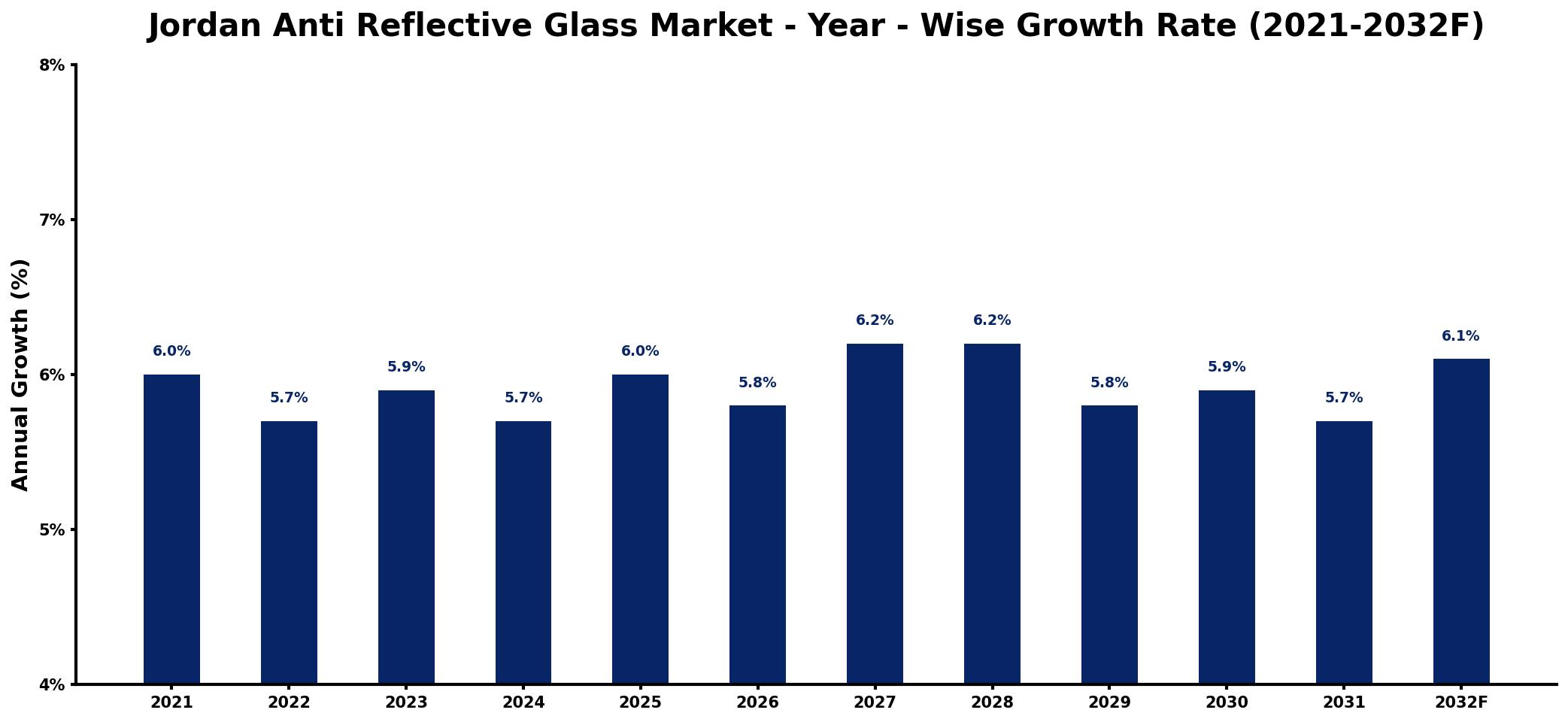
The table below presents the year‑wise growth rates along with the key drivers influencing the market
| Year | Growth Rate | Major Drivers |
| 2021 | 6.0% | Rising construction sector investments |
| 2022 | 5.7% | Increased demand for energy efficiency |
| 2023 | 5.9% | Growing automotive manufacturing output |
| 2024 | 5.7% | Expansion of solar energy projects |
| 2025 | 6.0% | Surge in architectural innovations |
| 2026 | 5.8% | Boost in consumer electronics production |
| 2027 | 6.2% | Growth in luxury vehicle sales |
| 2028 | 6.2% | Increased focus on sustainability practices |
| 2029 | 5.8% | Rising consumer awareness levels |
| 2030 | 5.9% | growing emerging market penetration |
| 2031 | 5.7% | growing regional consumption patterns |
| 2032 | 6.1% | Increased investments in infrastructure |
Note: Market size estimations and growth projections presented in this report are based on 6Wresearch's proprietary forecasting methodology, utilizing the latest available industry data, government publications, and primary research inputs.
Jordan Anti Reflective Glass Market Synopsis
The strongest force currently shaping the Jordan Anti Reflective Glass Market is the shift towards sustainable and energy-efficient construction practices. As more developers prioritize reducing glare and improving clarity in their projects, the adoption of anti-reflective glass solutions has gained significant traction.
In parallel, advancements in anti-reflective glass technology—such as improved durability and UV protection—are enhancing product appeal across multiple sectors. These innovations position anti-reflective glass as an attractive option for residential and commercial applications alike, further solidifying its importance in the market.
Jordan Anti Reflective Glass Market Key Takeaways
- The market is benefiting from growing infrastructure investments and a demand for high-performance building materials.
- Technological innovations are driving the development of more durable and efficient anti-reflective glass solutions.
- Consumer awareness of the benefits of anti-reflective glass remains limited, posing a challenge to market penetration.
- The automotive sector's demand for advanced glass features is significantly influencing market dynamics.
- Strategic partnerships and product innovation are essential for players looking to enhance their market presence.
Evaluation of Restraints in Jordan Anti Reflective Glass Market
Despite the positive growth trajectory, several restraints hinder the Jordan Anti Reflective Glass Market. A notable challenge is the limited awareness among consumers regarding the advantages of anti-reflective glass compared to traditional alternatives. This results in slower adoption rates, especially in a price-sensitive market. The initial cost of anti-reflective products can deter budget-conscious customers, compounding the challenge. Additionally, competition from alternative solutions, such as window films, further complicates market dynamics, necessitating effective marketing strategies to showcase the unique benefits of anti-reflective glass.
Jordan Anti Reflective Glass Market Trends
Currently, the market is witnessing a trend toward energy-efficient solutions and sustainability in construction practices. Anti-reflective glass products are increasingly favored for their glare-reduction capabilities and aesthetic enhancement. Moreover, technological advancements, such as self-cleaning and improved UV resistance, are emerging as key differentiators, appealing to architects and builders alike. As consumers become more environmentally conscious, the demand for such innovative glass solutions is expected to grow.
Jordan Anti Reflective Glass Market Opportunities
The Jordan Anti Reflective Glass Market presents substantial investment opportunities, particularly in the construction and automotive sectors. With a heightened focus on sustainability, the need for innovative anti-reflective glass solutions tailored to local conditions is on the rise. Partnerships with local manufacturers, coupled with collaborations with architects and developers, can pave the way for new projects and boost market penetration. Additionally, government incentives promoting energy-efficient materials further enhance the attractiveness of this market for potential investors.
Government Initiatives in the Jordan Anti Reflective Glass Market
The Jordanian government has enacted several policies aimed at fostering the growth of the anti-reflective glass market. These initiatives include financial incentives for manufacturers focused on research and development of innovative products. Additionally, subsidies to encourage the adoption of energy-efficient and sustainable glass solutions are in place. Regulatory frameworks have also been established to maintain quality and safety standards in the market, promoting fair competition while protecting consumer interests.
Future Insights of the Jordan Anti Reflective Glass Market
Looking ahead to 2026-2032, the Jordan Anti Reflective Glass Market is expected to continue on its upward trajectory, spurred by ongoing investments in infrastructure and a stronger emphasis on sustainability. The incorporation of anti-reflective glass in various applications, from residential buildings to automotive designs, is anticipated to rise as builders and manufacturers seek improved clarity and reduced glare. Technological innovations will likely enhance product offerings, solidifying anti-reflective glass's position as a pivotal component in modern construction and design practices.
Jordan Anti Reflective Glass Market Latest Developments (2025 - 2026)
In recent months, the Jordan Anti Reflective Glass Market has seen notable developments that reflect its dynamic nature. Industry players are increasingly investing in research initiatives to develop advanced glass solutions that meet the growing demands for durability and energy efficiency. Concurrently, partnerships between glass manufacturers and construction companies are being forged to address the increasing demand for high-performance building materials, particularly in light of new governmental initiatives supporting sustainable construction.
Jordan Anti Reflective Glass Market - Key Attractiveness of the Report
- 10 Years of Market Numbers
- Historical Data Starting from 2022 to 2025
- Base Year: 2025
- Forecast Data until 2032
- Key Performance Indicators Impacting the Market
- Major Upcoming Developments and Projects
Key Highlights of the Report:
- Jordan Anti Reflective Glass Market Outlook
- Market Size of Jordan Anti Reflective Glass Market, 2025
- Forecast of Jordan Anti Reflective Glass Market, 2032
- Historical Data and Forecast of Jordan Anti Reflective Glass Revenues & Volume for the Period 2022-2032F
- Jordan Anti Reflective Glass Market Trend Evolution
- Jordan Anti Reflective Glass Market Drivers and Challenges
- Jordan Anti Reflective Glass Price Trends
- Jordan Anti Reflective Glass Porter's Five Forces
- Jordan Anti Reflective Glass Industry Life Cycle
- Historical Data and Forecast of Jordan Anti Reflective Glass Market Revenues & Volume By Type for the Period 2022-2032F
- Historical Data and Forecast of Jordan Anti Reflective Glass Market Revenues & Volume By Double Layers for the Period 2022-2032F
- Historical Data and Forecast of Jordan Anti Reflective Glass Market Revenues & Volume By Four Layers for the Period 2022-2032F
- Historical Data and Forecast of Jordan Anti Reflective Glass Market Revenues & Volume By Others for the Period 2022-2032F
- Historical Data and Forecast of Jordan Anti Reflective Glass Market Revenues & Volume By Application for the Period 2022-2032F
- Historical Data and Forecast of Jordan Anti Reflective Glass Market Revenues & Volume By Architectural Windows for the Period 2022-2032F
- Historical Data and Forecast of Jordan Anti Reflective Glass Market Revenues & Volume By Instrumentation Windows for the Period 2022-2032F
- Historical Data and Forecast of Jordan Anti Reflective Glass Market Revenues & Volume By Electronic Displays for the Period 2022-2032F
- Historical Data and Forecast of Jordan Anti Reflective Glass Market Revenues & Volume By Picture Framing Glass for the Period 2022-2032F
- Historical Data and Forecast of Jordan Anti Reflective Glass Market Revenues & Volume By Showcase Glass for the Period 2022-2032F
- Historical Data and Forecast of Jordan Anti Reflective Glass Market Revenues & Volume By Cold Storage Displays for the Period 2022-2032F
- Historical Data and Forecast of Jordan Anti Reflective Glass Market Revenues & Volume By Lamps Glass for the Period 2022-2032F
- Historical Data and Forecast of Jordan Anti Reflective Glass Market Revenues & Volume By Others for the Period 2022-2032F
- Jordan Anti Reflective Glass Import Export Trade Statistics
- Market Opportunity Assessment By Type
- Market Opportunity Assessment By Application
- Jordan Anti Reflective Glass Top Companies Market Share
- Jordan Anti Reflective Glass Competitive Benchmarking By Technical and Operational Parameters
- Jordan Anti Reflective Glass Company Profiles
- Jordan Anti Reflective Glass Key Strategic Recommendations






































