Vietnam Anti Reflective Glass Market Size, Share & Growth Rate
The Vietnam Anti Reflective Glass Market was estimated at USD 368 Million in 2025 and is projected to reach USD 521 Million by 2032, growing at a CAGR of 5.1% from 2026 to 2032. This growth trajectory is fueled by the burgeoning applications of anti-reflective glass across multiple sectors, particularly in electronics, automotive, and architecture. As Vietnam accelerates its commitment to advanced technologies and sustainable building practices, the demand for high-quality glass solutions is poised to increase significantly.
Vietnam Anti Reflective Glass Market Year-wise Growth Rate and Key Drivers
This graph highlights how the Vietnam Anti Reflective Glass Market has steadily grown over the years, supported by major growth factors.
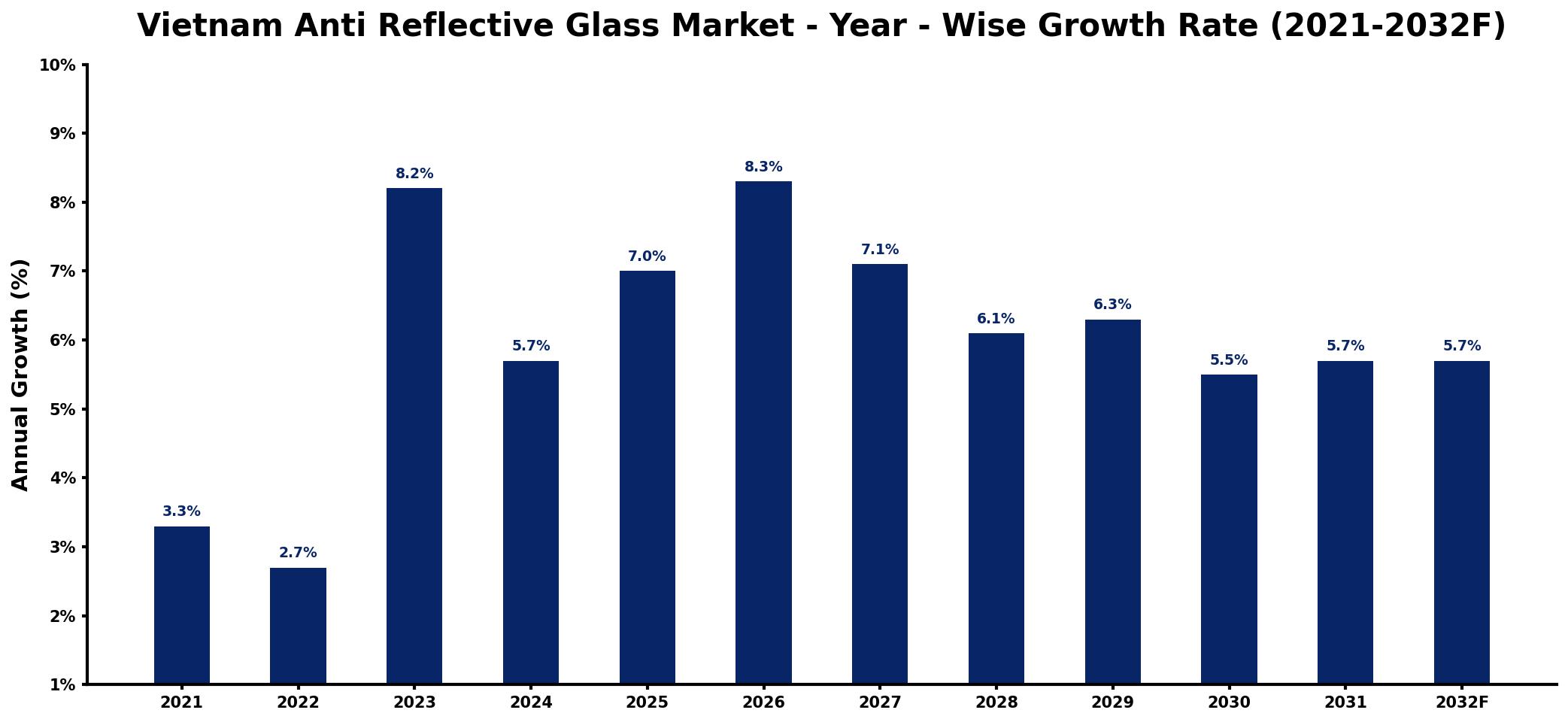
The table below presents the year‑wise growth rates along with the key drivers influencing the market
| Year | Growth Rate | Major Drivers |
| 2021 | 3.3% | Increased demand from construction sector |
| 2022 | 2.7% | Rising investments in energy efficiency |
| 2023 | 8.2% | Growth in automotive industry applications |
| 2024 | 5.7% | Expansion of electronics manufacturing sector |
| 2025 | 7.0% | Surge in architectural design trends |
| 2026 | 8.3% | Increased focus on sustainability initiatives |
| 2027 | 7.1% | Growing popularity of smart technologies |
| 2028 | 6.1% | Rising consumer awareness on quality |
| 2029 | 6.3% | increased production capacity utilization |
| 2030 | 5.5% | Increase in export opportunities abroad |
| 2031 | 5.7% | Growing interest in luxury markets |
| 2032 | 5.7% | growing regional consumption patterns |
Note: Market size estimations and growth projections presented in this report are based on 6Wresearch's proprietary forecasting methodology, utilizing the latest available industry data, government publications, and primary research inputs.
Vietnam Anti Reflective Glass Market Synopsis
The Vietnam anti-reflective glass market has witnessed substantial advancements, driven by an increasing focus on enhancing user experience and product functionality. Notably, the shift towards renewable energy and the growing automotive sector are critical in amplifying the demand for these specialized glass products.
As Vietnam's urban landscape evolves, anti-reflective glass has become essential in modern architecture, improving aesthetics while contributing to energy efficiency. Furthermore, industries are increasingly recognizing the value of anti-reflective coatings in optimizing performance across electronic devices and display technologies.
Vietnam Anti Reflective Glass Market Key Takeaways
- Rapid growth driven by technological advancements in the electronics and solar industries.
- Heightened awareness of sustainability and energy efficiency among builders and consumers.
- Significant applications in automotive windshields and display technologies enhance user safety.
- Market resilience observed during the COVID-19 recovery period, emphasizing adaptability.
- Ongoing investments into research and development to overcome durability challenges.
Evaluation of Restraints in Vietnam Anti Reflective Glass Market
Despite its promising growth, the Vietnam anti-reflective glass market faces several critical restraints. One significant challenge is achieving optimal optical properties while ensuring durability, as maintaining high-quality standards can be technically demanding. Furthermore, the cost of production may hinder widespread adoption, particularly in price-sensitive segments. These barriers necessitate innovative solutions and strategies to enhance market penetration.
Vietnam Anti Reflective Glass Market Trends
A noteworthy trend in the Vietnam anti-reflective glass market is the increasing integration of smart technologies. The convergence of smart glass with anti-reflective coatings is becoming a focal point, especially in the architectural and automotive sectors. Additionally, the trend toward green building practices is driving the demand for energy-efficient materials, with anti-reflective glass at the forefront. This trend aligns with Vietnams commitment to sustainable urban development.
Vietnam Anti Reflective Glass Market Opportunities
The anti-reflective glass market in Vietnam offers numerous growth and investment opportunities. With the ongoing expansion of the automotive sector, the demand for advanced coatings in vehicle displays and windshields presents a lucrative avenue for manufacturers. Furthermore, the rising interest in solar energy projects provides a fertile ground for anti-reflective glass applications in improving solar panel efficiency, a key area ripe for innovation and investment.
Government Initiatives in the Vietnam Anti Reflective Glass Market
The Vietnamese government has shown a keen interest in promoting sustainable building practices and advanced material technologies. Various public spending initiatives and policy frameworks are being introduced to encourage investments in green construction projects, which often incorporate anti-reflective glass. These initiatives aim to bolster energy efficiency and contribute to urban sustainability efforts, positioning anti-reflective glass as a vital component of future development plans.
Future Insights of the Vietnam Anti Reflective Glass Market
Looking ahead to the period from 2026 to 2032, the Vietnam anti-reflective glass market is set to evolve significantly. As industries increasingly prioritize advanced glass technologies and sustainable practices, the demand for anti-reflective coatings will likely surge. The market is expected to benefit from continued innovation in production processes and applications, positioning Vietnam as a key player in the regional anti-reflective glass landscape.
Vietnam Anti Reflective Glass Market Latest Developments (2025 - 2026)
In recent months, the Vietnam anti-reflective glass market has seen a shift towards innovative coatings that enhance durability and optical performance. As the economy continues its recovery from the pandemic, manufacturers are focusing on partnerships and collaborations to develop next-generation anti-reflective technologies. Additionally, there is a noticeable uptick in projects integrating anti-reflective glass into green building initiatives, aligning with broader national sustainability goals.
Vietnam Anti Reflective Glass Market - Key Attractiveness of the Report
- 10 Years of Market Numbers
- Historical Data Starting from 2022 to 2025
- Base Year: 2025
- Forecast Data until 2032
- Key Performance Indicators Impacting the Market
- Major Upcoming Developments and Projects
Key Highlights of the Report:
- Vietnam Anti Reflective Glass Market Outlook
- Market Size of Vietnam Anti Reflective Glass Market, 2025
- Forecast of Vietnam Anti Reflective Glass Market, 2032
- Historical Data and Forecast of Vietnam Anti Reflective Glass Revenues & Volume for the Period 2022-2032F
- Vietnam Anti Reflective Glass Market Trend Evolution
- Vietnam Anti Reflective Glass Market Drivers and Challenges
- Vietnam Anti Reflective Glass Price Trends
- Vietnam Anti Reflective Glass Porter's Five Forces
- Vietnam Anti Reflective Glass Industry Life Cycle
- Historical Data and Forecast of Vietnam Anti Reflective Glass Market Revenues & Volume By Type for the Period 2022-2032F
- Historical Data and Forecast of Vietnam Anti Reflective Glass Market Revenues & Volume By Double Layers for the Period 2022-2032F
- Historical Data and Forecast of Vietnam Anti Reflective Glass Market Revenues & Volume By Four Layers for the Period 2022-2032F
- Historical Data and Forecast of Vietnam Anti Reflective Glass Market Revenues & Volume By Others for the Period 2022-2032F
- Historical Data and Forecast of Vietnam Anti Reflective Glass Market Revenues & Volume By Application for the Period 2022-2032F
- Historical Data and Forecast of Vietnam Anti Reflective Glass Market Revenues & Volume By Architectural Windows for the Period 2022-2032F
- Historical Data and Forecast of Vietnam Anti Reflective Glass Market Revenues & Volume By Instrumentation Windows for the Period 2022-2032F
- Historical Data and Forecast of Vietnam Anti Reflective Glass Market Revenues & Volume By Electronic Displays for the Period 2022-2032F
- Historical Data and Forecast of Vietnam Anti Reflective Glass Market Revenues & Volume By Picture Framing Glass for the Period 2022-2032F
- Historical Data and Forecast of Vietnam Anti Reflective Glass Market Revenues & Volume By Showcase Glass for the Period 2022-2032F
- Historical Data and Forecast of Vietnam Anti Reflective Glass Market Revenues & Volume By Cold Storage Displays for the Period 2022-2032F
- Historical Data and Forecast of Vietnam Anti Reflective Glass Market Revenues & Volume By Lamps Glass for the Period 2022-2032F
- Historical Data and Forecast of Vietnam Anti Reflective Glass Market Revenues & Volume By Others for the Period 2022-2032F
- Vietnam Anti Reflective Glass Import Export Trade Statistics
- Market Opportunity Assessment By Type
- Market Opportunity Assessment By Application
- Vietnam Anti Reflective Glass Top Companies Market Share
- Vietnam Anti Reflective Glass Competitive Benchmarking By Technical and Operational Parameters
- Vietnam Anti Reflective Glass Company Profiles
- Vietnam Anti Reflective Glass Key Strategic Recommendations






































