Kazakhstan Alcohol Testing Market Summary
The kazakhstan alcohol testing market was estimated at USD 795 Million in 2025 and is projected to reach USD 1161 Million by 2032, growing at a CAGR of 6.7% from 2026 to 2032.
Kazakhstan Alcohol Testing Market Year-wise Growth Rate and Key Drivers
This graph highlights how the Kazakhstan Alcohol Testing Market has steadily grown over the past five years, supported by major growth factors.
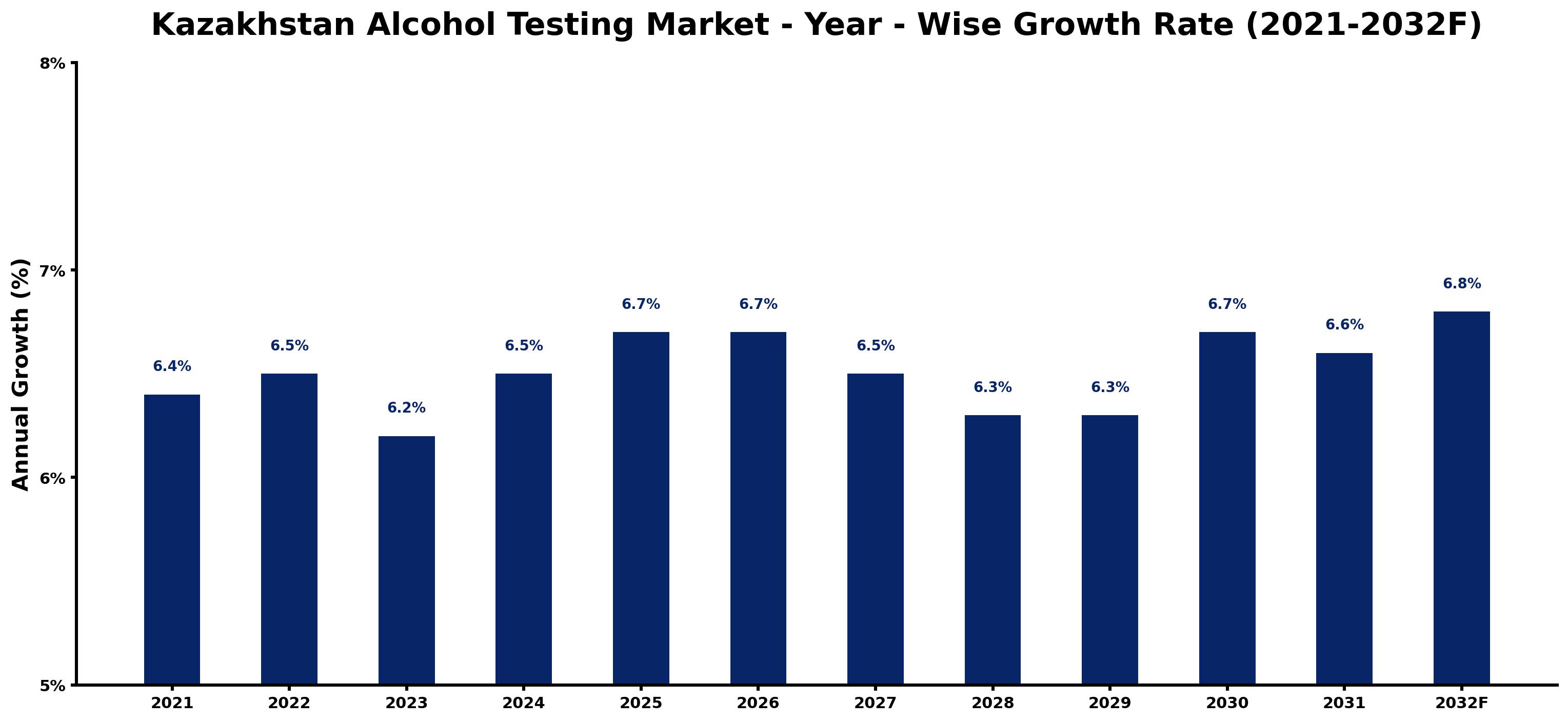
The table below presents the year wise growth rates along with the key drivers influencing the market
| Year | Growth Rate | Major Drivers |
| 2021 | 6.4% | Post-pandemic health awareness led to increased interest in alcohol testing technologies. |
| 2022 | 6.5% | Local authorities began emphasizing workplace safety standards and stricter testing measures. |
| 2023 | 6.2% | Urbanization trends in Kazakhstan created a demand for improved public safety solutions. |
| 2024 | 6.5% | Corporate responsibility initiatives gained traction, emphasizing employee wellness programs. |
| 2025 | 6.7% | Technological partnerships emerged to enhance mobile alcohol testing device capabilities. |
| 2026 | 6.7% | Increased visibility of alcohol-related accidents prompted public campaigns for testing compliance. |
| 2027 | 6.5% | Changing consumer attitudes toward responsible drinking influenced testing market dynamics. |
| 2028 | 6.3% | Expanding transportation networks necessitated stronger regulations surrounding driver alcohol testing. |
| 2029 | 6.3% | Investment in healthcare infrastructure prioritized accurate alcohol testing in hospitals and clinics. |
| 2030 | 6.7% | Cultural shifts towards preventive health measures expanded market opportunities for testing products. |
| 2031 | 6.6% | The rise of e-commerce facilitated broader distribution channels for alcohol testing devices. |
| 2032 | 6.8% | International collaborations strengthened local expertise in alcohol testing technology and processes. |
Note - Market size estimations and growth projections presented in this report are based on 6Wresearch's advanced forecasting approach, validated with industry datasets as of June 2026.
Kazakhstan Alcohol Testing Market Synopsis
The Kazakhstan Alcohol Testing Market is projected to reach 6.7% and witness significant growth during the forecast period (2026-2032). This growth is primarily fueled by an increasing awareness of health risks associated with excessive alcohol consumption, rising disposable income, and the government's commitment to reducing incidents of drunk driving.
Kazakhstan Alcohol Testing Market Growth Drivers
The Kazakhstan Alcohol Testing Market is benefitting from multiple growth factors. First, the rising awareness about health risks associated with excessive drinking has led to an increase in the demand for reliable alcohol testing methods. Second, as disposable incomes rise, individuals are more willing to invest in personal health and safety, including alcohol testing products. Third, improvements in healthcare infrastructure and services are facilitating better access to testing tools. Furthermore, government initiatives aimed at reducing drunk driving incidents are contributing to market expansion. Lastly, technological advancements in testing methods are driving innovation and attracting interest in new testing products.
Kazakhstan Alcohol Testing Market Trends and Opportunities
The Kazakhstan Alcohol Testing Market is witnessing several trends that indicate growth opportunities. Among these trends, there is an increasing preference for non-invasive testing methods, such as breathalyzers, which account for 45% of the testing market. In addition, urine test kits (26%) and saliva swabs (19%) are gaining popularity due to their practicality and ease of use. Moreover, emerging testing technologies like hair strand analysis and sweat patch testing are attracting attention for their accuracy and reliability. The market also presents opportunities for educational campaigns aimed at raising awareness about responsible drinking and the importance of regular testing.
Kazakhstan Alcohol Testing Market Challenges and Restraints
Despite the promising growth in the Kazakhstan Alcohol Testing Market, several challenges may hinder its progress. First, there is a lack of widespread public knowledge regarding the availability and benefits of different alcohol testing methods, which limits market penetration. Second, affordability of testing products poses a barrier for lower-income segments, potentially slowing adoption rates. Third, regulatory hurdles may affect the introduction of new testing technologies. Additionally, cultural attitudes towards alcohol consumption and testing can influence consumer behavior negatively. Finally, competition from alternative wellness products may divert consumer attention away from alcohol testing.
Kazakhstan Alcohol Testing Market Government Investment and Initiatives
The government of Kazakhstan has been actively engaged in promoting public safety through various initiatives aimed at reducing drunk driving incidents. Investments in healthcare infrastructure are being prioritized, facilitating better access to alcohol testing tools. Furthermore, the government has developed comprehensive policies that support the adoption of effective alcohol testing measures, promoting regular screenings and public awareness campaigns. These efforts include partnerships with healthcare providers and educational institutions to raise awareness about the dangers of excessive drinking. Such government interventions are designed to create a conducive environment for the growth of the alcohol testing market.
Kazakhstan Alcohol Testing Market Latest Developments (May 2025 - June 2026)
In the period between May 2025 and June 2026, the Kazakhstan Alcohol Testing Market has shown dynamic shifts in industry direction. The government has announced new initiatives aimed at enhancing the accessibility of alcohol testing tools, with a particular focus on urban areas where drunk driving incidents are more prevalent. Furthermore, the introduction of new testing technologies has sparked interest among both healthcare providers and consumers. Collaborative efforts between public health organizations and private companies have also gained momentum, aiming to create educational programs about the importance of responsible drinking. Recent industry trends have highlighted the effectiveness of breathalyzers and urine tests, leading to increased adoption rates among various sectors.
Kazakhstan Alcohol Testing Market - Key Attractiveness of the Report
- 10 Years of Market Numbers
- Historical Data Starting from 2022 to 2025
- Base Year: 2025
- Forecast Data until 2032
- Key Performance Indicators Impacting the Market
- Major Upcoming Developments and Projects
Key Highlights of the Report:
- Kazakhstan Alcohol Testing Market Outlook
- Market Size of Kazakhstan Alcohol Testing Market, 2025
- Forecast of Kazakhstan Alcohol Testing Market, 2032
- Historical Data and Forecast of Kazakhstan Alcohol Testing Revenues & Volume for the Period 2022-2032
- Kazakhstan Alcohol Testing Market Trend Evolution
- Kazakhstan Alcohol Testing Market Drivers and Challenges
- Kazakhstan Alcohol Testing Price Trends
- Kazakhstan Alcohol Testing Porter's Five Forces
- Kazakhstan Alcohol Testing Industry Life Cycle
- Historical Data and Forecast of Kazakhstan Alcohol Testing Market Revenues & Volume By Testing Equipment Types for the Period 2022-2032
- Historical Data and Forecast of Kazakhstan Alcohol Testing Market Revenues & Volume By Infrared Based Breathalyzer for the Period 2022-2032
- Historical Data and Forecast of Kazakhstan Alcohol Testing Market Revenues & Volume By Semi-conductor Based Breathalyzer for the Period 2022-2032
- Historical Data and Forecast of Kazakhstan Alcohol Testing Market Revenues & Volume By Immunoassay Analyzers for the Period 2022-2032
- Historical Data and Forecast of Kazakhstan Alcohol Testing Market Revenues & Volume By Fuel Cell Based Breathalyzer for the Period 2022-2032
- Historical Data and Forecast of Kazakhstan Alcohol Testing Market Revenues & Volume By Oral Fluid Testing Devices for the Period 2022-2032
- Historical Data and Forecast of Kazakhstan Alcohol Testing Market Revenues & Volume By Hair Testing Devices for the Period 2022-2032
- Historical Data and Forecast of Kazakhstan Alcohol Testing Market Revenues & Volume By Urine Testing Devices for the Period 2022-2032
- Historical Data and Forecast of Kazakhstan Infrared Based Breathalyzer Alcohol Testing Market Revenues & Volume By Others for the Period 2022-2032
- Historical Data and Forecast of Kazakhstan Alcohol Testing Market Revenues & Volume By Applications for the Period 2022-2032
- Historical Data and Forecast of Kazakhstan Alcohol Testing Market Revenues & Volume By Alcohol Detection for the Period 2022-2032
- Historical Data and Forecast of Kazakhstan Alcohol Testing Market Revenues & Volume By Drug Detection for the Period 2022-2032
- Kazakhstan Alcohol Testing Import Export Trade Statistics
- Market Opportunity Assessment By Testing Equipment Types
- Market Opportunity Assessment By Applications
- Kazakhstan Alcohol Testing Top Companies Market Share
- Kazakhstan Alcohol Testing Competitive Benchmarking By Technical and Operational Parameters
- Kazakhstan Alcohol Testing Company Profiles
- Kazakhstan Alcohol Testing Key Strategic Recommendations






































