Kazakhstan Canvas Market Size, Share & Growth Rate
The Kazakhstan Canvas Market was estimated at USD 181 Million in 2025 and is projected to reach USD 245 Million by 2032, growing at a CAGR of 4.4% from 2026 to 2032. This promising trajectory is driven by the burgeoning demand across multiple sectors, notably in art, fashion, and industrial applications. The rise in construction activities, alongside the increasing preference for eco-friendly materials, further fuels market expansion, signifying a vibrant landscape for canvas manufacturers and stakeholders.
Kazakhstan Canvas Market Year-wise Growth Rate and Key Drivers
This graph highlights how the Kazakhstan Canvas Market has steadily grown over the years, supported by major growth factors.
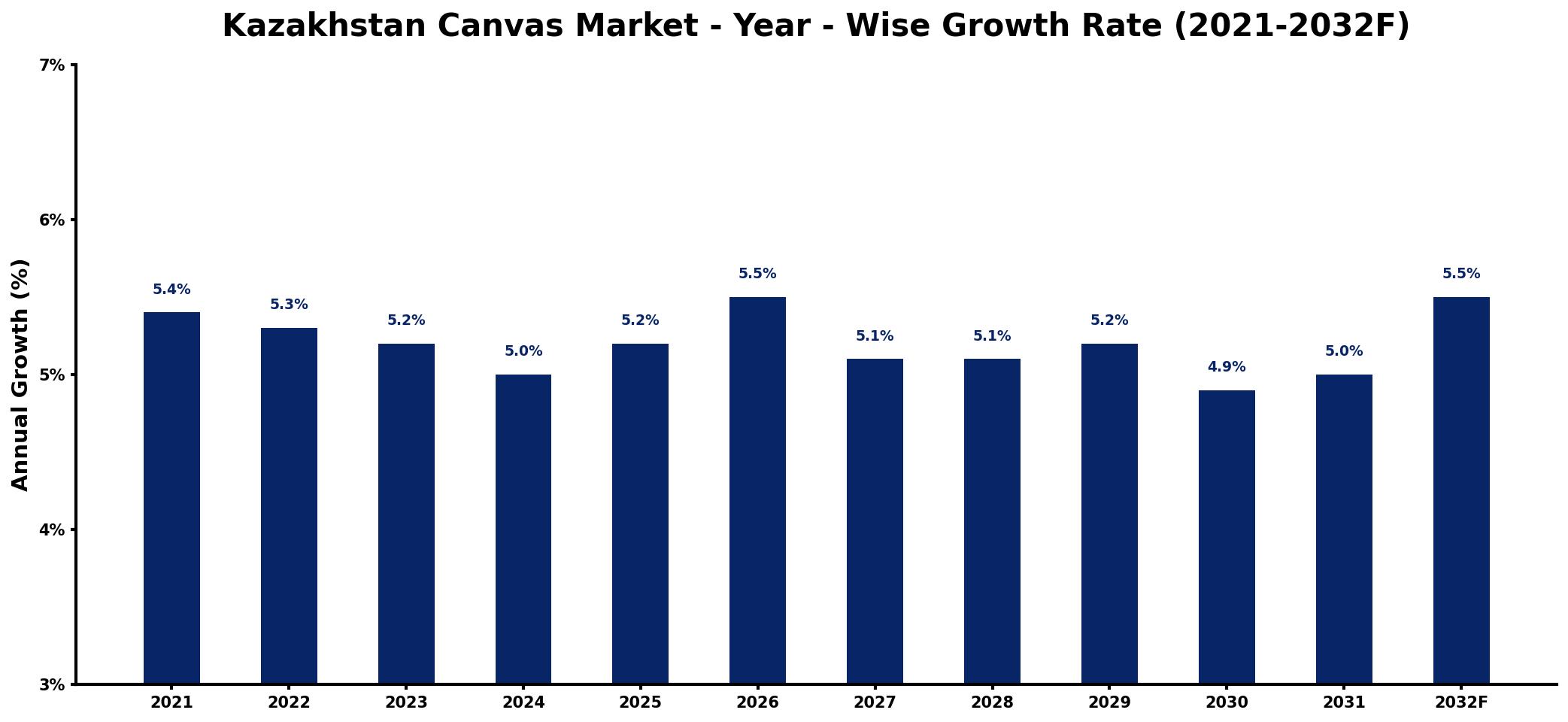
The table below presents the year‑wise growth rates along with the key drivers influencing the market
| Year | Growth Rate | Major Drivers |
| 2021 | 5.4% | Rising demand for artistic supplies |
| 2022 | 5.3% | Increased investment in creative industries |
| 2023 | 5.2% | Growing popularity of DIY projects |
| 2024 | 5.0% | Expansion of online art communities |
| 2025 | 5.2% | Surge in educational art programs |
| 2026 | 5.5% | Boost in home decor trends |
| 2027 | 5.1% | Growth in sustainable art materials |
| 2028 | 5.1% | Increased collaborations with local artists |
| 2029 | 5.2% | growing emerging market penetration |
| 2030 | 4.9% | Emergence of new art technologies |
| 2031 | 5.0% | stronger distribution network expansion |
| 2032 | 5.5% | Rise in art festival events |
Note: Market size estimations and growth projections presented in this report are based on 6Wresearch's proprietary forecasting methodology, utilizing the latest available industry data, government publications, and primary research inputs.
Kazakhstan Canvas Market Synopsis
A notable feature of the Kazakhstan Canvas Market is the growing inclination towards sustainable practices, leading to heightened demand for eco-friendly canvas materials. This demand is particularly pronounced in the fashion and upholstery sectors, where consumers increasingly prioritize environmentally responsible products.
Moreover, the art and craft industry is witnessing significant growth, with local artists and artisans embracing canvas for a variety of creative endeavors. This trend not only bolsters the canvas market but also promotes local culture and craftsmanship, creating a unique synergy between art and industry.
Kazakhstan Canvas Market Key Takeaways
- The market is projected to grow from USD 181 Million in 2025 to USD 245 Million by 2032.
- Increasing infrastructure development and demand from the textile sector are key growth drivers.
- There is a notable shift towards eco-friendly materials, catering to environmentally-conscious consumers.
- Local government policies actively support the canvas industry through subsidies and technology investments.
- Challenges include competition from synthetic materials and fluctuations in raw material prices.
Evaluation of Restraints in Kazakhstan Canvas Market
The Kazakhstan Canvas Market faces certain restraints that can impact its growth trajectory. Competition from synthetic alternatives poses a significant challenge, as these materials often offer lower costs and enhanced durability. Additionally, fluctuations in the prices of raw materials, such as cotton and linen, can strain profit margins for canvas manufacturers. This volatility can lead to uncertainty in pricing strategies and affect the overall supply chain. Furthermore, ensuring the durability and environmental resistance of canvas products remains a crucial hurdle for producers seeking to maintain quality standards.
Kazakhstan Canvas Market Trends
Current trends in the Kazakhstan Canvas Market reveal an increasing integration of technology in production processes. Manufacturers are exploring innovative techniques to enhance the durability and functionality of canvas products, meeting the rising consumer expectations. Additionally, the fusion of art with technology is creating unique opportunities, allowing for personalized canvas items that cater to a more niche market.
The growing popularity of DIY projects also reflects a shift in consumer behavior, prompting higher demand for raw canvas materials. This trend signifies a potential avenue for manufacturers to diversify their offerings and attract a broader consumer base, ultimately contributing to the market's growth.
Kazakhstan Canvas Market Opportunities
The evolving preferences of consumers toward sustainable and locally-sourced materials present significant growth opportunities for the Kazakhstan Canvas Market. As demand for eco-friendly products rises, manufacturers can innovate their offerings to include organic or recycled materials, appealing to environmentally-conscious consumers. Furthermore, potential collaborations with local artists and designers can facilitate unique product lines, creating a distinct market niche.
Additionally, the expansion of e-commerce platforms provides a robust opportunity for canvas products to reach a wider audience. By tapping into online sales channels, manufacturers can enhance their visibility and accessibility, driving growth in both domestic and international markets.
Government Initiatives in the Kazakhstan Canvas Market
Government initiatives are playing a pivotal role in the development of the Kazakhstan Canvas Market. Policies aimed at supporting the textile industry include subsidies for local manufacturers, as well as investments focused on technological upgrades. Import tariffs are periodically adjusted to protect local production while fostering competition. Moreover, the government promotes the use of local raw materials, which not only supports domestic agriculture but also ensures a sustainable supply chain for the canvas sector.
Future Insights of the Kazakhstan Canvas Market
Looking ahead to 2026-2032, the Kazakhstan Canvas Market is poised for steady growth, driven by continued infrastructure developments and a burgeoning interest in sustainable materials. As consumer preferences shift toward eco-conscious products, manufacturers who adapt to these trends will likely see considerable market gains. Additionally, the ongoing support from government initiatives will further strengthen local production capabilities, enabling manufacturers to innovate and cater to evolving consumer demands.
Kazakhstan Canvas Market Latest Developments (2025 - 2026)
Recent developments within the Kazakhstan Canvas Market indicate a strengthening of collaborative efforts between manufacturers and local artisans. Initiatives aimed at promoting local craftsmanship are gaining momentum, contributing to a unique blend of artistic expression and commercial viability. Furthermore, advancements in production technology are enhancing the quality and appeal of canvas products, ensuring they remain competitive against synthetic alternatives.
Kazakhstan Canvas Market - Key Attractiveness of the Report
- 10 Years of Market Numbers
- Historical Data Starting from 2022 to 2025
- Base Year: 2025
- Forecast Data until 2032
- Key Performance Indicators Impacting the Market
- Major Upcoming Developments and Projects
Key Highlights of the Report:
- Kazakhstan Canvas Market Outlook
- Market Size of Kazakhstan Canvas Market, 2025
- Forecast of Kazakhstan Canvas Market, 2032
- Historical Data and Forecast of Kazakhstan Canvas Revenues & Volume for the Period 2022-2032F
- Kazakhstan Canvas Market Trend Evolution
- Kazakhstan Canvas Market Drivers and Challenges
- Kazakhstan Canvas Price Trends
- Kazakhstan Canvas Porter's Five Forces
- Kazakhstan Canvas Industry Life Cycle
- Historical Data and Forecast of Kazakhstan Canvas Market Revenues & Volume By Types for the Period 2022-2032F
- Historical Data and Forecast of Kazakhstan Canvas Market Revenues & Volume By Plane Canvas for the Period 2022-2032F
- Historical Data and Forecast of Kazakhstan Canvas Market Revenues & Volume By Duck Canvas for the Period 2022-2032F
- Historical Data and Forecast of Kazakhstan Canvas Market Revenues & Volume By Application for the Period 2022-2032F
- Historical Data and Forecast of Kazakhstan Canvas Market Revenues & Volume By Tent for the Period 2022-2032F
- Historical Data and Forecast of Kazakhstan Canvas Market Revenues & Volume By Luggage Fabric for the Period 2022-2032F
- Historical Data and Forecast of Kazakhstan Canvas Market Revenues & Volume By Automotive Fabric for the Period 2022-2032F
- Historical Data and Forecast of Kazakhstan Canvas Market Revenues & Volume By Apparel for the Period 2022-2032F
- Historical Data and Forecast of Kazakhstan Canvas Market Revenues & Volume By Others for the Period 2022-2032F
- Kazakhstan Canvas Import Export Trade Statistics
- Market Opportunity Assessment By Types
- Market Opportunity Assessment By Application
- Kazakhstan Canvas Top Companies Market Share
- Kazakhstan Canvas Competitive Benchmarking By Technical and Operational Parameters
- Kazakhstan Canvas Company Profiles
- Kazakhstan Canvas Key Strategic Recommendations






































