Kazakhstan Cigarette Market Size, Share & Growth Rate
The Kazakhstan Cigarette Market was estimated at USD 409 Million in 2025 and is projected to reach USD 537 Million by 2032, growing at a CAGR of 4.0% from 2026 to 2032. This growth trajectory is largely driven by the continued prevalence of smoking in the country, compounded by relatively low cigarette prices that appeal to price-sensitive consumers. Additionally, innovative product offerings and a gradual shift towards low-cost brands are helping to sustain market demand amid tightening regulations.
Kazakhstan Cigarette Market Year-wise Growth Rate and Key Drivers
This graph highlights how the Kazakhstan Cigarette Market has steadily grown over the years, supported by major growth factors.
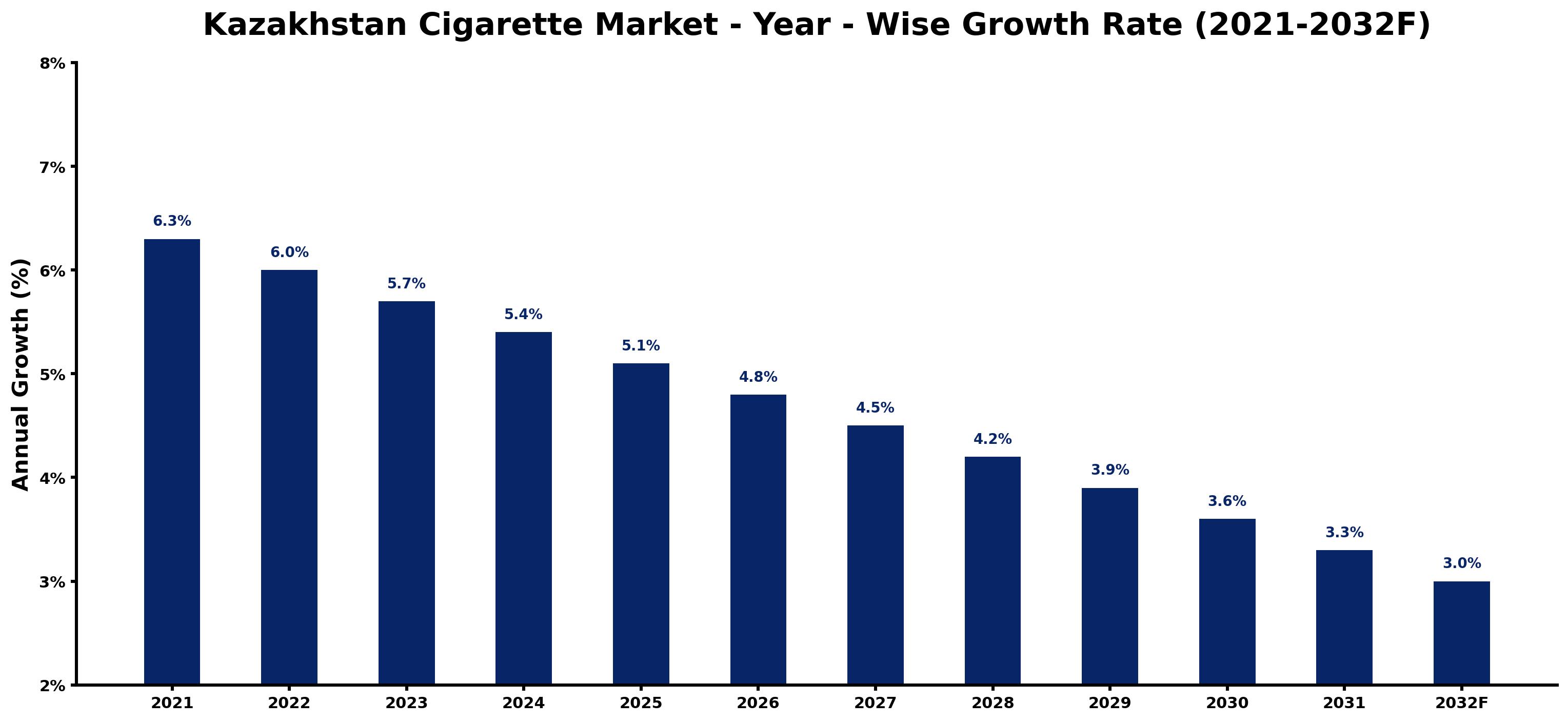
The table below presents the year‑wise growth rates along with the key drivers influencing the market
| Year | Growth Rate | Major Drivers |
| 2021 | 6.3% | Growing urbanization and commercial development |
| 2022 | 6.0% | Increasing industrial automation investments |
| 2023 | 5.7% | Increasing smart city development projects |
| 2024 | 5.4% | Growing urbanization and commercial development |
| 2025 | 5.1% | Increasing industrial infrastructure investments |
| 2026 | 4.8% | Declining investments in legacy infrastructure |
| 2027 | 4.5% | Growing adoption of energy efficient systems |
| 2028 | 4.2% | Declining investments in legacy infrastructure |
| 2029 | 3.9% | Growing adoption of energy efficient systems |
| 2030 | 3.6% | Growing adoption of energy efficient systems |
| 2031 | 3.3% | Increasing shift toward cleaner alternatives |
| 2032 | 3.0% | Increasing shift toward cleaner alternatives |
Note - Market size estimations and growth projections presented in this report are based on 6Wresearch’s advanced forecasting approach, validated with industry datasets as of June 2026.
Kazakhstan Cigarette Market Synopsis
Recently, the Kazakhstan cigarette market has shown robust activity, characterized by a strong presence of international tobacco companies and a loyal smoking demographic. However, as the government intensifies regulations aimed at promoting public health, the market is expected to transition towards a future with declining smoking prevalence.
While the current landscape favors traditional cigarette sales, emerging trends indicate a growing consumer interest in flavored and alternative tobacco products. This evolving consumer behavior could reshape market dynamics and push companies to innovate in response to health awareness and regulatory pressures.
Kazakhstan Cigarette Market Key Takeaways
- The market is currently valued at USD 409 Million and is anticipated to grow to USD 537 Million by 2032.
- International players dominate the market, leveraging brand recognition and distribution networks.
- Price sensitivity drives demand for low-cost cigarettes amid economic challenges.
- Health consciousness is rising, leading consumers to explore alternative tobacco products.
- Government initiatives are increasingly focused on reducing smoking rates through rigorous regulations.
Evaluation of Restraints in Kazakhstan Cigarette Market
The Kazakhstan cigarette market faces significant restraints primarily from the increasing regulatory landscape. With stringent advertising restrictions and health warnings now mandated on packaging, companies are challenged in their marketing strategies. Additionally, the heightened awareness of the health risks associated with smoking has influenced public perception, contributing to a gradual decline in overall smoking rates. Economic fluctuations can also affect consumer spending behavior, further complicating the business landscape for cigarette manufacturers.
Kazakhstan Cigarette Market Trends
Current trends in the Kazakhstan cigarette market highlight a rising demand for low-cost and value-oriented cigarette brands, especially among price-sensitive consumers. Flavored and menthol cigarettes are gaining popularity, particularly among younger smokers who seek a more diverse smoking experience. Additionally, the market is witnessing a growing shift towards e-cigarettes and heated tobacco products, as consumers increasingly prioritize health-conscious alternatives. Overall, these trends illustrate a complex interplay of affordability and evolving preferences within the market.
Kazakhstan Cigarette Market Opportunities
Investment opportunities in the Kazakhstan cigarette market remain abundant, especially in the context of a still sizeable smoking population. With lower cigarette consumption taxes compared to many Western nations, there is potential for profitability. Furthermore, the rising disposable income levels and social smoking trends among young adults create a fertile ground for innovative products and marketing strategies. Companies that can effectively adapt to consumer preferences while navigating the regulatory landscape may find significant growth opportunities.
Government Initiatives in the Kazakhstan Cigarette Market
Government policies related to the Kazakhstan cigarette market have become increasingly stringent. Authorities have implemented graphic health warnings on packaging and prohibited smoking in public spaces to curb consumption. The legal smoking age has been raised to 21, while high excise taxes on tobacco products are intended to discourage smoking and finance public health initiatives. These efforts reflect a commitment to improving public health while managing the challenges posed by a persistent smoking culture.
Future Insights of the Kazakhstan Cigarette Market
Looking ahead to 2026-2032, the Kazakhstan cigarette market is poised for a gradual transformation. With ongoing government regulations focused on reducing smoking rates, companies will need to pivot towards more health-conscious product offerings. While cultural habits and the affordability of cigarettes may provide short-term stability, a long-term decline in consumption is anticipated. Therefore, firms will need to innovate and potentially diversify into alternative tobacco products to maintain competitiveness in a shifting landscape.
Kazakhstan Cigarette Market Latest Developments (May 2025 - June 2026)
Recent developments in the Kazakhstan cigarette market indicate a focus on product innovation and adaptation to regulatory changes. Manufacturers are increasingly exploring low-cost and flavored cigarette options to appeal to diverse consumer segments. Additionally, there has been a noticeable increase in the marketing of e-cigarettes and heated tobacco products, reflecting a broader industry trend towards alternatives that align with health-conscious consumer preferences.
Kazakhstan Cigarette Market - Key Attractiveness of the Report
- 10 Years of Market Numbers
- Historical Data Starting from 2022 to 2025
- Base Year: 2025
- Forecast Data until 2032
- Key Performance Indicators Impacting the Market
- Major Upcoming Developments and Projects
Key Highlights of the Report:
- Kazakhstan Cigarette? Market Outlook
- Market Size of Kazakhstan Cigarette? Market, 2025
- Forecast of Kazakhstan Cigarette? Market, 2032
- Historical Data and Forecast of Kazakhstan Cigarette? Revenues & Volume for the Period 2022-2032F
- Kazakhstan Cigarette? Market Trend Evolution
- Kazakhstan Cigarette? Market Drivers and Challenges
- Kazakhstan Cigarette? Price Trends
- Kazakhstan Cigarette? Porter's Five Forces
- Kazakhstan Cigarette? Industry Life Cycle
- Historical Data and Forecast of Kazakhstan Cigarette? Market Revenues & Volume By Type for the Period 2022-2032F
- Historical Data and Forecast of Kazakhstan Cigarette? Market Revenues & Volume By Light for the Period 2022-2032F
- Historical Data and Forecast of Kazakhstan Cigarette? Market Revenues & Volume By Medium for the Period 2022-2032F
- Historical Data and Forecast of Kazakhstan Cigarette? Market Revenues & Volume By Others for the Period 2022-2032F
- Historical Data and Forecast of Kazakhstan Cigarette? Market Revenues & Volume By Distribution Channel for the Period 2022-2032F
- Historical Data and Forecast of Kazakhstan Cigarette? Market Revenues & Volume By Tobacco Shops for the Period 2022-2032F
- Historical Data and Forecast of Kazakhstan Cigarette? Market Revenues & Volume By Supermarket and Hypermarkets for the Period 2022-2032F
- Historical Data and Forecast of Kazakhstan Cigarette? Market Revenues & Volume By Convenience Stores for the Period 2022-2032F
- Historical Data and Forecast of Kazakhstan Cigarette? Market Revenues & Volume By Online Stores for the Period 2022-2032F
- Historical Data and Forecast of Kazakhstan Cigarette? Market Revenues & Volume By Others for the Period 2022-2032F
- Kazakhstan Cigarette? Import Export Trade Statistics
- Market Opportunity Assessment By Type
- Market Opportunity Assessment By Distribution Channel
- Kazakhstan Cigarette? Top Companies Market Share
- Kazakhstan Cigarette? Competitive Benchmarking By Technical and Operational Parameters
- Kazakhstan Cigarette? Company Profiles
- Kazakhstan Cigarette? Key Strategic Recommendations






































