Kazakhstan Nuclear Imaging Market Size, Share & Growth Rate
The Kazakhstan Nuclear Imaging Market was estimated at USD 314 Million in 2025 and is projected to reach USD 430 Million by 2032, growing at a CAGR of 4.6% from 2026 to 2032. This growth trajectory is primarily fueled by the rising prevalence of chronic diseases, particularly cancer and cardiovascular conditions, which demand advanced diagnostic solutions. Furthermore, the expansion of healthcare infrastructure and increased investments in nuclear imaging technology are key factors enhancing market dynamics.
Kazakhstan Nuclear Imaging Market Year-wise Growth Rate and Key Drivers
This graph highlights how the Kazakhstan Nuclear Imaging Market has steadily grown over the years, supported by major growth factors.
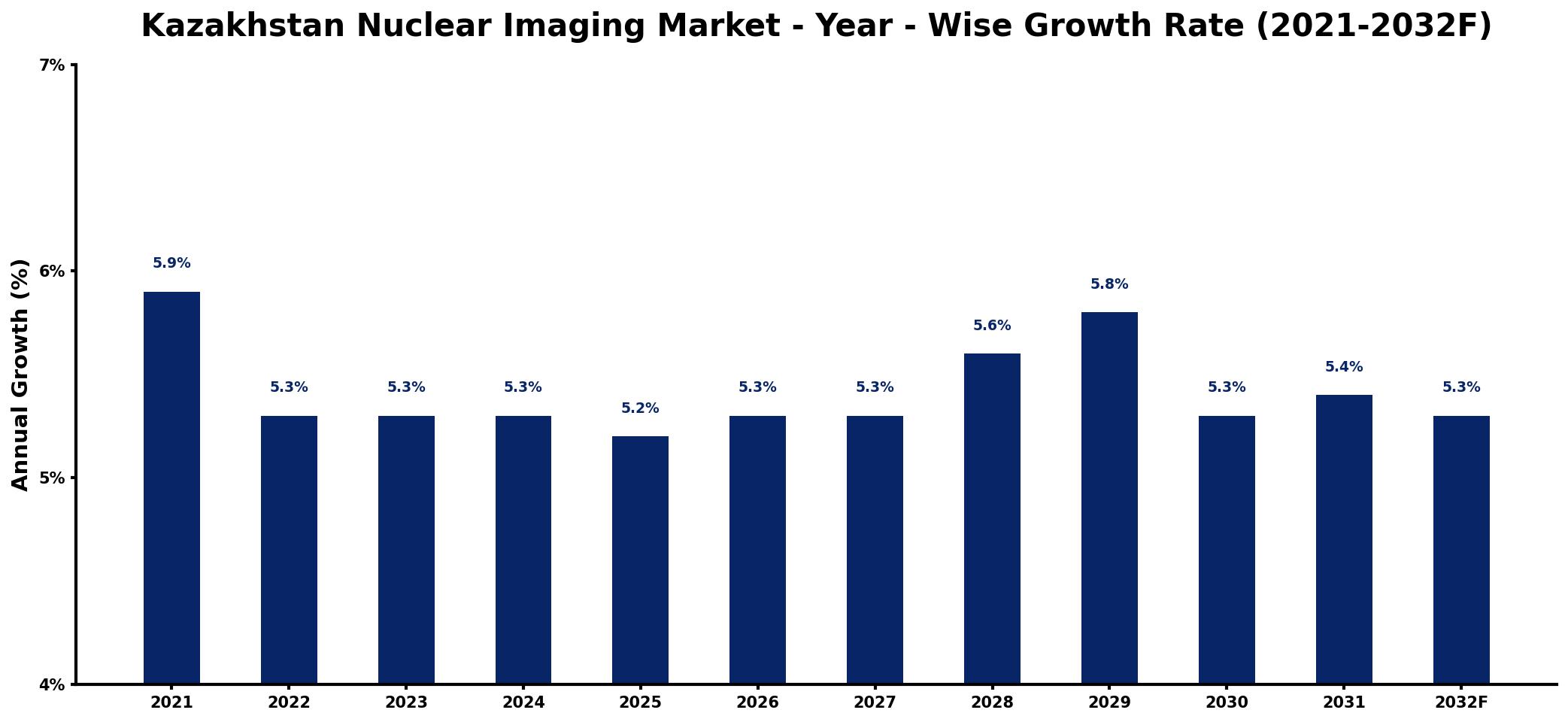
The table below presents the year‑wise growth rates along with the key drivers influencing the market
| Year | Growth Rate | Major Drivers |
| 2021 | 5.9% | Rising healthcare investment initiatives |
| 2022 | 5.3% | Increased diagnostic procedure adoption |
| 2023 | 5.3% | Advancements in medical technologies |
| 2024 | 5.3% | Growing aging population demands |
| 2025 | 5.2% | Expansion of healthcare facilities |
| 2026 | 5.3% | Enhanced patient awareness programs |
| 2027 | 5.3% | Government health policy reforms |
| 2028 | 5.6% | Emerging private healthcare investments |
| 2029 | 5.8% | Collaborations with research institutions |
| 2030 | 5.3% | Technological innovations in diagnostics |
| 2031 | 5.4% | Strengthened healthcare workforce training |
| 2032 | 5.3% | Increased focus on preventive care |
Note: Market size estimations and growth projections presented in this report are based on 6Wresearch's proprietary forecasting methodology, utilizing the latest available industry data, government publications, and primary research inputs.
Kazakhstan Nuclear Imaging Market Synopsis
Nuclear imaging techniques, such as PET and SPECT, are increasingly recognized in Kazakhstan for their capabilities in early disease detection and monitoring. The growing incidence of chronic diseases necessitates reliable diagnostic methods, driving the adoption of these technologies within healthcare facilities.
As the healthcare sector evolves, there is a marked shift towards establishing decentralized imaging services, resulting in the proliferation of imaging centers across the nation. This trend enhances accessibility and ensures that advanced diagnostic tools are available to a broader segment of the population.
Kazakhstan Nuclear Imaging Market Key Takeaways
- The market is experiencing a significant shift towards advanced imaging technologies like PET/CT and SPECT/CT for heightened diagnostic accuracy.
- Rising chronic disease prevalence is driving demand for nuclear imaging procedures, notably in oncology and cardiology.
- Investment in healthcare infrastructure and imaging technology is projected to accelerate market growth.
- Decentralized imaging services are emerging, improving access to nuclear imaging across various regions.
- Advancements in radiopharmaceuticals are fostering innovation in personalized imaging solutions.
Evaluation of Restraints in Kazakhstan Nuclear Imaging Market
Despite the promising growth of the Kazakhstan Nuclear Imaging Market, several constraints hinder its expansion. One critical limitation is the uneven access to advanced imaging technologies, particularly in remote areas, where sophisticated diagnostic tools are often lacking. Furthermore, a shortage of skilled professionals trained in nuclear imaging poses a challenge, as these specialists are essential for optimal operation and patient care. The high setup and maintenance costs of nuclear imaging facilities also present financial barriers for healthcare providers. These factors combined create disparities in service delivery and can impact the overall quality of patient care across the country.
Kazakhstan Nuclear Imaging Market Trends
The Kazakhstan Nuclear Imaging Market is experiencing several transformative trends. A significant trend is the increasing integration of advanced imaging technologies, notably SPECT/CT and PET/CT, which enhance the precision of diagnoses. Concurrently, the demand for nuclear imaging services continues to rise, driven by the growing incidence of chronic illnesses. The market is also seeing a shift towards the establishment of more decentralized imaging centers, thereby improving service accessibility. Furthermore, ongoing advancements in radiopharmaceuticals are paving the way for personalized imaging approaches, making diagnostic processes more accurate and tailored to individual patient needs.
Kazakhstan Nuclear Imaging Market Opportunities
The evolving landscape of the Kazakhstan Nuclear Imaging Market presents several lucrative investment opportunities. As the demand for advanced diagnostic tools increases, there is substantial potential for partnerships with local healthcare providers to offer nuclear imaging technologies. Research and development initiatives aimed at enhancing imaging technologies can also attract investment, particularly in light of the aging population and the rising prevalence of chronic diseases. Furthermore, government initiatives focused on healthcare infrastructure improvement are likely to catalyze growth in the market, creating favorable conditions for stakeholders to capitalize on emerging opportunities.
Government Initiatives in the Kazakhstan Nuclear Imaging Market
The government of Kazakhstan plays a vital role in shaping the nuclear imaging market through regulatory frameworks and funding initiatives. Policies are in place to ensure safety and effectiveness in the use of nuclear imaging technologies, adhering to international standards set by organizations such as the IAEA. Licensing and certification processes for healthcare facilities and professionals help maintain high-quality standards. Additionally, the government is actively supporting research and development within the sector, facilitating innovation and advancements that can propel the market forward.
Future Insights of the Kazakhstan Nuclear Imaging Market
Looking ahead to 2026-2032, the Kazakhstan Nuclear Imaging Market is positioned for robust growth. Continued investments in healthcare infrastructure and technological advancements are expected to enhance diagnostic capabilities across the nation. As nuclear imaging technologies become more accessible, the market is likely to witness increased utilization for various medical conditions, especially chronic diseases. While challenges such as high equipment costs and workforce shortages may persist, the overall outlook remains optimistic, characterized by significant opportunities for innovation and development in healthcare diagnostics.
Kazakhstan Nuclear Imaging Market Latest Developments (2025 - 2026)
Recent months have seen a surge in strategic partnerships aimed at expanding the availability of nuclear imaging technologies in Kazakhstan. Healthcare providers are increasingly collaborating with technology firms to enhance their diagnostic capabilities. Additionally, ongoing government support for healthcare initiatives is expected to lead to the establishment of new imaging centers, promoting broader access to advanced nuclear imaging services throughout the country.
Kazakhstan Nuclear Imaging Market - Key Attractiveness of the Report
- 10 Years of Market Numbers
- Historical Data Starting from 2022 to 2025
- Base Year: 2025
- Forecast Data until 2032
- Key Performance Indicators Impacting the Market
- Major Upcoming Developments and Projects
Key Highlights of the Report:
- Kazakhstan Nuclear Imaging Market Outlook
- Market Size of Kazakhstan Nuclear Imaging Market, 2025
- Forecast of Kazakhstan Nuclear Imaging Market, 2032
- Historical Data and Forecast of Kazakhstan Nuclear Imaging Revenues & Volume for the Period 2022-2032F
- Kazakhstan Nuclear Imaging Market Trend Evolution
- Kazakhstan Nuclear Imaging Market Drivers and Challenges
- Kazakhstan Nuclear Imaging Price Trends
- Kazakhstan Nuclear Imaging Porter's Five Forces
- Kazakhstan Nuclear Imaging Industry Life Cycle
- Historical Data and Forecast of Kazakhstan Nuclear Imaging Market Revenues & Volume By Product for the Period 2022-2032F
- Historical Data and Forecast of Kazakhstan Nuclear Imaging Market Revenues & Volume By Single Photon-Emission Computed Tomography (SPECT) for the Period 2022-2032F
- Historical Data and Forecast of Kazakhstan Nuclear Imaging Market Revenues & Volume By Hybrid Pet for the Period 2022-2032F
- Historical Data and Forecast of Kazakhstan Nuclear Imaging Market Revenues & Volume By Planar Scintigraphy for the Period 2022-2032F
- Historical Data and Forecast of Kazakhstan Nuclear Imaging Market Revenues & Volume By Application for the Period 2022-2032F
- Historical Data and Forecast of Kazakhstan Nuclear Imaging Market Revenues & Volume By Oncology for the Period 2022-2032F
- Historical Data and Forecast of Kazakhstan Nuclear Imaging Market Revenues & Volume By Cardiology for the Period 2022-2032F
- Historical Data and Forecast of Kazakhstan Nuclear Imaging Market Revenues & Volume By Neurology for the Period 2022-2032F
- Historical Data and Forecast of Kazakhstan Nuclear Imaging Market Revenues & Volume By Others for the Period 2022-2032F
- Historical Data and Forecast of Kazakhstan Nuclear Imaging Market Revenues & Volume By Portability for the Period 2022-2032F
- Historical Data and Forecast of Kazakhstan Nuclear Imaging Market Revenues & Volume By Pocket-Sized/Handheld Device for the Period 2022-2032F
- Historical Data and Forecast of Kazakhstan Nuclear Imaging Market Revenues & Volume By Fixed for the Period 2022-2032F
- Historical Data and Forecast of Kazakhstan Nuclear Imaging Market Revenues & Volume By End user for the Period 2022-2032F
- Historical Data and Forecast of Kazakhstan Nuclear Imaging Market Revenues & Volume By Hospitals for the Period 2022-2032F
- Historical Data and Forecast of Kazakhstan Nuclear Imaging Market Revenues & Volume By Imaging Centers for the Period 2022-2032F
- Historical Data and Forecast of Kazakhstan Nuclear Imaging Market Revenues & Volume By Academic and Research Centers for the Period 2022-2032F
- Historical Data and Forecast of Kazakhstan Nuclear Imaging Market Revenues & Volume By Others for the Period 2022-2032F
- Kazakhstan Nuclear Imaging Import Export Trade Statistics
- Market Opportunity Assessment By Product
- Market Opportunity Assessment By Application
- Market Opportunity Assessment By Portability
- Market Opportunity Assessment By End user
- Kazakhstan Nuclear Imaging Top Companies Market Share
- Kazakhstan Nuclear Imaging Competitive Benchmarking By Technical and Operational Parameters
- Kazakhstan Nuclear Imaging Company Profiles
- Kazakhstan Nuclear Imaging Key Strategic Recommendations






































