Kazakhstan Oil & Gas Pumps Market Size, Share & Growth Rate
The Kazakhstan Oil & Gas Pumps Market was estimated at USD 170 Million in 2025 and is projected to reach USD 236 Million by 2032, growing at a CAGR of 4.8% from 2026 to 2032. This growth is driven by Kazakhstan's extensive oil and gas reserves, coupled with the government's commitment to advancing exploration and production activities. Additionally, ongoing investments in infrastructure and an emphasis on technological innovation further bolster market expansion.
Kazakhstan Oil & Gas Pumps Market Year-wise Growth Rate and Key Drivers
This graph highlights how the Kazakhstan Oil & Gas Pumps Market has steadily grown over the years, supported by major growth factors.
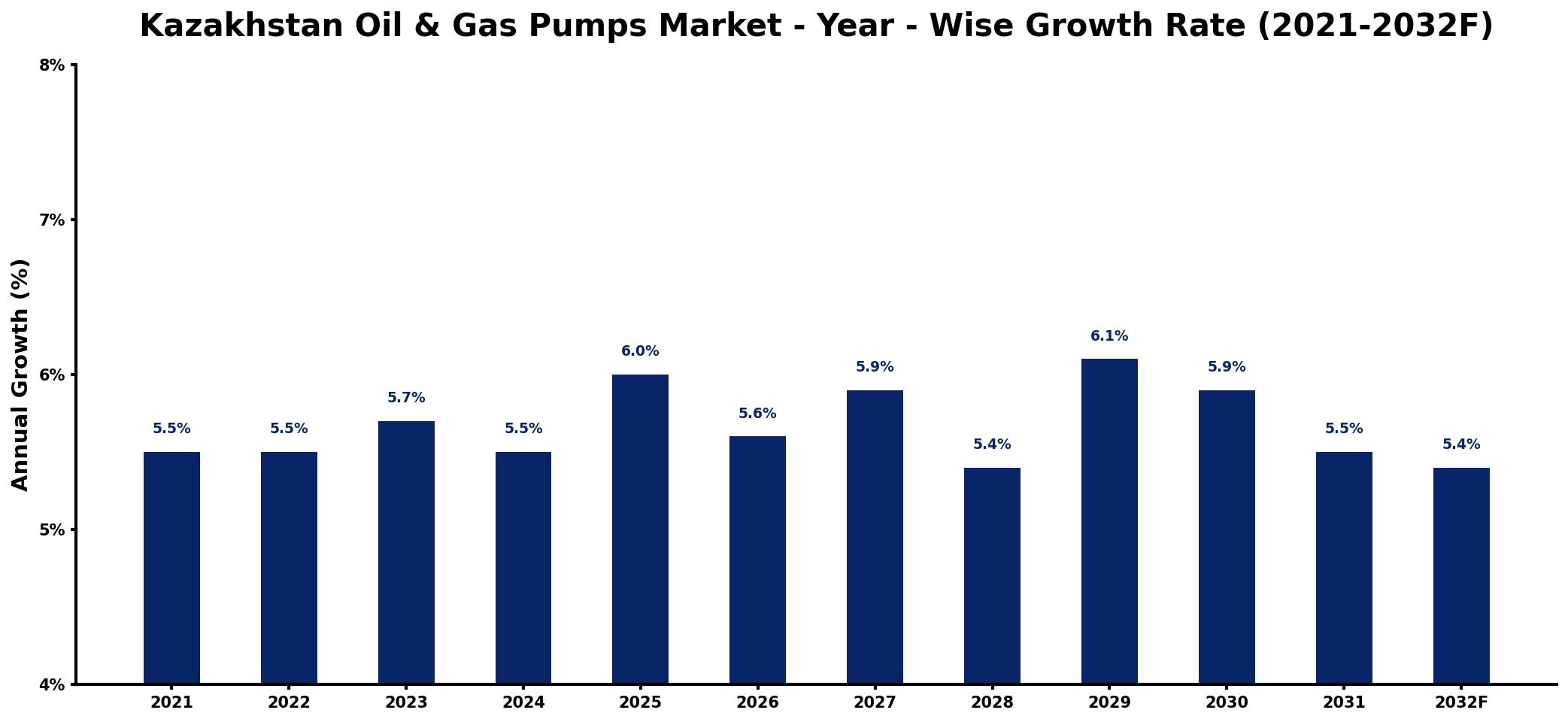
The table below presents the year‑wise growth rates along with the key drivers influencing the market
| Year | Growth Rate | Major Drivers |
| 2021 | 5.5% | Rising demand for energy efficiency |
| 2022 | 5.5% | Increased industrial production activities |
| 2023 | 5.7% | Growing infrastructure development projects |
| 2024 | 5.5% | Expansion of renewable energy initiatives |
| 2025 | 6.0% | Investment in modernization initiatives |
| 2026 | 5.6% | Technological advancements in automation |
| 2027 | 5.9% | Surge in international collaborations |
| 2028 | 5.4% | Strengthening regulatory compliance measures |
| 2029 | 6.1% | Focus on environmental sustainability practices |
| 2030 | 5.9% | Enhanced supply chain reliability |
| 2031 | 5.5% | Growing urbanization and population |
| 2032 | 5.4% | Rising focus on operational efficiency |
Note: Market size estimations and growth projections presented in this report are based on 6Wresearch's proprietary forecasting methodology, utilizing the latest available industry data, government publications, and primary research inputs.
Kazakhstan Oil & Gas Pumps Market Synopsis
The Kazakhstan Oil & Gas Pumps Market is rapidly evolving, underpinned by the nation's strategic position as a significant player in the global energy sector. Increasing investment in oil exploration and production is enhancing the demand for efficient and reliable pumping solutions critical to various operational processes.
As environmental sustainability becomes a priority, the market is witnessing a rise in the adoption of advanced pump technologies. Key advancements focus on energy efficiency and smart systems, which are reshaping the operational landscape of the oil and gas industry in Kazakhstan.
- The market is set to grow at a CAGR of 4.8% from 2026 to 2032, reflecting a robust investment landscape.
- Technological advancements are playing a crucial role in enhancing pump efficiency and reliability.
- The shift towards environmental sustainability is driving the demand for energy-efficient pumping solutions.
- Centrifugal and positive displacement pumps are in high demand for upstream and midstream applications.
- Government initiatives are creating a conducive environment for investment and growth in the oil and gas sector.
Despite its promising trajectory, the Kazakhstan Oil & Gas Pumps Market faces several real constraints that could impede growth. The fluctuations in global oil prices can significantly influence investment decisions, leading to uncertainty in project financing. Furthermore, ongoing regulatory changes within Kazakhstans energy sector create an unpredictable environment for pump manufacturers and suppliers. Geopolitical tensions in the region also pose risks, impacting operations and the overall investment climate. Companies must adeptly navigate these complexities to seize market opportunities.
The Kazakhstan Oil & Gas Pumps Market is seeing a pronounced trend towards more technologically advanced pump systems. There is a growing preference for smart pumps equipped with remote monitoring capabilities, which enable real-time data analysis and predictive maintenance. Additionally, the reliability and versatility of centrifugal pumps are leading to their increased adoption across various fluid handling applications, particularly in demanding environments. Environmental considerations are further driving innovation, with the industry prioritizing pumps that reduce emissions and minimize environmental impact.
With Kazakhstan's energy sector poised for expansion, numerous investment opportunities are emerging within the Oil & Gas Pumps Market. Companies can explore avenues such as the supply of high-quality pump solutions, as well as maintenance and repair services tailored to the evolving demands of the industry. The focus on digitalization and automation technologies also presents a lucrative space for innovation and growth. Furthermore, potential partnerships with local firms can enhance market penetration, catering to the diverse needs of Kazakhstan's oil and gas landscape.
Kazakhstan's government is actively fostering the growth of the Oil & Gas Pumps Market through supportive policies and initiatives. This includes the establishment of a regulatory framework designed to attract investment in the sector, offering tax incentives and subsidies to companies engaged in oil and gas operations. There is also a strong push for environmentally friendly technologies and practices, emphasizing energy-efficient solutions. By prioritizing local content requirements, the government aims to stimulate domestic manufacturing and contribute to job creation within the oil and gas industry.
Looking ahead to 2026-2032, the future of the Kazakhstan Oil & Gas Pumps Market appears promising, driven by the nation's ambition to enhance its oil and gas production capabilities. Ongoing investments in exploration and infrastructure development, including the expansion of pipelines and refineries, will create ample opportunities for pump manufacturers. As the industry embraces advanced technologies focused on operational efficiency and sustainability, the demand for innovative pumping solutions will continue to grow, ensuring a vibrant market landscape.
Recent developments in the Kazakhstan Oil & Gas Pumps Market indicate a strong trend towards integrating digital technologies in operational processes. Companies are increasingly adopting smart pump technologies that enhance operational efficiency and support real-time monitoring. Furthermore, ongoing discussions around environmental regulations are steering manufacturers towards developing greener pumping solutions, aligning with global sustainability goals. The market is also witnessing increased collaborations among industry players to foster innovation and share expertise.
- 10 Years of Market Numbers
- Historical Data Starting from 2022 to 2025
- Base Year: 2025
- Forecast Data until 2032
- Key Performance Indicators Impacting the Market
- Major Upcoming Developments and Projects
Key Highlights of the Report:
- Kazakhstan Oil & Gas Pumps Market Outlook
- Market Size of Kazakhstan Oil & Gas Pumps Market, 2025
- Forecast of Kazakhstan Oil & Gas Pumps Market, 2032
- Historical Data and Forecast of Kazakhstan Oil & Gas Pumps Revenues & Volume for the Period 2022-2032F
- Kazakhstan Oil & Gas Pumps Market Trend Evolution
- Kazakhstan Oil & Gas Pumps Market Drivers and Challenges
- Kazakhstan Oil & Gas Pumps Price Trends
- Kazakhstan Oil & Gas Pumps Porter's Five Forces
- Kazakhstan Oil & Gas Pumps Industry Life Cycle
- Historical Data and Forecast of Kazakhstan Oil & Gas Pumps Market Revenues & Volume By Type for the Period 2022-2032F
- Historical Data and Forecast of Kazakhstan Oil & Gas Pumps Market Revenues & Volume By Submersible Pumps for the Period 2022-2032F
- Historical Data and Forecast of Kazakhstan Oil & Gas Pumps Market Revenues & Volume By Non-submersible Pumps for the Period 2022-2032F
- Historical Data and Forecast of Kazakhstan Oil & Gas Pumps Market Revenues & Volume By Pump Type for the Period 2022-2032F
- Historical Data and Forecast of Kazakhstan Oil & Gas Pumps Market Revenues & Volume By Centrifugal Pump for the Period 2022-2032F
- Historical Data and Forecast of Kazakhstan Oil & Gas Pumps Market Revenues & Volume By Positive Displacement Pump for the Period 2022-2032F
- Historical Data and Forecast of Kazakhstan Oil & Gas Pumps Market Revenues & Volume By Cryogenic Pump for the Period 2022-2032F
- Historical Data and Forecast of Kazakhstan Oil & Gas Pumps Market Revenues & Volume By Application for the Period 2022-2032F
- Historical Data and Forecast of Kazakhstan Oil & Gas Pumps Market Revenues & Volume By Upstream for the Period 2022-2032F
- Historical Data and Forecast of Kazakhstan Oil & Gas Pumps Market Revenues & Volume By Midstream for the Period 2022-2032F
- Historical Data and Forecast of Kazakhstan Oil & Gas Pumps Market Revenues & Volume By Downstream for the Period 2022-2032F
- Kazakhstan Oil & Gas Pumps Import Export Trade Statistics
- Market Opportunity Assessment By Type
- Market Opportunity Assessment By Pump Type
- Market Opportunity Assessment By Application
- Kazakhstan Oil & Gas Pumps Top Companies Market Share
- Kazakhstan Oil & Gas Pumps Competitive Benchmarking By Technical and Operational Parameters
- Kazakhstan Oil & Gas Pumps Company Profiles
- Kazakhstan Oil & Gas Pumps Key Strategic Recommendations






































