Kazakhstan Publishing Market Summary
The kazakhstan publishing market was estimated at USD 1138 Million in 2025 and is projected to reach USD 1638 Million by 2032, growing at a CAGR of 6.5% from 2026 to 2032.
Kazakhstan Publishing Market Year-wise Growth Rate and Key Drivers
This graph highlights how the Kazakhstan Publishing Market has steadily grown over the past five years, supported by major growth factors.
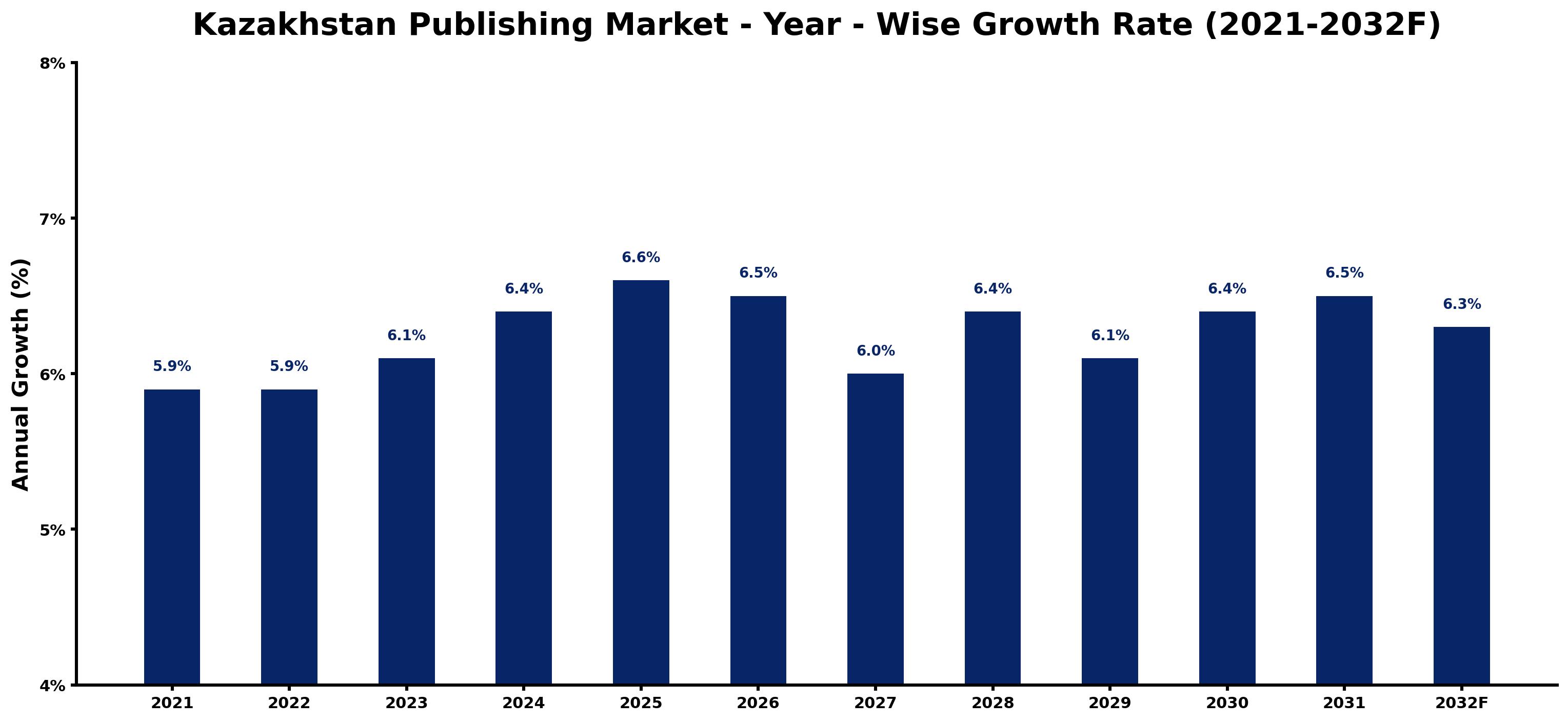
The table below presents the year wise growth rates along with the key drivers influencing the market
| Year | Growth Rate | Major Drivers |
| 2021 | 5.9% | Local authors increasingly seek publishing opportunities, enhancing regional literary diversity. |
| 2022 | 5.9% | Digital publishing platforms facilitate access to underserved parts of Kazakhstan. |
| 2023 | 6.1% | University enrollment growth stimulates demand for educational materials and textbooks. |
| 2024 | 6.4% | E-commerce integration enables easy distribution of books across remote areas. |
| 2025 | 6.6% | Emerging trends in youth literature attract international publishing collaborations and investments. |
| 2026 | 6.5% | Marketing efforts tailored to local cultures create a broader readership base. |
| 2027 | 6.0% | Technological advancements in print-on-demand reduce upfront costs for publishers. |
| 2028 | 6.4% | Library modernization projects expand access to a wider range of genres for readers. |
| 2029 | 6.1% | Government policies supporting copyright protections encourage creative content development. |
| 2030 | 6.4% | Increased interest in indigenous storytelling promotes unique publishing ventures. |
| 2031 | 6.5% | Establishment of literary festivals amplifies the visibility of local authors and works. |
| 2032 | 6.3% | Collaborative ventures between publishers and educational institutions enhance content relevance. |
Note - Market size estimations and growth projections presented in this report are based on 6Wresearch's advanced forecasting approach, validated with industry datasets as of June 2026.
Kazakhstan Publishing Market Synopsis
The Kazakhstan Publishing Market is projected to reach 6.5% and witness significant growth during the forecast period (2026-2032). This market is currently experiencing a paradigm shift influenced by digital innovation, changing consumer preferences, and a move towards modern reading habits. While print publishing remains relevant, the landscape is increasingly dominated by digital formats such as e-books, audiobooks, and online publications. This transformative phase is supported by the rising penetration of digital devices including smartphones, tablets, and e-readers, thereby enhancing the accessibility and convenience of published content.
Kazakhstan Publishing Market Growth Drivers
The drivers propelling the Kazakhstan Publishing Market forward include several key factors:
- The increasing literacy rates across Kazakhstan significantly bolster the market, as a more literate population fuels demand for diverse reading materials.
- Government support, through various initiatives, further stimulates the publishing industry by providing subsidies and grants aimed at fostering local talent and production.
- The rising popularity of digital content, including e-books and audiobooks, reflects changing consumer behaviors, with more readers opting for the convenience of digital formats.
- The proliferation of online platforms promotes content consumption, as consumers increasingly prefer accessing publications via the internet rather than traditional print media.
- Additionally, the expansion of subscription models and content licensing agreements allows publishers to explore new revenue streams, aligning with global trends in the publishing sector.
Kazakhstan Publishing Market Challenges and Restraints
Despite promising growth, the Kazakhstan Publishing Market faces several challenges that could impede its progress:
- Digital piracy remains a pressing concern, undermining the financial viability of publishers and authors while complicating efforts to enforce intellectual property rights.
- The democratization of content creation through self-publishing platforms disrupts traditional publishing models, making it crucial for established publishers to adapt their strategies.
- Evolving consumer expectations for personalized content and interactive multimedia formats necessitate investments in new technologies and innovative content strategies.
- Market players must also navigate the challenges posed by changing reader preferences, which require a swift response to emerging trends in content consumption.
- Lastly, the intense competition in the digital realm demands that publishers enhance their digital marketing capabilities and reader engagement efforts to retain their market share.
Kazakhstan Publishing Market Government Investment and Initiatives
In the Kazakhstan Publishing Market, government investment plays a pivotal role in nurturing the industry. Various policies are designed to support the growth of local publishing companies and authors. The government provides financial assistance through grants and subsidies that aim to stimulate creativity and innovation within the sector. Regulations are also in place to safeguard intellectual property rights, ensuring that local publishers can operate without the threat of infringement. Programs aimed at enhancing literacy rates are being actively promoted, thereby increasing the demand for educational materials. Furthermore, the government encourages the distribution of locally produced content to foster a robust publishing ecosystem that reflects Kazakhstan's rich cultural heritage.
Kazakhstan Publishing Market Latest Developments (May 2025 - June 2026)
Recent developments in the Kazakhstan Publishing Market reflect significant trends and shifts in direction. During this period, there has been an observable increase in the adoption of digital publishing technologies, with more publishers investing in e-books and online content distribution platforms. Additionally, the rise of audiobook popularity is becoming more pronounced, attracting a new demographic of listeners. Publishers are also exploring partnerships with technology firms to enhance their digital offerings and improve reader experience. The government's continued focus on enhancing literacy rates has led to increased public interest in educational publishing, further invigorating market dynamics. There is a heightened recognition of the importance of protecting intellectual property, prompting discussions around effective measures to combat digital piracy.
Kazakhstan Publishing Market - Key Attractiveness of the Report
- 10 Years of Market Numbers
- Historical Data Starting from 2022 to 2025
- Base Year: 2025
- Forecast Data until 2032
- Key Performance Indicators Impacting the Market
- Major Upcoming Developments and Projects
Key Highlights of the Report:
- Kazakhstan Publishing Market Outlook
- Market Size of Kazakhstan Publishing Market, 2025
- Forecast of Kazakhstan Publishing Market, 2032
- Historical Data and Forecast of Kazakhstan Publishing Revenues & Volume for the Period 2022-2032F
- Kazakhstan Publishing Market Trend Evolution
- Kazakhstan Publishing Market Drivers and Challenges
- Kazakhstan Publishing Price Trends
- Kazakhstan Publishing Porter's Five Forces
- Kazakhstan Publishing Industry Life Cycle
- Historical Data and Forecast of Kazakhstan Publishing Market Revenues & Volume By Types for the Period 2022-2032F
- Historical Data and Forecast of Kazakhstan Publishing Market Revenues & Volume By Newspaper for the Period 2022-2032F
- Historical Data and Forecast of Kazakhstan Publishing Market Revenues & Volume By Journals for the Period 2022-2032F
- Historical Data and Forecast of Kazakhstan Publishing Market Revenues & Volume By Catalogues for the Period 2022-2032F
- Historical Data and Forecast of Kazakhstan Publishing Market Revenues & Volume By Magazine for the Period 2022-2032F
- Historical Data and Forecast of Kazakhstan Publishing Market Revenues & Volume By Books for the Period 2022-2032F
- Historical Data and Forecast of Kazakhstan Publishing Market Revenues & Volume By E-Books for the Period 2022-2032F
- Historical Data and Forecast of Kazakhstan Publishing Market Revenues & Volume By Platform for the Period 2022-2032F
- Historical Data and Forecast of Kazakhstan Publishing Market Revenues & Volume By Digital? for the Period 2022-2032F
- Historical Data and Forecast of Kazakhstan Publishing Market Revenues & Volume By Paper for the Period 2022-2032F
- Kazakhstan Publishing Import Export Trade Statistics
- Market Opportunity Assessment By Types
- Market Opportunity Assessment By Platform
- Kazakhstan Publishing Top Companies Market Share
- Kazakhstan Publishing Competitive Benchmarking By Technical and Operational Parameters
- Kazakhstan Publishing Company Profiles
- Kazakhstan Publishing Key Strategic Recommendations






































