Kenya Amoxicillin Market Size, Share & Growth Rate
The Kenya Amoxicillin Market was estimated at USD 197 Million in 2025 and is projected to reach USD 259 Million by 2032, growing at a CAGR of 4.0% from 2026 to 2032. This growth trajectory can be attributed to a combination of increasing bacterial infections and heightened public awareness about effective treatments. Moreover, the expansion of healthcare services and access in both urban and rural settings plays a crucial role in driving demand for this essential antibiotic.
Kenya Amoxicillin Market Year-wise Growth Rate and Key Drivers
This graph highlights how the Kenya Amoxicillin Market has steadily grown over the years, supported by major growth factors.
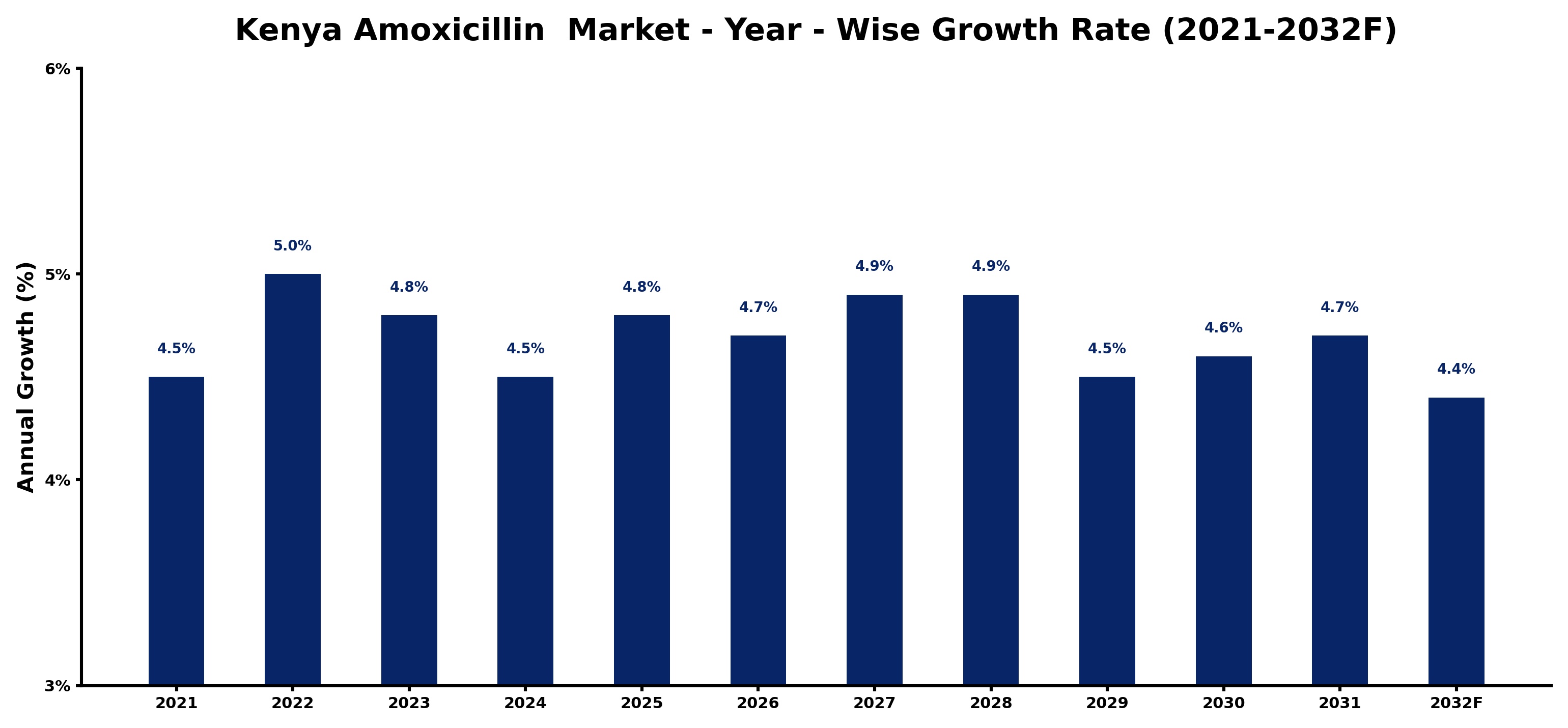
The table below presents the year‑wise growth rates along with the key drivers influencing the market
| Year | Growth Rate | Major Drivers |
| 2021 | 4.5% | Local pharmaceutical firms upgraded facilities for higher amoxicillin output |
| 2022 | 5.0% | Pharmaceutical manufacturers optimize supply chains to meet amoxicillin demand |
| 2023 | 4.8% | New facilities boost local amoxicillin production capacity and supply |
| 2024 | 4.5% | Local amoxicillin production expansion drives pharmaceutical manufacturing investments |
| 2025 | 4.8% | Pharmaceutical firms implement digital solutions to enhance production efficiency |
| 2026 | 4.7% | Pharmaceutical companies modernize facilities to boost amoxicillin output |
| 2027 | 4.9% | Amoxicillin production capacity upgrades boost pharmaceutical export volumes |
| 2028 | 4.9% | Local manufacturing investments boosted amoxicillin production capacity and reliability |
| 2029 | 4.5% | Improved supply chain logistics boosted Amoxicillin distribution efficiency in Kenya |
| 2030 | 4.6% | Local amoxicillin production facilities upgrade equipment for efficiency gains |
| 2031 | 4.7% | Local amoxicillin production facilities expanded due to market demand |
| 2032 | 4.4% | Technological upgrades in production lines boosted amoxicillin output efficiency |
Note - Market size estimations and growth projections presented in this report are based on 6Wresearch’s advanced forecasting approach, validated with industry datasets as of June 2026.
Kenya Amoxicillin Market Synopsis
The Kenya Amoxicillin market has witnessed significant momentum due to a rising prevalence of bacterial infections and an expanding healthcare infrastructure. However, as we look ahead, the market is poised for further growth as the healthcare sector continues to develop, supported by government initiatives aimed at enhancing access to essential medications.
In recent years, the market's shift towards more affordable generic versions of Amoxicillin has gained traction, making it increasingly accessible to a broader population. This trend is coupled with ongoing public education campaigns highlighting the importance of antibiotics in treating infections effectively.
Kenya Amoxicillin Market Key Takeaways
- The market is driven by a high prevalence of bacterial infections requiring effective antibiotic treatments.
- Growing healthcare expenditure and initiatives are improving access to essential medicines like Amoxicillin.
- Increased demand for generic versions of Amoxicillin is reshaping the competitive landscape.
- Ongoing government regulations aim to ensure the safety and efficacy of Amoxicillin products.
- Collaboration among stakeholders is essential to enhance distribution and mitigate counterfeit risks.
Evaluation of Restraints in Kenya Amoxicillin Market
While the Kenya Amoxicillin market shows promise, several restraints limit its potential. The prevalence of counterfeit products poses significant risks, eroding trust in medication safety. Additionally, price fluctuations driven by economic variables may impact affordability for consumers. Regulatory hurdles complicate quality assurance processes, while inadequacies in distribution networks hinder access in remote regions. These factors necessitate focused collaboration among pharmaceutical companies, regulatory bodies, and healthcare providers to effectively address these challenges and ensure market integrity.
Kenya Amoxicillin Market Trends
Emerging trends in the Kenya Amoxicillin market highlight a distinct shift towards generic products, spurred by the increasing demand for affordable treatment options. Furthermore, the ongoing development of healthcare infrastructure is likely to enhance accessibility, particularly in underserved areas. A growing awareness of antibiotic stewardship is also shaping consumer behavior, with a focus on proper usage to combat resistance issues. These trends collectively influence the market landscape, emphasizing the importance of innovation in manufacturing and distribution.
Kenya Amoxicillin Market Opportunities
Investment opportunities within the Kenya Amoxicillin market are abundant. With the demand for antibiotics on the rise, investors may find lucrative prospects in the production and distribution of generic formulations. Additionally, collaborations with local manufacturers could facilitate the development of innovative products tailored to meet market needs. Strategic marketing initiatives aimed at healthcare providers and consumers can amplify visibility and boost market share, providing a solid foundation for growth.
Government Initiatives in the Kenya Amoxicillin Market
The Kenyan government has implemented robust regulations surrounding the use and distribution of Amoxicillin, focusing on quality assurance through the Pharmacy and Poisons Board. Policies aimed at combating antimicrobial resistance promote rational antibiotic use. Furthermore, there are stringent restrictions on the sale of Amoxicillin without a prescription to mitigate the risk of misuse. Such initiatives are designed to ensure that safe and effective medications remain accessible, supporting overall public health objectives.
Future Insights of the Kenya Amoxicillin Market
Looking ahead to 2026-2032, the Kenya Amoxicillin market is set for steady growth. The increasing incidence of bacterial infections, coupled with a rising population and enhanced healthcare access, will likely propel demand. Government initiatives focused on expanding healthcare services and raising awareness about the importance of timely treatment will further support market expansion. However, ongoing vigilance regarding antibiotic resistance and market pricing dynamics will remain essential for sustaining growth in the long term.
Kenya Amoxicillin Market Latest Developments (May 2025 - June 2026)
Recent developments in the Kenya Amoxicillin market underscore a continued push towards improving access to effective antibiotics. Efforts to combat counterfeit products have intensified, as stakeholders collaborate on regulatory enforcement and consumer education. The market is also witnessing an influx of generic product offerings, catering to the rising demand from both urban and rural populations. As public health initiatives strengthen, the overall landscape for Amoxicillin is expected to evolve, reflecting greater accessibility and education around its use.
Kenya Amoxicillin Market - Key Attractiveness of the Report
- 10 Years of Market Numbers
- Historical Data Starting from 2022 to 2025
- Base Year: 2025
- Forecast Data until 2032
- Key Performance Indicators Impacting the Market
- Major Upcoming Developments and Projects
Key Highlights of the Report:
- Kenya Amoxicillin Market Outlook
- Market Size of Kenya Amoxicillin Market, 2025
- Forecast of Kenya Amoxicillin Market, 2032
- Historical Data and Forecast of Kenya Amoxicillin Revenues & Volume for the Period 2022-2032F
- Kenya Amoxicillin Market Trend Evolution
- Kenya Amoxicillin Market Drivers and Challenges
- Kenya Amoxicillin Price Trends
- Kenya Amoxicillin Porter's Five Forces
- Kenya Amoxicillin Industry Life Cycle
- Historical Data and Forecast of Kenya Amoxicillin Market Revenues & Volume By Infection Type for the Period 2022-2032F
- Historical Data and Forecast of Kenya Amoxicillin Market Revenues & Volume By Skin Infections for the Period 2022-2032F
- Historical Data and Forecast of Kenya Amoxicillin Market Revenues & Volume By ENT (Ear, Nose & Throat) Infections for the Period 2022-2032F
- Historical Data and Forecast of Kenya Amoxicillin Market Revenues & Volume By Stomach Infections for the Period 2022-2032F
- Historical Data and Forecast of Kenya Amoxicillin Market Revenues & Volume By Lungs Infections for the Period 2022-2032F
- Historical Data and Forecast of Kenya Amoxicillin Market Revenues & Volume By Urinary tract infections (UTI) for the Period 2022-2032F
- Historical Data and Forecast of Kenya Amoxicillin Market Revenues & Volume By Pneumonia for the Period 2022-2032F
- Historical Data and Forecast of Kenya Amoxicillin Market Revenues & Volume By Bronchitis for the Period 2022-2032F
- Historical Data and Forecast of Kenya Skin Infections Amoxicillin Market Revenues & Volume By Gonorrhea for the Period 2022-2032F
- Historical Data and Forecast of Kenya Amoxicillin Market Revenues & Volume By Route of Administration for the Period 2022-2032F
- Historical Data and Forecast of Kenya Amoxicillin Market Revenues & Volume By Oral for the Period 2022-2032F
- Historical Data and Forecast of Kenya Amoxicillin Market Revenues & Volume By Intravenous for the Period 2022-2032F
- Historical Data and Forecast of Kenya Amoxicillin Market Revenues & Volume By Form for the Period 2022-2032F
- Historical Data and Forecast of Kenya Amoxicillin Market Revenues & Volume By Tablets for the Period 2022-2032F
- Historical Data and Forecast of Kenya Amoxicillin Market Revenues & Volume By Capsule for the Period 2022-2032F
- Historical Data and Forecast of Kenya Amoxicillin Market Revenues & Volume By Suspensions for the Period 2022-2032F
- Historical Data and Forecast of Kenya Amoxicillin Market Revenues & Volume By Syrup for the Period 2022-2032F
- Historical Data and Forecast of Kenya Amoxicillin Market Revenues & Volume By Powder for the Period 2022-2032F
- Historical Data and Forecast of Kenya Amoxicillin Market Revenues & Volume By Distribution Channel for the Period 2022-2032F
- Historical Data and Forecast of Kenya Amoxicillin Market Revenues & Volume By Hospitals Pharmacies for the Period 2022-2032F
- Historical Data and Forecast of Kenya Amoxicillin Market Revenues & Volume By Retail Pharmacies for the Period 2022-2032F
- Historical Data and Forecast of Kenya Amoxicillin Market Revenues & Volume By Online Pharmacies for the Period 2022-2032F
- Historical Data and Forecast of Kenya Amoxicillin Market Revenues & Volume By Others for the Period 2022-2032F
- Kenya Amoxicillin Import Export Trade Statistics
- Market Opportunity Assessment By Infection Type
- Market Opportunity Assessment By Route of Administration
- Market Opportunity Assessment By Form
- Market Opportunity Assessment By Distribution Channel
- Kenya Amoxicillin Top Companies Market Share
- Kenya Amoxicillin Competitive Benchmarking By Technical and Operational Parameters
- Kenya Amoxicillin Company Profiles
- Kenya Amoxicillin Key Strategic Recommendations






































