Kenya Automotive Drive Shaft Market Size, Share & Growth Rate
The Kenya Automotive Drive Shaft Market was estimated at USD 178 Million in 2025 and is projected to reach USD 248 Million by 2032, growing at a CAGR of 4.9% from 2026 to 2032. This upward trajectory is supported by a burgeoning automotive sector, characterized by a rise in passenger and commercial vehicle registrations, coupled with increasing urbanization across the nation. Additionally, the government's support for local manufacturing and infrastructure projects plays a pivotal role in stimulating market growth.
Kenya Automotive Drive Shaft Market Year-wise Growth Rate and Key Drivers
This graph highlights how the Kenya Automotive Drive Shaft Market has steadily grown over the years, supported by major growth factors.
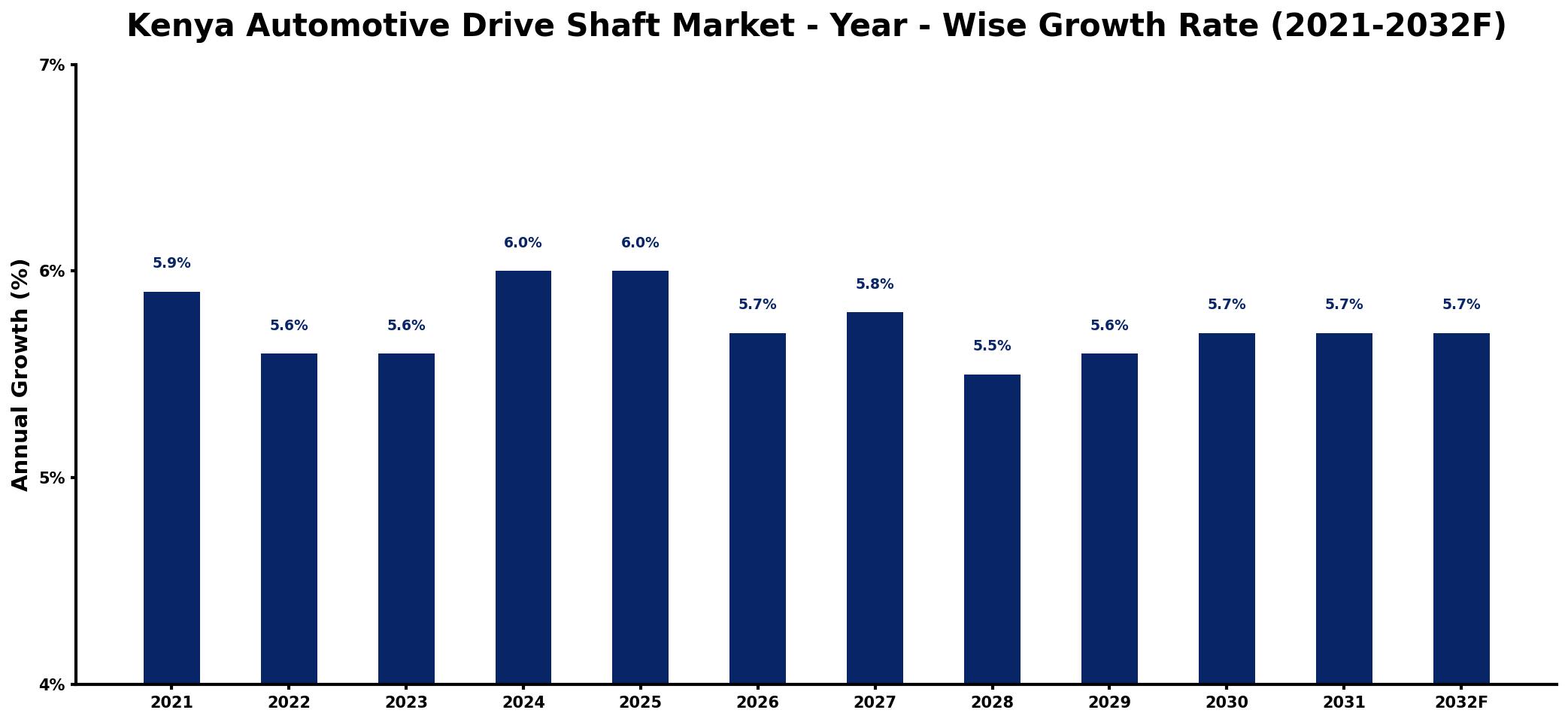
The table below presents the year‑wise growth rates along with the key drivers influencing the market
| Year | Growth Rate | Major Drivers |
| 2021 | 5.9% | Rising demand for transportation services |
| 2022 | 5.6% | Growth in local manufacturing activities |
| 2023 | 5.6% | Increased infrastructure development projects |
| 2024 | 6.0% | Expansion of logistics networks |
| 2025 | 6.0% | Surge in vehicle ownership rates |
| 2026 | 5.7% | Improved urban mobility solutions |
| 2027 | 5.8% | Investments in renewable energy vehicles |
| 2028 | 5.5% | Development of regional trade agreements |
| 2029 | 5.6% | Technological advancements in mobility |
| 2030 | 5.7% | growing downstream application demand |
| 2031 | 5.7% | Increased foreign direct investments |
| 2032 | 5.7% | Strengthening of supply chain networks |
Note: Market size estimations and growth projections presented in this report are based on 6Wresearch's proprietary forecasting methodology, utilizing the latest available industry data, government publications, and primary research inputs.
Kenya Automotive Drive Shaft Market Synopsis
In recent years, the Kenya Automotive Drive Shaft Market has shown steady progress, reflecting a growing consumer appetite for vehicles across diverse segments. Looking ahead, the market is expected to harness technological advancements while overcoming challenges such as reliance on imported components.
The growth of local manufacturers, alongside strategic partnerships with international players, is set to redefine market dynamics. This evolution will foster an environment ripe for innovation, especially in developing eco-friendly drive shaft solutions to align with global sustainability trends.
Kenya Automotive Drive Shaft Market Key Takeaways
- Steady market growth, driven by rising demand for vehicles and urbanization.
- Technological advancements are enhancing drive shaft performance and durability.
- The government is actively supporting local manufacturing through favorable policies.
- Concerns surrounding counterfeit products may impact consumer trust and safety.
- Investment in local capabilities presents significant opportunities for market players.
Evaluation of Restraints in Kenya Automotive Drive Shaft Market
The Kenya Automotive Drive Shaft Market faces significant challenges that could inhibit growth. A major concern is the high cost of importing drive shaft components, largely due to insufficient local manufacturing capabilities. This dependency on imports can lead to supply chain disruptions and price volatility, adversely affecting vehicle affordability for consumers. Moreover, the scarcity of specialized skills within the local workforce limits the ability to produce high-quality components, thereby compromising service quality. The proliferation of counterfeit products also raises serious safety concerns and diminishes consumer confidence in the market.
Kenya Automotive Drive Shaft Market Trends
The market is undergoing a transformation fueled by a surge in demand for commercial vehicles and advancements in drive shaft materials. Innovations are aimed at enhancing performance and longevity, with a notable shift toward electric vehicle integration influencing new product development. As environmental concerns rise, manufacturers are increasingly focusing on lightweight materials that meet stringent emissions regulations, further shaping market dynamics.
Kenya Automotive Drive Shaft Market Opportunities
Significant investment opportunities exist in the Kenya Automotive Drive Shaft Market, especially in enhancing local production capabilities. With the ongoing expansion of road infrastructure and a growing middle class, the demand for vehicles is poised to increase. This surge provides manufacturers with a chance to cater to both original equipment manufacturers and the aftermarket segment. Furthermore, engaging in R&D to develop innovative and reliable drive shaft solutions will be crucial for capturing a larger share of the market.
Government Initiatives in the Kenya Automotive Drive Shaft Market
The Kenyan government has implemented several initiatives to bolster the automotive industry, including the drive shaft market. These efforts encompass reductions in import duties on automotive components to encourage local manufacturing. Incentives such as tax breaks and subsidies are also available to attract investments in this sector. Furthermore, regulations aimed at ensuring compliance with safety and environmental standards help enhance the quality of drive shafts produced and marketed.
Future Insights of the Kenya Automotive Drive Shaft Market
Looking toward 2026-2032, the Kenya Automotive Drive Shaft Market is expected to maintain its growth momentum, driven by increased vehicle production and infrastructure development. Continuous advancements in materials technology are likely to lead to drive shafts that offer improved durability and efficiency. The market will also increasingly align with global sustainability efforts, creating opportunities for manufacturers who focus on eco-friendly products. As international manufacturers recognize the potential of the Kenyan automotive sector, investment in local operations will likely surge, further elevating market prospects.
Kenya Automotive Drive Shaft Market Latest Developments (2025 - 2026)
Recent developments in the Kenya Automotive Drive Shaft Market indicate a heightened focus on local manufacturing initiatives. Industry stakeholders are increasingly collaborating with technical institutes to enhance skill development among the workforce. Moreover, manufacturers are ramping up efforts to innovate drive shaft designs, responding to the growing demand for more efficient and sustainable automotive solutions. Additionally, several programs have emerged aimed at raising awareness about counterfeit products, seeking to improve safety and consumer trust in the market.
Kenya Automotive Drive Shaft Market - Key Attractiveness of the Report
- 10 Years of Market Numbers
- Historical Data Starting from 2022 to 2025
- Base Year: 2025
- Forecast Data until 2032
- Key Performance Indicators Impacting the Market
- Major Upcoming Developments and Projects
Key Highlights of the Report:
- Kenya Automotive Drive Shaft Market Outlook
- Market Size of Kenya Automotive Drive Shaft Market, 2025
- Forecast of Kenya Automotive Drive Shaft Market, 2032
- Historical Data and Forecast of Kenya Automotive Drive Shaft Revenues & Volume for the Period 2022-2032F
- Kenya Automotive Drive Shaft Market Trend Evolution
- Kenya Automotive Drive Shaft Market Drivers and Challenges
- Kenya Automotive Drive Shaft Price Trends
- Kenya Automotive Drive Shaft Porter's Five Forces
- Kenya Automotive Drive Shaft Industry Life Cycle
- Historical Data and Forecast of Kenya Automotive Drive Shaft Market Revenues & Volume By Design Type for the Period 2022-2032F
- Historical Data and Forecast of Kenya Automotive Drive Shaft Market Revenues & Volume By Hollow Shaft for the Period 2022-2032F
- Historical Data and Forecast of Kenya Automotive Drive Shaft Market Revenues & Volume By Solid Shaft for the Period 2022-2032F
- Historical Data and Forecast of Kenya Automotive Drive Shaft Market Revenues & Volume By Position Type for the Period 2022-2032F
- Historical Data and Forecast of Kenya Automotive Drive Shaft Market Revenues & Volume By Rear Axle for the Period 2022-2032F
- Historical Data and Forecast of Kenya Automotive Drive Shaft Market Revenues & Volume By Front Axle for the Period 2022-2032F
- Historical Data and Forecast of Kenya Automotive Drive Shaft Market Revenues & Volume By Vehicle Type for the Period 2022-2032F
- Historical Data and Forecast of Kenya Automotive Drive Shaft Market Revenues & Volume By Passenger Cars for the Period 2022-2032F
- Historical Data and Forecast of Kenya Automotive Drive Shaft Market Revenues & Volume By Commercial Vehicles for the Period 2022-2032F
- Kenya Automotive Drive Shaft Import Export Trade Statistics
- Market Opportunity Assessment By Design Type
- Market Opportunity Assessment By Position Type
- Market Opportunity Assessment By Vehicle Type
- Kenya Automotive Drive Shaft Top Companies Market Share
- Kenya Automotive Drive Shaft Competitive Benchmarking By Technical and Operational Parameters
- Kenya Automotive Drive Shaft Company Profiles
- Kenya Automotive Drive Shaft Key Strategic Recommendations






































