Kenya Car Air Fresheners Market Size, Share & Growth Rate
The Kenya Car Air Fresheners Market was estimated at USD 967 Million in 2025 and is projected to reach USD 1741 Million by 2032, growing at a CAGR of 8.8% from 2026 to 2032. This remarkable growth trajectory is underpinned by factors such as increasing car ownership rates driven by urbanization and rising disposable incomes. Additionally, consumers are increasingly prioritizing their driving environment, further stimulating demand for diverse and innovative air freshening solutions.
Kenya Car Air Fresheners Market Year-wise Growth Rate and Key Drivers
This graph highlights how the Kenya Car Air Fresheners Market has steadily grown over the years, supported by major growth factors.
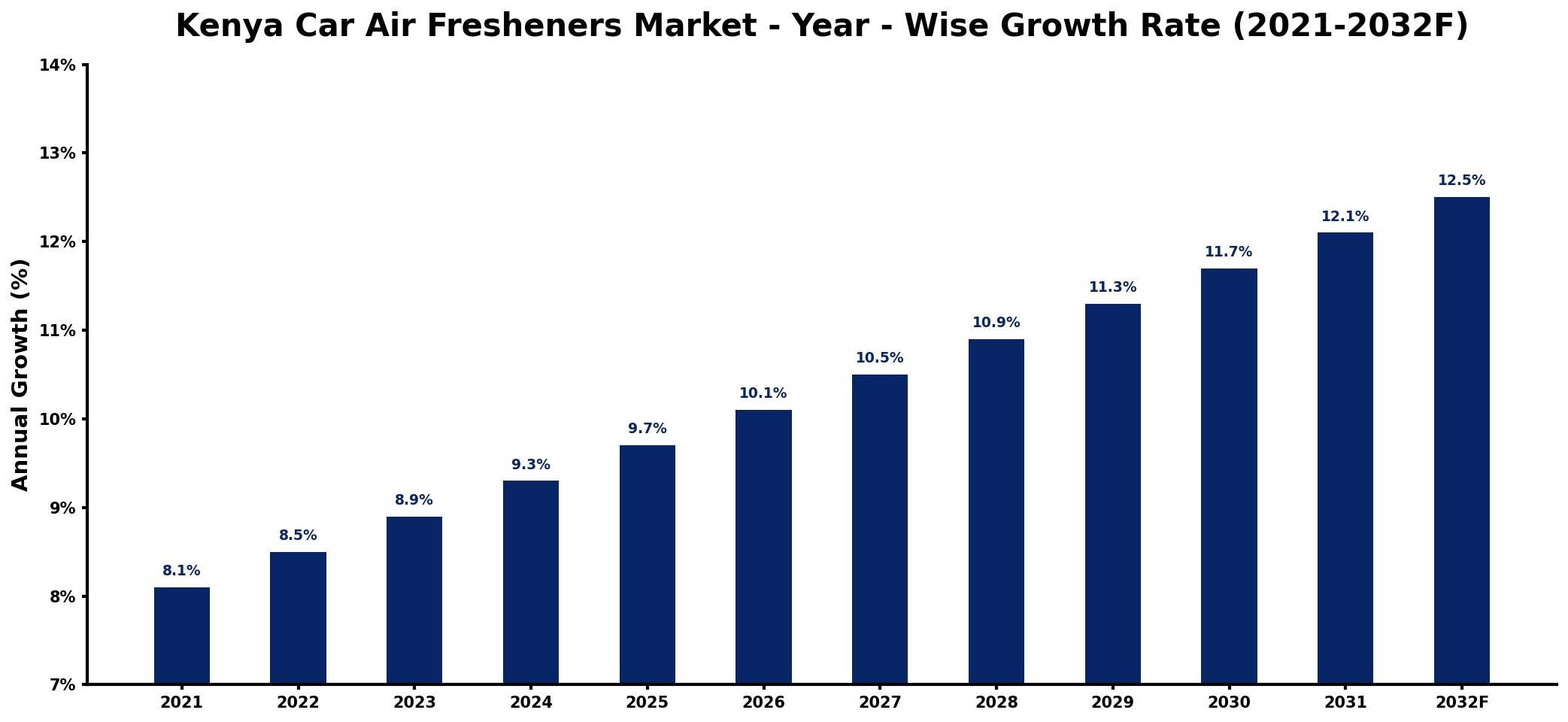
The table below presents the year‑wise growth rates along with the key drivers influencing the market
| Year | Growth Rate | Major Drivers |
| 2021 | 8.1% | Rising consumer disposable income |
| 2022 | 8.5% | Growing demand for home fragrances |
| 2023 | 8.9% | Increased focus on sustainability |
| 2024 | 9.3% | Expansion of retail distribution channels |
| 2025 | 9.7% | Innovations in scent technology |
| 2026 | 10.1% | Surge in online shopping preferences |
| 2027 | 10.5% | Enhanced marketing strategies deployment |
| 2028 | 10.9% | Rising popularity of luxury products |
| 2029 | 11.3% | Growth in automotive sector revival |
| 2030 | 11.7% | Increased awareness of wellness benefits |
| 2031 | 12.1% | growing emerging market penetration |
| 2032 | 12.5% | Development of eco-friendly alternatives |
Note: Market size estimations and growth projections presented in this report are based on 6Wresearch's proprietary forecasting methodology, utilizing the latest available industry data, government publications, and primary research inputs.
Kenya Car Air Fresheners Market Synopsis
The Kenya Car Air Fresheners Market has recently gained momentum as car ownership continues to rise, reflecting the countrys economic growth. This momentum is expected to transition into a vibrant market landscape, where consumer preferences are rapidly evolving towards personalized, eco-friendly, and technologically advanced products.
As the market matures, businesses are innovating to stay competitive by introducing new fragrances and packaging options. With urbanization influencing consumer lifestyles, the demand for car air fresheners that enhance the driving experience is projected to surge, reflecting a broader trend towards personal well-being and environmental awareness.
Kenya Car Air Fresheners Market Key Takeaways
- The market is witnessing robust growth driven by rising disposable incomes and urbanization.
- Eco-friendly and organic air fresheners are gaining traction among environmentally conscious consumers.
- Technological innovations such as smart air fresheners are emerging, offering consumers greater convenience.
- Customization options are becoming increasingly popular as consumers seek unique scents to express their individuality.
- Intense competition and price sensitivity remain critical factors influencing market dynamics.
Evaluation of Restraints in Kenya Car Air Fresheners Market
Despite its growth potential, the Kenya Car Air Fresheners Market faces several restraints. Intense competition, particularly from established local and international brands, complicates the market landscape and puts pressure on pricing strategies. Furthermore, consumers display price sensitivity due to varied income levels, often influencing their purchasing decisions. There are also significant challenges related to distribution, especially in reaching remote areas, which can hinder market penetration. Companies must navigate these challenges through innovative marketing strategies and by building strong distribution networks while maintaining a commitment to quality to foster consumer trust.
Kenya Car Air Fresheners Market Trends
A notable trend in the Kenya Car Air Fresheners Market is the rising demand for natural and eco-friendly products, reflecting a shift towards sustainable consumer behavior. Fragrances derived from organic materials or essential oils are becoming increasingly popular for their health benefits and environmental consciousness. Additionally, there is a growing interest in customization and personalization, with consumers looking for products that resonate with their unique tastes. The advent of smart air fresheners, which can be controlled via mobile applications, exemplifies the technological advancements shaping this market, promoting convenience and a tailored driving experience.
Kenya Car Air Fresheners Market Opportunities
The Kenya Car Air Fresheners Market presents significant opportunities for growth and investment, particularly given the expansion of the automotive industry and the increasing consumer focus on car care. Investors have the potential to tap into the growing demand for innovative fragrances and eco-friendly options. Collaborating with automotive dealers and employing strategic digital marketing initiatives can enhance market penetration. Furthermore, focusing on product longevity and convenience in delivery methods will likely resonate well with consumers, thereby improving market performance.
Government Initiatives in the Kenya Car Air Fresheners Market
In Kenya, the car air fresheners market operates under the regulatory oversight of the Kenya Bureau of Standards (KEBS), which sets essential quality standards and regulations aimed at ensuring consumer safety. The Kenya Revenue Authority (KRA) governs the importation and distribution of these products, imposing relevant tariffs. Furthermore, the National Environment Management Authority (NEMA) has established guidelines to mitigate the environmental impact of air fresheners, particularly regarding the use of certain chemicals and packaging materials. Compliance with these regulations is vital for businesses seeking to maintain consumer trust and avoid penalties.
Future Insights of the Kenya Car Air Fresheners Market
Looking ahead to 2026-2032, the Kenya Car Air Fresheners Market is poised for steady expansion. The correlation between rising car ownership and increased disposable income suggests that consumer demand will continue to grow. A heightened awareness of personal hygiene and cleanliness will drive the need for products that provide not only pleasant fragrances but also enhance the overall driving experience. Furthermore, the introduction of innovative fragrances and convenient packaging is expected to further boost market attractiveness. Although challenges remain, such as competition from alternative products and environmental regulations, the outlook for this sector remains promising, with ample opportunities for manufacturers and investors.
Kenya Car Air Fresheners Market Latest Developments (2025 - 2026)
Recent developments in the Kenya Car Air Fresheners Market indicate a dynamic shift towards innovation and sustainability. Manufacturers are increasingly focusing on eco-friendly products that align with consumer preferences for natural ingredients. Marketing campaigns have also evolved, utilizing digital platforms to engage consumers more effectively. Moreover, advancements in smart technology are being integrated into product offerings, allowing users to personalize their experiences in new and exciting ways. Overall, the industry is adapting to the changing landscape with a keen eye on meeting evolving consumer demands.
Kenya Car Air Fresheners Market - Key Attractiveness of the Report
- 10 Years of Market Numbers
- Historical Data Starting from 2022 to 2025
- Base Year: 2025
- Forecast Data until 2032
- Key Performance Indicators Impacting the Market
- Major Upcoming Developments and Projects
Key Highlights of the Report:
- Kenya Car Air Fresheners Market Outlook
- Market Size of Kenya Car Air Fresheners Market, 2025
- Forecast of Kenya Car Air Fresheners Market, 2032
- Historical Data and Forecast of Kenya Car Air Fresheners Revenues & Volume for the Period 2022-2032F
- Kenya Car Air Fresheners Market Trend Evolution
- Kenya Car Air Fresheners Market Drivers and Challenges
- Kenya Car Air Fresheners Price Trends
- Kenya Car Air Fresheners Porter's Five Forces
- Kenya Car Air Fresheners Industry Life Cycle
- Historical Data and Forecast of Kenya Car Air Fresheners Market Revenues & Volume By Product for the Period 2022-2032F
- Historical Data and Forecast of Kenya Car Air Fresheners Market Revenues & Volume By Gel & Cans for the Period 2022-2032F
- Historical Data and Forecast of Kenya Car Air Fresheners Market Revenues & Volume By Spray/Aerosol for the Period 2022-2032F
- Historical Data and Forecast of Kenya Car Air Fresheners Market Revenues & Volume By Paper Car Air Fresheners for the Period 2022-2032F
- Historical Data and Forecast of Kenya Car Air Fresheners Market Revenues & Volume By Vents & Clips for the Period 2022-2032F
- Historical Data and Forecast of Kenya Car Air Fresheners Market Revenues & Volume By End-User for the Period 2022-2032F
- Historical Data and Forecast of Kenya Car Air Fresheners Market Revenues & Volume By Sports Car for the Period 2022-2032F
- Historical Data and Forecast of Kenya Car Air Fresheners Market Revenues & Volume By Mid-range Car for the Period 2022-2032F
- Historical Data and Forecast of Kenya Car Air Fresheners Market Revenues & Volume By SUV for the Period 2022-2032F
- Historical Data and Forecast of Kenya Car Air Fresheners Market Revenues & Volume By Others for the Period 2022-2032F
- Historical Data and Forecast of Kenya Car Air Fresheners Market Revenues & Volume By Fragrance for the Period 2022-2032F
- Historical Data and Forecast of Kenya Car Air Fresheners Market Revenues & Volume By Scented for the Period 2022-2032F
- Historical Data and Forecast of Kenya Car Air Fresheners Market Revenues & Volume By UnScented for the Period 2022-2032F
- Kenya Car Air Fresheners Import Export Trade Statistics
- Market Opportunity Assessment By Product
- Market Opportunity Assessment By End-User
- Market Opportunity Assessment By Fragrance
- Kenya Car Air Fresheners Top Companies Market Share
- Kenya Car Air Fresheners Competitive Benchmarking By Technical and Operational Parameters
- Kenya Car Air Fresheners Company Profiles
- Kenya Car Air Fresheners Key Strategic Recommendations






































