Kenya Data Center Market Size & Growth Rate (2026-2032)
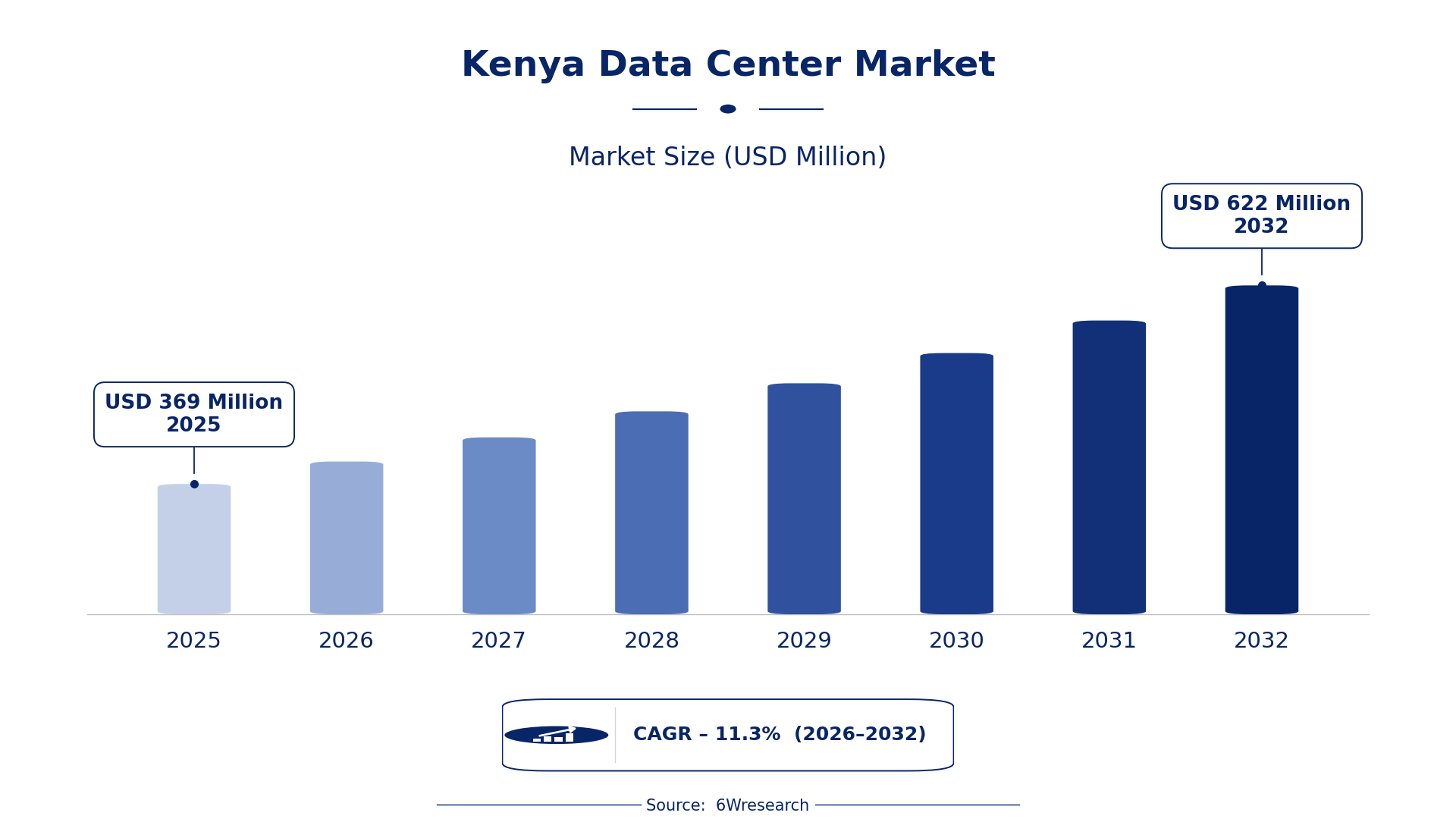
The Kenya Data Center Market was estimated at USD 369 Million in 2025 and is projected to reach USD 622 Million by 2032, growing at a CAGR of 11.3% from 2026 to 2032.
Kenya Data Center Market Synopsis
The demand for data center services in Kenya is surging, primarily driven by the explosive growth of cloud computing and e-commerce. Nairobi has emerged as the central hub, attracting both local and international businesses eager to capitalize on the region's digital transformation.
Data-intensive applications, coupled with ongoing investments in infrastructure, are pushing the boundaries of traditional data storage and processing capabilities. As companies continue to adopt digital solutions, the need for reliable and secure data centers becomes increasingly critical.
Kenya Data Center Market Year-wise Growth Rate and Key Drivers
This graph illustrates the annual growth rates of the Kenya Data Center Market from 2021 to 2032, highlighting a steady upward trajectory and projected expansion over the forecast period.
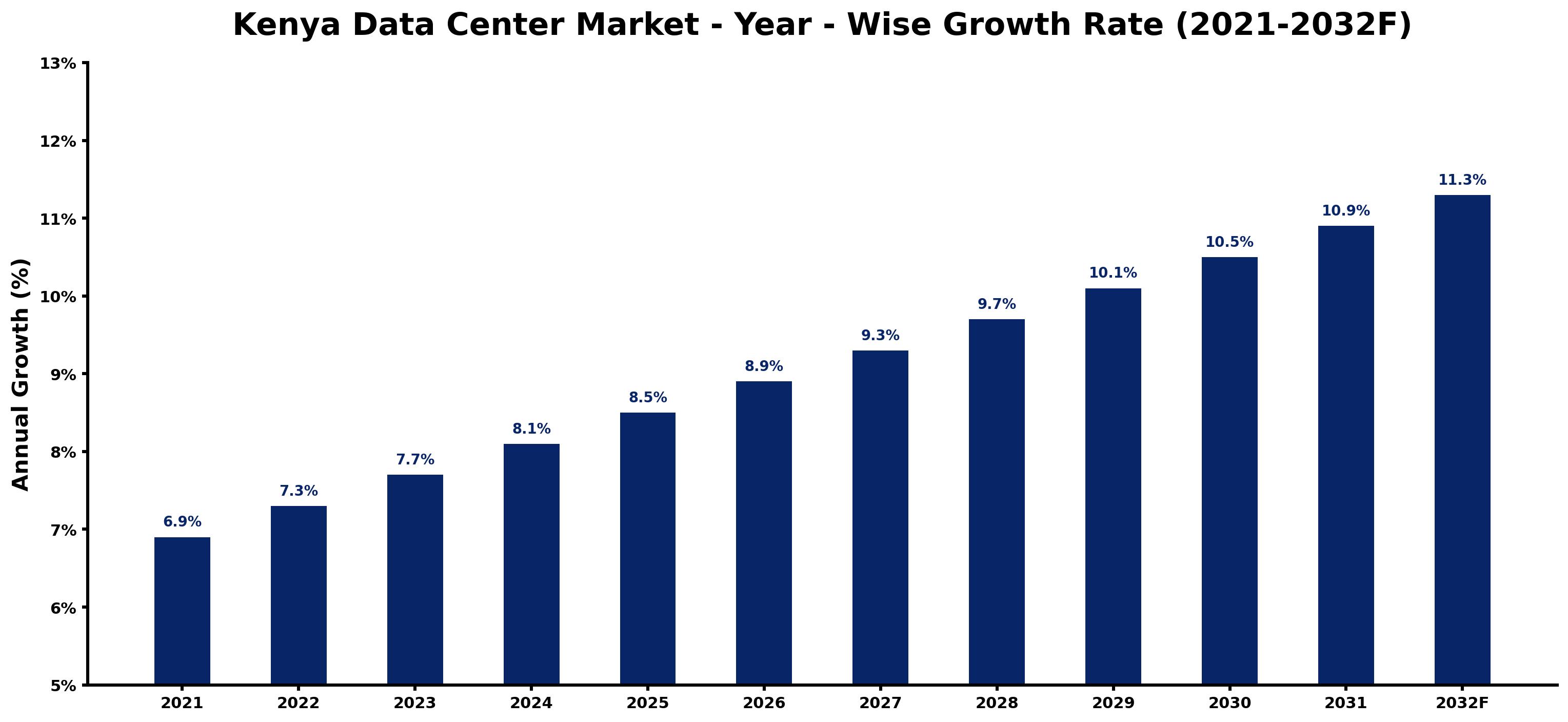
The table below presents the year‑wise growth rates along with the key drivers influencing the market
| Year | Growth Rate | Major Drivers |
| 2021 | 6.9% | New regulatory framework encourages cloud services adoption. |
| 2022 | 7.3% | Increased demand for mobile banking drives data center growth. |
| 2023 | 7.7% | Government's Vision 2030 promotes tech infrastructure development. |
| 2024 | 8.1% | Rising need for cybersecurity solutions boosts data management. |
| 2025 | 8.5% | Local startups drive demand for scalable infrastructure services. |
| 2026 | 8.9% | E-commerce growth necessitates enhanced data processing capabilities. |
| 2027 | 9.3% | Adoption of AI solutions increases data storage needs. |
| 2028 | 9.7% | Telecom upgrades improve internet access for data centers. |
| 2029 | 10.1% | Expanding educational institutions drive technological research initiatives. |
| 2030 | 10.5% | Local enterprises pushing for hybrid cloud solutions. |
| 2031 | 10.9% | Ongoing urbanization increases digital service demands. |
| 2032 | 11.3% | Emerging fintech companies require robust data processing. |
Note: Market size estimations and growth projections presented in this report are based on 6Wresearch's proprietary forecasting methodology, utilizing the latest available industry data, government publications, and primary research inputs.
Kenya Data Center Market Key Takeaways
Below are some of the specific key takeaways from the market, including:
- Growing demand for co-location and managed hosting services from various sectors.
- Significant investments in green technologies to enhance sustainability.
- Expansion of edge data centers to support IoT and real-time applications.
- Heightened focus on cybersecurity measures to combat rising threats.
- Government initiatives promoting digital infrastructure development are shaping market growth.
Evaluation of Restraints in Kenya Data Center Market
The Kenya Data Center Market faces several significant hurdles. A persistent power supply issue, coupled with high electricity costs, can severely hinder operational efficiency. Limited internet connectivity and expensive bandwidth further complicate service delivery, making it challenging for providers to meet the increasing demand. on top of that, a skills gap in IT professionals and strict regulatory requirements add layers of complexity, making it crucial for operators to navigate these challenges effectively.
Kenya Data Center Market Trends
Several trends are shaping the Kenya Data Center Market. The adoption of hybrid cloud solutions is on the rise, allowing businesses to balance between public and private cloud environments. Additionally, the development of edge data centers is gaining traction as companies strive to support IoT applications and reduce latency. Green data center technologies are becoming a priority, as businesses aim to minimize their carbon footprints while enhancing energy efficiency. on top of that, the emphasis on cybersecurity is intensifying, with operators investing heavily in measures to safeguard data integrity and privacy.
Kenya Data Center Market Opportunities
Investment opportunities in the Kenya Data Center Market are abundant. With Kenya positioning itself as a tech hub in East Africa, the demand for secure and reliable data storage solutions is skyrocketing. The ongoing digitalization and the increasing use of IoT devices, big data analytics, and AI technologies provide fertile ground for growth. As the government continues to enhance digital infrastructure, stakeholders can expect lucrative returns on investments aimed at expanding data center capabilities.
Government Initiatives in the Kenya Data Center Market
Government policy is crucial in shaping the Kenya Data Center Market, focusing on enhancing digital infrastructure and promoting foreign investment. Recent initiatives highlight a commitment to building a solid framework for data security and operational efficiency. With a supportive regulatory environment and ongoing infrastructure projects, the market is positioned for sustainable growth.
- A national digital infrastructure upgrade programme launched in 2023 aims to improve connectivity across urban and rural areas.
- Tax incentives introduced in 2022 for data center operators to encourage local and international investments.
- A regulatory framework enacted in 2021 to enhance data protection and privacy standards across all data centers.
- Ongoing efforts to streamline licensing processes for new data center establishments to facilitate quicker market entry.
- Planned public-private partnerships expected to be unveiled by 2025 to expand data center capacity and capabilities.
Future Insights of the Kenya Data Center Market
Looking ahead to 2026-2032, the Kenya Data Center Market is set for substantial growth. The continuous push for digital transformation across various sectors will drive demand for advanced data storage and processing capabilities. As businesses migrate to cloud solutions and adopt hybrid models, data center operators must innovate and expand their offerings. The government's commitment to improving digital infrastructure will further stimulate market activities, providing a conducive environment for both local and international players.
Kenya Data Center Market Latest Developments
Recent developments in the Kenya Data Center Market reflect a proactive approach toward meeting the growing demand for digital services. Operators are increasingly focusing on enhancing their infrastructure and service offerings to stay competitive. The past year has seen a flurry of activity, setting the stage for future expansion and innovation.
- A leading regional operator completed a major data center expansion in Q2 2023, increasing its capacity to meet rising demand.
- An initiative that began in early 2023 to upgrade existing data center facilities for improved energy efficiency is currently underway.
- A collaboration between technology vendors aimed at developing advanced cybersecurity solutions was initiated in late 2023.
- A rollout expected to begin in early 2025 focuses on establishing new edge data centers in strategic locations across the country.
- Plans for a new data center cluster in Nairobi are in the final stages, with construction expected to start in mid-2024.
Kenya Data Center Market - Key Attractiveness of the Report
- 10 Years of Market Numbers
- Historical Data Starting from 2022 to 2025
- Base Year: 2025
- Forecast Data until 2032
- Key Performance Indicators Impacting the Market
- Major Upcoming Developments and Projects
Key Highlights of the Report:
- Kenya Data Center Market Outlook
- Market Size of Kenya Data Center Market, 2025
- Forecast of Kenya Data Center Market, 2032
- Historical Data and Forecast of Kenya Data Center Revenues & Volume for the Period 2022-2032F
- Kenya Data Center Market Trend Evolution
- Kenya Data Center Market Drivers and Challenges
- Kenya Data Center Price Trends
- Kenya Data Center Porter's Five Forces
- Kenya Data Center Industry Life Cycle
- Historical Data and Forecast of Kenya Data Center Market Revenues & Volume By Component for the Period 2022-2032F
- Historical Data and Forecast of Kenya Data Center Market Revenues & Volume By Electrical for the Period 2022-2032F
- Historical Data and Forecast of Kenya Data Center Market Revenues & Volume By Mechanical for the Period 2022-2032F
- Historical Data and Forecast of Kenya Data Center Market Revenues & Volume By Networking for the Period 2022-2032F
- Historical Data and Forecast of Kenya Data Center Market Revenues & Volume By Racks for the Period 2022-2032F
- Historical Data and Forecast of Kenya Data Center Market Revenues & Volume By Security Systems for the Period 2022-2032F
- Historical Data and Forecast of Kenya Data Center Market Revenues & Volume By Fire Systems for the Period 2022-2032F
- Historical Data and Forecast of Kenya Data Center Market Revenues & Volume By Vertical for the Period 2022-2032F
- Historical Data and Forecast of Kenya Data Center Market Revenues & Volume By Banking Financial Services & Insurance (BFSI) for the Period 2022-2032F
- Historical Data and Forecast of Kenya Data Center Market Revenues & Volume By Government for the Period 2022-2032F
- Historical Data and Forecast of Kenya Data Center Market Revenues & Volume By IT & Telecom for the Period 2022-2032F
- Historical Data and Forecast of Kenya Data Center Market Revenues & Volume By Media for the Period 2022-2032F
- Historical Data and Forecast of Kenya Data Center Market Revenues & Volume By Retail for the Period 2022-2032F
- Historical Data and Forecast of Kenya Data Center Market Revenues & Volume By Manufacturing for the Period 2022-2032F
- Historical Data and Forecast of Kenya Data Center Market Revenues & Volume By Others for the Period 2022-2032F
- Kenya Data Center Import Export Trade Statistics
- Market Opportunity Assessment By Component
- Market Opportunity Assessment By Vertical
- Kenya Data Center Top Companies Market Share
- Kenya Data Center Competitive Benchmarking By Technical and Operational Parameters
- Kenya Data Center Company Profiles
- Kenya Data Center Key Strategic Recommendations






































