Kenya Drilling Services Market Size, Share & Growth Rate
The Kenya Drilling Services Market was estimated at USD 262 Million in 2025 and is projected to reach USD 360 Million by 2032, growing at a CAGR of 4.6% from 2026 to 2032. This growth trajectory is primarily fueled by an escalating demand for borehole drilling services across urban and rural landscapes, driven by the increasing need for clean water sources. Factors such as population growth, urbanization, and heightened awareness of water conservation are pivotal in shaping this market's evolution.
Kenya Drilling Services Market Year-wise Growth Rate and Key Drivers
This graph highlights how the Kenya Drilling Services Market has steadily grown over the years, supported by major growth factors.
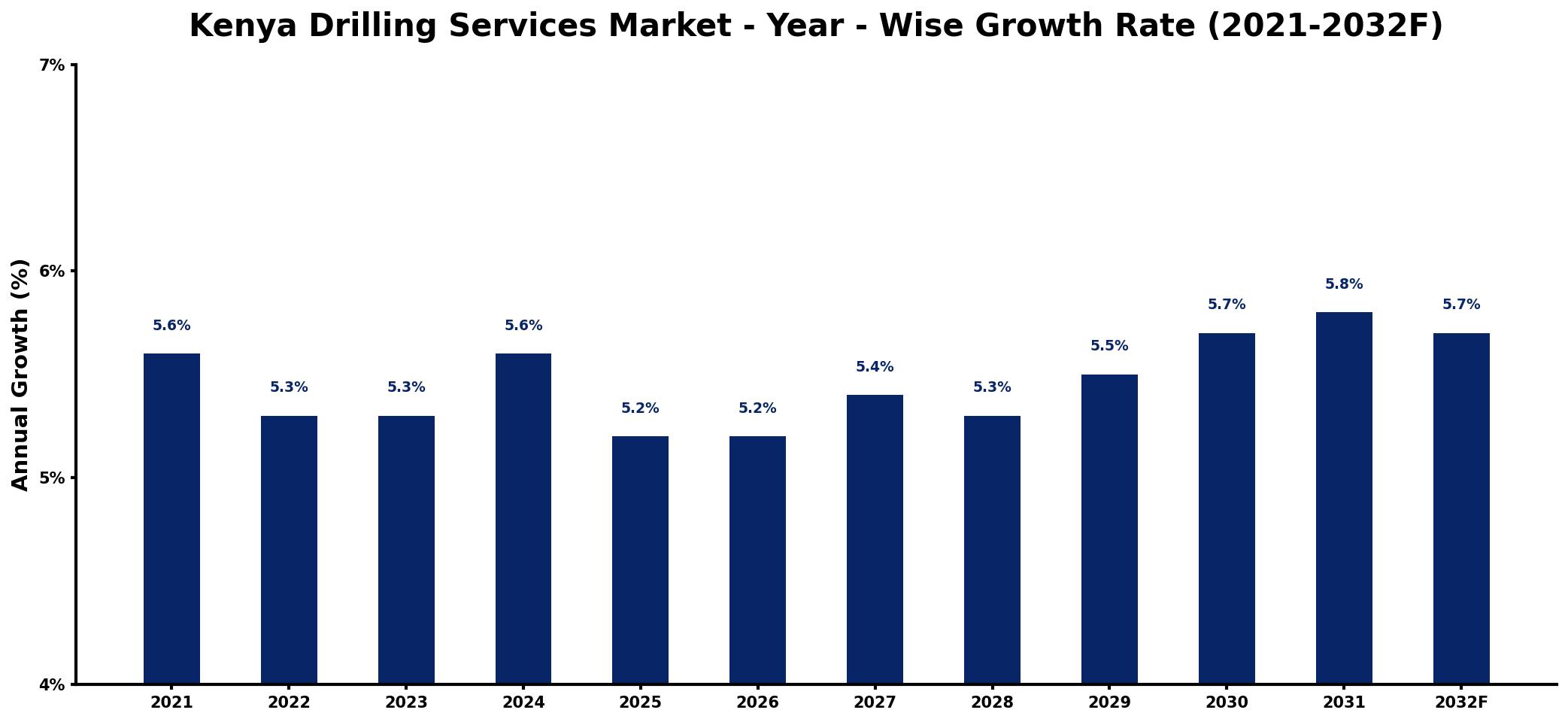
The table below presents the year‑wise growth rates along with the key drivers influencing the market
| Year | Growth Rate | Major Drivers |
| 2021 | 5.6% | Increased investment in infrastructure projects |
| 2022 | 5.3% | Rising demand for renewable energy |
| 2023 | 5.3% | Expansion of mining exploration activities |
| 2024 | 5.6% | Growing urbanization and housing needs |
| 2025 | 5.2% | Enhanced government regulations enforcement |
| 2026 | 5.2% | Technological advancements in exploration |
| 2027 | 5.4% | Surge in agricultural production requirements |
| 2028 | 5.3% | Boost in environmental sustainability initiatives |
| 2029 | 5.5% | Increase in foreign direct investments |
| 2030 | 5.7% | Development of new energy sources |
| 2031 | 5.8% | Rising population driving resource demand |
| 2032 | 5.7% | enhanced product quality standards |
Note: Market size estimations and growth projections presented in this report are based on 6Wresearch's proprietary forecasting methodology, utilizing the latest available industry data, government publications, and primary research inputs.
Kenya Drilling Services Market Synopsis
As water scarcity becomes an ever-pressing issue in Kenya, the demand for water well drilling services is surging. This demand is not limited to residential needs but extends significantly to agricultural and industrial applications, reflecting the multifaceted nature of water usage in the country.
Additionally, the market is witnessing a growing interest in geothermal drilling, attributed to Kenya's rich geothermal resources. This has opened up new avenues for drilling services as the nation aims to diversify its energy sources and reduce dependence on fossil fuels.
Kenya Drilling Services Market Key Takeaways
- Rising urbanization and population growth are key drivers of demand in the Kenya Drilling Services Market.
- Growing interest in geothermal energy exploration is creating new investment opportunities.
- Technological advancements are enhancing drilling efficiency, safety, and sustainability.
- Government initiatives aim to facilitate better access to clean water, positively impacting market growth.
- Infrastructure development challenges require strategic partnerships for successful project implementation.
Evaluation of Restraints in Kenya Drilling Services Market
Despite the market's promising growth prospects, several restraints hinder its full potential. Regulatory uncertainties concerning licensing and permits can lead to extended project timelines and increased operational costs. Additionally, the high cost of advanced drilling equipment poses a barrier for smaller companies entering the market. Limited access to skilled labor remains a significant challenge, impacting service delivery and operational efficiency. Furthermore, infrastructural limitations, such as inadequate road networks, complicate the logistics of reaching remote drilling sites, thus affecting project viability.
Kenya Drilling Services Market Trends
The Kenya Drilling Services Market is currently marked by several noteworthy trends. Notably, there is an increasing focus on environmentally sustainable drilling practices. Companies are adopting advanced technologies that minimize environmental impact while enhancing operational efficiency. Another significant trend is the heightened interest in digital solutions to improve data collection and analysis, leading to better decision-making in drilling operations. Additionally, the oil and gas sector's expanding exploration activities are propelling the demand for more specialized drilling services.
Kenya Drilling Services Market Opportunities
Investment opportunities abound in the Kenya Drilling Services Market, particularly driven by the urgent need for sustainable water supply solutions amid growing population pressures. The government's commitment to expanding renewable energy infrastructure, especially in geothermal energy, provides a lucrative avenue for investors. Companies can also explore opportunities in providing comprehensive maintenance and equipment supply services, catering to the increasing demand for high-quality drilling services. The alignment of private and public sector initiatives presents a strong foundation for strategic partnerships.
Government Initiatives in the Kenya Drilling Services Market
The Kenyan government has introduced several policies aimed at bolstering the drilling services market, focusing on sustainable development. The Water Act regulates water resource management and ensures responsible drilling activities to promote equitable access to clean water. The Environmental Management and Coordination Act mandates environmental assessments for drilling projects, aligning economic activities with environmental protection. Such frameworks are crucial in fostering a balanced approach to resource extraction and community welfare, contributing to long-term market stability.
Future Insights of the Kenya Drilling Services Market
Looking ahead to 2026-2032, the Kenya Drilling Services Market is poised for consistent growth, supported by increasing infrastructure investments and heightened demand for clean water resources. The government's initiatives to expand irrigation and improve water access will further stimulate demand for drilling services. Additionally, technological advancements are expected to continue reshaping the market landscape, promoting efficiency, and enhancing service delivery across various sectors. Overall, a robust future outlook underscores the significant potential for growth in this vital market.
Kenya Drilling Services Market Latest Developments (2025 - 2026)
In recent months, the Kenya Drilling Services Market has seen a surge in private sector investments, particularly focused on water well and geothermal drilling projects. Industry players are increasingly collaborating with local governments to expedite the delivery of drilling services while adhering to regulatory frameworks. Furthermore, advancements in drilling technologies, including the integration of AI and data analytics, are being embraced to enhance operational efficiencies and environmental compliance. These developments signal a dynamic shift towards modernized drilling practices that promise to shape the market in the near future.
Kenya Drilling Services Market - Key Attractiveness of the Report
- 10 Years of Market Numbers
- Historical Data Starting from 2022 to 2025
- Base Year: 2025
- Forecast Data until 2032
- Key Performance Indicators Impacting the Market
- Major Upcoming Developments and Projects
Key Highlights of the Report:
- Kenya Drilling Services Market Outlook
- Market Size of Kenya Drilling Services Market, 2025
- Forecast of Kenya Drilling Services Market, 2032
- Historical Data and Forecast of Kenya Drilling Services Revenues & Volume for the Period 2022-2032F
- Kenya Drilling Services Market Trend Evolution
- Kenya Drilling Services Market Drivers and Challenges
- Kenya Drilling Services Price Trends
- Kenya Drilling Services Porter's Five Forces
- Kenya Drilling Services Industry Life Cycle
- Historical Data and Forecast of Kenya Drilling Services Market Revenues & Volume By Service for the Period 2022-2032F
- Historical Data and Forecast of Kenya Drilling Services Market Revenues & Volume By Directional Drilling for the Period 2022-2032F
- Historical Data and Forecast of Kenya Drilling Services Market Revenues & Volume By Non-Directional Drilling for the Period 2022-2032F
- Historical Data and Forecast of Kenya Drilling Services Market Revenues & Volume By Application for the Period 2022-2032F
- Historical Data and Forecast of Kenya Drilling Services Market Revenues & Volume By Onshore for the Period 2022-2032F
- Historical Data and Forecast of Kenya Drilling Services Market Revenues & Volume By Offshore for the Period 2022-2032F
- Historical Data and Forecast of Kenya Drilling Services Market Revenues & Volume By End-User for the Period 2022-2032F
- Historical Data and Forecast of Kenya Drilling Services Market Revenues & Volume By Oil & Gas for the Period 2022-2032F
- Historical Data and Forecast of Kenya Drilling Services Market Revenues & Volume By Mining for the Period 2022-2032F
- Historical Data and Forecast of Kenya Drilling Services Market Revenues & Volume By Water Exploration for the Period 2022-2032F
- Historical Data and Forecast of Kenya Drilling Services Market Revenues & Volume By Others for the Period 2022-2032F
- Kenya Drilling Services Import Export Trade Statistics
- Market Opportunity Assessment By Service
- Market Opportunity Assessment By Application
- Market Opportunity Assessment By End-User
- Kenya Drilling Services Top Companies Market Share
- Kenya Drilling Services Competitive Benchmarking By Technical and Operational Parameters
- Kenya Drilling Services Company Profiles
- Kenya Drilling Services Key Strategic Recommendations






































