Kenya Foot Care Products Market Size, Share & Growth Rate
The Kenya Foot Care Products Market was estimated at USD 1252 Million in 2025 and is projected to reach USD 1828 Million by 2032, growing at a CAGR of 5.6% from 2026 to 2032. This growth trajectory is fueled by a surge in consumer awareness regarding foot health and a burgeoning interest in personal grooming. As urbanization continues to reshape lifestyles, Kenyans are increasingly investing in foot care products that offer both therapeutic benefits and everyday convenience.
Kenya Foot Care Products Market Year-wise Growth Rate and Key Drivers
This graph highlights how the Kenya Foot Care Products Market has steadily grown over the years, supported by major growth factors.
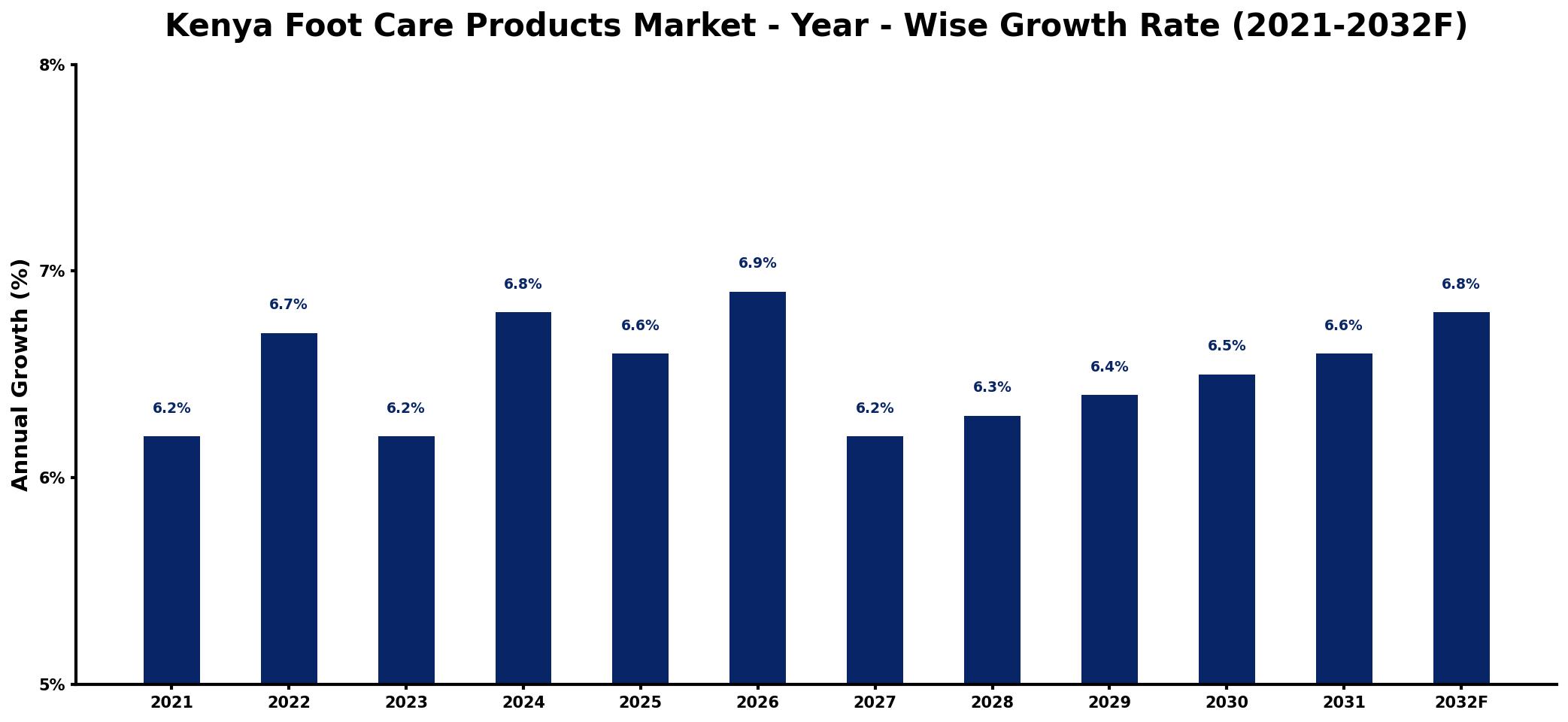
The table below presents the year‑wise growth rates along with the key drivers influencing the market
| Year | Growth Rate | Major Drivers |
| 2021 | 6.2% | Rising health awareness among consumers |
| 2022 | 6.7% | Increased disposable income levels |
| 2023 | 6.2% | Growth in online retail channels |
| 2024 | 6.8% | Expanding distribution networks nationwide |
| 2025 | 6.6% | Emergence of innovative formulations |
| 2026 | 6.9% | Growing demand for natural ingredients |
| 2027 | 6.2% | Increased focus on preventive wellness |
| 2028 | 6.3% | Surge in lifestyle-related ailments |
| 2029 | 6.4% | Strengthening local manufacturing capabilities |
| 2030 | 6.5% | Rising popularity of holistic treatments |
| 2031 | 6.6% | Enhanced marketing and promotional activities |
| 2032 | 6.8% | strengthening underlying market demand |
Note: Market size estimations and growth projections presented in this report are based on 6Wresearch's proprietary forecasting methodology, utilizing the latest available industry data, government publications, and primary research inputs.
Kenya Foot Care Products Market Synopsis
Rising disposable incomes and a cultural shift towards self-care are elevating the demand for foot care products in Kenya. This market reflects a unique blend of traditional practices and modern beauty standards, where foot creams, scrubs, and specialized treatments are becoming essential components of personal care regimens.
Additionally, the increasing inclination towards natural and organic ingredients is revolutionizing the landscape of the Kenya Foot Care Products Market. Consumers are not only looking for effective solutions for common foot ailments but also prioritizing eco-friendly and sustainable choices, highlighting a significant trend towards holistic foot care.
Kenya Foot Care Products Market Key Takeaways
- Steady growth in foot care product demand, fueled by rising awareness and disposable incomes.
- Increased preference for natural and organic ingredients among consumers.
- Innovative packaging and product formulations are gaining traction in the marketplace.
- Key distribution channels include supermarkets, pharmacies, and online platforms.
- Investment opportunities are emerging in manufacturing and specialized product development.
Evaluation of Restraints in Kenya Foot Care Products Market
Despite its promising outlook, the Kenya Foot Care Products Market faces several constraints. A significant portion of the consumer base remains unaware of the importance of foot care, leading to a lack of demand for specialized products. Furthermore, the proliferation of counterfeit goods poses a risk to consumer trust, complicating the landscape for legitimate brands. Rural areas often experience limited access to foot care products due to infrastructural challenges, and pricing sensitivity can deter consumers from opting for premium products. Addressing these issues will be crucial for sustained market growth.
Kenya Foot Care Products Market Trends
Emerging trends indicate a growing demand for multifunctional foot care products that address specific issues such as dryness, calluses, and fungal infections. Consumers are increasingly seeking moisturizing and antibacterial properties, reflecting a shift towards products that not only enhance appearance but also prioritize health. Brands are also innovating in packaging, focusing on eco-friendly materials to cater to the environmentally conscious consumer base. Furthermore, the influence of social media is reshaping marketing strategies, making it vital for companies to adapt to consumer preferences.
Kenya Foot Care Products Market Opportunities
The burgeoning interest in personal grooming presents significant investment opportunities in the Kenya Foot Care Products Market. Companies can explore avenues for manufacturing or distributing innovative products tailored to local preferences, such as natural creams and specialized footwear. There is also potential for online retail platforms to flourish, given the increasing digital penetration in urban areas. Partnerships with foot care specialists and podiatrists to create tailored product lines could differentiate brands and meet evolving consumer demands.
Government Initiatives in the Kenya Foot Care Products Market
The Kenyan government has established several regulations affecting the foot care products market, primarily through the Kenya Bureau of Standards (KEBS). These regulations ensure the quality and safety of foot care products to protect consumers. Import regulations are in place, necessitating compliance with specific standards for products entering the market. Additionally, taxation policies can influence product pricing, impacting affordability and market dynamics. Companies must stay abreast of these regulations to maintain competitive viability.
Future Insights of the Kenya Foot Care Products Market
Looking ahead to the period between 2026 and 2032, the Kenya Foot Care Products Market is poised for consistent growth. With increasing awareness of foot health and the rise of disposable incomes, consumers will likely continue seeking high-quality foot care products. The expansion of retail and e-commerce channels will improve product accessibility, while trends toward sustainability and natural ingredients will shape the offerings from brands. This evolving market landscape presents fertile ground for both local and international players.
Kenya Foot Care Products Market Latest Developments (2025 - 2026)
Recent developments in the Kenya Foot Care Products Market indicate a shift towards more sophisticated product offerings and marketing strategies. Many companies are prioritizing product innovation, particularly in the use of natural ingredients. There is a noticeable increase in partnerships between retailers and foot care specialists, leading to more personalized product recommendations. Furthermore, the integration of e-commerce platforms is making foot care products more accessible, which is expected to boost overall market growth.
Kenya Foot Care Products Market - Key Attractiveness of the Report
- 10 Years of Market Numbers
- Historical Data Starting from 2022 to 2025
- Base Year: 2025
- Forecast Data until 2032
- Key Performance Indicators Impacting the Market
- Major Upcoming Developments and Projects
Key Highlights of the Report:
- Kenya Foot Care Products Market Outlook
- Market Size of Kenya Foot Care Products Market, 2025
- Forecast of Kenya Foot Care Products Market, 2032
- Historical Data and Forecast of Kenya Foot Care Products Revenues & Volume for the Period 2022-2032F
- Kenya Foot Care Products Market Trend Evolution
- Kenya Foot Care Products Market Drivers and Challenges
- Kenya Foot Care Products Price Trends
- Kenya Foot Care Products Porter's Five Forces
- Kenya Foot Care Products Industry Life Cycle
- Historical Data and Forecast of Kenya Foot Care Products Market Revenues & Volume By Application for the Period 2022-2032F
- Historical Data and Forecast of Kenya Foot Care Products Market Revenues & Volume By Sports & Athletics for the Period 2022-2032F
- Historical Data and Forecast of Kenya Foot Care Products Market Revenues & Volume By Medical for the Period 2022-2032F
- Historical Data and Forecast of Kenya Foot Care Products Market Revenues & Volume By Personal Comfort for the Period 2022-2032F
- Historical Data and Forecast of Kenya Foot Care Products Market Revenues & Volume By Distribution Channel for the Period 2022-2032F
- Historical Data and Forecast of Kenya Foot Care Products Market Revenues & Volume By Drug Stores & Pharmacies for the Period 2022-2032F
- Historical Data and Forecast of Kenya Foot Care Products Market Revenues & Volume By Hospitals & Specialty Clinics for the Period 2022-2032F
- Historical Data and Forecast of Kenya Foot Care Products Market Revenues & Volume By Online Stores for the Period 2022-2032F
- Historical Data and Forecast of Kenya Foot Care Products Market Revenues & Volume By Others for the Period 2022-2032F
- Kenya Foot Care Products Import Export Trade Statistics
- Market Opportunity Assessment By Application
- Market Opportunity Assessment By Distribution Channel
- Kenya Foot Care Products Top Companies Market Share
- Kenya Foot Care Products Competitive Benchmarking By Technical and Operational Parameters
- Kenya Foot Care Products Company Profiles
- Kenya Foot Care Products Key Strategic Recommendations






































