Tanzania Foot Care Products Market Size, Share & Growth Rate
The Tanzania Foot Care Products Market was estimated at USD 208 Million in 2025 and is projected to reach USD 283 Million by 2032, growing at a CAGR of 4.5% from 2026 to 2032. This growth is fueled by rising disposable incomes and a heightened awareness surrounding foot health among consumers. As individuals increasingly prioritize personal grooming and well-being, the demand for a diverse array of foot care products is expected to surge.
Tanzania Foot Care Products Market Year-wise Growth Rate and Key Drivers
This graph highlights how the Tanzania Foot Care Products Market has steadily grown over the years, supported by major growth factors.
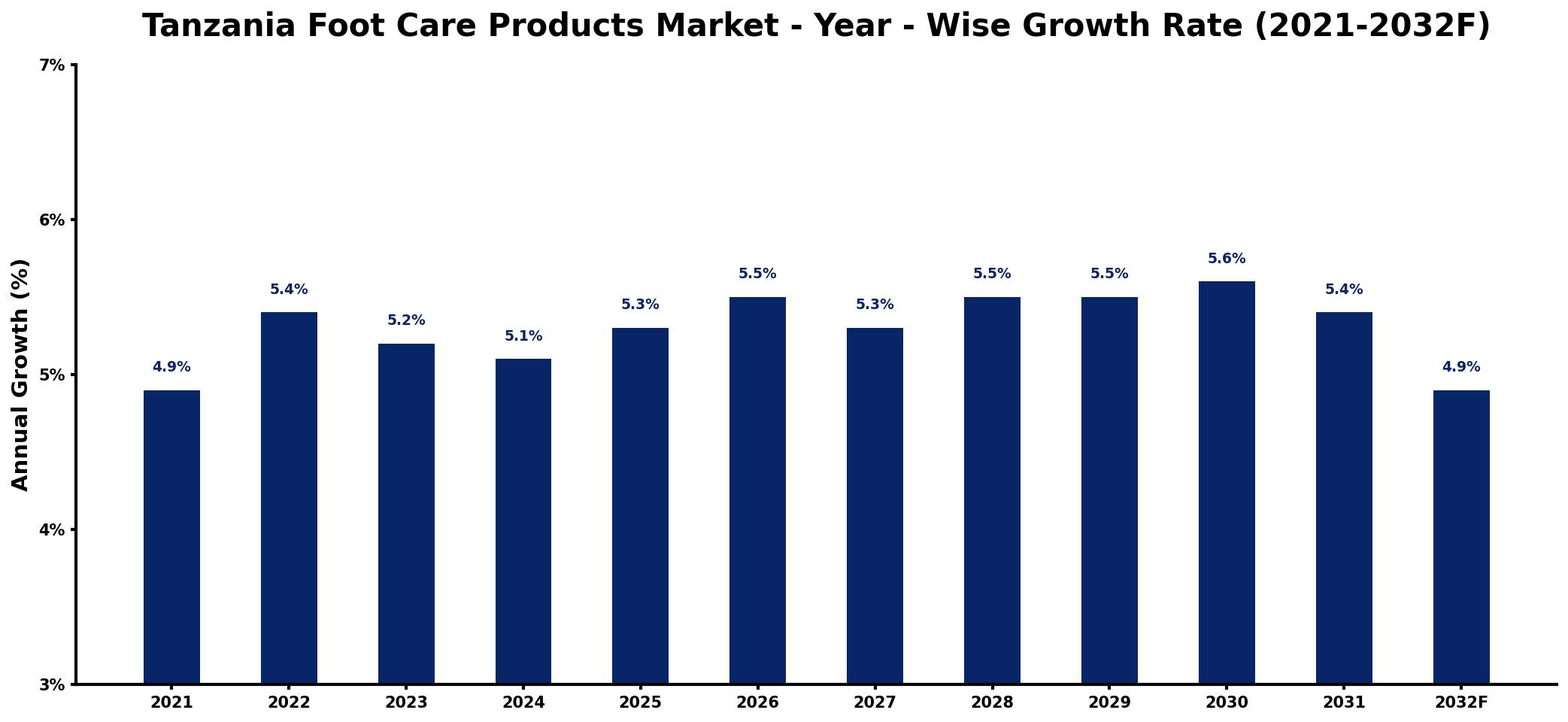
The table below presents the year‑wise growth rates along with the key drivers influencing the market
| Year | Growth Rate | Major Drivers |
| 2021 | 4.9% | Rising health awareness among consumers |
| 2022 | 5.4% | Increased disposable income levels |
| 2023 | 5.2% | Growing e-commerce market penetration |
| 2024 | 5.1% | Expanding retail distribution channels |
| 2025 | 5.3% | Surge in online shopping adoption |
| 2026 | 5.5% | Investment in local manufacturing facilities |
| 2027 | 5.3% | Enhanced promotional marketing strategies |
| 2028 | 5.5% | Growth in preventive health measures |
| 2029 | 5.5% | Emerging trends in wellness tourism |
| 2030 | 5.6% | Rising influence of social media |
| 2031 | 5.4% | Growing interest in organic alternatives |
| 2032 | 4.9% | Increased focus on sustainability practices |
Note: Market size estimations and growth projections presented in this report are based on 6Wresearch's proprietary forecasting methodology, utilizing the latest available industry data, government publications, and primary research inputs.
Tanzania Foot Care Products Market Synopsis
Currently, the Tanzania Foot Care Products Market is witnessing an upswing, driven by a growing consumer base that values foot health and hygiene. A broad spectrum of products is available, ranging from creams and scrubs to specialized treatments for common foot ailments.
Moreover, the increasing popularity of natural and organic foot care solutions resonates with consumers seeking safer, chemical-free alternatives. This shift towards more conscious consumerism is significantly influencing purchasing behavior and product development.
Tanzania Foot Care Products Market Key Takeaways
- Growing consumer awareness about foot health is driving market demand.
- Product innovation is crucial, focusing on convenience and multifunctional benefits.
- Natural and organic products are gaining traction among health-conscious consumers.
- Effective distribution channels are vital for reaching diverse demographics, including rural areas.
- Investment opportunities abound in specialized and eco-friendly product development.
Evaluation of Restraints in Tanzania Foot Care Products Market
The Tanzania Foot Care Products Market faces significant challenges, particularly in enhancing consumer awareness regarding the importance of foot care, especially in remote and rural regions. Many consumers still rely on traditional remedies due to limited access to information and products. Affordability is also a considerable barrier, as many high-quality foot care items remain out of reach for a substantial portion of the population. Furthermore, a lack of robust distribution networks hampers effective product accessibility, leading to reliance on conventional home remedies rather than commercial solutions.
Tanzania Foot Care Products Market Trends
Emerging trends indicate a distinct consumer preference for products that not only provide targeted solutions but also promote overall foot health. Multifunctional foot care products that combine moisturizing, exfoliating, and antifungal properties are becoming increasingly sought after. Additionally, there is a palpable shift towards sustainability, with brands adopting eco-friendly packaging and organic formulations to align with consumer values.
Tanzania Foot Care Products Market Opportunities
As the market matures, significant growth opportunities lie in the development of localized foot care products that address specific concerns prevalent within the Tanzanian demographic. Investments in marketing specialized foot care items, such as creams for fungal infections and innovative solutions like orthotic inserts, are likely to yield favorable returns. Furthermore, collaborations with local healthcare providers and retailers will enhance market penetration and cater to the evolving preferences of consumers seeking both efficacy and sustainability.
Government Initiatives in the Tanzania Foot Care Products Market
The Tanzanian government has put forth several initiatives to enhance the Foot Care Products Market, primarily focusing on ensuring product safety and quality. The Tanzania Bureau of Standards (TBS) enforces regulations to monitor the market, preventing the circulation of counterfeit or substandard products. These measures not only protect consumer health but also bolster the market's credibility, encouraging fair competition among manufacturers.
Future Insights of the Tanzania Foot Care Products Market
Looking ahead to 2026-2032, the Tanzania Foot Care Products Market is poised for steady expansion. Increased disposable income and a rise in lifestyle-related foot issues will likely propel demand for specialized foot care solutions. Additionally, as awareness around foot health continues to grow, manufacturers are expected to leverage product innovation to cater to the diversifying needs of consumers, thus unlocking new market potential.
Tanzania Foot Care Products Market Latest Developments (2025 - 2026)
In recent months, the industry has observed a surge in interest surrounding natural formulations and eco-friendly products. Companies are increasingly investing in research and development to create effective foot care solutions that meet the rising demand for organic ingredients. Additionally, brands are enhancing their digital presence and utilizing social media platforms to educate consumers about foot health and the benefits of their products.
Tanzania Foot Care Products Market - Key Attractiveness of the Report
- 10 Years of Market Numbers
- Historical Data Starting from 2022 to 2025
- Base Year: 2025
- Forecast Data until 2032
- Key Performance Indicators Impacting the Market
- Major Upcoming Developments and Projects
Key Highlights of the Report:
- Tanzania Foot Care Products Market Outlook
- Market Size of Tanzania Foot Care Products Market, 2025
- Forecast of Tanzania Foot Care Products Market, 2032
- Historical Data and Forecast of Tanzania Foot Care Products Revenues & Volume for the Period 2022-2032F
- Tanzania Foot Care Products Market Trend Evolution
- Tanzania Foot Care Products Market Drivers and Challenges
- Tanzania Foot Care Products Price Trends
- Tanzania Foot Care Products Porter's Five Forces
- Tanzania Foot Care Products Industry Life Cycle
- Historical Data and Forecast of Tanzania Foot Care Products Market Revenues & Volume By Application for the Period 2022-2032F
- Historical Data and Forecast of Tanzania Foot Care Products Market Revenues & Volume By Sports & Athletics for the Period 2022-2032F
- Historical Data and Forecast of Tanzania Foot Care Products Market Revenues & Volume By Medical for the Period 2022-2032F
- Historical Data and Forecast of Tanzania Foot Care Products Market Revenues & Volume By Personal Comfort for the Period 2022-2032F
- Historical Data and Forecast of Tanzania Foot Care Products Market Revenues & Volume By Distribution Channel for the Period 2022-2032F
- Historical Data and Forecast of Tanzania Foot Care Products Market Revenues & Volume By Drug Stores & Pharmacies for the Period 2022-2032F
- Historical Data and Forecast of Tanzania Foot Care Products Market Revenues & Volume By Hospitals & Specialty Clinics for the Period 2022-2032F
- Historical Data and Forecast of Tanzania Foot Care Products Market Revenues & Volume By Online Stores for the Period 2022-2032F
- Historical Data and Forecast of Tanzania Foot Care Products Market Revenues & Volume By Others for the Period 2022-2032F
- Tanzania Foot Care Products Import Export Trade Statistics
- Market Opportunity Assessment By Application
- Market Opportunity Assessment By Distribution Channel
- Tanzania Foot Care Products Top Companies Market Share
- Tanzania Foot Care Products Competitive Benchmarking By Technical and Operational Parameters
- Tanzania Foot Care Products Company Profiles
- Tanzania Foot Care Products Key Strategic Recommendations






































