Kenya Gold Bullion Market Size, Share & Growth Rate
The Kenya Gold Bullion Market was estimated at USD 285 Million in 2025 and is projected to reach USD 379 Million by 2032, growing at a CAGR of 4.2% from 2026 to 2032. This growth trajectory is fueled by a notable increase in individual and institutional investment in gold as a secure asset amidst economic volatility and inflationary pressures. Furthermore, the rising awareness of gold's long-term value as a hedge against currency fluctuations is driving the demand for physical gold bullion in Kenya.
Kenya Gold Bullion Market Year-wise Growth Rate and Key Drivers
This graph highlights how the Kenya Gold Bullion Market has steadily grown over the years, supported by major growth factors.
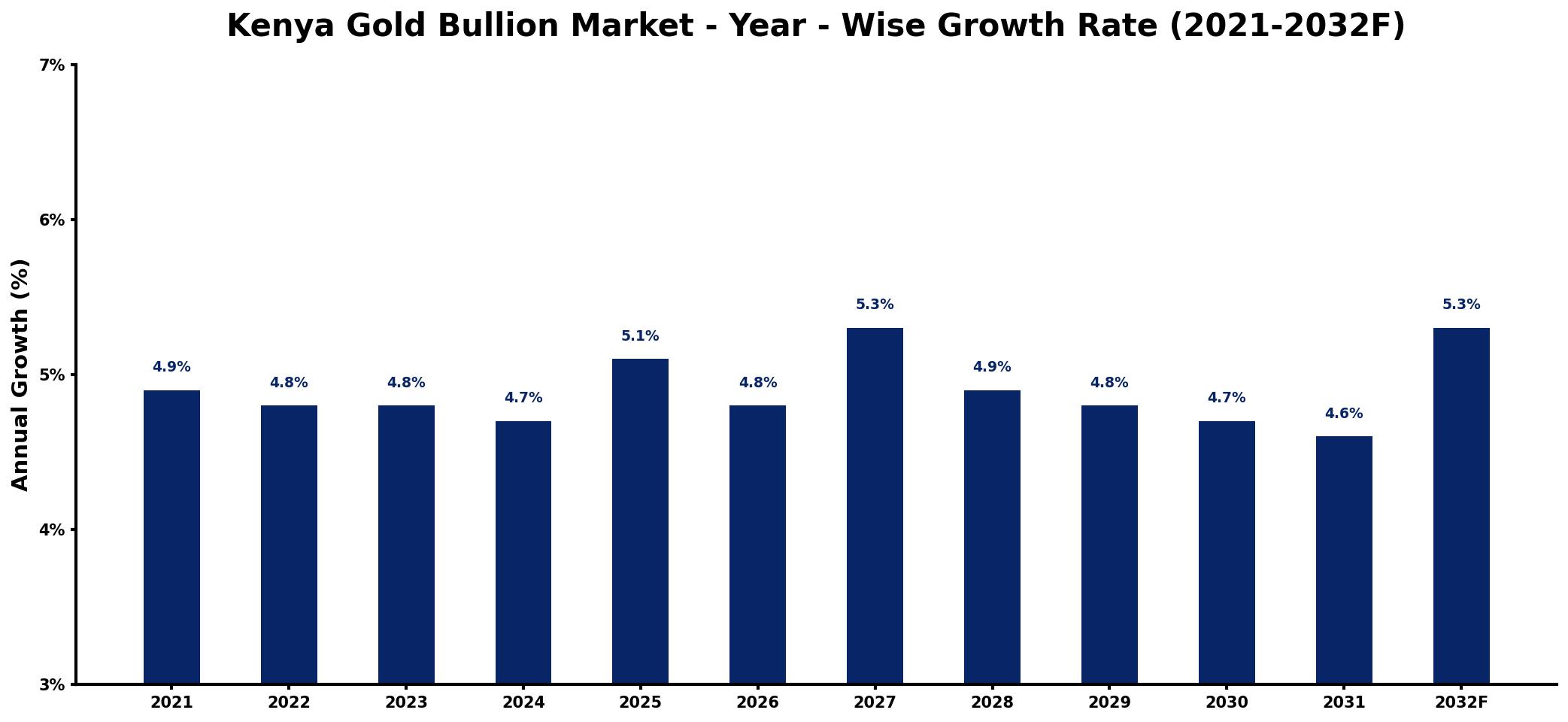
The table below presents the year‑wise growth rates along with the key drivers influencing the market
| Year | Growth Rate | Major Drivers |
| 2021 | 4.9% | Increased investor interest globally |
| 2022 | 4.8% | Rise in alternative asset allocations |
| 2023 | 4.8% | Growing demand for secure investments |
| 2024 | 4.7% | Surge in wealth preservation strategies |
| 2025 | 5.1% | Expansion of retail investment platforms |
| 2026 | 4.8% | Increased market accessibility online |
| 2027 | 5.3% | Higher institutional investment participation |
| 2028 | 4.9% | Growth in cross-border trading activities |
| 2029 | 4.8% | Rising popularity of digital assets |
| 2030 | 4.7% | Increased awareness of inflation hedging |
| 2031 | 4.6% | expanding healthcare application demand |
| 2032 | 5.3% | increased production capacity utilization |
Note: Market size estimations and growth projections presented in this report are based on 6Wresearch's proprietary forecasting methodology, utilizing the latest available industry data, government publications, and primary research inputs.
Kenya Gold Bullion Market Synopsis
The Kenya Gold Bullion Market has recently witnessed significant momentum, marked by an uptick in individual investments and institutional interest in gold as a reliable store of value. This momentum is set against a backdrop of increasing economic uncertainties that make gold an attractive option for risk-averse investors. Moving forward, the market is poised for further growth, driven by evolving investment strategies and greater awareness of gold's strategic value.
As the sector matures, there is a clear shift towards ethical sourcing and sustainable practices, reflecting the demands of conscientious consumers. This evolving landscape presents both challenges and opportunities, as market participants must navigate regulatory frameworks while adhering to enhanced standards of transparency and accountability.
Kenya Gold Bullion Market Key Takeaways
- The market is driven by growing demand for physical gold as a hedge against economic instability.
- Gold bullion bars and coins are favored for their liquidity and ease of storage.
- There is a rising trend towards ethical sourcing and responsible mining practices.
- Investors should conduct thorough research to navigate market complexities.
- Regulatory frameworks are evolving to enhance market integrity and combat illegal trade.
Evaluation of Restraints in Kenya Gold Bullion Market
Despite its growth potential, the Kenya Gold Bullion Market faces several restraints that hinder its full realization. A lack of transparency in pricing and transactions can breed distrust among buyers and sellers, complicating market dynamics. Furthermore, smuggling and illegal trade practices not only threaten the integrity of the market but also undermine legitimate business efforts and government revenues. Addressing these challenges necessitates a concerted effort from all stakeholders to foster a more transparent and regulated environment.
Kenya Gold Bullion Market Trends
Current trends indicate a burgeoning interest in gold investments as a safeguard against inflation and market volatility. Additionally, the popularity of gold as a tangible asset continues to rise among both individual and institutional investors, illustrating a significant shift in investment preferences. The emphasis on sustainability and ethical sourcing is shaping consumer behavior, further prompting market players to adapt to this new demand landscape. As a result, initiatives focused on responsible mining practices are becoming increasingly prominent in shaping the market's future.
Kenya Gold Bullion Market Opportunities
Investment opportunities in the Kenya Gold Bullion Market are varied and robust. Investors can explore purchasing physical gold bars or coins through reputable dealers, engage in gold exchange-traded funds (ETFs), or consider investing in shares of gold mining companies. These avenues provide opportunities for capital appreciation, particularly in times of economic downturns. Moreover, the increasing acceptance of gold as a key asset class offers new paths for portfolio diversification and risk management.
Government Initiatives in the Kenya Gold Bullion Market
The Kenyan government has put forth several initiatives to regulate the Gold Bullion Market, aiming to enhance industry integrity and deter illegal activities. The Mining Act of 2016 mandates gold traders to acquire proper licenses and adhere to strict regulations that promote accountability and transparency. Additionally, the Central Bank of Kenya has introduced guidelines to oversee gold bullion imports and exports, which help combat money laundering and safeguard against illicit financial flows, ultimately fostering a healthier investment environment.
Future Insights of the Kenya Gold Bullion Market
Looking ahead to 2026-2032, the Kenya Gold Bullion Market is set to experience steady growth, fueled by the countrys expanding economy and an increasing shift towards gold as an alternative investment. Heightened global uncertainties and geopolitical tensions are likely to enhance the appeal of gold among investors seeking safe-haven assets. Government efforts to bolster regulatory frameworks and improve market conditions will further attract both domestic and international investors, positioning Kenya as a pivotal player in the East African gold sector.
Kenya Gold Bullion Market Latest Developments (2025 - 2026)
Recent developments in the Kenya Gold Bullion Market indicate a strengthening of regulatory frameworks as the government continues to emphasize transparency and combat illegal activities. Market participants are increasingly adopting sustainable practices in their operations, responding to consumer demand for ethically sourced gold. Additionally, new investment channels and platforms are emerging, offering greater accessibility and variety for investors looking to diversify their portfolios in the gold sector.
Kenya Gold Bullion Market - Key Attractiveness of the Report
- 10 Years of Market Numbers
- Historical Data Starting from 2022 to 2025
- Base Year: 2025
- Forecast Data until 2032
- Key Performance Indicators Impacting the Market
- Major Upcoming Developments and Projects
Key Highlights of the Report:
- Kenya Gold Bullion Market Outlook
- Market Size of Kenya Gold Bullion Market, 2025
- Forecast of Kenya Gold Bullion Market, 2032
- Historical Data and Forecast of Kenya Gold Bullion Revenues & Volume for the Period 2022-2032F
- Kenya Gold Bullion Market Trend Evolution
- Kenya Gold Bullion Market Drivers and Challenges
- Kenya Gold Bullion Price Trends
- Kenya Gold Bullion Porter's Five Forces
- Kenya Gold Bullion Industry Life Cycle
- Historical Data and Forecast of Kenya Gold Bullion Market Revenues & Volume By Type for the Period 2022-2032F
- Historical Data and Forecast of Kenya Gold Bullion Market Revenues & Volume By Gold Bar for the Period 2022-2032F
- Historical Data and Forecast of Kenya Gold Bullion Market Revenues & Volume By Gold Coin for the Period 2022-2032F
- Historical Data and Forecast of Kenya Gold Bullion Market Revenues & Volume By Distribution Channel for the Period 2022-2032F
- Historical Data and Forecast of Kenya Gold Bullion Market Revenues & Volume By Online for the Period 2022-2032F
- Historical Data and Forecast of Kenya Gold Bullion Market Revenues & Volume By Offline for the Period 2022-2032F
- Kenya Gold Bullion Import Export Trade Statistics
- Market Opportunity Assessment By Type
- Market Opportunity Assessment By Distribution Channel
- Kenya Gold Bullion Top Companies Market Share
- Kenya Gold Bullion Competitive Benchmarking By Technical and Operational Parameters
- Kenya Gold Bullion Company Profiles
- Kenya Gold Bullion Key Strategic Recommendations






































