Kenya Image Recognition Market Size & Growth Rate (2026-2032)
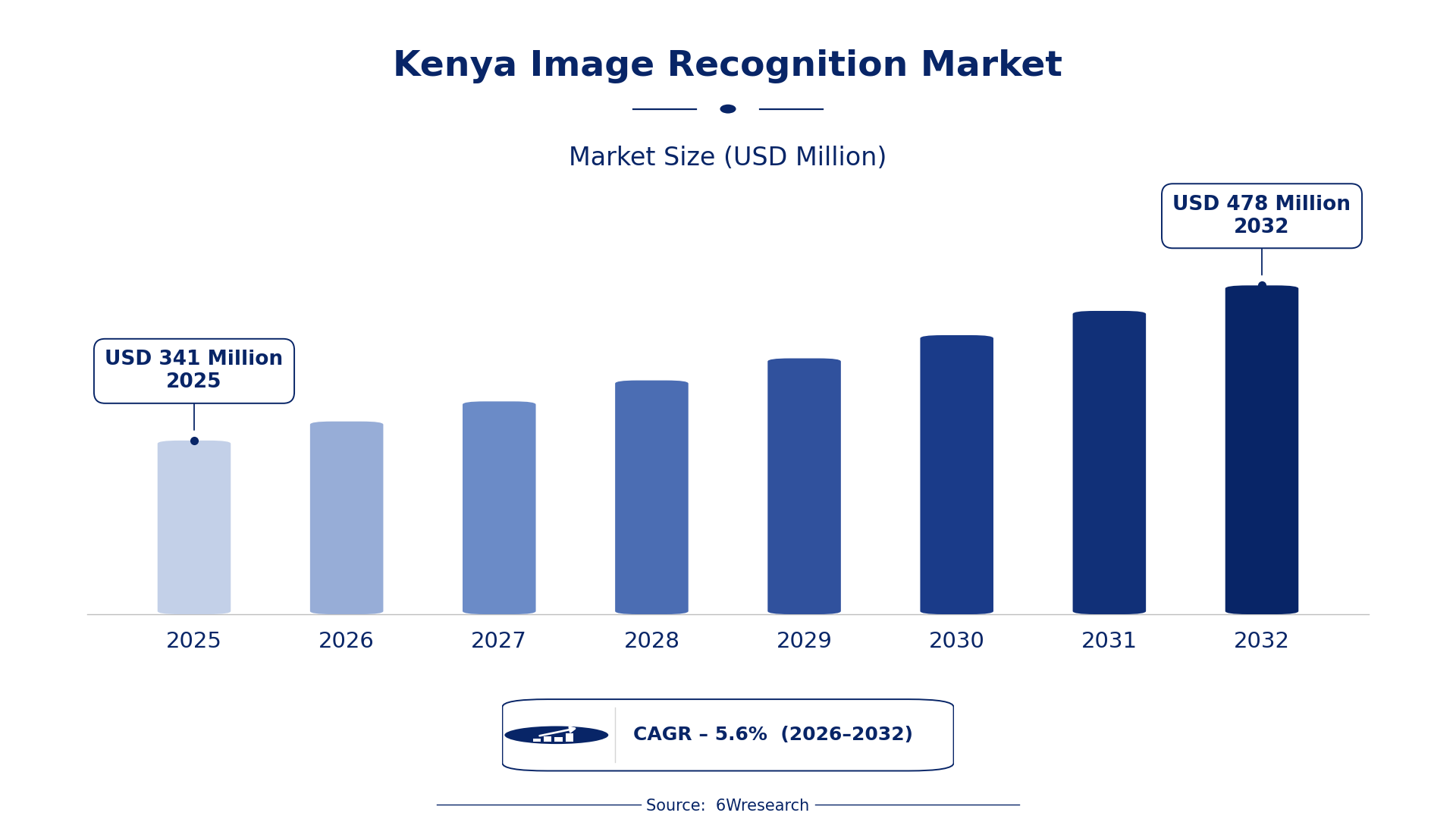
The Kenya Image Recognition Market was estimated at USD 341 Million in 2025 and is projected to reach USD 478 Million by 2032, growing at a CAGR of 5.6% from 2026 to 2032.
Kenya Image Recognition Market Synopsis
The Kenya Image Recognition Market has witnessed notable momentum recently, driven primarily by advancements in artificial intelligence and machine learning. This growth is fueled by increasing demand from various sectors, including healthcare and retail, as businesses seek to enhance operations and security.
Looking ahead, the market is set for continued expansion as more organizations recognize the potential of image recognition technologies. With a tech-savvy population and supportive governmental policies, the conditions are ripe for innovation and investment in this dynamic sector.
Kenya Image Recognition Market Year-wise Growth Rate and Key Drivers
This graph illustrates the annual growth rates of the Kenya Image Recognition Market from 2021 to 2032, highlighting a steady upward trajectory and projected expansion over the forecast period.
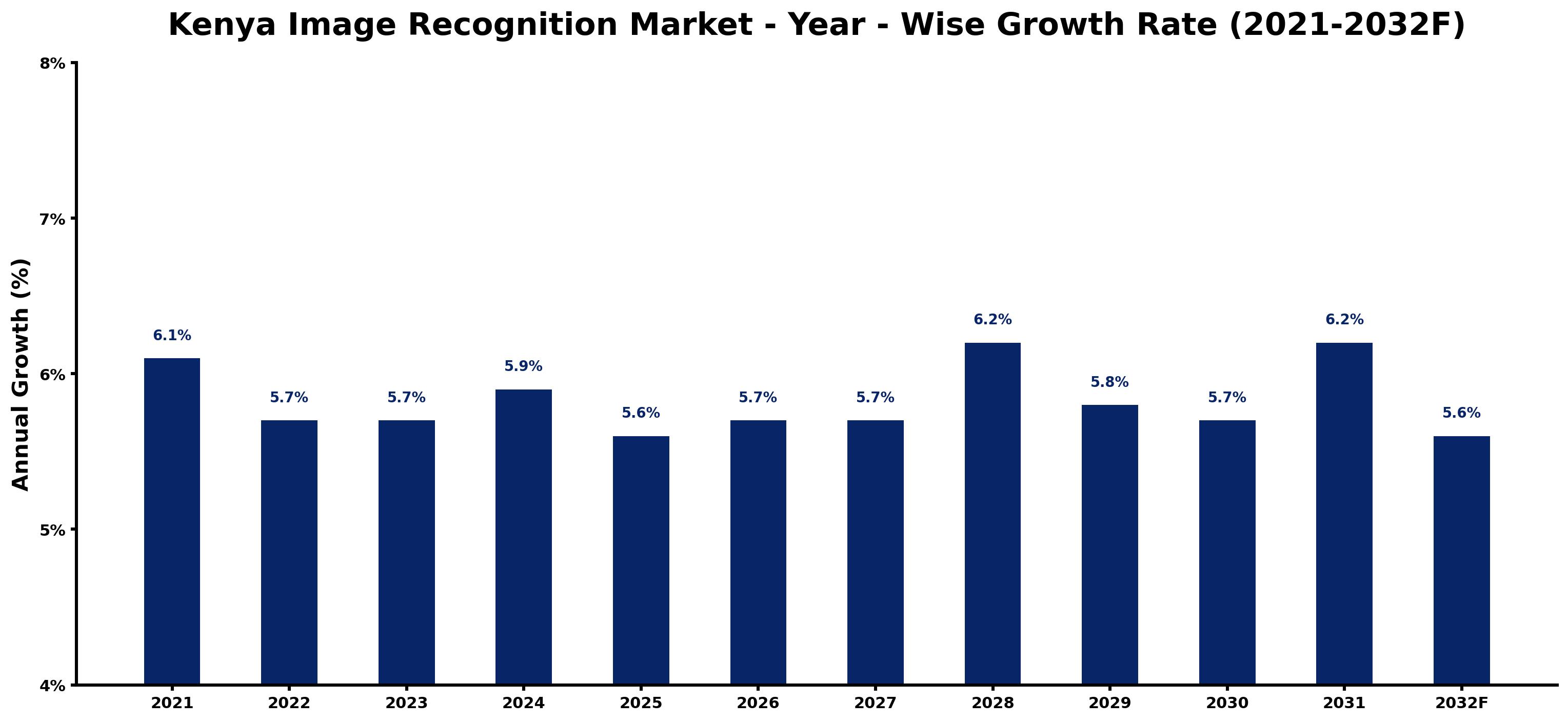
The table below presents the year‑wise growth rates along with the key drivers influencing the market
| Year | Growth Rate | Major Drivers |
| 2021 | 6.1% | Increased mobile penetration enhancing software accessibility. |
| 2022 | 5.7% | Government support for AI in security applications. |
| 2023 | 5.7% | Growing retail sector adopting visual search technologies. |
| 2024 | 5.9% | Rise in mobile payments driving image-based authentication. |
| 2025 | 5.6% | Demand for urban surveillance spurring image analysis investments. |
| 2026 | 5.7% | Boost in e-commerce necessitating product recognition tools. |
| 2027 | 5.7% | Educational institutions integrating image recognition in learning. |
| 2028 | 6.2% | Launch of new image recognition startups in Nairobi. |
| 2029 | 5.8% | Health sector implementing facial recognition for patient identification. |
| 2030 | 5.7% | Insurance companies leveraging images for claims processing. |
| 2031 | 6.2% | Tourism sector adopting image recognition for enhanced experiences. |
| 2032 | 5.6% | Local tech hubs promoting innovation in image processing solutions. |
Note: Market size estimations and growth projections presented in this report are based on 6Wresearch's proprietary forecasting methodology, utilizing the latest available industry data, government publications, and primary research inputs.
Kenya Image Recognition Market Key Takeaways
Below are some of the specific key takeaways from the market, including:
- The market is experiencing steady growth, driven by AI adoption across multiple industries.
- Healthcare and security sectors are leading in demand for image recognition solutions.
- Government initiatives are enhancing the ecosystem for digital transformation.
- Cloud-based services are increasingly popular, reflecting a shift in technology usage.
- Startups are emerging with tailored solutions, catering to specific industry needs.
Evaluation of Restraints in Kenya Image Recognition Market
Several factors are currently holding back the Kenya Image Recognition Market. Limited access to high-quality training data remains a significant barrier, hindering the development of effective algorithms. Additionally, the shortage of skilled talent complicates efforts to innovate and advance the technology further.
Infrastructure constraints also pose challenges, impacting the ability of businesses to implement and maintain sophisticated image recognition systems. on top of that, data privacy concerns are increasingly coming to the forefront, affecting user trust and adoption rates.
Kenya Image Recognition Market Trends
Several trends are shaping the Kenya Image Recognition Market. The integration of image recognition technology into mobile applications is a notable development, enhancing user experiences across various platforms. on top of that, there is a growing emphasis on the development of advanced algorithms to improve accuracy and efficiency.
The use of image recognition in security systems is on the rise, driven by increasing safety concerns. Additionally, a shift towards cloud-based image recognition services is evident, as businesses aim to reduce costs and improve scalability.
Kenya Image Recognition Market Opportunities
The Kenya Image Recognition Market presents numerous investment opportunities. With increasing adoption across sectors such as healthcare, agriculture, and retail, there’s a growing demand for innovative solutions. Companies that specialize in developing tailored software and hardware can find a receptive audience in this evolving market.
Strategic partnerships with local startups focused on niche image recognition applications can provide a significant entry point for investors. As the technology landscape continues to evolve, the potential for returns on investment appears promising.
Government Initiatives in the Kenya Image Recognition Market
The Kenyan government is actively shaping the image recognition market through various initiatives aimed at enhancing digital capabilities. By focusing on digital transformation, the government is creating an environment conducive to the growth of image recognition technologies. These efforts include policies that encourage innovation and investment in the tech sector.
- The Kenya National ICT Policy, recently updated, supports the development of information and communication technologies, including image recognition.
- A current initiative involves the Digital Literacy Program, enhancing skills and knowledge in digital technologies.
- Ongoing efforts to expand broadband access are critical for supporting image recognition applications across the country.
- Plans for a National Innovation Agency are in place to bolster startup growth in tech sectors, including image recognition.
- Upcoming projects focus on integrating image recognition in public safety initiatives, set to launch by mid-2026.
Future Insights of the Kenya Image Recognition Market
In the period from 2026 to 2032, the Kenya Image Recognition Market is expected to see significant advancements driven by technological innovations. The growing use of smartphones equipped with advanced camera capabilities will likely boost demand for image recognition solutions.
With the government's commitment to digital transformation and an increase in e-commerce activities, the market is primed for growth. Companies will need to focus on research and development to create customized solutions that meet the unique demands of Kenyan businesses and consumers.
Kenya Image Recognition Market Latest Developments
Recent developments in the Kenya Image Recognition Market highlight the dynamic nature of the industry. Over the past year, various initiatives and projects have emerged, reflecting the ongoing commitment to technological advancement and innovation.
- A major technology vendor launched a new facial recognition system aimed at enhancing security in urban areas, which started rollout in early 2025 and is expected to be fully operational by late 2025.
- An initiative to develop cloud-based image recognition services is currently underway, aimed at improving accessibility for small and medium enterprises.
- A collaboration between local universities and tech companies is focused on enhancing algorithm development, a project that began in Q2 2025 and remains ongoing.
- New investments in infrastructure to support image recognition technologies are planned for 2026, targeting underserved regions.
Kenya Image Recognition Market - Key Attractiveness of the Report
- 10 Years of Market Numbers
- Historical Data Starting from 2022 to 2025
- Base Year: 2025
- Forecast Data until 2032
- Key Performance Indicators Impacting the Market
- Major Upcoming Developments and Projects
Key Highlights of the Report:
- Kenya Image Recognition Market Outlook
- Market Size of Kenya Image Recognition Market, 2025
- Forecast of Kenya Image Recognition Market, 2032
- Historical Data and Forecast of Kenya Image Recognition Revenues & Volume for the Period 2022-2032F
- Kenya Image Recognition Market Trend Evolution
- Kenya Image Recognition Market Drivers and Challenges
- Kenya Image Recognition Price Trends
- Kenya Image Recognition Porter's Five Forces
- Kenya Image Recognition Industry Life Cycle
- Historical Data and Forecast of Kenya Image Recognition Market Revenues & Volume By Technology for the Period 2022-2032F
- Historical Data and Forecast of Kenya Image Recognition Market Revenues & Volume By Digital Image Processing for the Period 2022-2032F
- Historical Data and Forecast of Kenya Image Recognition Market Revenues & Volume By Facial Recognition for the Period 2022-2032F
- Historical Data and Forecast of Kenya Image Recognition Market Revenues & Volume By Pattern Recognition for the Period 2022-2032F
- Historical Data and Forecast of Kenya Image Recognition Market Revenues & Volume By Deployment Mode for the Period 2022-2032F
- Historical Data and Forecast of Kenya Image Recognition Market Revenues & Volume By On-premises for the Period 2022-2032F
- Historical Data and Forecast of Kenya Image Recognition Market Revenues & Volume By Cloud for the Period 2022-2032F
- Historical Data and Forecast of Kenya Image Recognition Market Revenues & Volume By Component for the Period 2022-2032F
- Historical Data and Forecast of Kenya Image Recognition Market Revenues & Volume By Hardware for the Period 2022-2032F
- Historical Data and Forecast of Kenya Image Recognition Market Revenues & Volume By Software for the Period 2022-2032F
- Historical Data and Forecast of Kenya Image Recognition Market Revenues & Volume By Services for the Period 2022-2032F
- Historical Data and Forecast of Kenya Image Recognition Market Revenues & Volume By Application for the Period 2022-2032F
- Historical Data and Forecast of Kenya Image Recognition Market Revenues & Volume By Scanning and Imaging for the Period 2022-2032F
- Historical Data and Forecast of Kenya Image Recognition Market Revenues & Volume By Security and Surveillance for the Period 2022-2032F
- Historical Data and Forecast of Kenya Image Recognition Market Revenues & Volume By Image Search for the Period 2022-2032F
- Historical Data and Forecast of Kenya Image Recognition Market Revenues & Volume By Augmented Reality for the Period 2022-2032F
- Historical Data and Forecast of Kenya Image Recognition Market Revenues & Volume By Marketing and Advertising for the Period 2022-2032F
- Kenya Image Recognition Import Export Trade Statistics
- Market Opportunity Assessment By Technology
- Market Opportunity Assessment By Deployment Mode
- Market Opportunity Assessment By Component
- Market Opportunity Assessment By Application
- Kenya Image Recognition Top Companies Market Share
- Kenya Image Recognition Competitive Benchmarking By Technical and Operational Parameters
- Kenya Image Recognition Company Profiles
- Kenya Image Recognition Key Strategic Recommendations






































