Kenya LED Professional Lighting Market Summary
The kenya led professional lighting market was estimated at USD 203 Million in 2025 and is projected to reach USD 278 Million by 2032, growing at a CAGR of 5.6% from 2026 to 2032.
Kenya LED Professional Lighting Market Year-wise Growth Rate and Key Drivers
This graph highlights how the Kenya LED Professional Lighting Market has steadily grown over the past five years, supported by major growth factors.
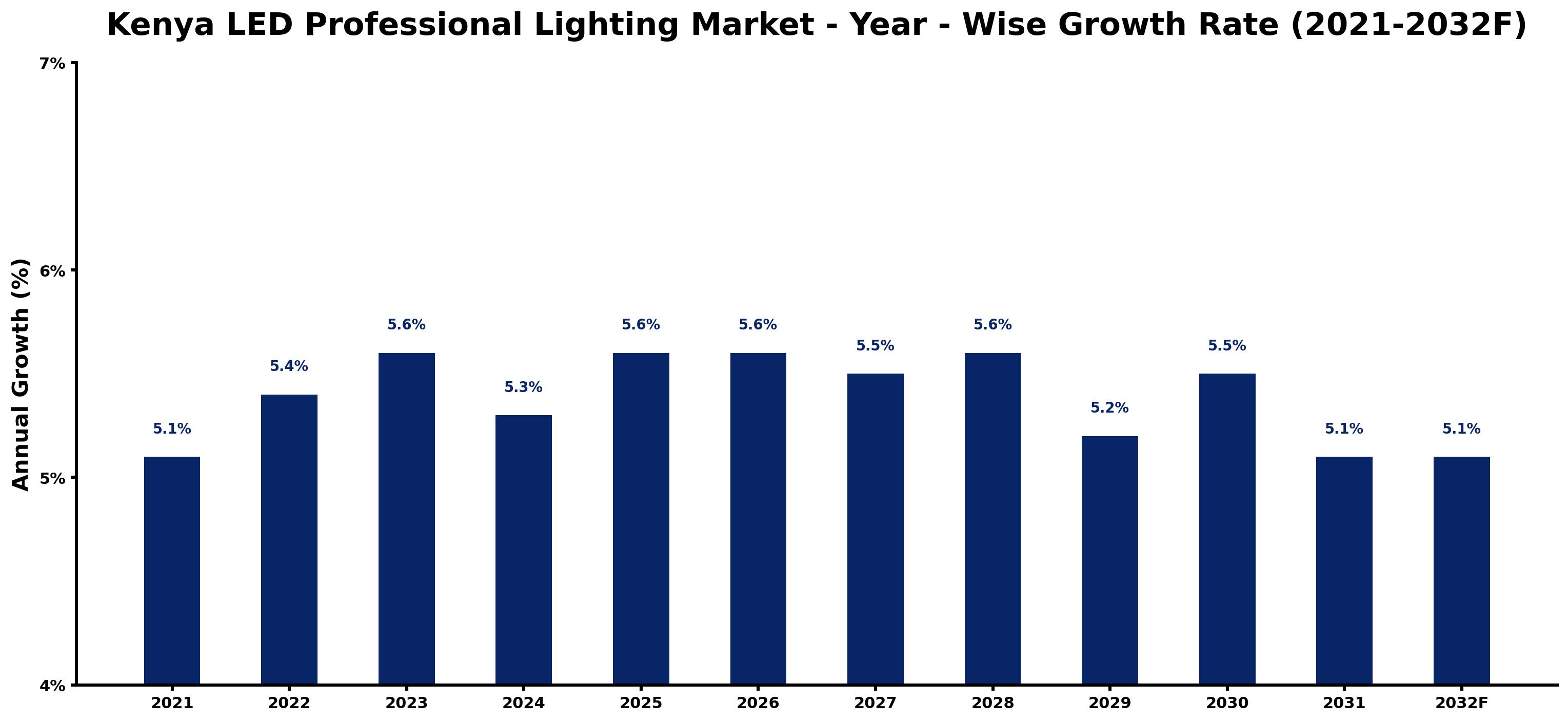
The table below presents the year wise growth rates along with the key drivers influencing the market
| Year | Growth Rate | Major Drivers |
| 2021 | 5.1% | Market recovery post-pandemic emphasizes energy-efficient solutions for urban infrastructure. |
| 2022 | 5.4% | Focus shifts towards retrofitting existing buildings with modern LED technologies. |
| 2023 | 5.6% | Innovations in smart lighting systems enhance energy savings and user experience. |
| 2024 | 5.3% | Public-private partnerships encourage investments in sustainable lighting initiatives nationwide. |
| 2025 | 5.6% | Rural electrification projects highlight LED lighting's role in community development efforts. |
| 2026 | 5.6% | Urbanization trends create heightened demand for scalable and efficient lighting solutions. |
| 2027 | 5.5% | Educational campaigns inform consumers about long-term cost benefits of LED adoption. |
| 2028 | 5.6% | Technological collaborations optimize local manufacturing, reducing dependency on imports. |
| 2029 | 5.2% | Emergence of green building certifications incentivizes energy-efficient lighting installations. |
| 2030 | 5.5% | Impact of climate change drives urgency for sustainable lighting practices across sectors. |
| 2031 | 5.1% | Increased competition among suppliers fosters innovation and diverse product offerings. |
| 2032 | 5.1% | Economic growth translates into higher disposable income, boosting demand for quality lighting. |
Note - Market size estimations and growth projections presented in this report are based on 6Wresearch's advanced forecasting approach, validated with industry datasets as of June 2026.
Kenya LED Professional Lighting Market Synopsis
The Kenya LED Professional Lighting Market is projected to reach USD 8.3 million and witness significant growth during the forecast period (2026-2032). This expansion is primarily driven by advancements in both the industrial and commercial sectors, alongside increasing governmental support for energy-efficient solutions. As LED technology continues to dominate owing to its various advantages, including lower power consumption, extended lifespan, and enhanced luminous efficacy, its adoption in residential applications is also expected to rise significantly.
Kenya LED Professional Lighting Market Growth Drivers
The growth trajectory of the Kenya LED Professional Lighting Market is influenced by several key drivers:
- The industrial and commercial sectors in Kenya are experiencing rapid growth, leading to increased demand for efficient lighting solutions that can significantly reduce operational costs.
- Government initiatives aimed at promoting energy efficiency are creating a conducive environment for the adoption of LED technology, enhancing its attractiveness in various applications.
- As LED lights replace conventional lighting sources, their eco-friendliness and energy savings are persuading more consumers and businesses to invest in LED systems.
- Infrastructural development activities across Kenya, including the construction of buildings and highways, are generating substantial demand for modern lighting solutions, further fueling market growth.
- Growing awareness about sustainability among the Kenyan population is driving increased adoption of energy-efficient lighting systems, including LEDs, which are viewed as environmentally responsible choices.
Kenya LED Professional Lighting Market Government Investment and Initiatives
The Kenyan government has been proactive in driving the LED professional lighting market through various initiatives and investments. Policies aimed at reducing energy consumption have prompted public and private sectors to invest in LED infrastructure, thereby boosting market prospects. The government has undertaken initiatives to educate citizens on the benefits of energy-efficient technologies, promoting wider acceptance of LED lighting. Furthermore, incentives for businesses and homeowners who transition to energy-efficient lighting have been put in place, enhancing overall demand.
In addition, partnerships with various organizations to support the development of energy-efficient technologies are benefiting the market. Public spending on infrastructure is anticipated to continue growing, further encouraging the integration of LED solutions across the country. These combined efforts create a favorable regulatory landscape, facilitating the expansion of the Kenya LED Professional Lighting Market.
Kenya LED Professional Lighting Market Latest Developments (May 2025 - June 2026)
Recent developments from May 2025 to June 2026 highlight the evolving dynamics of the Kenya LED Professional Lighting Market. During this period, there has been an observable increase in collaborations between public institutions and private stakeholders aimed at promoting LED technologies. The focus has shifted towards enhancing product offerings and improving service delivery, reflecting the market's adaptability to changing consumer needs.
Moreover, innovations in LED technology have continued to emerge, with an emphasis on enhancing energy efficiency and reducing production costs, which is vital in market adaptation. Awareness campaigns targeting residential and commercial sectors have escalated, encouraging consumers to consider LED lighting as a viable option for both cost savings and environmental benefits. Public projects integrating LED solutions into urban infrastructure have gained momentum, providing significant visibility and encouraging further adoption.
Kenya LED Professional Lighting Market Future Outlook
Looking ahead, the Kenya LED Professional Lighting Market is well-positioned for sustained growth from 2026 to 2032. The increasing focus on energy efficiency in both governmental and private sector projects will be pivotal in driving the adoption of LED solutions. As infrastructure developments continue to rise, the demand for advanced lighting solutions is expected to expand correspondingly.
Additionally, the growing trend toward sustainability among Kenyans is anticipated to generate further interest in LED products. As consumer preferences shift towards environmentally friendly options, the market is likely to witness innovative product developments that cater to these demands. Overall, the Kenya LED Professional Lighting Market is expected to thrive, propelled by both economic growth and a robust framework supporting energy-efficient technologies.
Kenya LED Professional Lighting Market - Key Attractiveness of the Report
- 10 Years of Market Numbers
- Historical Data Starting from 2022 to 2025
- Base Year: 2025
- Forecast Data until 2032
- Key Performance Indicators Impacting the Market
- Major Upcoming Developments and Projects
Key Highlights of the Report:
- Kenya LED Professional Lighting Market Outlook
- Market Size of Kenya LED Professional Lighting Market, 2025
- Forecast of Kenya LED Professional Lighting Market, 2032
- Historical Data and Forecast of Kenya LED Professional Lighting Revenues & Volume for the Period 2022-2032
- Kenya LED Professional Lighting Market Trend Evolution
- Kenya LED Professional Lighting Market Drivers and Challenges
- Kenya LED Professional Lighting Price Trends
- Kenya LED Professional Lighting Porter's Five Forces
- Kenya LED Professional Lighting Industry Life Cycle
- Historical Data and Forecast of Kenya LED Professional Lighting Market Revenues & Volume By Product Type for the Period 2022-2032
- Historical Data and Forecast of Kenya LED Professional Lighting Market Revenues & Volume By LED Bulbs for the Period 2022-2032
- Historical Data and Forecast of Kenya LED Professional Lighting Market Revenues & Volume By LED Fixtures for the Period 2022-2032
- Historical Data and Forecast of Kenya LED Professional Lighting Market Revenues & Volume By Bare LED Tubes for the Period 2022-2032
- Historical Data and Forecast of Kenya LED Professional Lighting Market Revenues & Volume By LED Down lights for the Period 2022-2032
- Historical Data and Forecast of Kenya LED Professional Lighting Market Revenues & Volume By Applications for the Period 2022-2032
- Historical Data and Forecast of Kenya LED Professional Lighting Market Revenues & Volume By Indoor for the Period 2022-2032
- Historical Data and Forecast of Kenya LED Professional Lighting Market Revenues & Volume By Outdoor for the Period 2022-2032
- Historical Data and Forecast of Kenya LED Professional Lighting Market Revenues & Volume By Automotive for the Period 2022-2032
- Historical Data and Forecast of Kenya LED Professional Lighting Market Revenues & Volume By Backlighting for the Period 2022-2032
- Kenya LED Professional Lighting Import Export Trade Statistics
- Market Opportunity Assessment By Product Type
- Market Opportunity Assessment By Applications
- Kenya LED Professional Lighting Top Companies Market Share
- Kenya LED Professional Lighting Competitive Benchmarking By Technical and Operational Parameters
- Kenya LED Professional Lighting Company Profiles
- Kenya LED Professional Lighting Key Strategic Recommendations
Market Covered
This report offers a comprehensive study of the subsequent market segments:
By Product Type
- LED Bulbs
- LED Fixtures
- Bare LED Tubes
- LED Down lights
By Applications
- Indoor, Outdoor
- Automotive
- Backlighting






































