Kenya Manufacturing Analytics Market Size & Growth Rate (2026-2032)
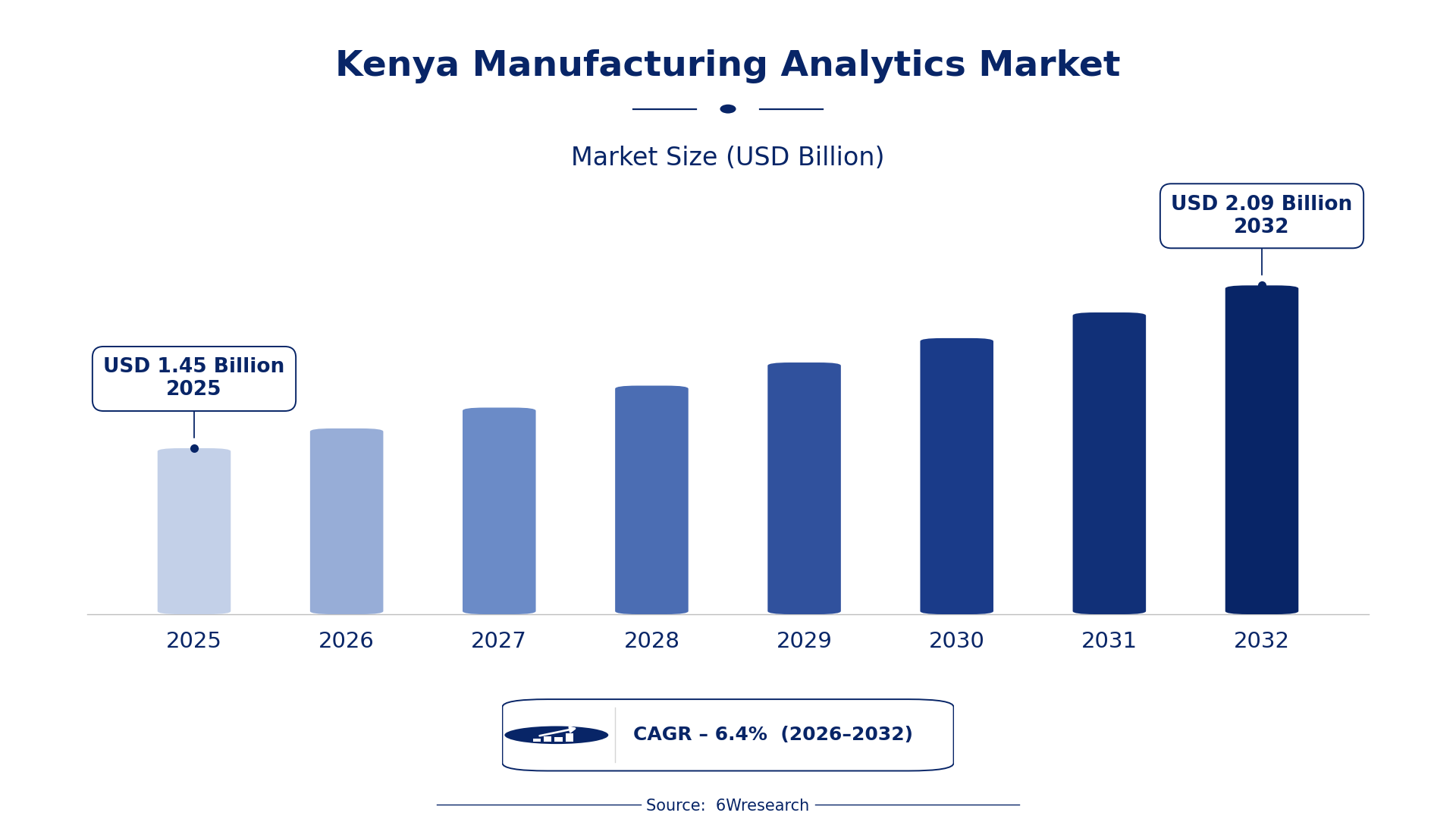
The Kenya Manufacturing Analytics Market was estimated at USD 1448 Million in 2025 and is projected to reach USD 2087 Million by 2032, growing at a CAGR of 6.4% from 2026 to 2032.
Kenya Manufacturing Analytics Market Synopsis
Manufacturers in Kenya are increasingly turning to analytics to enhance operational efficiency and reduce costs. The demand for data-driven insights is being fueled by the integration of Industry 4.0 practices, which are reshaping traditional manufacturing processes.
This shift is not merely about adopting new technologies; it reflects a broader commitment to improving product quality and customer satisfaction. As manufacturers seek to optimize their production processes, the focus on data analytics becomes crucial in maintaining competitiveness in a challenging economic environment.
Kenya Manufacturing Analytics Market Year-wise Growth Rate and Key Drivers
This graph illustrates the annual growth rates of the Kenya Manufacturing Analytics Market from 2021 to 2032, highlighting a steady upward trajectory and projected expansion over the forecast period.
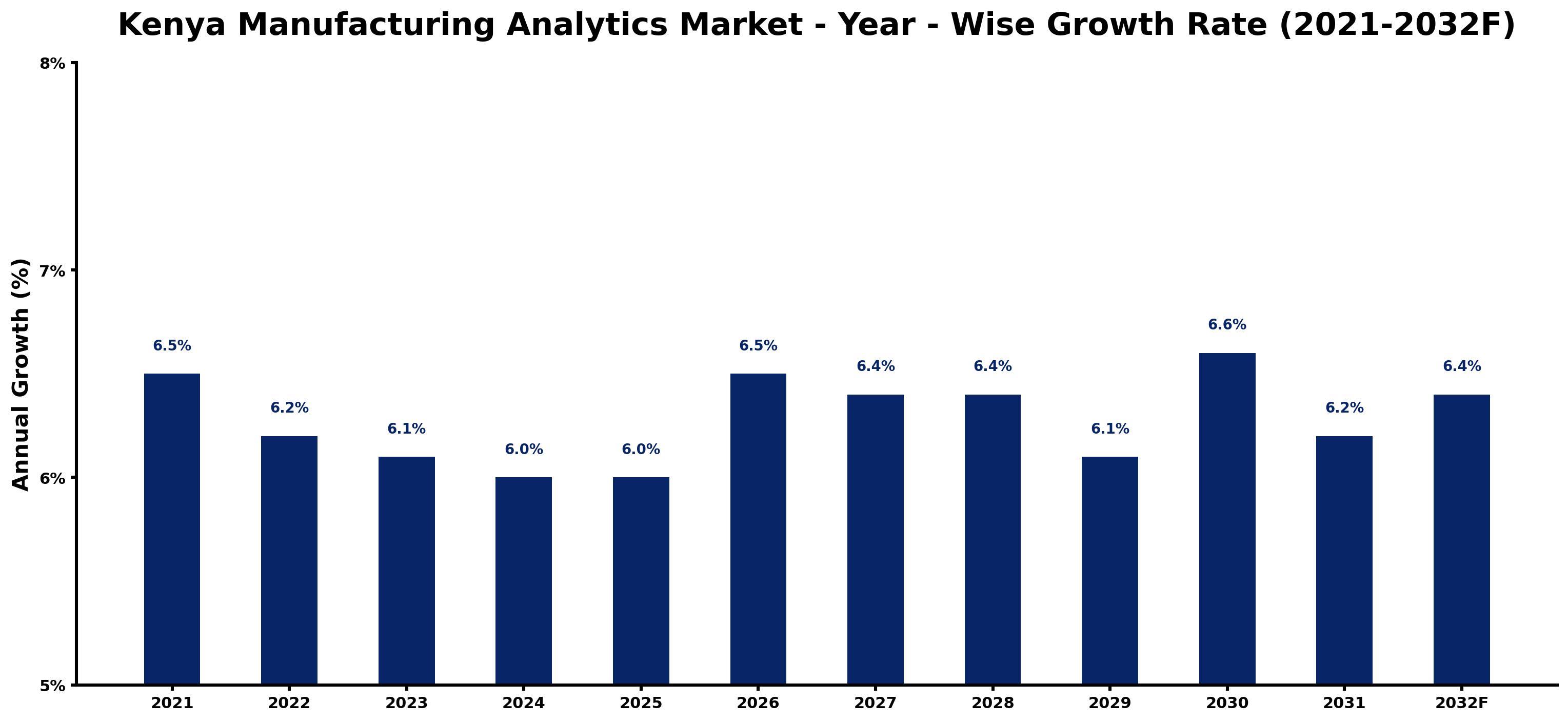
The table below presents the year‑wise growth rates along with the key drivers influencing the market
| Year | Growth Rate | Major Drivers |
| 2021 | 6.5% | Government pushing for digitization in manufacturing sector. |
| 2022 | 6.2% | Increased focus on operational efficiency post-COVID-19 pandemic. |
| 2023 | 6.1% | Adoption of cloud-based analytics tools among SMEs. |
| 2024 | 6.0% | Local universities enhancing manufacturing data analytics curriculum. |
| 2025 | 6.0% | Investments from foreign firms in Kenyan production analytics. |
| 2026 | 6.5% | Emergence of local analytics startups addressing industry needs. |
| 2027 | 6.4% | Regulatory incentives for manufacturers utilizing data-driven solutions. |
| 2028 | 6.4% | Growing awareness of predictive maintenance benefits among manufacturers. |
| 2029 | 6.1% | Supportive government policies for technology adoption in factories. |
| 2030 | 6.6% | Rise of localized manufacturing hubs leveraging analytics insights. |
| 2031 | 6.2% | Increased collaboration between tech firms and manufacturers. |
| 2032 | 6.4% | Focus on sustainability driving data-driven manufacturing practices. |
Note: Market size estimations and growth projections presented in this report are based on 6Wresearch's proprietary forecasting methodology, utilizing the latest available industry data, government publications, and primary research inputs.
Kenya Manufacturing Analytics Market Key Takeaways
Below are some of the specific key takeaways from the market, including:
- The market is heavily driven by the adoption of IoT and machine learning technologies.
- Investment in analytics solutions is crucial for improving quality control and minimizing downtime.
- There are significant barriers to entry, including high implementation costs and a lack of skilled professionals.
- Government initiatives are increasingly prioritizing digital transformation in manufacturing.
- Ongoing technological advancements will shape the future of manufacturing analytics in Kenya.
Evaluation of Restraints in Kenya Manufacturing Analytics Market
The primary constraints impacting the Kenya Manufacturing Analytics Market stem from several factors. High costs associated with advanced analytics implementations pose a significant challenge for many manufacturers. Compounding this issue is a shortage of skilled personnel proficient in both data analytics and manufacturing processes, which limits effective adoption. on top of that, the complexities of regulatory compliance related to data privacy and security add another layer of difficulty. Manufacturers must also invest in substantial technological infrastructure to manage and analyze large datasets, which can deter smaller firms from entering the market.
Kenya Manufacturing Analytics Market Trends
Several key trends are shaping the Kenya Manufacturing Analytics Market. One prominent trend is the increasing utilization of predictive analytics, which allows manufacturers to anticipate equipment failures and optimize maintenance schedules. Another trend is the rising integration of artificial intelligence (AI) to enhance decision-making processes, providing deeper insights into operational efficiencies. on top of that, the shift towards cloud-based analytics solutions is making advanced tools more accessible to small and medium enterprises, democratizing data insights across the sector.
Kenya Manufacturing Analytics Market Opportunities
Opportunities abound within the Kenya Manufacturing Analytics Market, particularly for technology providers and service firms. There is a growing demand for tailored analytics solutions that cater specifically to local manufacturing needs. Additionally, partnerships between public and private sectors can facilitate the development of training programs aimed at addressing skill shortages. As government policies increasingly favor digital transformation, manufacturers who invest early can position themselves as leaders in their respective sectors.
Government Initiatives in the Kenya Manufacturing Analytics Market
Government policy plays a crucial role in shaping the Kenya Manufacturing Analytics Market. The Kenyan government has recognized the importance of manufacturing analytics in driving economic growth and is committed to fostering an environment conducive to technology adoption. This includes initiatives aimed at enhancing digital infrastructure and providing incentives for manufacturers to integrate analytics into their operations.
- A recently completed initiative focused on upgrading the digital infrastructure within industrial zones, aimed at facilitating better data collection and analysis.
- Currently ongoing is a public-private partnership program that supports skill development in data analytics for manufacturing professionals.
- A planned regulatory framework is expected to be introduced by 2026, aimed at enhancing data security standards for manufacturing analytics.
- The government is exploring funding opportunities for small manufacturers to adopt advanced analytics technologies, with initiatives expected to roll out in 2027.
- Ongoing workshops and training sessions are being conducted to raise awareness about the benefits of analytics in the manufacturing sector.
Future Insights of the Kenya Manufacturing Analytics Market
Looking ahead to the period between 2026 and 2032, the Kenya Manufacturing Analytics Market is expected to experience robust growth. As more manufacturers embrace analytics to drive efficiency, the demand for innovative solutions will rise. The increasing penetration of IoT devices and AI technology will further enhance data collection capabilities, leading to improved decision-making processes. Manufacturers that prioritize analytics will likely see enhanced competitiveness and greater market share in an increasingly digital economy.
Kenya Manufacturing Analytics Market Latest Developments
Recent developments in the Kenya Manufacturing Analytics Market indicate a strong push towards technological integration. Over the last year, several initiatives have emerged that highlight the sector's commitment to harnessing data analytics for operational improvements. As manufacturers adapt, the focus remains on aligning with global best practices while addressing local challenges.
- A leading technology vendor launched a new analytics platform tailored for Kenyan manufacturers in early 2025, aimed at simplifying data management.
- An initiative that began in mid-2025 is underway to enhance collaboration between universities and manufacturing firms to promote research in analytics applications.
- A major technology firm is planning to introduce an AI-driven predictive maintenance tool in Q3 2026, targeting the automotive manufacturing sector.
- By late 2025, a collaborative project was completed to integrate IoT sensors in local factories, enhancing real-time data collection capabilities.
- A government-backed initiative is expected to roll out in early 2026 to provide subsidies for manufacturers implementing analytics solutions.
Kenya Manufacturing Analytics Market - Key Attractiveness of the Report
- 10 Years of Market Numbers
- Historical Data Starting from 2022 to 2025
- Base Year: 2025
- Forecast Data until 2032
- Key Performance Indicators Impacting the Market
- Major Upcoming Developments and Projects
Key Highlights of the Report:
- Kenya Manufacturing Analytics Market Outlook
- Market Size of Kenya Manufacturing Analytics Market, 2025
- Forecast of Kenya Manufacturing Analytics Market, 2032
- Historical Data and Forecast of Kenya Manufacturing Analytics Revenues & Volume for the Period 2022-2032F
- Kenya Manufacturing Analytics Market Trend Evolution
- Kenya Manufacturing Analytics Market Drivers and Challenges
- Kenya Manufacturing Analytics Price Trends
- Kenya Manufacturing Analytics Porter's Five Forces
- Kenya Manufacturing Analytics Industry Life Cycle
- Historical Data and Forecast of Kenya Manufacturing Analytics Market Revenues & Volume By Type for the Period 2022-2032F
- Historical Data and Forecast of Kenya Manufacturing Analytics Market Revenues & Volume By Software for the Period 2022-2032F
- Historical Data and Forecast of Kenya Manufacturing Analytics Market Revenues & Volume By Service for the Period 2022-2032F
- Historical Data and Forecast of Kenya Manufacturing Analytics Market Revenues & Volume By Deployment Models for the Period 2022-2032F
- Historical Data and Forecast of Kenya Manufacturing Analytics Market Revenues & Volume By On-premises for the Period 2022-2032F
- Historical Data and Forecast of Kenya Manufacturing Analytics Market Revenues & Volume By On-demand for the Period 2022-2032F
- Historical Data and Forecast of Kenya Manufacturing Analytics Market Revenues & Volume By Applications for the Period 2022-2032F
- Historical Data and Forecast of Kenya Manufacturing Analytics Market Revenues & Volume By Predictive maintenance & asset management for the Period 2022-2032F
- Historical Data and Forecast of Kenya Manufacturing Analytics Market Revenues & Volume By Inventory management for the Period 2022-2032F
- Historical Data and Forecast of Kenya Manufacturing Analytics Market Revenues & Volume By Supply chain planning & procurement for the Period 2022-2032F
- Historical Data and Forecast of Kenya Manufacturing Analytics Market Revenues & Volume By Energy management for the Period 2022-2032F
- Historical Data and Forecast of Kenya Manufacturing Analytics Market Revenues & Volume By Emergency management for the Period 2022-2032F
- Historical Data and Forecast of Kenya Manufacturing Analytics Market Revenues & Volume By Sales & customer management for the Period 2022-2032F
- Historical Data and Forecast of Kenya Manufacturing Analytics Market Revenues & Volume By Other applications for the Period 2022-2032F
- Historical Data and Forecast of Kenya Manufacturing Analytics Market Revenues & Volume By Industry Vertical for the Period 2022-2032F
- Historical Data and Forecast of Kenya Manufacturing Analytics Market Revenues & Volume By Automotive & aerospace manufacturing for the Period 2022-2032F
- Historical Data and Forecast of Kenya Manufacturing Analytics Market Revenues & Volume By Electronics equipment manufacturing for the Period 2022-2032F
- Historical Data and Forecast of Kenya Manufacturing Analytics Market Revenues & Volume By Food & beverages manufacturing for the Period 2022-2032F
- Historical Data and Forecast of Kenya Manufacturing Analytics Market Revenues & Volume By Chemicals & materials manufacturing for the Period 2022-2032F
- Historical Data and Forecast of Kenya Manufacturing Analytics Market Revenues & Volume By Machinery & industrial equipment manufacturing for the Period 2022-2032F
- Historical Data and Forecast of Kenya Manufacturing Analytics Market Revenues & Volume By Pharma and life sciences for the Period 2022-2032F
- Historical Data and Forecast of Kenya Manufacturing Analytics Market Revenues & Volume By Paper, pulp, plastic and rubber manufacturing for the Period 2022-2032F
- Historical Data and Forecast of Kenya Manufacturing Analytics Market Revenues & Volume By Others for the Period 2022-2032F
- Kenya Manufacturing Analytics Import Export Trade Statistics
- Market Opportunity Assessment By Type
- Market Opportunity Assessment By Deployment Models
- Market Opportunity Assessment By Applications
- Market Opportunity Assessment By Industry Vertical
- Kenya Manufacturing Analytics Top Companies Market Share
- Kenya Manufacturing Analytics Competitive Benchmarking By Technical and Operational Parameters
- Kenya Manufacturing Analytics Company Profiles
- Kenya Manufacturing Analytics Key Strategic Recommendations






































