Kenya Mineral Processing Equipment Market Size, Share & Growth Rate
The Kenya Mineral Processing Equipment Market was estimated at USD 441 Million in 2025 and is projected to reach USD 622 Million by 2032, growing at a CAGR of 5.0% from 2026 to 2032. This growth trajectory is primarily fueled by the expansion of mining operations across the country, coupled with increased investments in modern processing technologies. As the mining sector matures, there is a pressing need for efficient equipment that can meet the demands of various minerals, including gold, coal, and iron ore.
Kenya Mineral Processing Equipment Market Year-wise Growth Rate and Key Drivers
This graph highlights how the Kenya Mineral Processing Equipment Market has steadily grown over the years, supported by major growth factors.
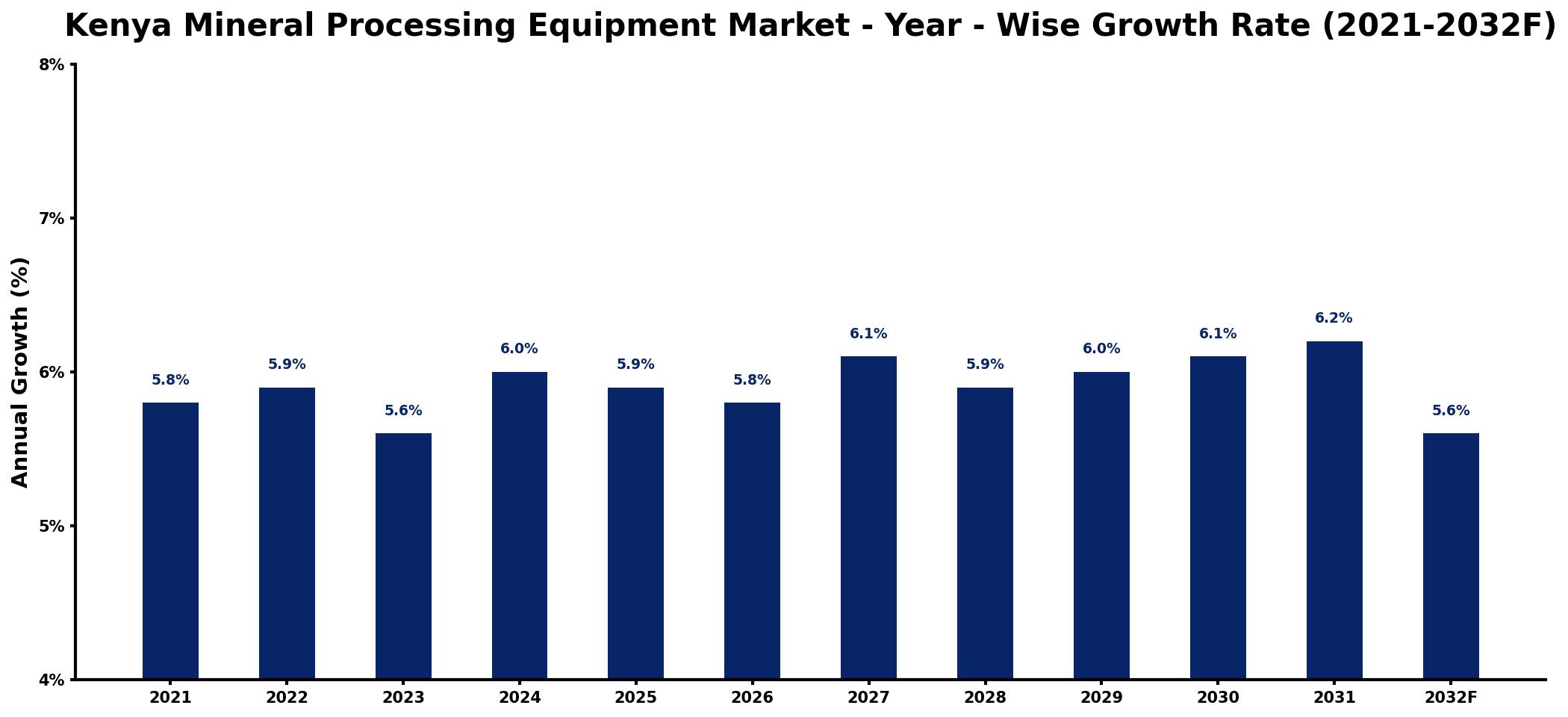
The table below presents the year‑wise growth rates along with the key drivers influencing the market
| Year | Growth Rate | Major Drivers |
| 2021 | 5.8% | Rising demand from construction sector |
| 2022 | 5.9% | Increased investments in mining projects |
| 2023 | 5.6% | Surge in infrastructure development initiatives |
| 2024 | 6.0% | Growing interest in sustainable practices |
| 2025 | 5.9% | Expansion of energy sector projects |
| 2026 | 5.8% | growing emerging market penetration |
| 2027 | 6.1% | Strengthened regulatory frameworks boosting confidence |
| 2028 | 5.9% | Diversification of industrial applications |
| 2029 | 6.0% | Technological advancements attracting investments |
| 2030 | 6.1% | Growing international partnerships and collaborations |
| 2031 | 6.2% | Increased focus on local manufacturing |
| 2032 | 5.6% | Heightened awareness of resource management |
Note: Market size estimations and growth projections presented in this report are based on 6Wresearch's proprietary forecasting methodology, utilizing the latest available industry data, government publications, and primary research inputs.
Kenya Mineral Processing Equipment Market Synopsis
The Kenya mineral processing equipment market has gained significant momentum recently, driven by robust government policies and rising exploration activities. However, as the market progresses, it is transitioning towards more advanced and sustainable processing solutions, reflecting global industry trends. This shift indicates an evolving landscape where efficiency and environmental considerations will increasingly dictate equipment choices.
Furthermore, the market is characterized by a surge in demand for cutting-edge technologies, such as automation and data analytics. These developments are not just enhancing operational efficiency but also aligning with the government's agenda for value addition in the mining sector. The overall outlook remains optimistic as stakeholders adapt to emerging trends and seek to capitalize on the country's mineral wealth.
Kenya Mineral Processing Equipment Market Key Takeaways
- The market is projected to grow significantly, reaching USD 622 Million by 2032.
- Government policies are promoting local content and value addition in mining operations.
- Increased adoption of advanced technologies is driving operational efficiency and productivity.
- There is a notable demand for sustainable and energy-efficient processing solutions.
- Investments in research and development are fostering innovation tailored to local needs.
Evaluation of Restraints in Kenya Mineral Processing Equipment Market
Despite its growth potential, the Kenya mineral processing equipment market faces several restraints that could impede progress. A significant challenge is the inadequate infrastructure, which limits efficient transportation and logistics. Additionally, many small to medium-sized enterprises struggle with access to financing, hindering their ability to invest in necessary equipment. Furthermore, the market is often affected by inconsistent government policies and high operational costs, particularly in energy and skilled labor. The reliance on imported equipment due to limited local manufacturing capabilities further adds to the financial strain, impacting competitiveness and innovation within the sector.
Kenya Mineral Processing Equipment Market Trends
Key trends shaping the Kenya mineral processing equipment market include a growing emphasis on advanced technologies aimed at optimizing operations. Automation, artificial intelligence, and data analytics are increasingly being integrated to streamline processes and reduce costs. Moreover, the focus on sustainability has led to heightened demand for energy-efficient solutions and waste reduction strategies. There is also a rising interest in modular and portable processing equipment, providing flexibility and scalability for varied production needs, which is crucial for accommodating the dynamic nature of mining operations.
Kenya Mineral Processing Equipment Market Opportunities
The Kenya mineral processing equipment market presents robust investment opportunities given the nations rich mineral resources. Companies can capitalize on the growing need for essential processing equipment such as crushers, grinders, and screens. Moreover, advanced technologies related to automation and sustainability are ripe areas for investment, as stakeholders seek innovative solutions. There are also opportunities in providing maintenance and repair services for existing equipment, enhancing overall operational efficiency within the industry.
Government Initiatives in the Kenya Mineral Processing Equipment Market
The Kenyan government has taken significant steps to promote the mineral processing equipment market through various policy initiatives. The Mining Act of 2016 emphasizes local ownership and encourages the procurement of goods and services from local suppliers. Additionally, the establishment of the Mining Cadastre Portal has streamlined licensing processes, thereby enhancing transparency and facilitating investment. The National Mining Corporation plays a pivotal role in implementing these policies, fostering a more sustainable and responsible exploitation of the country's mineral resources.
Future Insights of the Kenya Mineral Processing Equipment Market
Looking ahead to 2026-2032, the Kenya mineral processing equipment market is expected to continue its upward trajectory. As mining operations expand, there will be a corresponding rise in demand for efficient processing solutions. Technological advancements will play a critical role in enhancing productivity and minimizing environmental impacts. With the government's ongoing commitment to promoting the mining sector through favorable policies, the outlook for this market remains optimistic, positioning it as a key contributor to the nation's economic growth.
Kenya Mineral Processing Equipment Market Latest Developments (2025 - 2026)
In recent months, the Kenya mineral processing equipment market has seen notable movements towards enhancing technological integration within operations. Several initiatives focused on training local personnel in advanced equipment usage and maintenance have been launched, promoting skill development. The emphasis on sustainable practices has also grown, with companies exploring innovative waste management solutions. Overall, there is a clear direction towards improving efficiency and environmental responsibility in mining activities.
Kenya Mineral Processing Equipment Market - Key Attractiveness of the Report
- 10 Years of Market Numbers
- Historical Data Starting from 2022 to 2025
- Base Year: 2025
- Forecast Data until 2032
- Key Performance Indicators Impacting the Market
- Major Upcoming Developments and Projects
Key Highlights of the Report:
- Kenya Mineral Processing Equipment Market Outlook
- Market Size of Kenya Mineral Processing Equipment Market, 2025
- Forecast of Kenya Mineral Processing Equipment Market, 2032
- Historical Data and Forecast of Kenya Mineral Processing Equipment Revenues & Volume for the Period 2022-2032F
- Kenya Mineral Processing Equipment Market Trend Evolution
- Kenya Mineral Processing Equipment Market Drivers and Challenges
- Kenya Mineral Processing Equipment Price Trends
- Kenya Mineral Processing Equipment Porter's Five Forces
- Kenya Mineral Processing Equipment Industry Life Cycle
- Historical Data and Forecast of Kenya Mineral Processing Equipment Market Revenues & Volume By Mineral Mining Sector for the Period 2022-2032F
- Historical Data and Forecast of Kenya Mineral Processing Equipment Market Revenues & Volume By Bauxite for the Period 2022-2032F
- Historical Data and Forecast of Kenya Mineral Processing Equipment Market Revenues & Volume By Iron for the Period 2022-2032F
- Historical Data and Forecast of Kenya Mineral Processing Equipment Market Revenues & Volume By Lithium for the Period 2022-2032F
- Historical Data and Forecast of Kenya Mineral Processing Equipment Market Revenues & Volume By Others for the Period 2022-2032F
- Historical Data and Forecast of Kenya Mineral Processing Equipment Market Revenues & Volume By Equipment for the Period 2022-2032F
- Historical Data and Forecast of Kenya Mineral Processing Equipment Market Revenues & Volume By Crushers for the Period 2022-2032F
- Historical Data and Forecast of Kenya Mineral Processing Equipment Market Revenues & Volume By Feeders for the Period 2022-2032F
- Historical Data and Forecast of Kenya Mineral Processing Equipment Market Revenues & Volume By Conveyors for the Period 2022-2032F
- Historical Data and Forecast of Kenya Mineral Processing Equipment Market Revenues & Volume By Drills & Breakers for the Period 2022-2032F
- Historical Data and Forecast of Kenya Mineral Processing Equipment Market Revenues & Volume By Others for the Period 2022-2032F
- Historical Data and Forecast of Kenya Mineral Processing Equipment Market Revenues & Volume By Application for the Period 2022-2032F
- Historical Data and Forecast of Kenya Mineral Processing Equipment Market Revenues & Volume By Construction for the Period 2022-2032F
- Historical Data and Forecast of Kenya Mineral Processing Equipment Market Revenues & Volume By Mining for the Period 2022-2032F
- Historical Data and Forecast of Kenya Mineral Processing Equipment Market Revenues & Volume By Others for the Period 2022-2032F
- Kenya Mineral Processing Equipment Import Export Trade Statistics
- Market Opportunity Assessment By Mineral Mining Sector
- Market Opportunity Assessment By Equipment
- Market Opportunity Assessment By Application
- Kenya Mineral Processing Equipment Top Companies Market Share
- Kenya Mineral Processing Equipment Competitive Benchmarking By Technical and Operational Parameters
- Kenya Mineral Processing Equipment Company Profiles
- Kenya Mineral Processing Equipment Key Strategic Recommendations






































