Kenya Modular Data Center Market Size, Share & Growth Rate
The Kenya Modular Data Center Market was estimated at USD 777 Million in 2025 and is projected to reach USD 1399 Million by 2032, growing at a CAGR of 8.8% from 2026 to 2032. This growth trajectory can be attributed to the burgeoning demand for scalable IT solutions amidst Kenya's rapid digital transformation. As businesses increasingly rely on cloud computing and require swift deployment capabilities, the need for modular data centers has become essential in maintaining competitive advantage.
Kenya Modular Data Center Market Year-wise Growth Rate and Key Drivers
This graph highlights how the Kenya Modular Data Center Market has steadily grown over the years, supported by major growth factors.
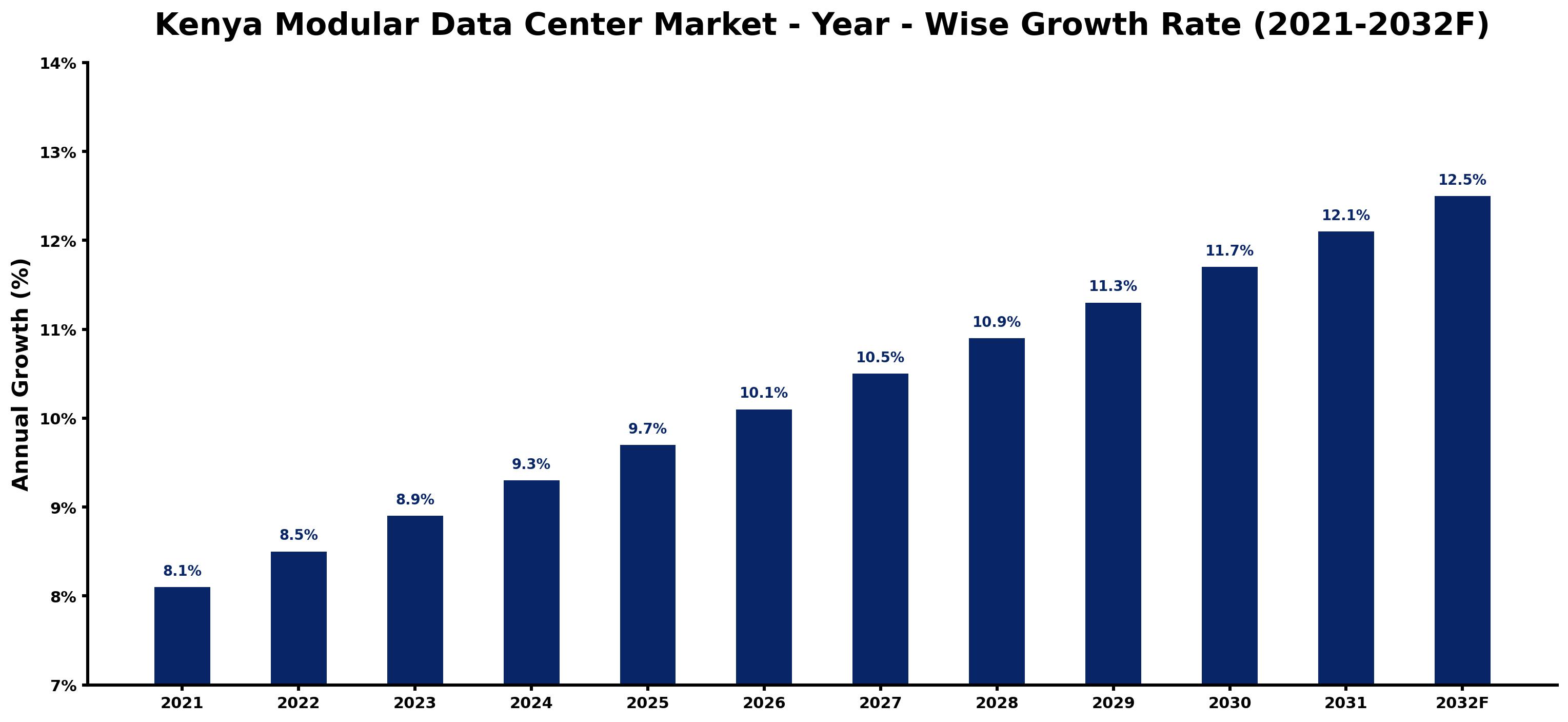
The table below presents the year‑wise growth rates along with the key drivers influencing the market
| Year | Growth Rate | Major Drivers |
| 2021 | 8.1% | Increasing industrial automation investments |
| 2022 | 8.5% | Expansion of manufacturing activities |
| 2023 | 8.9% | Growing renewable energy integration projects |
| 2024 | 9.3% | Expansion of manufacturing activities |
| 2025 | 9.7% | Increasing industrial infrastructure investments |
| 2026 | 10.1% | Expansion of transportation and logistics networks |
| 2027 | 10.5% | Expansion of manufacturing activities |
| 2028 | 10.9% | Growing urbanization and commercial development |
| 2029 | 11.3% | Expansion of transportation and logistics networks |
| 2030 | 11.7% | Rapid growth in telecom and data center sectors |
| 2031 | 12.1% | Increasing smart city development projects |
| 2032 | 12.5% | Expansion of commercial construction activities |
Note - Market size estimations and growth projections presented in this report are based on 6Wresearch's advanced forecasting approach, validated with industry datasets as of June 2026.
Kenya Modular Data Center Market Synopsis
The modular data center landscape in Kenya is distinguished by its potential for rapid setup, allowing enterprises to enhance their operational capacities swiftly. As cloud services proliferate and data consumption rises, organizations are turning towards modular solutions to meet their evolving IT infrastructure needs.
Moreover, the flexibility offered by these systems allows businesses to scale their operations in line with demand, a crucial factor in today's fast-paced digital environment. However, challenges such as infrastructural limitations and the high initial costs associated with modular setups remain pertinent considerations.
Kenya Modular Data Center Market Key Takeaways
- The market is fueled by increasing demands for cloud computing and digital services.
- Energy efficiency and quick deployment are pivotal advantages of modular solutions.
- Regulatory challenges around data localization significantly affect market dynamics.
- There exists a notable skills gap that hampers the efficient deployment of modular data centers.
- Competition from traditional data center models necessitates ongoing customer education.
Evaluation of Restraints in Kenya Modular Data Center Market
Despite its promising growth, the Kenya Modular Data Center Market faces several notable restraints. Infrastructure limitations remain a significant barrier, as inadequate facilities can impede the deployment and operation of modular data centers. Furthermore, affordability is a pressing concern for small and medium-sized enterprises looking to invest in modular solutions. Regulatory constraints around data localization add complexity, as firms must navigate compliance in a rapidly evolving legal landscape. Compounding these issues is the frequent power instability experienced in the region, which poses risks to uninterrupted data center operations. Additionally, the scarcity of skilled professionals capable of managing such advanced systems remains a persistent challenge for the market.
Kenya Modular Data Center Market Trends
Several key trends are currently shaping the Kenya Modular Data Center Market. The shift towards hybrid cloud environments is becoming increasingly prevalent, prompting businesses to seek flexible solutions that integrate seamlessly with both on-premise and cloud infrastructures. Additionally, the rising focus on energy efficiency is steering investment toward modular designs that optimize power consumption and environmental impact. Lastly, as data privacy and security concerns grow, there is an ongoing emphasis on designing systems that not only meet operational needs but also comply with stringent regulatory frameworks.
Kenya Modular Data Center Market Opportunities
The future of the Kenya Modular Data Center Market is rife with growth and investment opportunities. The expanding digital economy and increasing internet penetration present a fertile ground for the adoption of modular solutions. Furthermore, emerging technologies such as edge computing are gaining traction, creating a demand for localized data processing capabilities. Companies that can address the cost barriers for SMEs stand to capture a significant segment of the market. Lastly, partnerships with government bodies to improve infrastructure and streamline regulations could enhance the overall viability of modular data center projects.
Government Initiatives in the Kenya Modular Data Center Market
The Kenyan government has initiated several programs aimed at enhancing the digital landscape, which can significantly impact the modular data center market. Efforts to improve national connectivity and power reliability are crucial, as these factors are essential for data center operations. Additionally, public investments in technology infrastructure and incentives for green energy solutions may provide a conducive environment for the expansion of modular data centers. Regulatory frameworks are evolving, which may offer clearer guidelines to support local and international investments in this sector.
Future Insights of the Kenya Modular Data Center Market
Looking ahead to the period from 2026 to 2032, the Kenya Modular Data Center Market is poised for robust growth. The increasing reliance on data-driven technologies will drive demand for more sophisticated data handling capabilities. As businesses increasingly recognize the value of flexible IT solutions, modular data centers are likely to become a preferred choice. Moreover, advancements in technology will facilitate greater energy efficiency and scalability, further enhancing the attractiveness of modular systems. Overall, the market is expected to adapt and thrive in the evolving digital landscape, presenting substantial opportunities for strategic investments.
Kenya Modular Data Center Market Latest Developments (May 2025 - June 2026)
Recent developments in the Kenya Modular Data Center Market indicate a growing trend towards increased public-private partnerships aimed at addressing infrastructure gaps. As organizations seek innovative solutions, there has been a noticeable uptick in pilot projects showcasing the effectiveness of modular data centers. Additionally, industry stakeholders are increasingly focusing on integrating renewable energy sources, reflecting the global shift towards sustainability in technology solutions. As the market evolves, ongoing investments in training and skill development are becoming pivotal for facilitating the growth of this sector.
Kenya Modular Data Center Market - Key Attractiveness of the Report
- 10 Years of Market Numbers
- Historical Data Starting from 2022 to 2025
- Base Year: 2025
- Forecast Data until 2032
- Key Performance Indicators Impacting the Market
- Major Upcoming Developments and Projects
Key Highlights of the Report:
- Kenya Modular Data Center Market Outlook
- Market Size of Kenya Modular Data Center Market, 2025
- Forecast of Kenya Modular Data Center Market, 2032
- Historical Data and Forecast of Kenya Modular Data Center Revenues & Volume for the Period 2022-2032F
- Kenya Modular Data Center Market Trend Evolution
- Kenya Modular Data Center Market Drivers and Challenges
- Kenya Modular Data Center Price Trends
- Kenya Modular Data Center Porter's Five Forces
- Kenya Modular Data Center Industry Life Cycle
- Historical Data and Forecast of Kenya Modular Data Center Market Revenues & Volume By Functional module solution for the Period 2022-2032F
- Historical Data and Forecast of Kenya Modular Data Center Market Revenues & Volume By All-in One Functional Module for the Period 2022-2032F
- Historical Data and Forecast of Kenya Modular Data Center Market Revenues & Volume By Individual Functional Module for the Period 2022-2032F
- Historical Data and Forecast of Kenya Modular Data Center Market Revenues & Volume By Service for the Period 2022-2032F
- Historical Data and Forecast of Kenya Modular Data Center Market Revenues & Volume By Infrastructure Management for the Period 2022-2032F
- Historical Data and Forecast of Kenya Modular Data Center Market Revenues & Volume By Integration & Deployment for the Period 2022-2032F
- Historical Data and Forecast of Kenya Modular Data Center Market Revenues & Volume By Consulting for the Period 2022-2032F
- Historical Data and Forecast of Kenya Modular Data Center Market Revenues & Volume By Industry for the Period 2022-2032F
- Historical Data and Forecast of Kenya Modular Data Center Market Revenues & Volume By BFSI for the Period 2022-2032F
- Historical Data and Forecast of Kenya Modular Data Center Market Revenues & Volume By Retail for the Period 2022-2032F
- Historical Data and Forecast of Kenya Modular Data Center Market Revenues & Volume By Government for the Period 2022-2032F
- Historical Data and Forecast of Kenya Modular Data Center Market Revenues & Volume By Healthcare for the Period 2022-2032F
- Historical Data and Forecast of Kenya Modular Data Center Market Revenues & Volume By Telecommunication for the Period 2022-2032F
- Historical Data and Forecast of Kenya Modular Data Center Market Revenues & Volume By Utilities for the Period 2022-2032F
- Historical Data and Forecast of Kenya Modular Data Center Market Revenues & Volume By Others for the Period 2022-2032F
- Kenya Modular Data Center Import Export Trade Statistics
- Market Opportunity Assessment By Functional module solution
- Market Opportunity Assessment By Service
- Market Opportunity Assessment By Industry
- Kenya Modular Data Center Top Companies Market Share
- Kenya Modular Data Center Competitive Benchmarking By Technical and Operational Parameters
- Kenya Modular Data Center Company Profiles
- Kenya Modular Data Center Key Strategic Recommendations






































