Kenya Oil & Gas Pumps Market Size, Share & Growth Rate
The Kenya Oil & Gas Pumps Market was estimated at USD 486 Million in 2025 and is projected to reach USD 638 Million by 2032, growing at a CAGR of 4.0% from 2026 to 2032. This growth is primarily fueled by substantial investments in exploration and production activities, coupled with a government commitment to expanding energy infrastructure. As Kenya's oil and gas sector matures, the demand for reliable and efficient pumps is set to rise significantly, reflecting the increasing complexity of operations and the need for advanced technology.
Kenya Oil & Gas Pumps Market Year-wise Growth Rate and Key Drivers
This graph highlights how the Kenya Oil & Gas Pumps Market has steadily grown over the years, supported by major growth factors.
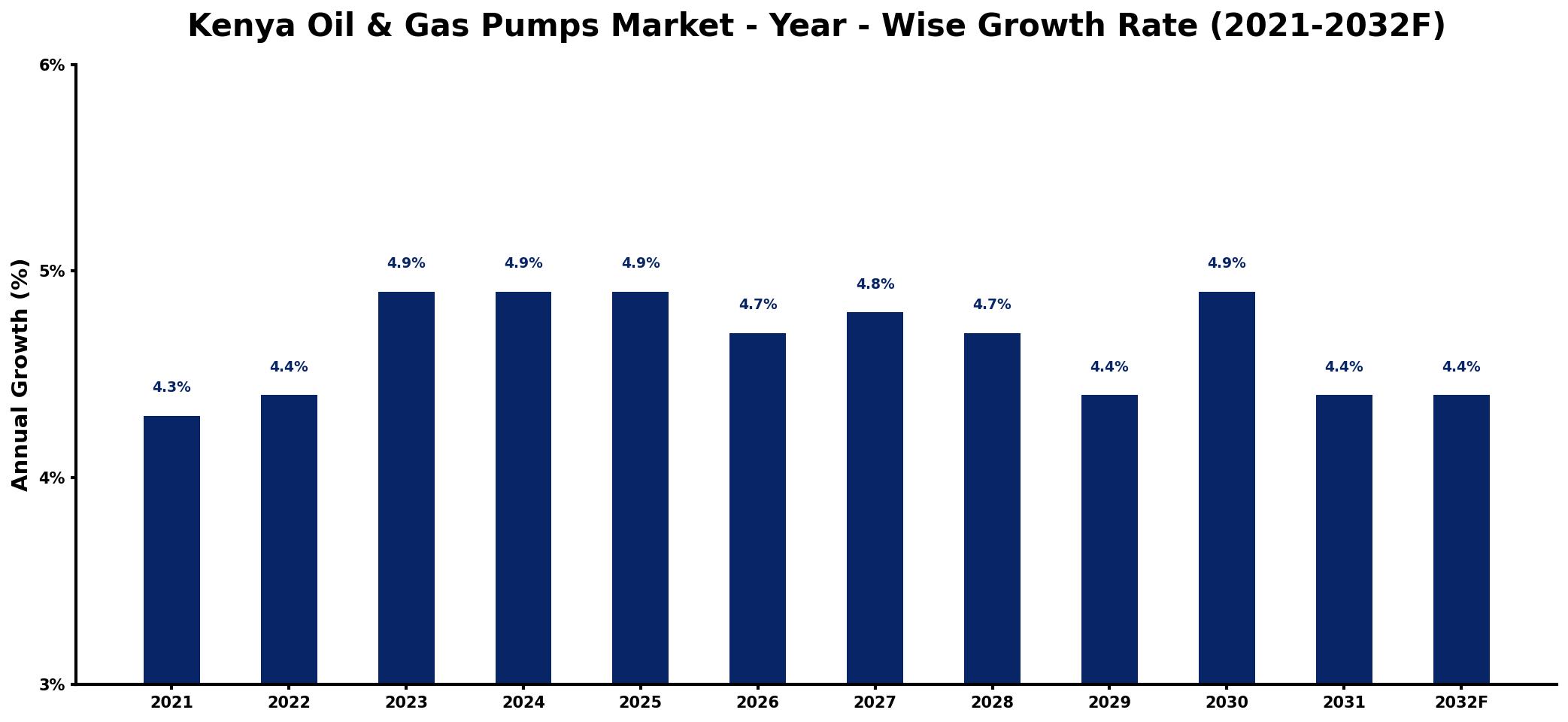
The table below presents the year‑wise growth rates along with the key drivers influencing the market
| Year | Growth Rate | Major Drivers |
| 2021 | 4.3% | Rising energy sector investments |
| 2022 | 4.4% | Growing infrastructure development projects |
| 2023 | 4.9% | Increased urbanization and mobility |
| 2024 | 4.9% | Expansion of transportation networks |
| 2025 | 4.9% | Boost in industrial activities demand |
| 2026 | 4.7% | Emergence of renewable energy initiatives |
| 2027 | 4.8% | Strengthening regional trade agreements |
| 2028 | 4.7% | Growth in manufacturing capabilities |
| 2029 | 4.4% | Surge in construction sector projects |
| 2030 | 4.9% | Advancements in technological innovations |
| 2031 | 4.4% | Greater focus on sustainability practices |
| 2032 | 4.4% | Rising consumer energy consumption |
Note: Market size estimations and growth projections presented in this report are based on 6Wresearch's proprietary forecasting methodology, utilizing the latest available industry data, government publications, and primary research inputs.
Kenya Oil & Gas Pumps Market Synopsis
The Kenya Oil & Gas Pumps Market is driven by a surging need for pumps to support exploration and production operations within the countrys burgeoning oil and gas sector. With ongoing investments in infrastructure, companies are increasingly focusing on integrating advanced pump solutions that enhance operational efficiency.
Furthermore, the shift towards environmentally friendly technologies is gaining traction among local operators. As firms seek to improve their environmental footprints, they are investing in intelligent pump systems that not only improve performance but also align with sustainability goals.
- Significant investment in exploration activities is driving demand for various pump types.
- Technological advancements are leading to the adoption of smart and automated pumping solutions.
- Environmentally friendly pump technologies are increasingly prioritized in procurement strategies.
- Government policies are fostering local participation and investment in the oil and gas sector.
- Market growth is supported by a favorable regulatory environment and ongoing infrastructure development.
Despite its promising growth, the Kenya Oil & Gas Pumps Market faces several challenges that could hinder its progress. High initial costs of acquiring advanced pumping solutions are a significant concern, particularly for smaller enterprises. Moreover, the necessity for ongoing investment in technology to comply with evolving industry standards adds another layer of complexity. Fluctuating global oil prices further introduce uncertainties that can impact demand within the sector, while political instability could influence investment sentiments and operational continuity.
Emerging trends in the Kenya Oil & Gas Pumps Market highlight a distinct movement towards energy-efficient and environmentally conscious pumping technologies. Companies are increasingly adopting advanced centrifugal pumps that offer improved energy efficiency and lower operational costs. Additionally, the integration of digital technologies, including automation and data analytics, is reshaping pump operations, enabling real-time monitoring and predictive maintenance to enhance overall efficiency.
The market presents numerous investment opportunities, particularly as exploration and production activities continue to expand. Investors can benefit from manufacturing and distributing specialized pumps tailored for the oil and gas industry, especially those that emphasize durability and corrosion resistance. Furthermore, the growing demand for maintenance, repair, and aftermarket services presents an avenue for sustained engagement and profitability in this evolving sector.
The Kenyan government has established a regulatory framework that promotes growth within the oil and gas sector. Key initiatives, such as the Petroleum Act, ensure that exploration and production activities adhere to safety and efficiency standards. Moreover, the Local Content Policy encourages the participation of Kenyan businesses, promoting local expertise and investment. These initiatives create a conducive environment for market players to thrive while fostering accountability and transparency in operations.
Looking ahead to 2026-2032, the Kenya Oil & Gas Pumps Market is set to experience notable growth driven by continuous exploration and increasing production capacities. As companies prioritize advanced and sustainable pump solutions, we anticipate that innovation will play a pivotal role in shaping market dynamics. Coupled with government initiatives aimed at attracting foreign investment, the market is positioned for significant expansion, albeit with potential risks related to global oil price fluctuations and environmental concerns.
Recent developments in the Kenya Oil & Gas Pumps Market indicate a surge in collaborative efforts between local firms and international companies to enhance technological capabilities. There is a noticeable shift towards implementing digital solutions and smart technologies in pump operations, aimed at optimizing performance and reducing downtime. Furthermore, an increased focus on environmental sustainability has prompted companies to explore innovative pump designs that align with global best practices.
- 10 Years of Market Numbers
- Historical Data Starting from 2022 to 2025
- Base Year: 2025
- Forecast Data until 2032
- Key Performance Indicators Impacting the Market
- Major Upcoming Developments and Projects
Key Highlights of the Report:
- Kenya Oil & Gas Pumps Market Outlook
- Market Size of Kenya Oil & Gas Pumps Market, 2025
- Forecast of Kenya Oil & Gas Pumps Market, 2032
- Historical Data and Forecast of Kenya Oil & Gas Pumps Revenues & Volume for the Period 2022-2032F
- Kenya Oil & Gas Pumps Market Trend Evolution
- Kenya Oil & Gas Pumps Market Drivers and Challenges
- Kenya Oil & Gas Pumps Price Trends
- Kenya Oil & Gas Pumps Porter's Five Forces
- Kenya Oil & Gas Pumps Industry Life Cycle
- Historical Data and Forecast of Kenya Oil & Gas Pumps Market Revenues & Volume By Type for the Period 2022-2032F
- Historical Data and Forecast of Kenya Oil & Gas Pumps Market Revenues & Volume By Submersible Pumps for the Period 2022-2032F
- Historical Data and Forecast of Kenya Oil & Gas Pumps Market Revenues & Volume By Non-submersible Pumps for the Period 2022-2032F
- Historical Data and Forecast of Kenya Oil & Gas Pumps Market Revenues & Volume By Pump Type for the Period 2022-2032F
- Historical Data and Forecast of Kenya Oil & Gas Pumps Market Revenues & Volume By Centrifugal Pump for the Period 2022-2032F
- Historical Data and Forecast of Kenya Oil & Gas Pumps Market Revenues & Volume By Positive Displacement Pump for the Period 2022-2032F
- Historical Data and Forecast of Kenya Oil & Gas Pumps Market Revenues & Volume By Cryogenic Pump for the Period 2022-2032F
- Historical Data and Forecast of Kenya Oil & Gas Pumps Market Revenues & Volume By Application for the Period 2022-2032F
- Historical Data and Forecast of Kenya Oil & Gas Pumps Market Revenues & Volume By Upstream for the Period 2022-2032F
- Historical Data and Forecast of Kenya Oil & Gas Pumps Market Revenues & Volume By Midstream for the Period 2022-2032F
- Historical Data and Forecast of Kenya Oil & Gas Pumps Market Revenues & Volume By Downstream for the Period 2022-2032F
- Kenya Oil & Gas Pumps Import Export Trade Statistics
- Market Opportunity Assessment By Type
- Market Opportunity Assessment By Pump Type
- Market Opportunity Assessment By Application
- Kenya Oil & Gas Pumps Top Companies Market Share
- Kenya Oil & Gas Pumps Competitive Benchmarking By Technical and Operational Parameters
- Kenya Oil & Gas Pumps Company Profiles
- Kenya Oil & Gas Pumps Key Strategic Recommendations






































