Nigeria Oil & Gas Pumps Market Size, Share & Growth Rate
The Nigeria Oil & Gas Pumps Market was estimated at USD 549 Million in 2025 and is projected to reach USD 785 Million by 2032, growing at a CAGR of 5.2% from 2026 to 2032. This growth trajectory is fueled by Nigeria's vast oil reserves and the government's strategic focus on enhancing exploration and production activities. As the country seeks to modernize its oil and gas infrastructure, the need for advanced pumping solutions has never been more critical, driving both efficiency and investment in the sector.
Nigeria Oil & Gas Pumps Market Year-wise Growth Rate and Key Drivers
This graph highlights how the Nigeria Oil & Gas Pumps Market has steadily grown over the years, supported by major growth factors.
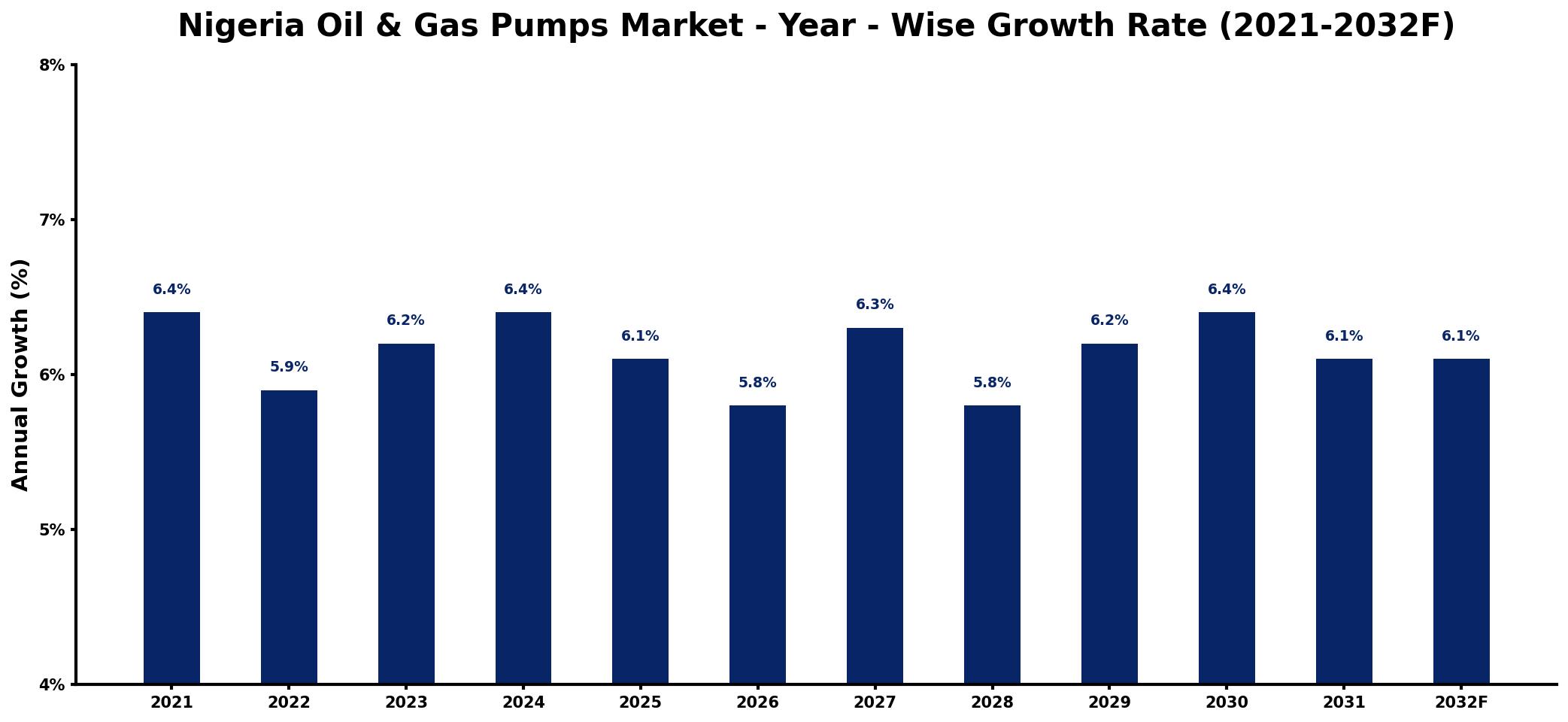
The table below presents the year‑wise growth rates along with the key drivers influencing the market
| Year | Growth Rate | Major Drivers |
| 2021 | 6.4% | Increased industrial infrastructure investments |
| 2022 | 5.9% | Growing demand for energy solutions |
| 2023 | 6.2% | Expansion of transportation networks |
| 2024 | 6.4% | Rising exploration and production activities |
| 2025 | 6.1% | Enhanced regulatory support for investments |
| 2026 | 5.8% | Technological advancements in energy sector |
| 2027 | 6.3% | Boost in renewable energy initiatives |
| 2028 | 5.8% | Increased urbanization driving consumption |
| 2029 | 6.2% | Strengthened international trade agreements |
| 2030 | 6.4% | Growing population driving energy needs |
| 2031 | 6.1% | Emergence of new market players |
| 2032 | 6.1% | Focus on sustainable energy practices |
Note: Market size estimations and growth projections presented in this report are based on 6Wresearch's proprietary forecasting methodology, utilizing the latest available industry data, government publications, and primary research inputs.
Nigeria Oil & Gas Pumps Market Synopsis
Recent momentum in the Nigeria Oil & Gas Pumps Market has been buoyed by increasing production demands and technological advancements. Looking ahead, the market is set to transform as eco-friendly technologies gain traction and the push for operational efficiency continues to escalate.
With a rising appetite for various pumping solutions—including centrifugal and positive displacement pumps—the market is evolving rapidly. Stakeholders are encouraged by the potential for improved performance and reduced downtime, aligning with the country's broader energy sector goals.
- The market is anticipated to experience steady growth driven by increased investments in oil and gas infrastructure.
- Technological innovations, particularly in digitalization and automation, are shaping the future of pumping solutions.
- Environmental sustainability is a growing priority, influencing the development of more eco-friendly pump technologies.
- Regulatory frameworks, such as the Petroleum Industry Bill, aim to enhance local participation and investment in the market.
- The evolving landscape necessitates strategic planning to navigate challenges posed by political and economic factors.
The Nigeria Oil & Gas Pumps Market faces several constraints that could impact growth trajectories. Regulatory uncertainties create a challenging environment, deterring potential investments and complicating market entry for newcomers. Furthermore, political instability and security issues can disrupt operations and hinder infrastructural development, particularly in remote areas where oil and gas exploration is most active. Infrastructure limitations related to transportation and storage facilities also pose challenges, complicating the efficient distribution of oil and gas products. Addressing these concerns requires focused strategic planning and collaboration between industry stakeholders and government entities.
Key trends in the Nigeria Oil & Gas Pumps Market reflect a shift towards more efficient and technologically advanced solutions. There is an increasing demand for pumps that not only enhance operational efficiency but also contribute to reduced energy consumption. Companies are integrating smart technologies and automation into their systems, allowing for real-time monitoring and improved maintenance practices.
Moreover, an emerging focus on environmental sustainability is prompting a movement towards greener pump options, aligning with global trends aimed at reducing carbon footprints. As companies prioritize cost-efficiency amid fluctuating oil prices, the market is leaning towards innovations that enhance reliability and performance.
Investment opportunities abound in the Nigeria Oil & Gas Pumps Market, especially for those looking to capitalize on the country's rich oil reserves. As the government intensifies its efforts to modernize oil and gas infrastructure, there is a pressing need for reliable pumping solutions tailored to the unique challenges of the region. The demand for advanced pump technologies—including smart pumps and integrated monitoring systems—presents significant avenues for growth.
Furthermore, the ongoing push for local content development opens doors for companies that can provide tailored solutions that meet both regulatory requirements and market needs. Engaging with the evolving landscape of this market can yield substantial returns for astute investors.
The Nigerian government has introduced several initiatives aimed at enhancing the Oil & Gas Pumps Market, significantly impacting operational dynamics. The Nigerian Oil and Gas Industry Content Development Act mandates increased local participation, ensuring that a portion of projects utilize local resources and expertise. Additionally, the Petroleum Industry Bill (PIB) seeks to create a more conducive environment for investment by addressing fiscal terms, regulatory frameworks, and environmental protections.
The Department of Petroleum Resources (DPR) plays a pivotal role in overseeing compliance and regulatory standards within the industry, promoting a framework that balances safety, environmental protection, and investment attraction. These initiatives are crucial for fostering a more sustainable and robust Oil & Gas Pumps Market.
Looking ahead to 2026-2032, the Nigeria Oil & Gas Pumps Market is anticipated to continue its upward trajectory, driven by ongoing investments in oil and gas exploration and the development of new fields. The focus on enhancing operational efficiency and reducing downtime will further fuel demand for advanced pump technologies. However, the market will need to navigate potential challenges related to fluctuating oil prices, regulatory uncertainties, and geopolitical risks.
In essence, the convergence of energy demand and government initiatives aimed at attracting investment positions the Nigeria Oil & Gas Pumps Market for moderate yet sustained growth in the coming years.
Recent developments in the Nigeria Oil & Gas Pumps Market indicate a growing trend towards the adoption of smart technologies and eco-friendly pumping solutions. The industry is increasingly leveraging digitalization to enhance operational efficiency and monitoring capabilities, allowing companies to respond proactively to market demands. Furthermore, discussions surrounding local content regulations have gained momentum, encouraging stakeholders to align their strategies with governmental policies aimed at boosting domestic production capacity.
- 10 Years of Market Numbers
- Historical Data Starting from 2022 to 2025
- Base Year: 2025
- Forecast Data until 2032
- Key Performance Indicators Impacting the Market
- Major Upcoming Developments and Projects
Key Highlights of the Report:
- Nigeria Oil & Gas Pumps Market Outlook
- Market Size of Nigeria Oil & Gas Pumps Market, 2025
- Forecast of Nigeria Oil & Gas Pumps Market, 2032
- Historical Data and Forecast of Nigeria Oil & Gas Pumps Revenues & Volume for the Period 2022-2032F
- Nigeria Oil & Gas Pumps Market Trend Evolution
- Nigeria Oil & Gas Pumps Market Drivers and Challenges
- Nigeria Oil & Gas Pumps Price Trends
- Nigeria Oil & Gas Pumps Porter's Five Forces
- Nigeria Oil & Gas Pumps Industry Life Cycle
- Historical Data and Forecast of Nigeria Oil & Gas Pumps Market Revenues & Volume By Type for the Period 2022-2032F
- Historical Data and Forecast of Nigeria Oil & Gas Pumps Market Revenues & Volume By Submersible Pumps for the Period 2022-2032F
- Historical Data and Forecast of Nigeria Oil & Gas Pumps Market Revenues & Volume By Non-submersible Pumps for the Period 2022-2032F
- Historical Data and Forecast of Nigeria Oil & Gas Pumps Market Revenues & Volume By Pump Type for the Period 2022-2032F
- Historical Data and Forecast of Nigeria Oil & Gas Pumps Market Revenues & Volume By Centrifugal Pump for the Period 2022-2032F
- Historical Data and Forecast of Nigeria Oil & Gas Pumps Market Revenues & Volume By Positive Displacement Pump for the Period 2022-2032F
- Historical Data and Forecast of Nigeria Oil & Gas Pumps Market Revenues & Volume By Cryogenic Pump for the Period 2022-2032F
- Historical Data and Forecast of Nigeria Oil & Gas Pumps Market Revenues & Volume By Application for the Period 2022-2032F
- Historical Data and Forecast of Nigeria Oil & Gas Pumps Market Revenues & Volume By Upstream for the Period 2022-2032F
- Historical Data and Forecast of Nigeria Oil & Gas Pumps Market Revenues & Volume By Midstream for the Period 2022-2032F
- Historical Data and Forecast of Nigeria Oil & Gas Pumps Market Revenues & Volume By Downstream for the Period 2022-2032F
- Nigeria Oil & Gas Pumps Import Export Trade Statistics
- Market Opportunity Assessment By Type
- Market Opportunity Assessment By Pump Type
- Market Opportunity Assessment By Application
- Nigeria Oil & Gas Pumps Top Companies Market Share
- Nigeria Oil & Gas Pumps Competitive Benchmarking By Technical and Operational Parameters
- Nigeria Oil & Gas Pumps Company Profiles
- Nigeria Oil & Gas Pumps Key Strategic Recommendations






































