Jordan Oil & Gas Pumps Market Size, Share & Growth Rate
The Jordan Oil & Gas Pumps Market was estimated at USD 359 Million in 2025 and is projected to reach USD 467 Million by 2032, growing at a CAGR of 3.8% from 2026 to 2032. This growth trajectory is largely driven by increased investments in the exploration and production of oil and gas, as well as rising demand for efficient pumping solutions. The governments initiatives to enhance domestic production capabilities further contribute to this favorable landscape.
Jordan Oil & Gas Pumps Market Year-wise Growth Rate and Key Drivers
This graph highlights how the Jordan Oil & Gas Pumps Market has steadily grown over the years, supported by major growth factors.
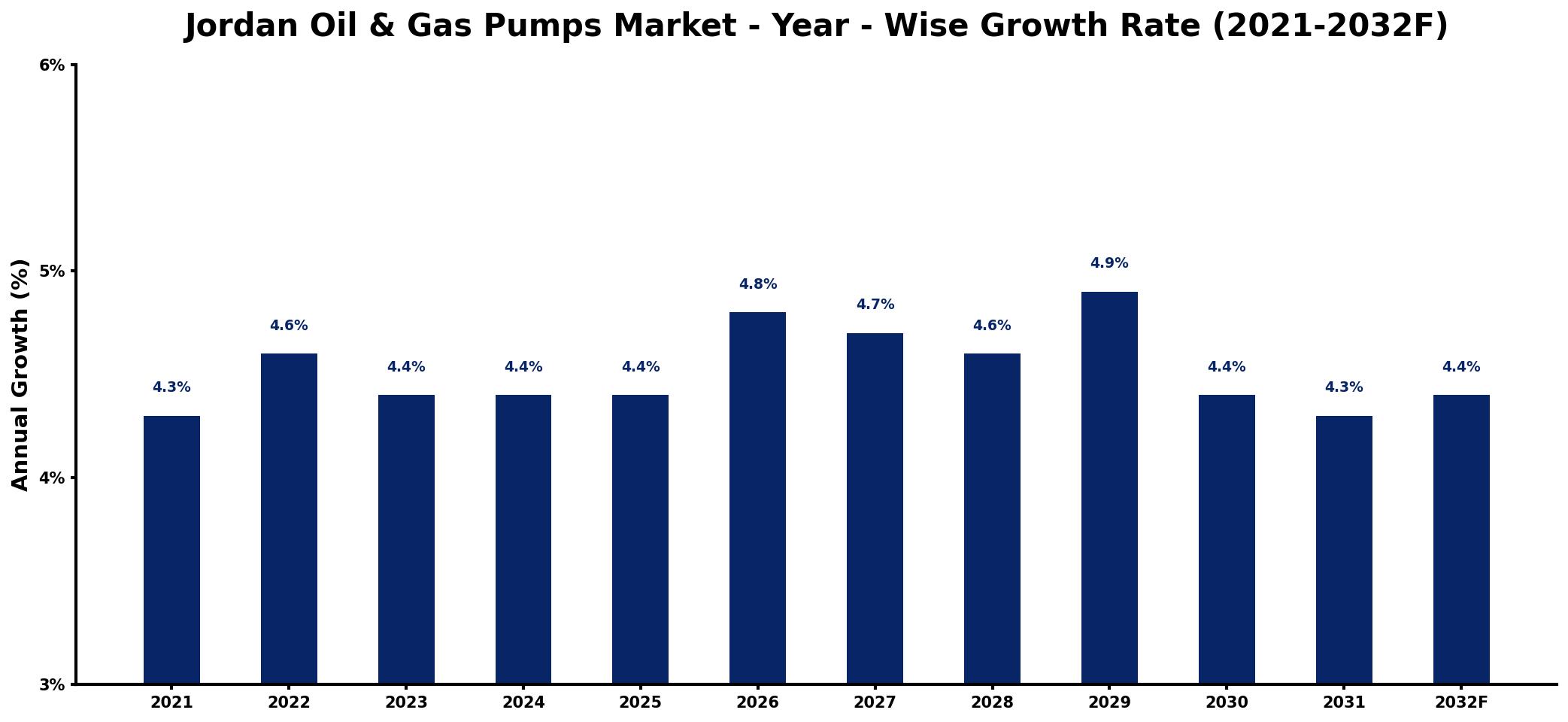
The table below presents the year‑wise growth rates along with the key drivers influencing the market
| Year | Growth Rate | Major Drivers |
| 2021 | 4.3% | Increased infrastructure development projects |
| 2022 | 4.6% | Rising demand in construction sector |
| 2023 | 4.4% | Expansion of renewable energy initiatives |
| 2024 | 4.4% | Growing urbanization and population density |
| 2025 | 4.4% | Investments in transportation networks |
| 2026 | 4.8% | Technological advancements in automation |
| 2027 | 4.7% | Strengthening industrial manufacturing capabilities |
| 2028 | 4.6% | Surge in environmental regulations compliance |
| 2029 | 4.9% | Increased export opportunities for services |
| 2030 | 4.4% | Development of smart city projects |
| 2031 | 4.3% | Focus on sustainable energy solutions |
| 2032 | 4.4% | Enhanced efficiency in logistics operations |
Note: Market size estimations and growth projections presented in this report are based on 6Wresearch's proprietary forecasting methodology, utilizing the latest available industry data, government publications, and primary research inputs.
Jordan Oil & Gas Pumps Market Synopsis
The Jordan oil & gas pumps market has experienced a period of steady growth, propelled by the surging demand for crude oil and natural gas. As the energy sector evolves, the market is poised to expand further, influenced by both domestic needs and global market dynamics.
Looking ahead, the market's trajectory seems promising, underpinned by technological innovations and increasing investments in oil and gas infrastructure. These advancements not only enhance pump efficiency but also cater to the specific demands of the industry, setting the stage for continued expansion in the coming years.
- The Jordan oil & gas pumps market is on a growth trajectory, driven by rising crude oil and natural gas production needs.
- Technological advancements are fostering greater efficiency and reliability within pump solutions.
- Government initiatives aimed at boosting domestic production are enhancing market dynamics.
- Energy-efficient pumping solutions are becoming increasingly crucial in response to environmental concerns.
- The market presents substantial investment opportunities as Jordan seeks to develop its domestic resources.
Despite positive growth indicators, the Jordan oil & gas pumps market faces several restraints. Fluctuating global oil prices create uncertainties, which can impact demand for pumping solutions in the region. Additionally, Jordan's heavy reliance on imported pumps due to limited domestic manufacturing capabilities exposes the market to potential supply chain disruptions and currency fluctuations. Regulatory compliance requirements add another layer of complexity, potentially increasing operational costs for companies. The competitive landscape, with both local and international manufacturers vying for market share, further complicates differentiation strategies for businesses aiming to maintain profitability.
Several key trends are shaping the Jordan oil & gas pumps market. There is a notable shift towards energy-efficient pumps, driven by a growing awareness of environmental impacts and the necessity to lower operational costs. Digitalization is making inroads, with smart pump systems facilitating remote monitoring and predictive maintenance, thus enhancing operational efficiency. Additionally, the focus on reliability and durability in pump design is intensifying, as companies seek to optimize overall performance in demanding oil and gas applications.
The Jordan oil & gas pumps market presents a wealth of investment opportunities, particularly as the nation seeks to bolster its energy independence. There is an increasing demand for efficient and environmentally friendly pumping solutions that can address both extraction and transportation challenges. Innovative technologies that enhance operational efficiency while reducing costs are likely to attract significant interest. Collaborations with local oil and gas companies and government entities can pave the way for further market penetration and growth.
The Jordanian government has rolled out several initiatives to encourage growth in the oil & gas pumps market. These include offering tax incentives and subsidies to attract foreign investments and promoting research and development in the sector. Additionally, partnerships with international organizations aim to facilitate technology transfer and knowledge sharing, which are vital for advancing local capabilities. These strategic government efforts contribute to enhancing efficiency and sustainability across the oil and gas pumps market while supporting broader economic growth and energy security initiatives.
Looking ahead to the period from 2026 to 2032, the Jordan oil & gas pumps market is expected to continue its upward trajectory. The ongoing emphasis on increasing energy self-sufficiency and reducing import dependence will drive demand for reliable pumping equipment. Government efforts to attract foreign investment and enhance domestic production capabilities will further fortify market growth. Additionally, the integration of advanced technologies and automation in pump solutions is anticipated to create new opportunities for manufacturers and suppliers, solidifying their positions within this evolving landscape.
Recent developments in the Jordan oil & gas pumps market have shown a shift towards increased investments in smart technology integration, enhancing operational efficiency. Companies are exploring partnerships to innovate and supply more energy-efficient pumps. Government programs aimed at boosting domestic production capabilities are gaining momentum, aligning with the country's broader energy strategies. These initiatives are fostering a more collaborative environment within the sector, which is expected to yield significant advancements in pumping technologies.
- 10 Years of Market Numbers
- Historical Data Starting from 2022 to 2025
- Base Year: 2025
- Forecast Data until 2032
- Key Performance Indicators Impacting the Market
- Major Upcoming Developments and Projects
Key Highlights of the Report:
- Jordan Oil & Gas Pumps Market Outlook
- Market Size of Jordan Oil & Gas Pumps Market, 2025
- Forecast of Jordan Oil & Gas Pumps Market, 2032
- Historical Data and Forecast of Jordan Oil & Gas Pumps Revenues & Volume for the Period 2022-2032F
- Jordan Oil & Gas Pumps Market Trend Evolution
- Jordan Oil & Gas Pumps Market Drivers and Challenges
- Jordan Oil & Gas Pumps Price Trends
- Jordan Oil & Gas Pumps Porter's Five Forces
- Jordan Oil & Gas Pumps Industry Life Cycle
- Historical Data and Forecast of Jordan Oil & Gas Pumps Market Revenues & Volume By Type for the Period 2022-2032F
- Historical Data and Forecast of Jordan Oil & Gas Pumps Market Revenues & Volume By Submersible Pumps for the Period 2022-2032F
- Historical Data and Forecast of Jordan Oil & Gas Pumps Market Revenues & Volume By Non-submersible Pumps for the Period 2022-2032F
- Historical Data and Forecast of Jordan Oil & Gas Pumps Market Revenues & Volume By Pump Type for the Period 2022-2032F
- Historical Data and Forecast of Jordan Oil & Gas Pumps Market Revenues & Volume By Centrifugal Pump for the Period 2022-2032F
- Historical Data and Forecast of Jordan Oil & Gas Pumps Market Revenues & Volume By Positive Displacement Pump for the Period 2022-2032F
- Historical Data and Forecast of Jordan Oil & Gas Pumps Market Revenues & Volume By Cryogenic Pump for the Period 2022-2032F
- Historical Data and Forecast of Jordan Oil & Gas Pumps Market Revenues & Volume By Application for the Period 2022-2032F
- Historical Data and Forecast of Jordan Oil & Gas Pumps Market Revenues & Volume By Upstream for the Period 2022-2032F
- Historical Data and Forecast of Jordan Oil & Gas Pumps Market Revenues & Volume By Midstream for the Period 2022-2032F
- Historical Data and Forecast of Jordan Oil & Gas Pumps Market Revenues & Volume By Downstream for the Period 2022-2032F
- Jordan Oil & Gas Pumps Import Export Trade Statistics
- Market Opportunity Assessment By Type
- Market Opportunity Assessment By Pump Type
- Market Opportunity Assessment By Application
- Jordan Oil & Gas Pumps Top Companies Market Share
- Jordan Oil & Gas Pumps Competitive Benchmarking By Technical and Operational Parameters
- Jordan Oil & Gas Pumps Company Profiles
- Jordan Oil & Gas Pumps Key Strategic Recommendations






































