Kuwait Oil & Gas Pumps Market Size, Share & Growth Rate
The Kuwait Oil & Gas Pumps Market was estimated at USD 1051 Million in 2025 and is projected to reach USD 1801 Million by 2032, growing at a CAGR of 8.0% from 2026 to 2032. This significant growth trajectory is driven by increasing investments in exploration and production within the oil and gas sector, coupled with a pressing need for advanced pumping solutions that enhance operational efficiency and reduce costs. As Kuwait continues to modernize its energy infrastructure, the demand for innovative and reliable pump technologies will play a pivotal role in shaping the market landscape.
Kuwait Oil & Gas Pumps Market Year-wise Growth Rate and Key Drivers
This graph highlights how the Kuwait Oil & Gas Pumps Market has steadily grown over the years, supported by major growth factors.
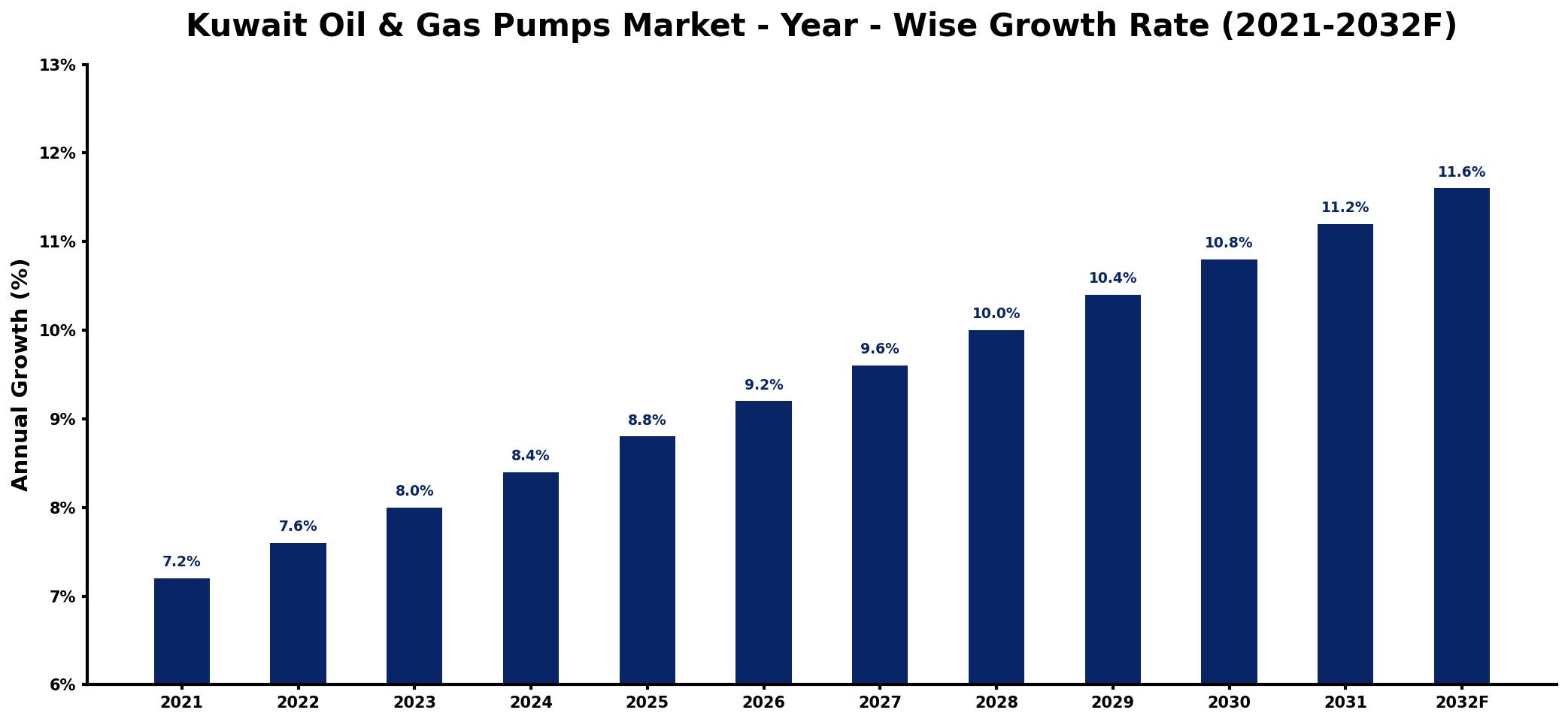
The table below presents the year‑wise growth rates along with the key drivers influencing the market
| Year | Growth Rate | Major Drivers |
| 2021 | 7.2% | Rising industrial infrastructure investments |
| 2022 | 7.6% | Increased energy sector activities |
| 2023 | 8.0% | Growing environmental regulations compliance |
| 2024 | 8.4% | Expansion of renewable energy initiatives |
| 2025 | 8.8% | Boost in construction projects demand |
| 2026 | 9.2% | Advancements in technology adoption |
| 2027 | 9.6% | Strengthening of regional trade agreements |
| 2028 | 10.0% | Surge in domestic manufacturing capabilities |
| 2029 | 10.4% | Enhanced focus on sustainability practices |
| 2030 | 10.8% | Growing need for efficient systems |
| 2031 | 11.2% | Increased foreign direct investments |
| 2032 | 11.6% | Rising urbanization and population growth |
Note: Market size estimations and growth projections presented in this report are based on 6Wresearch's proprietary forecasting methodology, utilizing the latest available industry data, government publications, and primary research inputs.
Kuwait Oil & Gas Pumps Market Synopsis
The strongest force currently shaping the Kuwait Oil & Gas Pumps Market is the country's strategic drive to augment oil production capabilities. This ambition is propelled by government policies aimed at attracting foreign investment and advancing technological development in pump manufacturing.
Amidst rising global energy demands, the focus on automation and digitalization in pumping systems has intensified. Players in the market are increasingly prioritizing the development of eco-friendly and energy-efficient pump solutions, aligning with Kuwaits commitment to sustainability and operational excellence in its oil and gas sector.
- The market is benefiting from robust government support aimed at enhancing oil and gas production.
- Technological advancements are transforming pump solutions, focusing on efficiency and sustainability.
- Centrifugal pumps continue to dominate due to their reliability across diverse applications.
- Investment opportunities are particularly promising for companies innovating in energy-efficient technologies.
- Digitalization is emerging as a critical trend, enhancing monitoring and predictive maintenance capabilities.
The Kuwait Oil & Gas Pumps Market faces notable restraints that could hinder its growth trajectory. Primarily, fluctuations in global oil prices can impact investment decisions, creating uncertainty in project timelines. Additionally, stringent regulations and compliance requirements present a challenge for operators seeking to implement new technologies. Moreover, local companies often contend with competition from established international manufacturers, which can complicate market entry and expansion. Limited domestic manufacturing capabilities for pumps and spare parts further exacerbate supply chain vulnerabilities, leading to increased operational costs. Overcoming these barriers necessitates agility, strong partnerships, and a commitment to continuous innovation.
A shift towards advanced and efficient pumping technologies is currently reshaping the Kuwait Oil & Gas Pumps Market. Companies are increasingly investing in automation and digital solutions to enhance operational performance, thus reducing maintenance costs. The market is witnessing a sustained demand for centrifugal pumps, recognized for their versatility across drilling, well stimulation, and water injection applications. Moreover, the emphasis on sustainable practices is prompting a growing focus on environmentally friendly pump solutions that align with Kuwaits climate goals.
Significant investment opportunities exist within the Kuwait Oil & Gas Pumps Market, largely attributable to the nations extensive oil reserves and ongoing exploration activities. Companies that can deliver high-quality, tailor-made pump technologies specifically designed for the unique demands of Kuwait's oil and gas operations are well-positioned for success. As the country embarks on ambitious projects to modernize and expand its energy infrastructure, the demand for innovative pumping solutions that enhance efficiency and productivity will continue to grow.
The Kuwait Oil & Gas Pumps Market is significantly influenced by government policies fostering sustainable production in the energy sector. Recent initiatives encourage foreign investment through joint ventures and strategic partnerships in pump manufacturing. Furthermore, the government is actively promoting the adoption of energy-efficient pumps, aiming to mitigate environmental impacts while enhancing operational efficiency. Regulatory frameworks are in place to ensure safety standards are upheld, safeguarding workers and the environment during oil and gas operations.
Looking ahead to 2026-2032, the Kuwait Oil & Gas Pumps Market is anticipated to maintain a steady growth trajectory fueled by sustained investments in exploration and production activities. With a continued emphasis on expanding existing oil fields and developing new projects, the need for efficient pumping solutions will be crucial. The increasing integration of digital technologies in the oil and gas sector is set to drive further adoption of advanced pump solutions. However, stakeholders will need to remain vigilant regarding potential challenges, including fluctuating oil prices and geopolitical factors, which may impact market dynamics.
Recent developments in the Kuwait Oil & Gas Pumps Market indicate a growing trend towards collaboration between local and international companies aimed at enhancing technology transfer and local manufacturing capabilities. There is also an increasing emphasis on adopting digital tools for better monitoring and predictive maintenance of pump systems. Such advancements are aligning with the broader objectives of improving operational efficiency and reducing environmental footprints in the oil and gas sector. Moreover, ongoing governmental initiatives continue to pave the way for innovative pump solutions tailored to meet the unique challenges of Kuwaits energy landscape.
- 10 Years of Market Numbers
- Historical Data Starting from 2022 to 2025
- Base Year: 2025
- Forecast Data until 2032
- Key Performance Indicators Impacting the Market
- Major Upcoming Developments and Projects
Key Highlights of the Report:
- Kuwait Oil & Gas Pumps Market Outlook
- Market Size of Kuwait Oil & Gas Pumps Market, 2025
- Forecast of Kuwait Oil & Gas Pumps Market, 2032
- Historical Data and Forecast of Kuwait Oil & Gas Pumps Revenues & Volume for the Period 2022-2032F
- Kuwait Oil & Gas Pumps Market Trend Evolution
- Kuwait Oil & Gas Pumps Market Drivers and Challenges
- Kuwait Oil & Gas Pumps Price Trends
- Kuwait Oil & Gas Pumps Porter's Five Forces
- Kuwait Oil & Gas Pumps Industry Life Cycle
- Historical Data and Forecast of Kuwait Oil & Gas Pumps Market Revenues & Volume By Type for the Period 2022-2032F
- Historical Data and Forecast of Kuwait Oil & Gas Pumps Market Revenues & Volume By Submersible Pumps for the Period 2022-2032F
- Historical Data and Forecast of Kuwait Oil & Gas Pumps Market Revenues & Volume By Non-submersible Pumps for the Period 2022-2032F
- Historical Data and Forecast of Kuwait Oil & Gas Pumps Market Revenues & Volume By Pump Type for the Period 2022-2032F
- Historical Data and Forecast of Kuwait Oil & Gas Pumps Market Revenues & Volume By Centrifugal Pump for the Period 2022-2032F
- Historical Data and Forecast of Kuwait Oil & Gas Pumps Market Revenues & Volume By Positive Displacement Pump for the Period 2022-2032F
- Historical Data and Forecast of Kuwait Oil & Gas Pumps Market Revenues & Volume By Cryogenic Pump for the Period 2022-2032F
- Historical Data and Forecast of Kuwait Oil & Gas Pumps Market Revenues & Volume By Application for the Period 2022-2032F
- Historical Data and Forecast of Kuwait Oil & Gas Pumps Market Revenues & Volume By Upstream for the Period 2022-2032F
- Historical Data and Forecast of Kuwait Oil & Gas Pumps Market Revenues & Volume By Midstream for the Period 2022-2032F
- Historical Data and Forecast of Kuwait Oil & Gas Pumps Market Revenues & Volume By Downstream for the Period 2022-2032F
- Kuwait Oil & Gas Pumps Import Export Trade Statistics
- Market Opportunity Assessment By Type
- Market Opportunity Assessment By Pump Type
- Market Opportunity Assessment By Application
- Kuwait Oil & Gas Pumps Top Companies Market Share
- Kuwait Oil & Gas Pumps Competitive Benchmarking By Technical and Operational Parameters
- Kuwait Oil & Gas Pumps Company Profiles
- Kuwait Oil & Gas Pumps Key Strategic Recommendations






































