Germany Oil & Gas Pumps Market Size, Share & Growth Rate
The Germany Oil & Gas Pumps Market was estimated at USD 117 Million in 2025 and is projected to reach USD 126 Million by 2032, growing at a CAGR of 1.1% from 2026 to 2032. This growth trajectory is fueled by escalating investments in exploration and production activities as Germany seeks to bolster its energy security. Moreover, stringent regulations aimed at enhancing energy efficiency are pushing stakeholders to adopt advanced pumping technologies that promote sustainability.
Germany Oil & Gas Pumps Market Year-wise Growth Rate and Key Drivers
This graph highlights how the Germany Oil & Gas Pumps Market has steadily grown over the years, supported by major growth factors.
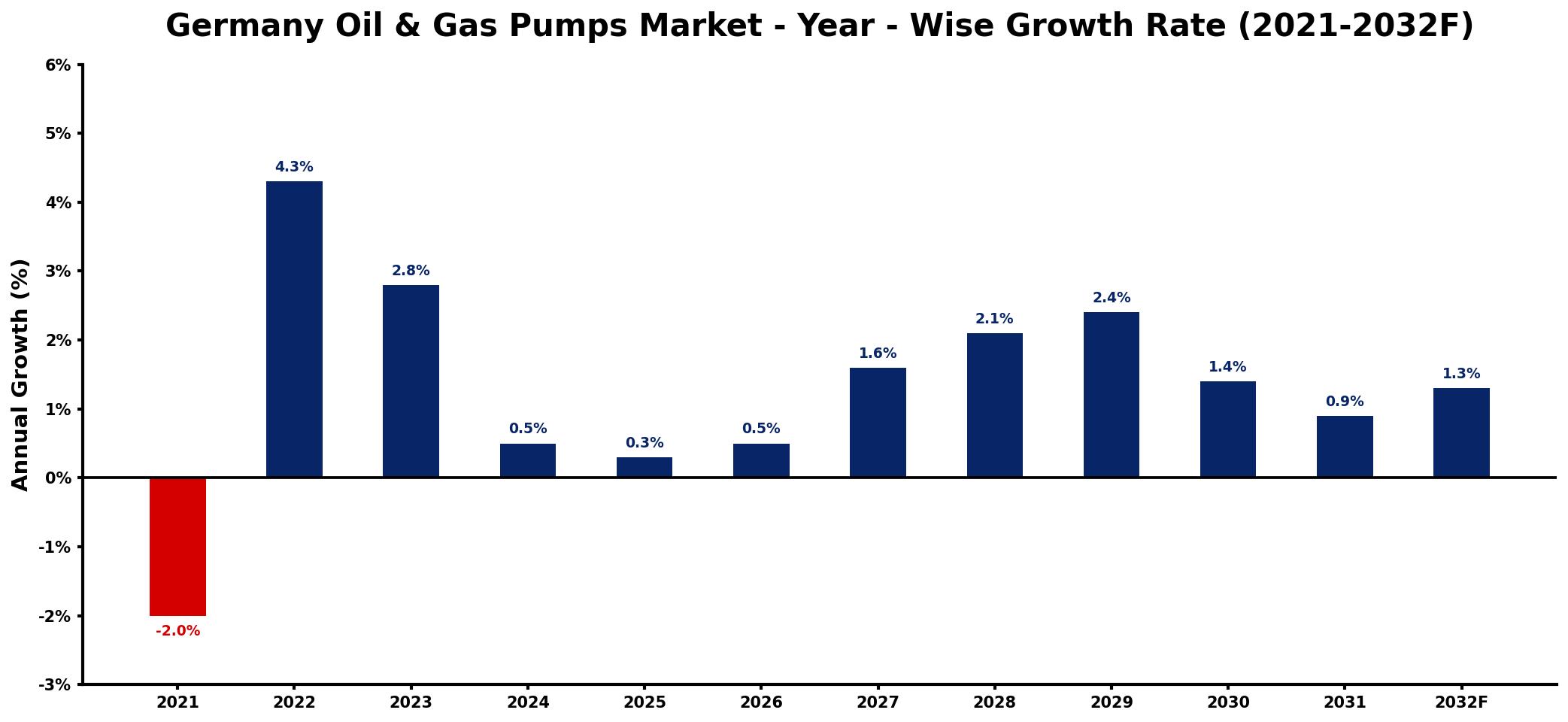
The table below presents the year‑wise growth rates along with the key drivers influencing the market
| Year | Growth Rate | Major Drivers |
| 2021 | -2.0% | decreased industrial production activities |
| 2022 | 4.3% | increased infrastructure development projects |
| 2023 | 2.8% | growing energy sector investments |
| 2024 | 0.5% | rising environmental regulations compliance |
| 2025 | 0.3% | expansion of renewable energy initiatives |
| 2026 | 0.5% | increased demand for automation solutions |
| 2027 | 1.6% | growth in international trade agreements |
| 2028 | 2.1% | surge in urbanization and development |
| 2029 | 2.4% | enhanced focus on sustainability practices |
| 2030 | 1.4% | rising technological advancements adoption |
| 2031 | 0.9% | growing importance of efficiency standards |
| 2032 | 1.3% | increased focus on energy transition |
Note: Market size estimations and growth projections presented in this report are based on 6Wresearch's proprietary forecasting methodology, utilizing the latest available industry data, government publications, and primary research inputs.
Germany Oil & Gas Pumps Market Synopsis
While the Germany Oil & Gas Pumps Market has recently experienced momentum driven by steady industrial activity and increasing energy demands, it is poised for further evolution as companies embrace innovative pump technologies. The shift towards sustainable practices and digitalization is not only transforming existing applications but also redefining operational paradigms within the sector.
As the landscape progresses, market participants are under pressure to develop and deploy advanced pumping solutions that align with the countrys ambitious energy transition goals. The increasing integration of digital technologies, such as IoT and automation, will play a pivotal role in ensuring that pump systems meet the future demands of efficiency and reliability.
- Steady growth anticipated in the market driven by rising energy demands and innovative pumping technologies.
- Regulatory frameworks are pushing for energy-efficient and environmentally friendly pump solutions.
- The emphasis on digital integration and automation is reshaping the performance monitoring of pumps.
- Investment opportunities are growing for both domestic and international stakeholders in pump manufacturing and technology development.
- Germany's commitment to sustainability is influencing market dynamics and technological advancements.
Despite its growth prospects, the Germany Oil & Gas Pumps Market faces constraints stemming from increasing regulatory pressures regarding environmental standards. Companies are compelled to align their operations with stringent regulations, which may elevate costs. Additionally, competition from the renewable energy sector is reshaping investment strategies, as stakeholders weigh the viability of fossil fuels against cleaner alternatives. The volatility in global oil and gas prices further complicates the investment landscape, potentially causing hesitations in project financing.
The current trends within the Germany Oil & Gas Pumps Market indicate a robust shift towards high-efficiency pump designs that minimize energy consumption. With sustainability at the forefront of industry priorities, more companies are integrating variable speed drives and intelligent control systems into their pumping solutions. Furthermore, digitalization is becoming a crucial trend, enabling enhanced performance monitoring and predictive maintenance practices through IoT technologies, which in turn fosters operational excellence.
Opportunities for investment abound in the Germany Oil & Gas Pumps Market, particularly in the realm of smart pump technologies and digital solutions. As companies strive to optimize efficiency and reduce operational costs, there is a strong demand for high-quality pumps tailored for extraction, transportation, and refining processes. The intersection of traditional pump manufacturing with cutting-edge technology presents a lucrative avenue for growth, appealing to both existing players and new entrants in the market.
Germany's government policies increasingly focus on promoting energy efficiency and reducing carbon emissions, particularly within the oil and gas sector. Regulatory measures encourage the adoption of energy-efficient pump solutions, reflecting a broader commitment to sustainability. Additionally, there are initiatives aimed at fostering innovation in pump technologies, which support the countrys transition towards cleaner energy sources. These policies not only impact demand but also shape the technological landscape of the market.
Looking ahead to 2026-2032, the Germany Oil & Gas Pumps Market is set to continue its upward trajectory fueled by ongoing investments in oil and gas operations and advancements in pump technology. The demand for more efficient and environmentally responsible pumping solutions will remain a critical driving force, encouraging companies to innovate and upgrade their offerings. The integration of digital technologies, such as automation and IoT, will further enhance operational efficiency, paving the way for improved performance metrics and reduced downtime.
Recent industry trends suggest a significant movement towards smarter, more efficient pump systems. Companies are increasingly adopting digital monitoring and automation technologies to boost performance and reliability. There has also been a noticeable push for partnerships and collaborations aimed at developing sustainable pumping solutions. This focus reflects the industry's commitment to meeting regulatory standards while also aligning with the growing demand for eco-friendly practices.
- 10 Years of Market Numbers
- Historical Data Starting from 2022 to 2025
- Base Year: 2025
- Forecast Data until 2032
- Key Performance Indicators Impacting the Market
- Major Upcoming Developments and Projects
Key Highlights of the Report:
- Germany Oil & Gas Pumps Market Outlook
- Market Size of Germany Oil & Gas Pumps Market, 2025
- Forecast of Germany Oil & Gas Pumps Market, 2032
- Historical Data and Forecast of Germany Oil & Gas Pumps Revenues & Volume for the Period 2022-2032F
- Germany Oil & Gas Pumps Market Trend Evolution
- Germany Oil & Gas Pumps Market Drivers and Challenges
- Germany Oil & Gas Pumps Price Trends
- Germany Oil & Gas Pumps Porter's Five Forces
- Germany Oil & Gas Pumps Industry Life Cycle
- Historical Data and Forecast of Germany Oil & Gas Pumps Market Revenues & Volume By Type for the Period 2022-2032F
- Historical Data and Forecast of Germany Oil & Gas Pumps Market Revenues & Volume By Submersible Pumps for the Period 2022-2032F
- Historical Data and Forecast of Germany Oil & Gas Pumps Market Revenues & Volume By Non-submersible Pumps for the Period 2022-2032F
- Historical Data and Forecast of Germany Oil & Gas Pumps Market Revenues & Volume By Pump Type for the Period 2022-2032F
- Historical Data and Forecast of Germany Oil & Gas Pumps Market Revenues & Volume By Centrifugal Pump for the Period 2022-2032F
- Historical Data and Forecast of Germany Oil & Gas Pumps Market Revenues & Volume By Positive Displacement Pump for the Period 2022-2032F
- Historical Data and Forecast of Germany Oil & Gas Pumps Market Revenues & Volume By Cryogenic Pump for the Period 2022-2032F
- Historical Data and Forecast of Germany Oil & Gas Pumps Market Revenues & Volume By Application for the Period 2022-2032F
- Historical Data and Forecast of Germany Oil & Gas Pumps Market Revenues & Volume By Upstream for the Period 2022-2032F
- Historical Data and Forecast of Germany Oil & Gas Pumps Market Revenues & Volume By Midstream for the Period 2022-2032F
- Historical Data and Forecast of Germany Oil & Gas Pumps Market Revenues & Volume By Downstream for the Period 2022-2032F
- Germany Oil & Gas Pumps Import Export Trade Statistics
- Market Opportunity Assessment By Type
- Market Opportunity Assessment By Pump Type
- Market Opportunity Assessment By Application
- Germany Oil & Gas Pumps Top Companies Market Share
- Germany Oil & Gas Pumps Competitive Benchmarking By Technical and Operational Parameters
- Germany Oil & Gas Pumps Company Profiles
- Germany Oil & Gas Pumps Key Strategic Recommendations






































