Iraq Oil & Gas Pumps Market Size, Share & Growth Rate
The Iraq Oil & Gas Pumps Market was estimated at USD 1296 Million in 2025 and is projected to reach USD 1869 Million by 2032, growing at a CAGR of 5.4% from 2026 to 2032. This robust growth trajectory is primarily driven by Iraq's vast oil reserves and the ongoing investments in infrastructure aimed at boosting production capacity. With a strategic focus on enhancing operational efficiency through modern pumping technologies, the market is positioned for sustained expansion.
Iraq Oil & Gas Pumps Market Year-wise Growth Rate and Key Drivers
This graph highlights how the Iraq Oil & Gas Pumps Market has steadily grown over the years, supported by major growth factors.
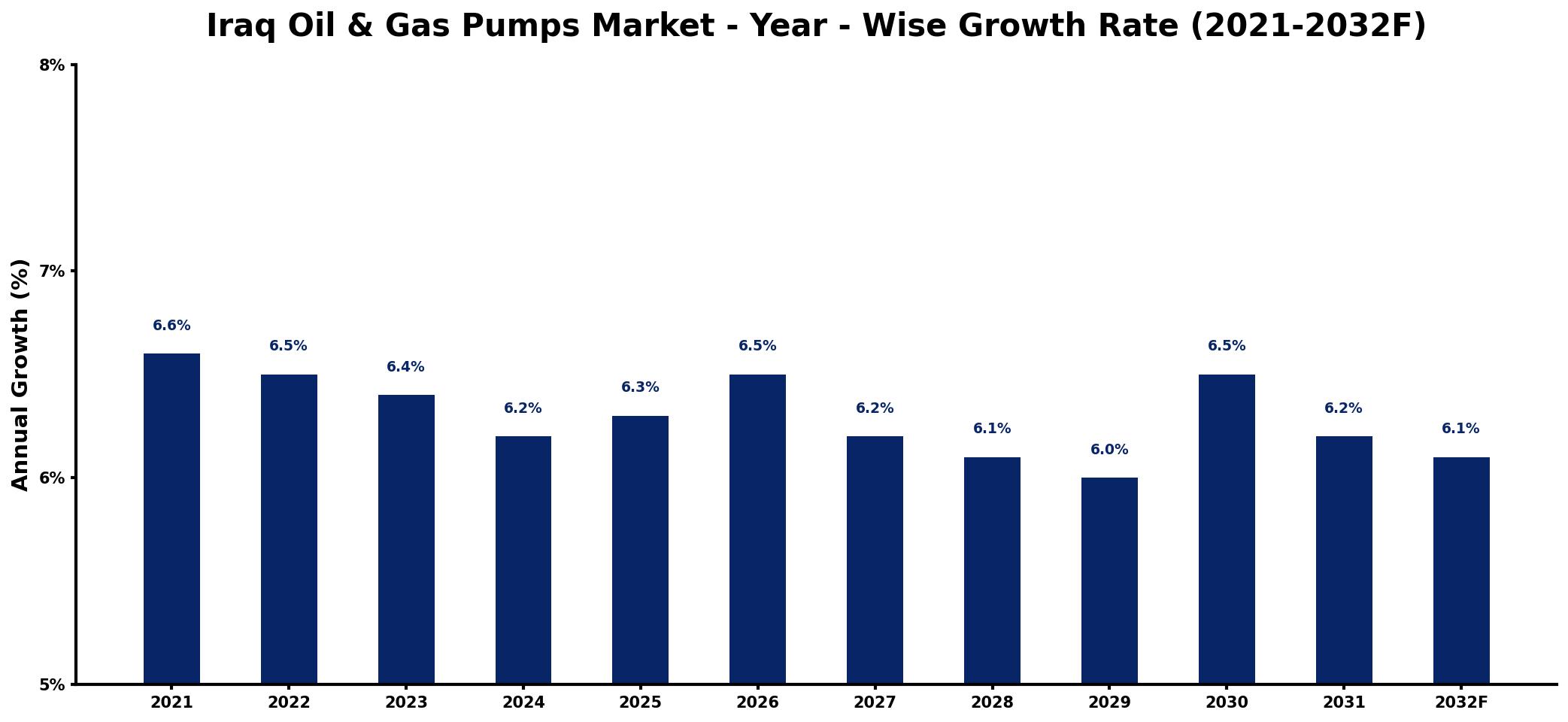
The table below presents the year‑wise growth rates along with the key drivers influencing the market
| Year | Growth Rate | Major Drivers |
| 2021 | 6.6% | Increased infrastructure development projects |
| 2022 | 6.5% | Rising energy sector investments |
| 2023 | 6.4% | Growing industrial manufacturing activities |
| 2024 | 6.2% | Expanding transportation and logistics networks |
| 2025 | 6.3% | Strengthening regional trade agreements |
| 2026 | 6.5% | rising demand from electronics |
| 2027 | 6.2% | Increased regulatory support frameworks |
| 2028 | 6.1% | rising procurement volume requirements |
| 2029 | 6.0% | Boost in foreign direct investments |
| 2030 | 6.5% | Growing urbanization and population |
| 2031 | 6.2% | Expansion of international partnerships |
| 2032 | 6.1% | Strengthening local supply chains |
Note: Market size estimations and growth projections presented in this report are based on 6Wresearch's proprietary forecasting methodology, utilizing the latest available industry data, government publications, and primary research inputs.
Iraq Oil & Gas Pumps Market Synopsis
The demand for pumps in Iraq's oil and gas sector is predominantly influenced by the significant expansion of oil extraction and processing activities. This growing requirement encompasses various pump types, including centrifugal, positive displacement, and submersible pumps, all critical for upstream, midstream, and downstream operations.
Additionally, the Iraqi market is characterized by the presence of both domestic manufacturers and international players, collaborating to deliver innovative pumping solutions tailored to local operational challenges. This blend fosters competition and encourages technological advancements that are vital for improving efficiency and compliance with environmental standards.
- Increasing demand for advanced pump technologies is enhancing operational efficiency in Iraq's oil and gas sector.
- Investment in environmentally sustainable pump solutions is gaining traction as companies aim to minimize carbon footprints.
- Customized pump systems are on the rise, aligning with specific operational needs in exploration and production activities.
- Integration of digital technologies, including IoT and AI, is transforming monitoring and maintenance practices.
- Political and security factors remain crucial in shaping the market environment and investment landscape.
The Iraq Oil & Gas Pumps Market is constrained by several notable factors that can impede growth. Political instability and persistent security issues significantly affect operational efficiencies and deter foreign investment. Furthermore, regulatory uncertainties and complex bureaucratic processes can delay project approvals, creating hesitance among potential investors. These elements collectively create a challenging operating environment for pump manufacturers and service providers, necessitating strategic navigation to achieve sustained market participation.
The market is currently experiencing significant trends that are shaping its future trajectory. The transition towards digital transformation, exemplified by the adoption of IoT and AI technologies, is enabling real-time monitoring and predictive maintenance of pumping systems. Furthermore, the increasing implementation of energy-efficient and environmentally friendly pumping solutions reflects the sector's commitment to sustainable practices. Another crucial trend is the shift towards customized solutions that cater to the unique requirements of Iraq's diverse oil fields, ensuring optimal performance across varying conditions.
Significant investment opportunities exist within the Iraq Oil & Gas Pumps Market, primarily due to the country's rich natural resources and the ongoing drive to enhance production capabilities. Investors can explore avenues in developing efficient pumping technologies that align with the rising demand for sustainable practices. Additionally, collaboration with local firms can present unique advantages, particularly in navigating regulatory landscapes and building capacity within the local manufacturing sector. This dual approach not only promotes market growth but also positions investors to capitalize on long-term trends in the oil and gas industry.
The Iraqi government has instituted various initiatives to foster growth in the Oil & Gas Pumps Market, recognizing its strategic importance in the national economy. Policies aimed at attracting foreign investment through partnerships with local companies are prevalent, promoting technology transfer and capacity building. Furthermore, the government emphasizes environmental sustainability by adhering to international standards and regulations. By increasing transparency and accountability, these initiatives create a conducive environment for investment and development, essential for the oil and gas sector's future.
Looking ahead to the 2026-2032 period, the Iraq Oil & Gas Pumps Market is set to experience steady growth, fueled by continued investments in exploration and production activities. As the country seeks to modernize its infrastructure, the demand for technologically advanced pumping solutions will grow. Moreover, the need for operational efficiency and compliance with environmental regulations will drive innovation and investment in the sector. While external challenges such as fluctuating oil prices and geopolitical tensions may pose risks, the long-term outlook remains promising as Iraq solidifies its position in the global energy landscape.
Recent developments in the Iraq Oil & Gas Pumps Market indicate a strong push toward modernization and efficiency. Industry stakeholders are increasingly prioritizing investment in advanced pumping technologies and sustainable solutions. Additionally, partnerships between local manufacturers and international firms are being fostered to enhance technological capabilities. The integration of digital tools for performance monitoring is also becoming more prevalent, aligning with global trends aimed at improving operational performance in the oil and gas sector.
- 10 Years of Market Numbers
- Historical Data Starting from 2022 to 2025
- Base Year: 2025
- Forecast Data until 2032
- Key Performance Indicators Impacting the Market
- Major Upcoming Developments and Projects
Key Highlights of the Report:
- Iraq Oil & Gas Pumps Market Outlook
- Market Size of Iraq Oil & Gas Pumps Market, 2025
- Forecast of Iraq Oil & Gas Pumps Market, 2032
- Historical Data and Forecast of Iraq Oil & Gas Pumps Revenues & Volume for the Period 2022-2032F
- Iraq Oil & Gas Pumps Market Trend Evolution
- Iraq Oil & Gas Pumps Market Drivers and Challenges
- Iraq Oil & Gas Pumps Price Trends
- Iraq Oil & Gas Pumps Porter's Five Forces
- Iraq Oil & Gas Pumps Industry Life Cycle
- Historical Data and Forecast of Iraq Oil & Gas Pumps Market Revenues & Volume By Type for the Period 2022-2032F
- Historical Data and Forecast of Iraq Oil & Gas Pumps Market Revenues & Volume By Submersible Pumps for the Period 2022-2032F
- Historical Data and Forecast of Iraq Oil & Gas Pumps Market Revenues & Volume By Non-submersible Pumps for the Period 2022-2032F
- Historical Data and Forecast of Iraq Oil & Gas Pumps Market Revenues & Volume By Pump Type for the Period 2022-2032F
- Historical Data and Forecast of Iraq Oil & Gas Pumps Market Revenues & Volume By Centrifugal Pump for the Period 2022-2032F
- Historical Data and Forecast of Iraq Oil & Gas Pumps Market Revenues & Volume By Positive Displacement Pump for the Period 2022-2032F
- Historical Data and Forecast of Iraq Oil & Gas Pumps Market Revenues & Volume By Cryogenic Pump for the Period 2022-2032F
- Historical Data and Forecast of Iraq Oil & Gas Pumps Market Revenues & Volume By Application for the Period 2022-2032F
- Historical Data and Forecast of Iraq Oil & Gas Pumps Market Revenues & Volume By Upstream for the Period 2022-2032F
- Historical Data and Forecast of Iraq Oil & Gas Pumps Market Revenues & Volume By Midstream for the Period 2022-2032F
- Historical Data and Forecast of Iraq Oil & Gas Pumps Market Revenues & Volume By Downstream for the Period 2022-2032F
- Iraq Oil & Gas Pumps Import Export Trade Statistics
- Market Opportunity Assessment By Type
- Market Opportunity Assessment By Pump Type
- Market Opportunity Assessment By Application
- Iraq Oil & Gas Pumps Top Companies Market Share
- Iraq Oil & Gas Pumps Competitive Benchmarking By Technical and Operational Parameters
- Iraq Oil & Gas Pumps Company Profiles
- Iraq Oil & Gas Pumps Key Strategic Recommendations






































