Kenya Print Label Market Size Growth Rate
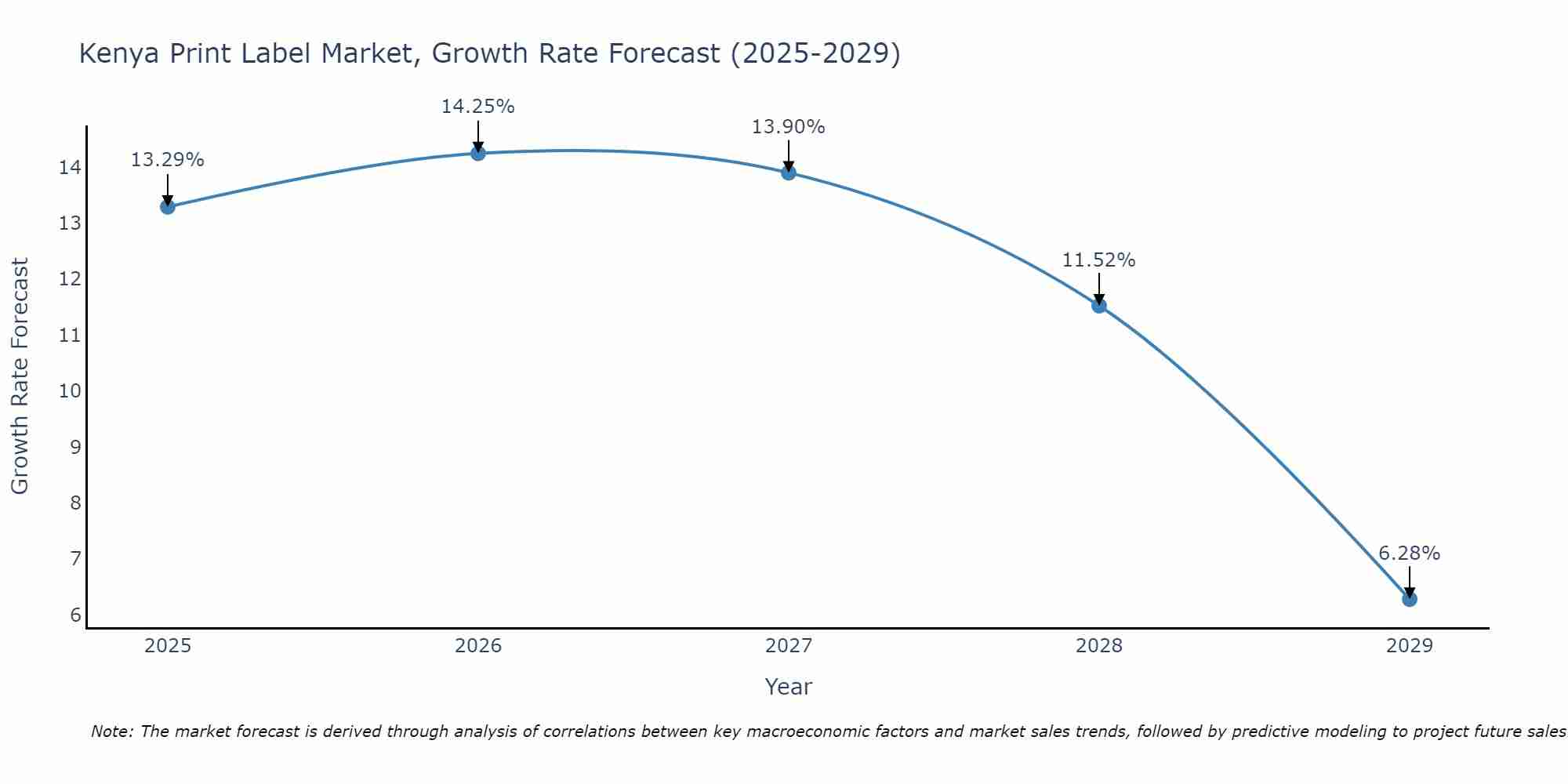
The Kenya Print Label Market is projected to witness mixed growth rate patterns during 2025 to 2029. Growth accelerates to 14.25% in 2026, following an initial rate of 13.29%, before easing to 6.28% at the end of the period.
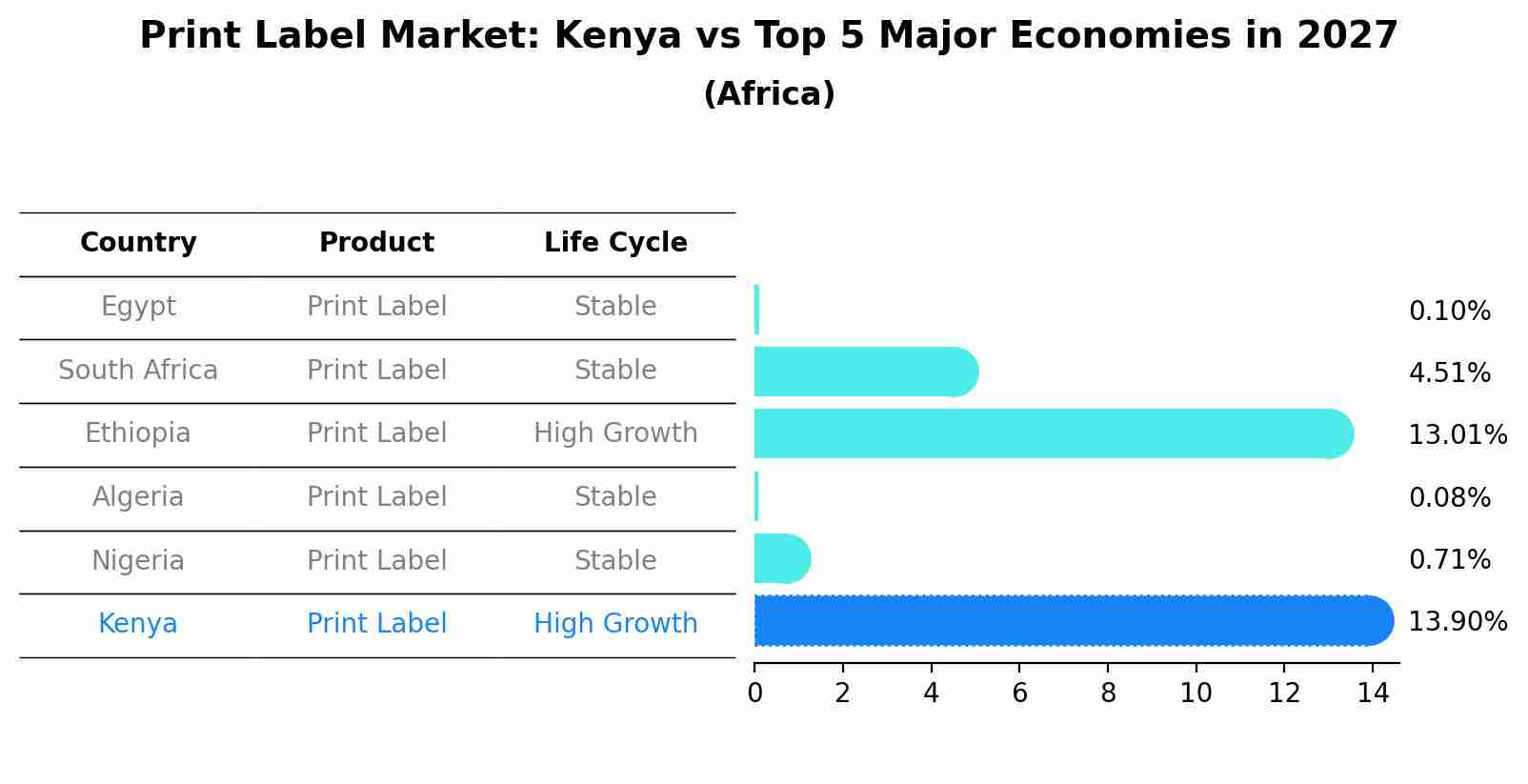
Print Label Market: Kenya vs Top 5 Major Economies in 2027 (Africa)
In the Africa region, the Print Label market in Kenya is projected to expand at a high growth rate of 13.90% by 2027. The largest economy is Egypt, followed by South Africa, Ethiopia, Algeria and Nigeria.
Kenya Print Label Market Overview
The Kenya Print Label Market is experiencing steady growth driven by factors such as increasing demand for packaged goods, growth in the retail sector, and rising consumer awareness about product information and branding. The market is characterized by a diverse range of label types including self-adhesive labels, in-mold labels, and shrink sleeves, catering to various industries such as food and beverage, pharmaceuticals, and personal care. Key players in the market are focusing on innovations in label materials, printing technologies, and sustainability practices to stay competitive and meet evolving consumer preferences. With the government`s initiatives to boost the manufacturing sector and promote local industries, the Kenya Print Label Market is expected to continue its growth trajectory in the coming years.
Kenya Print Label Market Trends
The Kenya Print Label Market is experiencing a shift towards sustainable and eco-friendly materials, driven by increasing awareness of environmental issues among consumers. Companies are increasingly opting for biodegradable, recyclable, and compostable label materials to align with sustainability goals and meet consumer demand for eco-conscious products. Digital printing technology is also gaining traction in the market due to its flexibility, cost-effectiveness, and ability to cater to small batch orders with quick turnaround times. Additionally, there is a growing trend towards customized and personalized labels to enhance brand identity and attract consumers in a competitive market landscape. Overall, the Kenya Print Label Market is evolving towards sustainability, innovation, and customization to meet the changing preferences of consumers and businesses.
Kenya Print Label Market Challenges
In the Kenya Print Label Market, some challenges are faced such as intense competition from both domestic and international players, fluctuating raw material prices, limited technological advancements leading to lower production efficiency, and a lack of skilled labor in the industry. Additionally, the market also faces issues related to counterfeit products and strict regulations regarding labeling and packaging standards. These challenges require companies operating in the Kenya Print Label Market to constantly innovate, invest in research and development, and adapt to changing market dynamics to stay competitive and meet the evolving needs of consumers and regulatory requirements.
Kenya Print Label Market Investment Opportunities
The Kenya Print Label Market presents promising investment opportunities due to the country`s growing consumer goods and manufacturing sectors. With increasing demand for packaged products, there is a corresponding need for high-quality labels to distinguish brands and provide essential product information. Investing in print label manufacturing companies or establishing a printing business catering to this market can be lucrative. Additionally, adopting innovative technologies such as digital printing and sustainable materials can help attract environmentally conscious consumers. As the economy continues to develop and the retail landscape expands, the demand for print labels is expected to rise, making it a strategic investment opportunity in Kenya`s fast-growing packaging industry.
Kenya Print Label Market Government Policy
The Kenyan government has implemented various policies related to the print label market to ensure consumer protection and promote fair competition. These policies include the requirement for labels to provide accurate and clear information about products, such as ingredients, expiration dates, and manufacturer details. Additionally, regulations are in place to ensure that labels are printed using environmentally friendly materials and processes to reduce the industry`s impact on the environment. The government also enforces strict guidelines on labeling standards to prevent misleading or false advertising practices. Overall, these policies aim to enhance consumer trust, promote market transparency, and support sustainable practices within the print label industry in Kenya.
Kenya Print Label Market Future Outlook
The Kenya Print Label Market is expected to experience steady growth in the coming years, driven by factors such as increasing demand for packaged goods, rising awareness about product information and branding, and the growth of various industries including food & beverage, pharmaceuticals, and cosmetics. With the implementation of stricter regulations regarding labeling and packaging standards, the market is likely to witness a shift towards more advanced labeling solutions such as RFID tags and smart labels. The adoption of digital printing technologies is also expected to increase, offering more customization options and shorter lead times for label production. Overall, the Kenya Print Label Market is poised for expansion as companies look to enhance their brand visibility and comply with evolving industry requirements.
Key Highlights of the Report:
- Kenya Print Label Market Outlook
- Market Size of Kenya Print Label Market, 2021
- Forecast of Kenya Print Label Market, 2031
- Historical Data and Forecast of Kenya Print Label Revenues & Volume for the Period 2018 - 2031
- Kenya Print Label Market Trend Evolution
- Kenya Print Label Market Drivers and Challenges
- Kenya Print Label Price Trends
- Kenya Print Label Porter's Five Forces
- Kenya Print Label Industry Life Cycle
- Historical Data and Forecast of Kenya Print Label Market Revenues & Volume By Print Process for the Period 2018 - 2031
- Historical Data and Forecast of Kenya Print Label Market Revenues & Volume By Offset lithography for the Period 2018 - 2031
- Historical Data and Forecast of Kenya Print Label Market Revenues & Volume By Gravure for the Period 2018 - 2031
- Historical Data and Forecast of Kenya Print Label Market Revenues & Volume By Flexography for the Period 2018 - 2031
- Historical Data and Forecast of Kenya Print Label Market Revenues & Volume By Screen for the Period 2018 - 2031
- Historical Data and Forecast of Kenya Print Label Market Revenues & Volume By Letterpress for the Period 2018 - 2031
- Historical Data and Forecast of Kenya Print Label Market Revenues & Volume By Electrophotography for the Period 2018 - 2031
- Historical Data and Forecast of Kenya Print Label Market Revenues & Volume By Inkjet for the Period 2018 - 2031
- Historical Data and Forecast of Kenya Print Label Market Revenues & Volume By Label Format for the Period 2018 - 2031
- Historical Data and Forecast of Kenya Print Label Market Revenues & Volume By Wet-glue labels for the Period 2018 - 2031
- Historical Data and Forecast of Kenya Print Label Market Revenues & Volume By Pressure-sensitive labels for the Period 2018 - 2031
- Historical Data and Forecast of Kenya Print Label Market Revenues & Volume By Linerless labels for the Period 2018 - 2031
- Historical Data and Forecast of Kenya Print Label Market Revenues & Volume By Multi-part tracking labels for the Period 2018 - 2031
- Historical Data and Forecast of Kenya Print Label Market Revenues & Volume By In-mold labels for the Period 2018 - 2031
- Historical Data and Forecast of Kenya Print Label Market Revenues & Volume By Sleeves for the Period 2018 - 2031
- Historical Data and Forecast of Kenya Print Label Market Revenues & Volume By End-User for the Period 2018 - 2031
- Historical Data and Forecast of Kenya Print Label Market Revenues & Volume By Food for the Period 2018 - 2031
- Historical Data and Forecast of Kenya Print Label Market Revenues & Volume By Beverage for the Period 2018 - 2031
- Historical Data and Forecast of Kenya Print Label Market Revenues & Volume By Healthcare for the Period 2018 - 2031
- Historical Data and Forecast of Kenya Print Label Market Revenues & Volume By Cosmetics for the Period 2018 - 2031
- Historical Data and Forecast of Kenya Print Label Market Revenues & Volume By Household for the Period 2018 - 2031
- Historical Data and Forecast of Kenya Print Label Market Revenues & Volume By Industrial for the Period 2018 - 2031
- Historical Data and Forecast of Kenya Print Label Market Revenues & Volume By Logistics for the Period 2018 - 2031
- Historical Data and Forecast of Kenya Print Label Market Revenues & Volume By Other for the Period 2018 - 2031
- Kenya Print Label Import Export Trade Statistics
- Market Opportunity Assessment By Print Process
- Market Opportunity Assessment By Label Format
- Market Opportunity Assessment By End-User
- Kenya Print Label Top Companies Market Share
- Kenya Print Label Competitive Benchmarking By Technical and Operational Parameters
- Kenya Print Label Company Profiles
- Kenya Print Label Key Strategic Recommendations






































