Kenya Retail And Wholesale Market Size, Share & Growth Rate
The Kenya Retail And Wholesale Market was estimated at USD 955 Million in 2025 and is projected to reach USD 1619 Million by 2032, growing at a CAGR of 7.8% from 2026 to 2032. This growth trajectory is driven by a burgeoning middle class and accelerated urbanization, leading to an increasing demand for diverse consumer goods and modern shopping experiences. The rise of digital platforms and e-commerce also plays a pivotal role, shifting traditional shopping habits toward more convenient online solutions.
Kenya Retail And Wholesale Market Year-wise Growth Rate and Key Drivers
This graph highlights how the Kenya Retail And Wholesale Market has steadily grown over the years, supported by major growth factors.
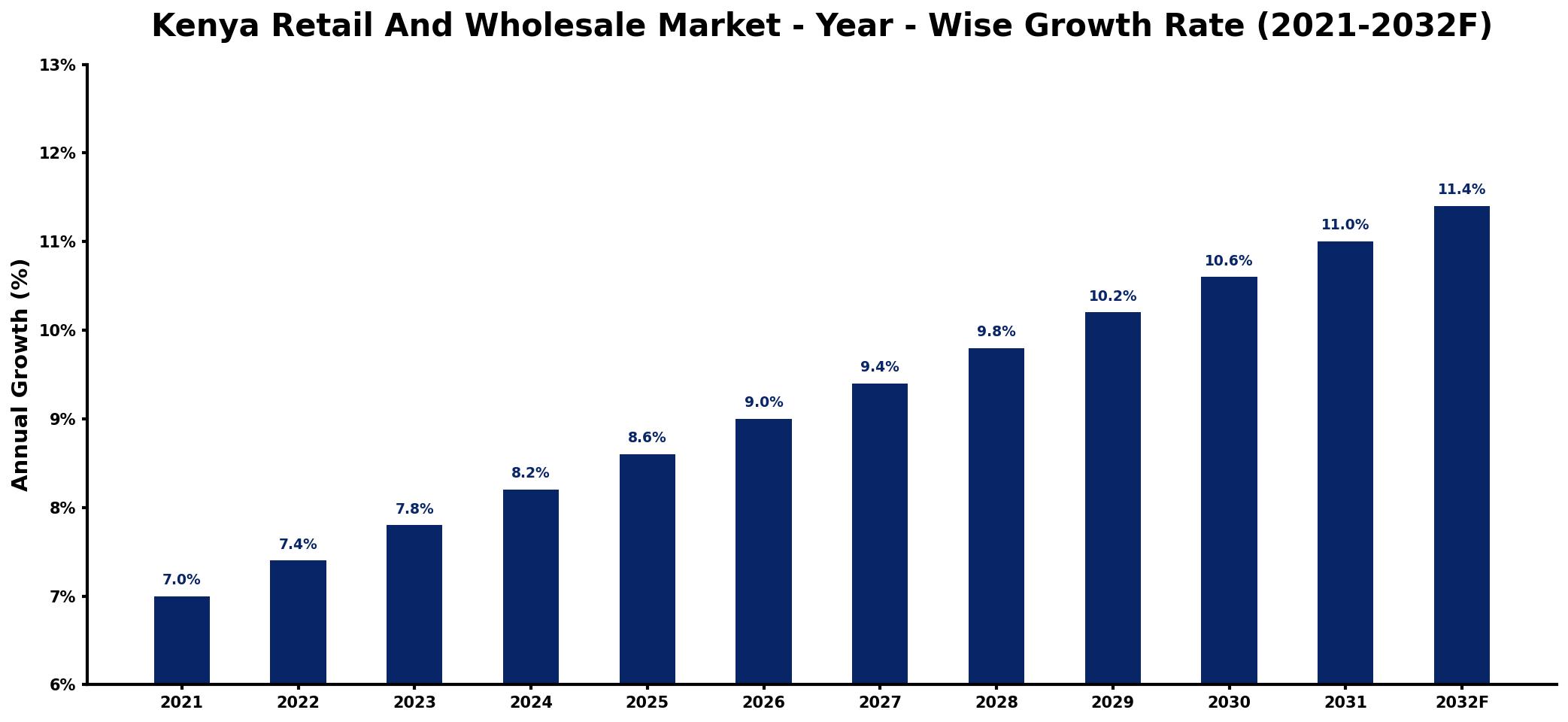
The table below presents the year‑wise growth rates along with the key drivers influencing the market
| Year | Growth Rate | Major Drivers |
| 2021 | 7.0% | Rising consumer disposable income levels |
| 2022 | 7.4% | Expansion of online shopping platforms |
| 2023 | 7.8% | Increased foreign direct investment influx |
| 2024 | 8.2% | Growth in urban population density |
| 2025 | 8.6% | Strengthening local manufacturing capabilities |
| 2026 | 9.0% | Widespread adoption of mobile payments |
| 2027 | 9.4% | improved raw material availability |
| 2028 | 9.8% | Increased focus on sustainability practices |
| 2029 | 10.2% | Development of logistics infrastructure projects |
| 2030 | 10.6% | Growing demand for convenience shopping |
| 2031 | 11.0% | growing automotive sector requirements |
| 2032 | 11.4% | strengthening international trade flows |
Note: Market size estimations and growth projections presented in this report are based on 6Wresearch's proprietary forecasting methodology, utilizing the latest available industry data, government publications, and primary research inputs.
Kenya Retail And Wholesale Market Synopsis
Recent momentum in the Kenya Retail and Wholesale market showcases an impressive shift toward modern retail formats and a growing acceptance of e-commerce. As consumer preferences evolve, the market is headed towards an increasingly digital and interconnected shopping environment, aligning with global retail trends.
The informal retail sector remains significant, contributing to a vibrant landscape of shopping options. As the market continues to mature, both local and international players are adapting strategies to capture the attention of a diverse consumer base that values innovation, quality, and sustainability.
Kenya Retail And Wholesale Market Key Takeaways
- Strong growth projected with an increase from USD 955 Million to USD 1619 Million by 2032.
- Urbanization and a rising middle class are key drivers of market expansion.
- Digitalization and e-commerce are reshaping consumer shopping behaviors.
- Sustainability and local sourcing are becoming increasingly important to consumers.
- Intense competition requires businesses to innovate continuously to maintain market share.
Evaluation of Restraints in Kenya Retail And Wholesale Market
The Kenya Retail and Wholesale market faces several constraints that can impede growth. Competition is fierce, resulting in price wars that shrink profit margins. Infrastructure deficiencies, such as inadequate road networks and unstable power supply, challenge efficient distribution. Furthermore, high operating costs and the prevalence of counterfeit goods can negatively impact consumer trust, complicating the market landscape. Businesses must navigate these challenges while adapting to evolving consumer preferences and complex regulations to thrive in this dynamic environment.
Kenya Retail And Wholesale Market Trends
Current trends highlight a notable shift towards digital shopping experiences, with an increasing number of consumers favoring the convenience of online platforms. Retailers are enhancing their omnichannel strategies to offer seamless transitions between online and offline shopping. Sustainability is also on the rise, with consumers showing a preference for locally sourced and eco-friendly products. Additionally, experiential retail is gaining traction, encouraging retailers to create engaging shopping environments that foster customer loyalty.
Kenya Retail And Wholesale Market Opportunities
Investment opportunities abound within the Kenya retail and wholesale market. The growing demand for fast-moving consumer goods (FMCG), fashion, electronics, and grocery retail signals a ripe landscape for new entrants. E-commerce is rapidly gaining popularity, presenting avenues for investment in logistics and online retail platforms. Moreover, adopting technology to streamline supply chain operations and enhance customer experiences can yield substantial returns. Investors must consider the challenges but should recognize the diverse potential for growth in this evolving market.
Government Initiatives in the Kenya Retail And Wholesale Market
The Kenyan government has enacted several policies aimed at regulating and supporting the retail and wholesale sector. Initiatives such as the Competition Act and the Consumer Protection Act are designed to ensure fair trading practices and safeguard consumer interests. Moreover, the Retail Trade Act provides a framework for retail operations, while the National Trade Policy promotes local industries. These government measures are crucial for fostering a competitive market environment and encouraging business growth.
Future Insights of the Kenya Retail And Wholesale Market
Looking ahead to 2026-2032, the Kenya Retail and Wholesale market is set for steady growth, driven primarily by urbanization and increasing disposable incomes among consumers. The digital transformation, including advancements in e-commerce and payment systems, will continue to revolutionize shopping behaviors. Furthermore, ongoing government initiatives to improve infrastructure and create a supportive business climate are expected to bolster the sector. However, businesses must remain agile and responsive to market changes to fully capitalize on these growth opportunities.
Kenya Retail And Wholesale Market Latest Developments (2025 - 2026)
The retail and wholesale sector in Kenya has recently seen significant strides in digital adoption, with many retailers launching new e-commerce platforms to attract tech-savvy consumers. Additionally, initiatives aimed at enhancing supply chain efficiencies are gaining traction, particularly in response to logistics challenges. Retailers are increasingly focusing on sustainability, with several brands pledging to use locally sourced products and reduce their environmental impact. This evolving landscape reflects the sector's adaptability to both consumer demand and competitive pressures.
Kenya Retail And Wholesale Market - Key Attractiveness of the Report
- 10 Years of Market Numbers
- Historical Data Starting from 2022 to 2025
- Base Year: 2025
- Forecast Data until 2032
- Key Performance Indicators Impacting the Market
- Major Upcoming Developments and Projects
Key Highlights of the Report:
- Kenya Retail And Wholesale Market Outlook
- Market Size of Kenya Retail And Wholesale Market, 2025
- Forecast of Kenya Retail And Wholesale Market, 2032
- Historical Data and Forecast of Kenya Retail And Wholesale Revenues & Volume for the Period 2022-2032F
- Kenya Retail And Wholesale Market Trend Evolution
- Kenya Retail And Wholesale Market Drivers and Challenges
- Kenya Retail And Wholesale Price Trends
- Kenya Retail And Wholesale Porter's Five Forces
- Kenya Retail And Wholesale Industry Life Cycle
- Historical Data and Forecast of Kenya Retail And Wholesale Market Revenues & Volume By Type for the Period 2022-2032F
- Historical Data and Forecast of Kenya Retail And Wholesale Market Revenues & Volume By Retail for the Period 2022-2032F
- Historical Data and Forecast of Kenya Retail And Wholesale Market Revenues & Volume By Wholesale for the Period 2022-2032F
- Historical Data and Forecast of Kenya Retail And Wholesale Market Revenues & Volume By Ownership for the Period 2022-2032F
- Historical Data and Forecast of Kenya Retail And Wholesale Market Revenues & Volume By Retail Chain/Wholesale Chain for the Period 2022-2032F
- Historical Data and Forecast of Kenya Retail And Wholesale Market Revenues & Volume By Independent Retailer/Independent Wholesalers for the Period 2022-2032F
- Historical Data and Forecast of Kenya Retail And Wholesale Market Revenues & Volume By Price Range for the Period 2022-2032F
- Historical Data and Forecast of Kenya Retail And Wholesale Market Revenues & Volume By Premium for the Period 2022-2032F
- Historical Data and Forecast of Kenya Retail And Wholesale Market Revenues & Volume By Mid-Range for the Period 2022-2032F
- Historical Data and Forecast of Kenya Retail And Wholesale Market Revenues & Volume By Economy for the Period 2022-2032F
- Historical Data and Forecast of Kenya Retail And Wholesale Market Revenues & Volume By Distribution Channel for the Period 2022-2032F
- Historical Data and Forecast of Kenya Retail And Wholesale Market Revenues & Volume By Supermarkets/Hypermarkets for the Period 2022-2032F
- Historical Data and Forecast of Kenya Retail And Wholesale Market Revenues & Volume By Convenience Stores for the Period 2022-2032F
- Historical Data and Forecast of Kenya Retail And Wholesale Market Revenues & Volume By Department Stores for the Period 2022-2032F
- Historical Data and Forecast of Kenya Retail And Wholesale Market Revenues & Volume By Specialty Stores for the Period 2022-2032F
- Kenya Retail And Wholesale Import Export Trade Statistics
- Market Opportunity Assessment By Type
- Market Opportunity Assessment By Ownership
- Market Opportunity Assessment By Price Range
- Market Opportunity Assessment By Distribution Channel
- Kenya Retail And Wholesale Top Companies Market Share
- Kenya Retail And Wholesale Competitive Benchmarking By Technical and Operational Parameters
- Kenya Retail And Wholesale Company Profiles
- Kenya Retail And Wholesale Key Strategic Recommendations






































