Kenya Sheet Metal Market Summary
The kenya sheet metal market was estimated at USD 249 Million in 2025 and is projected to reach USD 325 Million by 2032, growing at a CAGR of 4.5% from 2026 to 2032.
Kenya Sheet Metal Market Year-wise Growth Rate and Key Drivers
This graph highlights how the Kenya Sheet Metal Market has steadily grown over the past five years, supported by major growth factors.
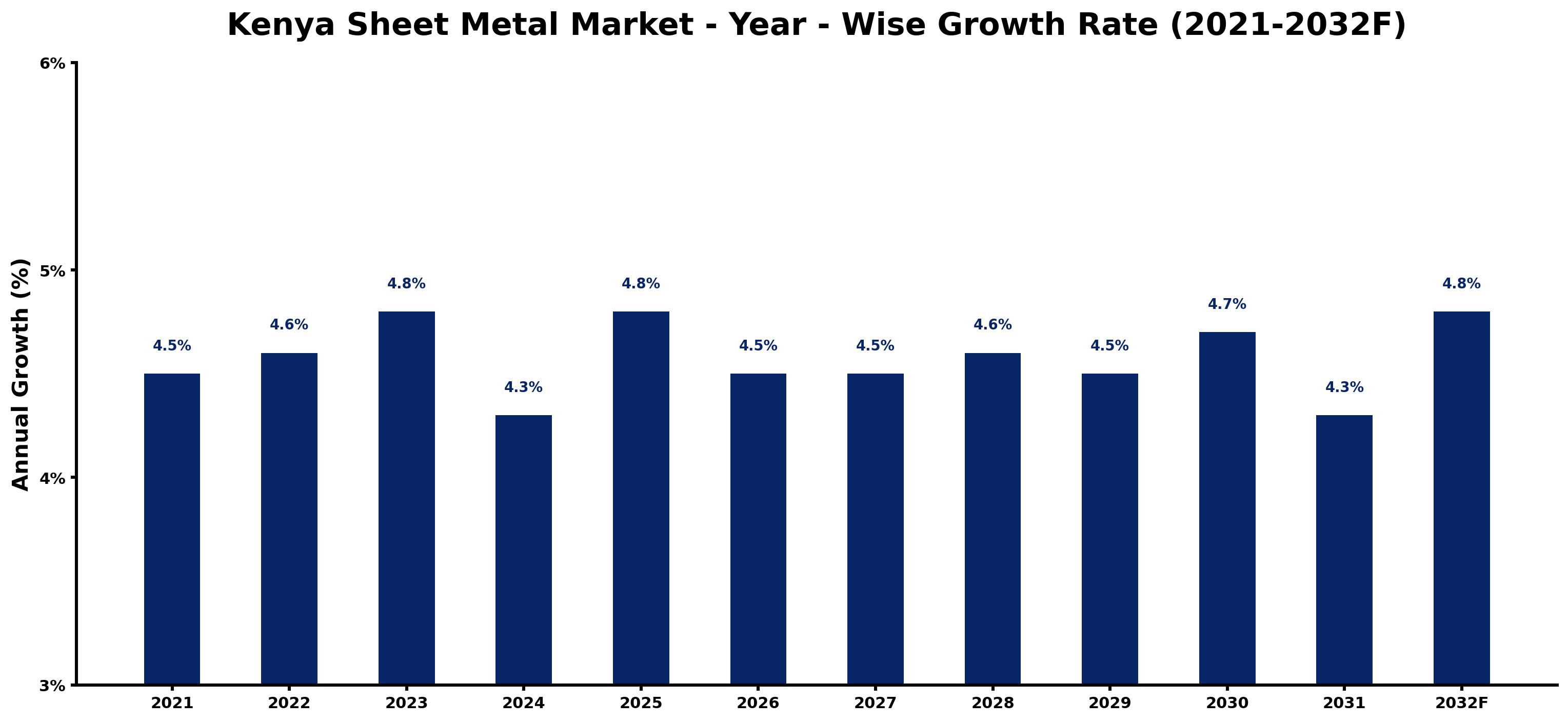
The table below presents the year wise growth rates along with the key drivers influencing the market
| Year | Growth Rate | Major Drivers |
| 2021 | 4.5% | Construction activity rebounded post-COVID, revitalizing the sheet metal sector. |
| 2022 | 4.6% | Increased urbanization trends pushed demand for roofing and walling solutions upward. |
| 2023 | 4.8% | Innovative manufacturing techniques improved production efficiency, lowering costs for businesses. |
| 2024 | 4.3% | Infrastructure projects expanded, leading to heightened sheet metal requirements in construction. |
| 2025 | 4.8% | Emerging middle-class consumers preferred durable materials, boosting market sales significantly. |
| 2026 | 4.5% | Sustainability goals prompted a shift towards eco-friendly sheet metal alternatives. |
| 2027 | 4.5% | Technological advancements facilitated better design and custom sheet metal offerings. |
| 2028 | 4.6% | Investment in renewable energy projects created additional opportunities for sheet metal applications. |
| 2029 | 4.5% | Manufacturers adapted to local sourcing, enhancing supply chain resilience and flexibility. |
| 2030 | 4.7% | Economic diversification promoted industrialization, increasing demand across various sectors. |
| 2031 | 4.3% | Rising construction standards required higher-quality materials, benefiting established sheet metal producers. |
| 2032 | 4.8% | Export opportunities expanded as regional economies strengthened, opening international markets. |
Note - Market size estimations and growth projections presented in this report are based on 6Wresearch's advanced forecasting approach, validated with industry datasets as of June 2026.
Kenya Sheet Metal Market Synopsis
The Kenya Sheet Metal Market is projected to reach 4.5% and witness significant growth during the forecast period (2026-2032). This growth is primarily driven by expanding sectors such as construction, automotive, and manufacturing, wherein high-quality sheet metal products are increasingly required for applications including roofing, cladding, and fabrication. As urbanization accelerates and government investments in infrastructure increase, the demand for these materials is expected to expand substantially.
Kenya Sheet Metal Market Growth Drivers
Several factors are propelling the growth of the Kenya Sheet Metal Market. Among these are:
- The ongoing urbanization trend is leading to enhanced construction activities, which significantly boosts the demand for sheet metal in residential and commercial buildings.
- Government investments in infrastructure development are fostering an environment conducive to the expansion of sheet metal applications across various sectors.
- Increased automotive production in Kenya has created a rising need for sheet metal components, directly impacting market demand.
- Technological advancements in manufacturing processes are improving the quality and efficiency of sheet metal production, thereby attracting new investments.
- Growing awareness regarding sustainable practices is encouraging manufacturers to innovate using eco-friendly materials, further driving market growth.
Kenya Sheet Metal Market Trends and Opportunities
The Kenya Sheet Metal Market is witnessing transformative trends that present ample opportunities for stakeholders. Key trends include:
- Adoption of advanced cutting and bending technologies is enhancing precision in fabrication, leading to improved product quality and efficiency.
- There is a noticeable shift towards sustainable manufacturing practices as companies seek to reduce their environmental footprint, aligning with global regulatory standards.
- The rise of customization in product offerings is addressing the diverse needs of various industries, making it a significant trend in the market.
- Digital transformation through automation and software integration is streamlining production processes, reducing lead times, and thus increasing competitiveness among manufacturers.
- Investments in research and development are fostering innovation, allowing companies to stay relevant in a rapidly evolving market environment.
Kenya Sheet Metal Market Challenges and Restraints
Despite the promising outlook, the Kenya Sheet Metal Market faces several challenges that could hinder its growth:
- Fluctuating raw material prices can severely impact the profit margins of manufacturers and challenge their pricing strategies.
- An unreliable power supply poses significant production disruptions, affecting overall operational efficiency.
- The shortage of skilled labor in the industry complicates the ability to maintain high-quality standards and meet the growing production demands.
- Competition from imported sheet metal products, which are often available at lower prices, pressures local manufacturers to compete on cost while ensuring quality.
- Regulatory compliance and navigating changing government policies may create additional hurdles for local manufacturers striving to remain competitive.
Kenya Sheet Metal Market Investment Opportunities
The investment landscape in the Kenya Sheet Metal Market is promising, largely due to the flourishing construction and manufacturing sectors. Key opportunities include:
- Investing in production facilities that leverage modern manufacturing technologies can yield high returns, particularly with rising local demand.
- Capitalizing on government initiatives aimed at boosting local manufacturing can provide an advantageous positioning for investors.
- Exploring partnerships with local construction firms could open new avenues for business, driven by the need for customized sheet metal solutions.
- Focus on innovative technologies that enhance efficiency in manufacturing processes can set an investor apart from competitors.
- Establishing distribution networks that ensure timely delivery of products can significantly enhance market presence and customer satisfaction.
Kenya Sheet Metal Market Government Investment and Initiatives
The government of Kenya has taken proactive steps to support the growth of the sheet metal market, implementing various policies and initiatives. These include:
- The establishment of the Kenya Bureau of Standards (KEBS) to ensure quality assurance and standardization of sheet metal products, fostering confidence among consumers and businesses.
- Investment in infrastructure projects, which directly increases the demand for sheet metal products required for construction and other applications.
- Implementation of trade policies aimed at promoting local manufacturing while protecting domestic producers from excessive foreign competition.
- The provision of tax incentives and subsidies designed to encourage innovation and increase production capacity within the industry.
- Promotion of sustainable practices through regulations that encourage the use of eco-friendly materials and production processes.
Kenya Sheet Metal Market Latest Developments (May 2025 - June 2026)
Recent developments in the Kenya Sheet Metal Market highlight the sector's dynamic nature. Key trends observed during the period from May 2025 to June 2026 include:
- Increased collaboration between private sector firms and government agencies to enhance infrastructure development initiatives, thereby boosting sheet metal demand.
- Growing emphasis on digital solutions as manufacturers adopt advanced technologies to improve operational efficiencies and reduce costs.
- Heightened focus on sustainability, with more companies incorporating eco-friendly materials into their production processes in response to regulatory pressures.
- Emergence of training programs aimed at addressing the skills gap in the workforce, ultimately enhancing production quality and workforce capacities.
- Expansion of local manufacturing capabilities as companies respond to the influx of imported sheet metal by developing competitive advantages through innovation and quality improvements.
Kenya Sheet Metal Market - Key Attractiveness of the Report
- 10 Years of Market Numbers
- Historical Data Starting from 2022 to 2025
- Base Year: 2025
- Forecast Data until 2032
- Key Performance Indicators Impacting the Market
- Major Upcoming Developments and Projects
Key Highlights of the Report:
- Kenya Sheet Metal Market Outlook
- Market Size of Kenya Sheet Metal Market, 2025
- Forecast of Kenya Sheet Metal Market, 2032F
- Historical Data and Forecast of Kenya Sheet Metal Revenues & Volume for the Period 2022-2032F
- Kenya Sheet Metal Market Trend Evolution
- Kenya Sheet Metal Market Drivers and Challenges
- Kenya Sheet Metal Price Trends
- Kenya Sheet Metal Porter's Five Forces
- Kenya Sheet Metal Industry Life Cycle
- Historical Data and Forecast of Kenya Sheet Metal Market Revenues & Volume By Material for the Period 2022-2032F
- Historical Data and Forecast of Kenya Sheet Metal Market Revenues & Volume By Steel for the Period 2022-2032F
- Historical Data and Forecast of Kenya Sheet Metal Market Revenues & Volume By Aluminum for the Period 2022-2032F
- Historical Data and Forecast of Kenya Sheet Metal Market Revenues & Volume By Others for the Period 2022-2032F
- Historical Data and Forecast of Kenya Sheet Metal Market Revenues & Volume By End-use for the Period 2022-2032F
- Historical Data and Forecast of Kenya Sheet Metal Market Revenues & Volume By Automotive & Transportation for the Period 2022-2032F
- Historical Data and Forecast of Kenya Sheet Metal Market Revenues & Volume By Building & Construction for the Period 2022-2032F
- Historical Data and Forecast of Kenya Sheet Metal Market Revenues & Volume By Industrial Machinery for the Period 2022-2032F
- Historical Data and Forecast of Kenya Sheet Metal Market Revenues & Volume By Others for the Period 2022-2032F
- Kenya Sheet Metal Import Export Trade Statistics
- Market Opportunity Assessment By Material
- Market Opportunity Assessment By End-use
- Kenya Sheet Metal Top Companies Market Share
- Kenya Sheet Metal Competitive Benchmarking By Technical and Operational Parameters
- Kenya Sheet Metal Company Profiles
- Kenya Sheet Metal Key Strategic Recommendations






































