Kenya Tractor Market Size, Share & Growth Rate
The Kenya Tractor Market was estimated at USD 1462 Million in 2025 and is projected to reach USD 2124 Million by 2032, growing at a CAGR of 5.5% from 2026 to 2032. This growth trajectory is primarily fueled by the increasing mechanization of the agricultural sector and an urgent need for enhanced productivity among smallholder farmers. Additionally, government incentives aimed at encouraging tractor adoption are expected to bolster market demand, making modern agricultural practices more accessible to a larger segment of the farming population.
Kenya Tractor Market Year-wise Growth Rate and Key Drivers
This graph highlights how the Kenya Tractor Market has steadily grown over the years, supported by major growth factors.
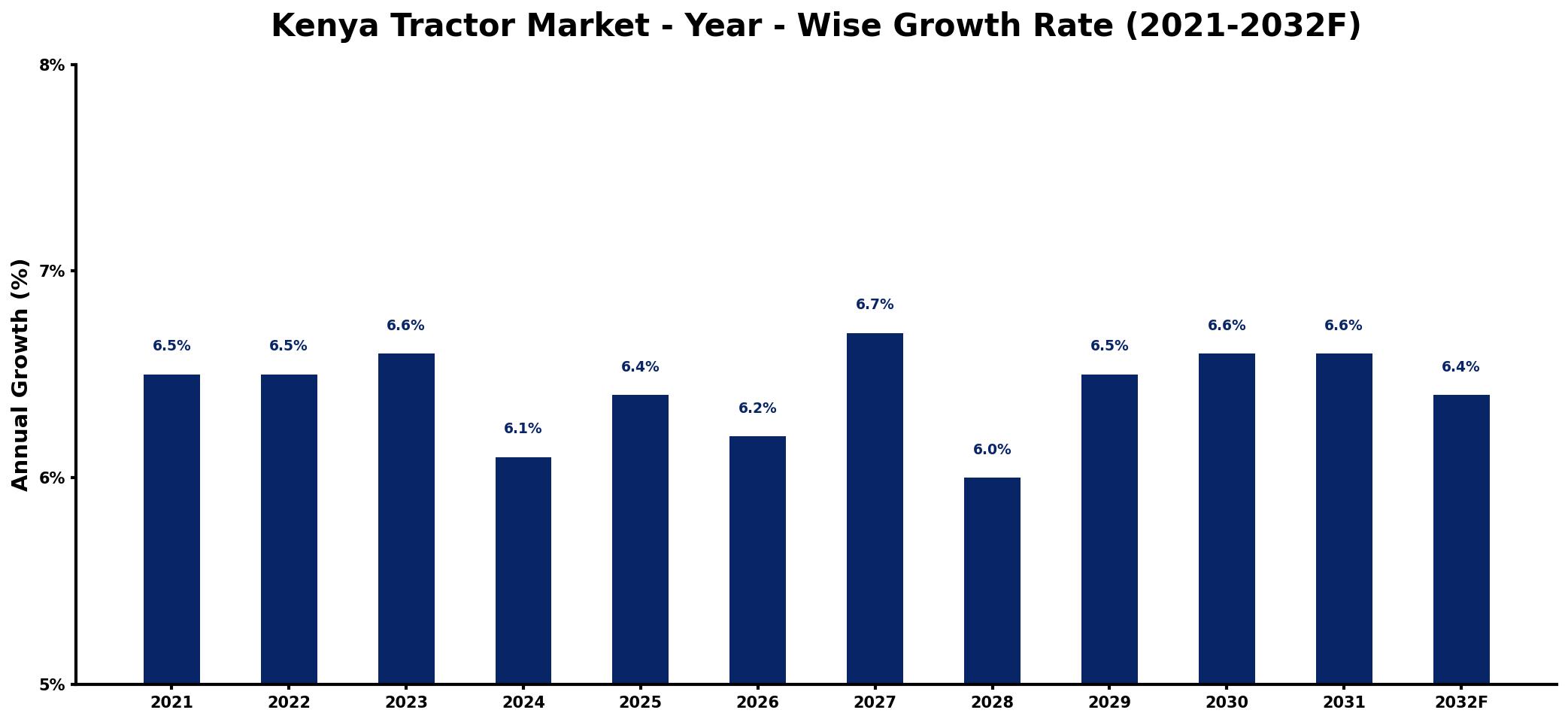
The table below presents the year‑wise growth rates along with the key drivers influencing the market
| Year | Growth Rate | Major Drivers |
| 2021 | 6.5% | Rising agricultural mechanization demand |
| 2022 | 6.5% | Increased rural infrastructure investments |
| 2023 | 6.6% | Expansion of agro-processing facilities |
| 2024 | 6.1% | Growing export opportunities for agriculture |
| 2025 | 6.4% | Technological advancements in farming |
| 2026 | 6.2% | Enhanced access to financing options |
| 2027 | 6.7% | Government support for agricultural innovation |
| 2028 | 6.0% | Higher demand for sustainable practices |
| 2029 | 6.5% | Increased awareness of efficiency benefits |
| 2030 | 6.6% | Rising population driving food production |
| 2031 | 6.6% | Strengthened agricultural supply chain networks |
| 2032 | 6.4% | Emergence of cooperative farming models |
Note: Market size estimations and growth projections presented in this report are based on 6Wresearch's proprietary forecasting methodology, utilizing the latest available industry data, government publications, and primary research inputs.
Kenya Tractor Market Synopsis
The demand for tractors in Kenya is gaining momentum as smallholder farmers seek to transition from traditional farming methods to more efficient, mechanized practices. This shift is driven by the need to optimize productivity and minimize reliance on manual labor, particularly in a country where agriculture remains a cornerstone of the economy.
As the farming landscape evolves, manufacturers are responding with a diverse range of tractor models tailored to meet the specific requirements of Kenyan farmers. Features such as adaptability for various farming tasks and the integration of modern technology reflect the growing sophistication of agricultural machinery in the region.
Kenya Tractor Market Key Takeaways
- Growing mechanization in agriculture is leading to increased tractor adoption among smallholders.
- Government support is essential for reducing costs and facilitating access to modern farming equipment.
- Emerging technologies such as precision agriculture tools are becoming increasingly sought after.
- The market is expected to see a shift towards environmentally friendly tractors as sustainability gains importance.
- Investment opportunities abound in dealership networks, financing solutions, and aftermarket services.
Evaluation of Restraints in Kenya Tractor Market
While the Kenya Tractor Market is on a growth path, it faces certain restraints that can inhibit its full potential. High initial costs associated with tractor purchases often deter small-scale farmers from investing in mechanization. Furthermore, access to financing remains a challenge, preventing many from securing necessary funds. Limited availability of maintenance services in rural areas results in prolonged downtime for tractors, thus affecting productivity. Additionally, inconsistent infrastructure and varying land sizes across regions complicate the delivery and usage of agricultural machinery, hindering market expansion.
Kenya Tractor Market Trends
The Kenya tractor market is currently witnessing a technological transformation. There is a notable shift towards tractors that incorporate advanced features like GPS and telematics for precision farming, enabling farmers to enhance their efficiency and lower costs. Furthermore, the versatility of tractors is becoming increasingly important, with farmers expressing a preference for machines that can perform a range of functions—plowing, planting, and harvesting—on different terrains. The trend towards environmentally sustainable practices is gaining traction, with an increasing interest in tractors powered by alternative fuels or electricity to lower carbon emissions.
Kenya Tractor Market Opportunities
The investment landscape in the Kenya tractor market is ripe with opportunities, particularly given the pressing need for modern agricultural equipment. Entrepreneurs can explore avenues such as establishing dealership networks, facilitating financing options tailored for smallholder farmers, and providing rental services to broaden accessibility. Additionally, investing in maintenance and repair services will cater to a growing demand for reliable aftersales support. Technology integration presents further potential, as incorporating smart solutions can improve tractor performance and operational efficiency in the Kenyan context.
Government Initiatives in the Kenya Tractor Market
The Kenyan government is actively promoting the tractor market through various supportive initiatives. These include eliminating import duties on tractors to reduce costs for farmers and implementing subsidies that make tractor purchases more financially feasible. Furthermore, the government is developing financing programs aimed at assisting farmers in acquiring tractors. Training programs and other incentives are also part of broader efforts to encourage mechanization in agriculture, aiming to boost productivity and foster economic growth within the sector.
Future Insights of the Kenya Tractor Market
The outlook for the Kenya Tractor Market from 2026 to 2032 appears optimistic, bolstered by an ongoing emphasis on modernizing agricultural practices. As Kenya faces increasing food security demands due to a growing population, the need for efficient farming solutions will escalate. Government policies promoting mechanization, along with technological advancements and financial support mechanisms, are expected to drive market demand. Addressing existing challenges will be vital, yet, with targeted strategies in place, the market is well-positioned for sustained growth.
Kenya Tractor Market Latest Developments (2025 - 2026)
Recent trends indicate a greater emphasis on the integration of technology in tractors sold in Kenya, with an increase in models equipped with smart features aimed at improving farming efficiency. Initiatives focusing on increasing farmer awareness about the benefits of mechanization are being launched across several regions. Additionally, private and public sector partnerships are evolving, focusing on developing robust distribution channels that enhance accessibility for smallholder farmers.
Kenya Tractor Market - Key Attractiveness of the Report
- 10 Years of Market Numbers
- Historical Data Starting from 2022 to 2025
- Base Year: 2025
- Forecast Data until 2032
- Key Performance Indicators Impacting the Market
- Major Upcoming Developments and Projects
Key Highlights of the Report:
- Kenya Tractor Market Outlook
- Market Size of Kenya Tractor Market, 2025
- Forecast of Kenya Tractor Market, 2032
- Historical Data and Forecast of Kenya Tractor Revenues & Volume for the Period 2022-2032F
- Kenya Tractor Market Trend Evolution
- Kenya Tractor Market Drivers and Challenges
- Kenya Tractor Price Trends
- Kenya Tractor Porter's Five Forces
- Kenya Tractor Industry Life Cycle
- Historical Data and Forecast of Kenya Tractor Market Revenues & Volume By Power Output for the Period 2022-2032F
- Historical Data and Forecast of Kenya Tractor Market Revenues & Volume By Less Than 30 HP for the Period 2022-2032F
- Historical Data and Forecast of Kenya Tractor Market Revenues & Volume By 30-50 HP for the Period 2022-2032F
- Historical Data and Forecast of Kenya Tractor Market Revenues & Volume By 51-100 HP for the Period 2022-2032F
- Historical Data and Forecast of Kenya Tractor Market Revenues & Volume By More Than 100 HP for the Period 2022-2032F
- Historical Data and Forecast of Kenya Tractor Market Revenues & Volume By Drive Type for the Period 2022-2032F
- Historical Data and Forecast of Kenya Tractor Market Revenues & Volume By 2 Wheel Drive for the Period 2022-2032F
- Historical Data and Forecast of Kenya Tractor Market Revenues & Volume By 4 Wheel Drive for the Period 2022-2032F
- Historical Data and Forecast of Kenya Tractor Market Revenues & Volume By Application for the Period 2022-2032F
- Historical Data and Forecast of Kenya Tractor Market Revenues & Volume By Agriculture for the Period 2022-2032F
- Kenya Tractor Import Export Trade Statistics
- Market Opportunity Assessment By Power Output
- Market Opportunity Assessment By Drive Type
- Market Opportunity Assessment By Application
- Kenya Tractor Top Companies Market Share
- Kenya Tractor Competitive Benchmarking By Technical and Operational Parameters
- Kenya Tractor Company Profiles
- Kenya Tractor Key Strategic Recommendations






































