Nigeria Tractor Market Size, Share & Growth Rate
The Nigeria Tractor Market was estimated at USD 220 Million in 2025 and is projected to reach USD 296 Million by 2032, growing at a CAGR of 4.3% from 2026 to 2032. This growth trajectory is largely driven by an increasing emphasis on agricultural mechanization aimed at enhancing farm productivity. With rising awareness among farmers regarding the benefits of modern farming techniques, the demand for tractors is set to climb significantly.
Nigeria Tractor Market Year-wise Growth Rate and Key Drivers
This graph highlights how the Nigeria Tractor Market has steadily grown over the years, supported by major growth factors.
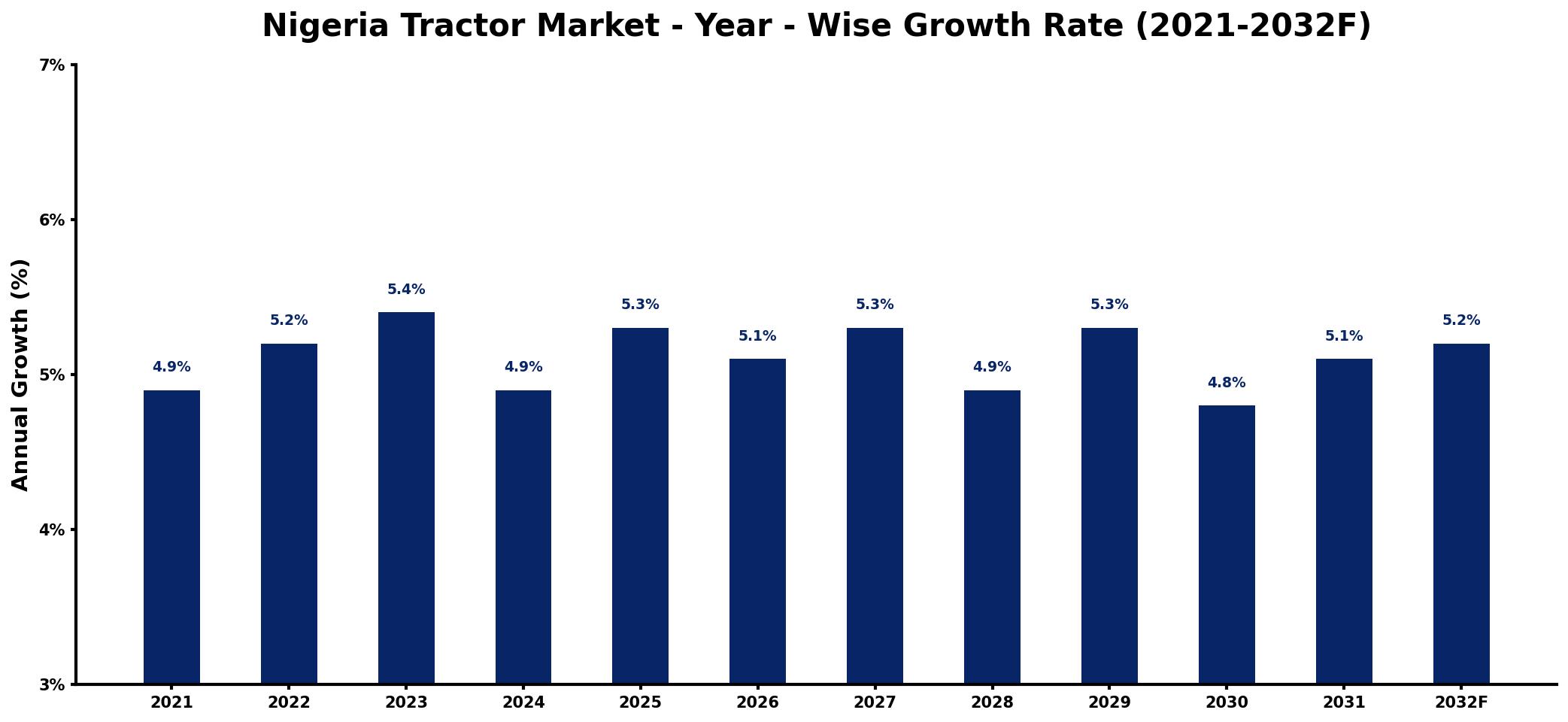
The table below presents the year‑wise growth rates along with the key drivers influencing the market
| Year | Growth Rate | Major Drivers |
| 2021 | 4.9% | Rising agricultural mechanization trends |
| 2022 | 5.2% | Increased government infrastructure investments |
| 2023 | 5.4% | Growing demand for food production |
| 2024 | 4.9% | Expansion of rural financing options |
| 2025 | 5.3% | Surge in agribusiness investments |
| 2026 | 5.1% | Technological advancements in farming |
| 2027 | 5.3% | Strengthening supply chain logistics |
| 2028 | 4.9% | Enhanced access to financing solutions |
| 2029 | 5.3% | Growing awareness of modern farming |
| 2030 | 4.8% | Increased focus on sustainability practices |
| 2031 | 5.1% | Rising export opportunities for agriculture |
| 2032 | 5.2% | rising infrastructure development spending |
Note: Market size estimations and growth projections presented in this report are based on 6Wresearch's proprietary forecasting methodology, utilizing the latest available industry data, government publications, and primary research inputs.
Nigeria Tractor Market Synopsis
The Nigeria tractor market is currently experiencing a notable shift towards mechanization in agriculture. Smallholder farmers are increasingly investing in tractor technology to enhance productivity and efficiency on their farms. This transformation is vital for meeting the food demands of a growing population and addressing labor shortages in rural areas.
Government policies promoting mechanization are further igniting market activity, as they provide necessary financial support and incentives to farmers. However, challenges such as high import costs and inadequate infrastructure still exist, impacting the overall effectiveness of these initiatives.
Nigeria Tractor Market Key Takeaways
- The tractor market is witnessing steady growth fueled by increasing agricultural mechanization efforts.
- Government initiatives provide crucial financial backing, enhancing accessibility for farmers.
- Compact and technologically advanced tractors are becoming more sought after among smallholder farmers.
- Challenges, including high costs and inadequate support services, hinder widespread adoption.
- Investment opportunities are emerging, particularly in financing and maintenance services.
Evaluation of Restraints in Nigeria Tractor Market
Several factors are constraining the growth of the Nigeria tractor market. Limited access to financing remains a significant barrier for smallholder farmers who wish to purchase tractors but lack the necessary capital. Additionally, high import duties and taxes elevate the overall cost of tractors, making them less affordable. Furthermore, inadequate maintenance services and a shortage of skilled operators complicate the effective use of these machines, stalling progress in mechanized farming. Addressing these issues will be pivotal in unlocking the markets full potential.
Nigeria Tractor Market Trends
Current trends indicate a growing inclination toward adopting compact and multifunctional tractors that are particularly well-suited for smallholdings. The integration of technology into tractors is also on the rise, with many models now featuring GPS guidance systems and precision farming capabilities, aimed at optimizing agricultural practices. Moreover, as awareness increases about sustainable farming techniques, more farmers are turning to modern machinery as a means to enhance both productivity and environmental stewardship.
Nigeria Tractor Market Opportunities
Investment opportunities in the Nigeria tractor market are abundant, particularly in areas such as tractor supply, financial solutions for equipment purchase, and after-sales support services. Moreover, collaborating with local agricultural programs and farmer cooperatives presents a unique avenue to reach more farmers and promote mechanized farming practices effectively. As farmers increasingly seek to improve productivity and efficiency, there is significant room for growth, particularly in the adoption of technology-driven solutions.
Government Initiatives in the Nigeria Tractor Market
The Nigerian government has introduced several initiatives to facilitate the growth of the tractor market, including the Agricultural Transformation Agenda, which focuses on increasing agricultural productivity through mechanization. The National Tractorization Initiative further supports this aim by providing subsidies and incentives for farmers to procure tractors. Additionally, the establishment of Agricultural Mechanization Service Centers aims to provide maintenance and repair services, ensuring that equipment remains operational. Efforts to improve financing access, such as the Anchor Borrowers Program, are also ongoing to empower farmers.
Future Insights of the Nigeria Tractor Market
The future outlook for the Nigeria tractor market appears bright, as the trend of mechanization in agriculture is expected to gain momentum. Driven by governmental support and a growing trend toward commercial farming, the market is anticipated to see a sustained increase in demand for tractors. As urbanization continues to rise and the population grows, the necessity for efficient agricultural practices becomes increasingly urgent, paving the way for substantial market growth in the coming years.
Nigeria Tractor Market Latest Developments (2025 - 2026)
Recent developments in the Nigeria tractor market reflect a significant push towards enhancing agricultural efficiency. Initiatives to streamline financing options for small-scale farmers are being implemented, coupled with increased efforts to promote the benefits of mechanization. Collaborations among stakeholders are also emerging, aiming to establish a more robust support network for farmers, which is anticipated to further boost market growth.
Nigeria Tractor Market - Key Attractiveness of the Report
- 10 Years of Market Numbers
- Historical Data Starting from 2022 to 2025
- Base Year: 2025
- Forecast Data until 2032
- Key Performance Indicators Impacting the Market
- Major Upcoming Developments and Projects
Key Highlights of the Report:
- Nigeria Tractor Market Outlook
- Market Size of Nigeria Tractor Market, 2025
- Forecast of Nigeria Tractor Market, 2032
- Historical Data and Forecast of Nigeria Tractor Revenues & Volume for the Period 2022-2032F
- Nigeria Tractor Market Trend Evolution
- Nigeria Tractor Market Drivers and Challenges
- Nigeria Tractor Price Trends
- Nigeria Tractor Porter's Five Forces
- Nigeria Tractor Industry Life Cycle
- Historical Data and Forecast of Nigeria Tractor Market Revenues & Volume By Power Output for the Period 2022-2032F
- Historical Data and Forecast of Nigeria Tractor Market Revenues & Volume By Less Than 30 HP for the Period 2022-2032F
- Historical Data and Forecast of Nigeria Tractor Market Revenues & Volume By 30-50 HP for the Period 2022-2032F
- Historical Data and Forecast of Nigeria Tractor Market Revenues & Volume By 51-100 HP for the Period 2022-2032F
- Historical Data and Forecast of Nigeria Tractor Market Revenues & Volume By More Than 100 HP for the Period 2022-2032F
- Historical Data and Forecast of Nigeria Tractor Market Revenues & Volume By Drive Type for the Period 2022-2032F
- Historical Data and Forecast of Nigeria Tractor Market Revenues & Volume By 2 Wheel Drive for the Period 2022-2032F
- Historical Data and Forecast of Nigeria Tractor Market Revenues & Volume By 4 Wheel Drive for the Period 2022-2032F
- Historical Data and Forecast of Nigeria Tractor Market Revenues & Volume By Application for the Period 2022-2032F
- Historical Data and Forecast of Nigeria Tractor Market Revenues & Volume By Agriculture for the Period 2022-2032F
- Nigeria Tractor Import Export Trade Statistics
- Market Opportunity Assessment By Power Output
- Market Opportunity Assessment By Drive Type
- Market Opportunity Assessment By Application
- Nigeria Tractor Top Companies Market Share
- Nigeria Tractor Competitive Benchmarking By Technical and Operational Parameters
- Nigeria Tractor Company Profiles
- Nigeria Tractor Key Strategic Recommendations






































