Algeria Tractor Market Size, Share & Growth Rate
The Algeria Tractor Market was estimated at USD 154 Million in 2025 and is projected to reach USD 215 Million by 2032, growing at a CAGR of 4.9% from 2026 to 2032. This promising trajectory is largely driven by the governments commitment to improving agricultural productivity through mechanization. As more farmers turn to modern equipment to enhance efficiency and crop yields, the demand for tractors is anticipated to rise significantly, further fueled by technological advancements.
Algeria Tractor Market Year-wise Growth Rate and Key Drivers
This graph highlights how the Algeria Tractor Market has steadily grown over the years, supported by major growth factors.
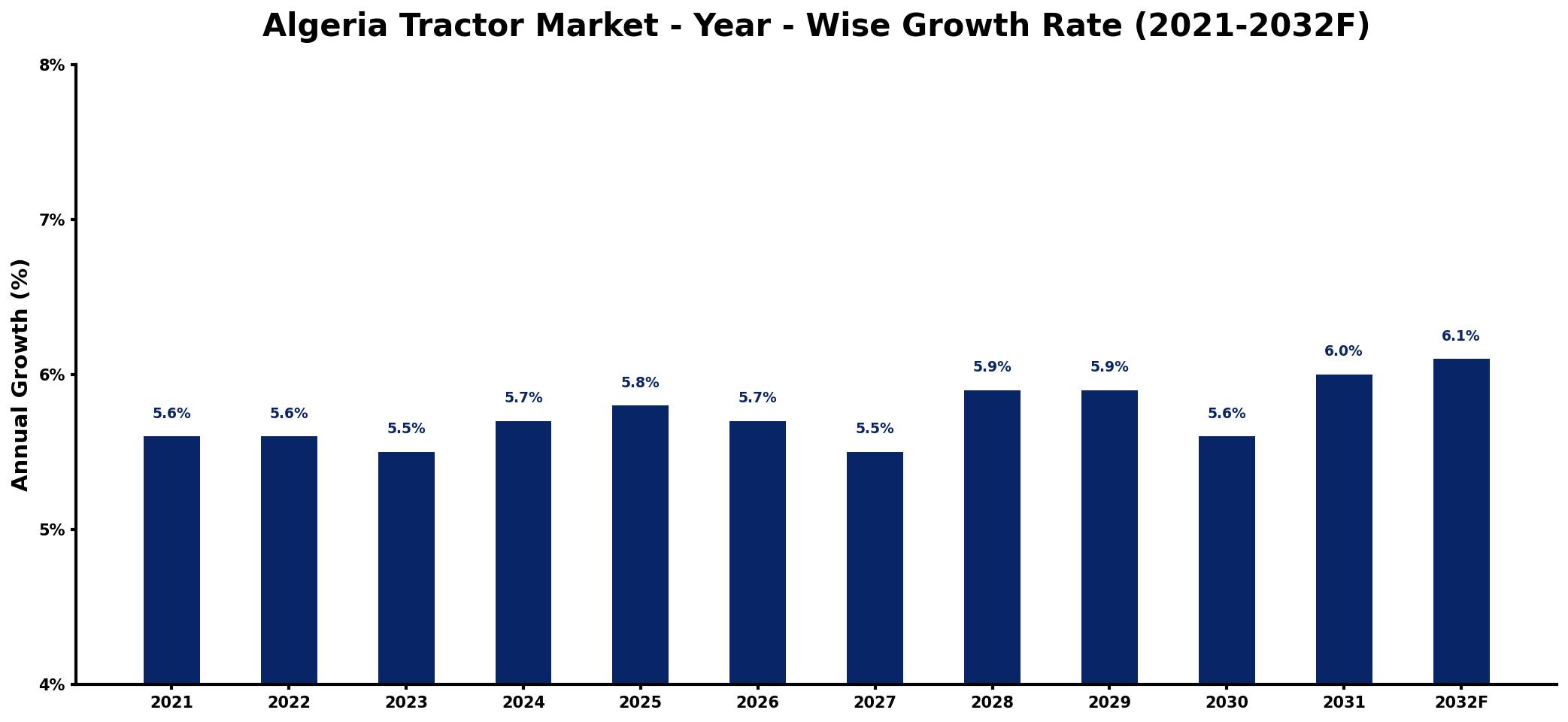
The table below presents the year‑wise growth rates along with the key drivers influencing the market
| Year | Growth Rate | Major Drivers |
| 2021 | 5.6% | Increased agricultural mechanization initiatives |
| 2022 | 5.6% | Growing investments in rural infrastructure |
| 2023 | 5.5% | Expansion of farming cooperatives networks |
| 2024 | 5.7% | Rising demand for sustainable farming |
| 2025 | 5.8% | Improvement in financing options available |
| 2026 | 5.7% | Enhanced government support programs launched |
| 2027 | 5.5% | Growth in export opportunities identified |
| 2028 | 5.9% | Adoption of precision agriculture techniques |
| 2029 | 5.9% | Increased focus on crop diversification |
| 2030 | 5.6% | Emerging technologies in agricultural practices |
| 2031 | 6.0% | Strengthening agricultural supply chain logistics |
| 2032 | 6.1% | Development of regional agribusiness partnerships |
Note: Market size estimations and growth projections presented in this report are based on 6Wresearch's proprietary forecasting methodology, utilizing the latest available industry data, government publications, and primary research inputs.
Algeria Tractor Market Synopsis
The most influential factor shaping the Algeria tractor market is the increasing mechanization of agriculture, which has become a cornerstone for enhancing farm productivity. This shift not only helps farmers meet growing food demands but also supports rural development through improved operational efficiency.
Additionally, government initiatives focused on agricultural advancement bolster the market's growth by providing subsidies and incentives for farmers to adopt modern equipment. However, challenges remain, particularly for small-scale farmers lacking access to financing and technical training.
Algeria Tractor Market Key Takeaways
- The market is being driven by rising mechanization in the agricultural sector, boosting farm productivity.
- Government policies are providing necessary support, including financial incentives for modern tractor adoption.
- Technological advancements are leading to increased demand for efficient and eco-friendly tractors.
- Challenges such as limited financing options and rural infrastructure gaps need addressing for full market potential.
- There are significant opportunities for innovation and investment in sustainable agricultural solutions.
Evaluation of Restraints in Algeria Tractor Market
The Algeria tractor market faces several notable restraints that hinder its full potential. One primary concern is the limited access to financing options for farmers, particularly small-scale operators. This lack of financial support limits their ability to invest in modern tractors. Additionally, high import tariffs on agricultural machinery create a burden for manufacturers and contribute to higher prices for consumers. Furthermore, the countrys infrastructure, particularly in rural areas, is often insufficient, complicating logistics and maintenance. Together, these challenges can stifle growth and hinder the widespread adoption of modern agricultural technologies.
Algeria Tractor Market Trends
There is a distinct trend towards the adoption of technologically advanced tractors within the Algeria tractor market. Farmers are increasingly interested in equipment that integrates GPS and smart technologies, allowing for precision farming techniques that optimize resource use and maximize yields. Additionally, there is a growing demand for environmentally friendly farming practices, driving interest in electric and hybrid tractors. The market is shifting towards solutions that not only improve productivity but also align with sustainability goals, reflecting broader trends in global agriculture.
Algeria Tractor Market Opportunities
The Algeria tractor market presents substantial investment opportunities, particularly as the country seeks to modernize its agricultural practices. Investors can explore avenues in the manufacturing, distribution, and servicing of tractors, tapping into a strong demand from an agricultural workforce eager for efficient solutions. Additionally, the increasing focus on sustainable agriculture opens up opportunities for eco-friendly tractor technology. Collaborating with local dealers or establishing operational footprints within the region can be beneficial strategies for those looking to capitalize on this expanding market.
Government Initiatives in the Algeria Tractor Market
The Algerian government is actively promoting agricultural mechanization through various initiatives designed to support the tractor market. These include subsidies aimed at reducing the financial burden on farmers looking to purchase tractors, as well as programs to enhance access to technology and training. By investing in rural infrastructure and improving financial literacy among farmers, the government is laying the groundwork for a more robust and modern agricultural sector, which is vital for food security and economic stability.
Future Insights of the Algeria Tractor Market
Looking ahead to 2026-2032, the Algeria tractor market is set for consistent growth as mechanization continues to penetrate the agricultural sector. The anticipated rise in tractor demand will likely coincide with improved financing options and enhanced farmer training initiatives. Furthermore, advancements in tractor technology will position manufacturers to offer products that meet the evolving demands of a modern agricultural landscape. However, economic stability will be crucial in mitigating risks that could affect purchasing power and overall market confidence.
Algeria Tractor Market Latest Developments (2025 - 2026)
Recent developments in the Algeria tractor market indicate a strong movement towards integrating advanced technologies into agricultural machinery. Manufacturers are increasingly focusing on sustainability, with new electric and hybrid models entering the market. There is also a notable push from government bodies to promote awareness about precision farming techniques, which further aligns with global agricultural trends. Overall, the landscape is evolving with a clear emphasis on efficiency, sustainability, and modernization.
Algeria Tractor Market - Key Attractiveness of the Report
- 10 Years of Market Numbers
- Historical Data Starting from 2022 to 2025
- Base Year: 2025
- Forecast Data until 2032
- Key Performance Indicators Impacting the Market
- Major Upcoming Developments and Projects
Key Highlights of the Report:
- Algeria Tractor Market Outlook
- Market Size of Algeria Tractor Market, 2025
- Forecast of Algeria Tractor Market, 2032
- Historical Data and Forecast of Algeria Tractor Revenues & Volume for the Period 2022-2032F
- Algeria Tractor Market Trend Evolution
- Algeria Tractor Market Drivers and Challenges
- Algeria Tractor Price Trends
- Algeria Tractor Porter's Five Forces
- Algeria Tractor Industry Life Cycle
- Historical Data and Forecast of Algeria Tractor Market Revenues & Volume By Power Output for the Period 2022-2032F
- Historical Data and Forecast of Algeria Tractor Market Revenues & Volume By Less Than 30 HP for the Period 2022-2032F
- Historical Data and Forecast of Algeria Tractor Market Revenues & Volume By 30-50 HP for the Period 2022-2032F
- Historical Data and Forecast of Algeria Tractor Market Revenues & Volume By 51-100 HP for the Period 2022-2032F
- Historical Data and Forecast of Algeria Tractor Market Revenues & Volume By More Than 100 HP for the Period 2022-2032F
- Historical Data and Forecast of Algeria Tractor Market Revenues & Volume By Drive Type for the Period 2022-2032F
- Historical Data and Forecast of Algeria Tractor Market Revenues & Volume By 2 Wheel Drive for the Period 2022-2032F
- Historical Data and Forecast of Algeria Tractor Market Revenues & Volume By 4 Wheel Drive for the Period 2022-2032F
- Historical Data and Forecast of Algeria Tractor Market Revenues & Volume By Application for the Period 2022-2032F
- Historical Data and Forecast of Algeria Tractor Market Revenues & Volume By Agriculture for the Period 2022-2032F
- Algeria Tractor Import Export Trade Statistics
- Market Opportunity Assessment By Power Output
- Market Opportunity Assessment By Drive Type
- Market Opportunity Assessment By Application
- Algeria Tractor Top Companies Market Share
- Algeria Tractor Competitive Benchmarking By Technical and Operational Parameters
- Algeria Tractor Company Profiles
- Algeria Tractor Key Strategic Recommendations






































