Kenya Warehousing and Storage Market Size, Share & Growth Rate
The Kenya Warehousing and Storage Market was estimated at USD 127 Million in 2025 and is projected to reach USD 139 Million by 2032, growing at a CAGR of 1.3% from 2026 to 2032. This growth trajectory is underpinned by an expanding e-commerce sector, which is creating a substantial demand for efficient storage solutions. As logistics networks develop and inventory management practices improve, the sector is positioned to meet the needs of an increasingly organized supply chain.
Kenya Warehousing and Storage Market Year-wise Growth Rate and Key Drivers
This graph highlights how the Kenya Warehousing and Storage Market has steadily grown over the years, supported by major growth factors.
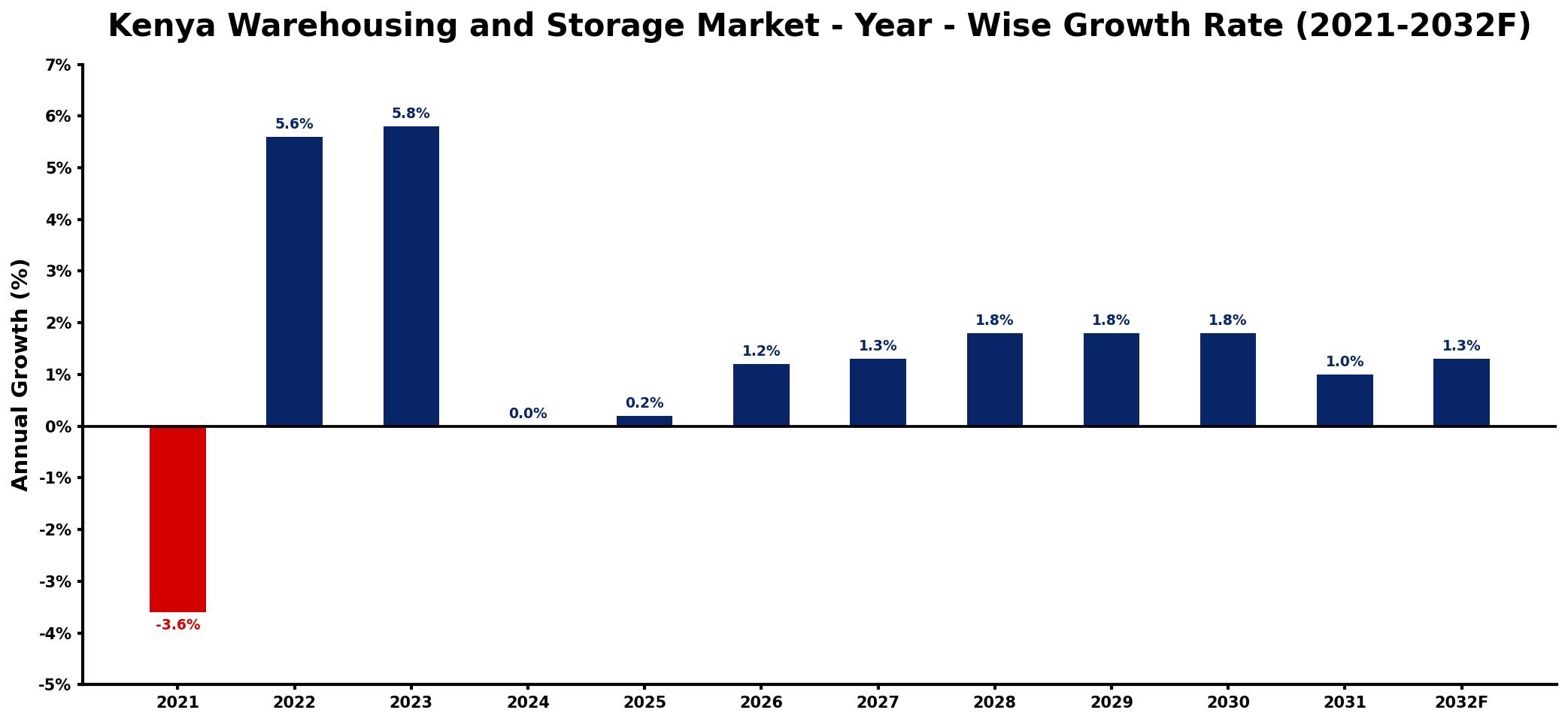
The table below presents the year‑wise growth rates along with the key drivers influencing the market
| Year | Growth Rate | Major Drivers |
| 2021 | -3.6% | decreased consumer demand for logistics |
| 2022 | 5.6% | rising e-commerce sector investments |
| 2023 | 5.8% | expanding agricultural supply chains |
| 2024 | 0.0% | increased foreign direct investments |
| 2025 | 0.2% | growing urbanization and population |
| 2026 | 1.2% | enhanced infrastructure development projects |
| 2027 | 1.3% | increased demand for cold chain |
| 2028 | 1.8% | growing multinational company presence |
| 2029 | 1.8% | expansion of local manufacturing industries |
| 2030 | 1.8% | increased technology adoption in logistics |
| 2031 | 1.0% | growing interest in sustainability practices |
| 2032 | 1.3% | rising demand for third-party services |
Note: Market size estimations and growth projections presented in this report are based on 6Wresearch's proprietary forecasting methodology, utilizing the latest available industry data, government publications, and primary research inputs.
Kenya Warehousing and Storage Market Synopsis
Recent growth in the Kenya warehousing and storage market is remarkable, driven by the surging demand for organized logistics and supply chain solutions. However, while the current momentum appears robust, future advancements hinge on overcoming infrastructural challenges and operational costs that have historically constrained the sector.
Looking ahead, the market is set to evolve further with government initiatives aimed at modernizing facilities and enhancing logistics infrastructure. These efforts are expected to catalyze the sector's potential, providing a platform for increased efficiency and expanded service capabilities.
Kenya Warehousing and Storage Market Key Takeaways
- The Kenya warehousing and storage market is experiencing growth fueled by the rise in e-commerce and retail sectors.
- Government policies are facilitating the establishment and modernization of storage facilities across the nation.
- There is a pressing need for improved logistics infrastructure and technological advancements in existing facilities.
- The market faces challenges related to inadequate infrastructure and fluctuating land costs that impact operational efficiency.
- Investments in industrial parks and free trade zones are pivotal in shaping the future landscape of warehousing in Kenya.
Evaluation of Restraints in Kenya Warehousing and Storage Market
Despite its promising outlook, the Kenya warehousing and storage market contends with significant restraints that inhibit its potential. Chief among these is inadequate infrastructure, which hampers efficient storage and distribution practices. Many existing facilities lack modern technologies that could streamline operations and optimize storage conditions. Furthermore, fluctuating land prices, coupled with regulatory complexities regarding land use, complicate the development of new facilities. Additionally, there is a notable scarcity of skilled personnel, which impacts the overall management and operational efficacy of warehouses.
Kenya Warehousing and Storage Market Trends
Emerging trends in the Kenya warehousing and storage market reflect a shift towards automation and technological integration. As businesses seek to optimize their logistics operations, there is an increasing adoption of advanced inventory management systems and warehouse management software. Moreover, sustainable practices are gaining traction, with companies looking to minimize their carbon footprint through efficient energy use and environmentally friendly materials. Additionally, the rise of multi-channel retailing necessitates flexible warehousing solutions to accommodate varied distribution channels.
Kenya Warehousing and Storage Market Opportunities
Significant opportunities abound within the Kenya warehousing and storage market, particularly in the realm of modernizing existing facilities. Investors are encouraged to explore the potential within free trade zones and industrial parks, which are anticipated to attract businesses seeking efficient logistics solutions. Additionally, the integration of advanced technology offers a pathway to enhance operational efficiency and inventory management, paving the way for improved customer service. Growth in the e-commerce sector continues to open new avenues for investment in specialized warehousing solutions that cater to online retailers.
Government Initiatives in the Kenya Warehousing and Storage Market
The Kenyan government has recognized the importance of a robust warehousing and storage sector and is implementing policies to stimulate growth. Initiatives include financial incentives aimed at encouraging private investments in warehouse construction and modernization efforts. Regulatory processes have been streamlined to facilitate the establishment of new storage facilities, while infrastructural improvements in logistics and transportation networks are also being prioritized. The government's focus on developing industrial parks is particularly significant, as these zones are designed to enhance operational efficiencies and attract businesses.
Future Insights of the Kenya Warehousing and Storage Market
From 2026 to 2032, the Kenya warehousing and storage market is poised for significant transformation. As e-commerce continues to thrive, demand for modern storage solutions will escalate, driving further investment in infrastructure. The ongoing development of logistics networks and supportive government policies will be crucial in addressing current challenges and facilitating growth. As the industry evolves, companies that leverage technology and innovative practices will be better positioned to capitalize on emerging opportunities, ensuring long-term sustainability and competitiveness.
Kenya Warehousing and Storage Market Latest Developments (2025 - 2026)
Recent developments in the Kenya warehousing and storage market indicate a proactive approach to overcoming infrastructure challenges. Many facilities are currently undergoing upgrades to incorporate modern technologies aimed at improving operational efficiencies. Additionally, there has been a noticeable increase in public-private partnerships designed to foster the development of logistics infrastructure. These initiatives signal a commitment to enhancing the overall capability of the sector, ensuring it is well-equipped to handle future demands.
Kenya Warehousing and Storage Market - Key Attractiveness of the Report
- 10 Years of Market Numbers
- Historical Data Starting from 2022 to 2025
- Base Year: 2025
- Forecast Data until 2032
- Key Performance Indicators Impacting the Market
- Major Upcoming Developments and Projects
Key Highlights of the Report:
- Kenya Warehousing and Storage Market Outlook
- Market Size of Kenya Warehousing and Storage Market, 2025
- Forecast of Kenya Warehousing and Storage Market, 2032
- Historical Data and Forecast of Kenya Warehousing and Storage Revenues & Volume for the Period 2022-2032F
- Kenya Warehousing and Storage Market Trend Evolution
- Kenya Warehousing and Storage Market Drivers and Challenges
- Kenya Warehousing and Storage Price Trends
- Kenya Warehousing and Storage Porter's Five Forces
- Kenya Warehousing and Storage Industry Life Cycle
- Historical Data and Forecast of Kenya Warehousing and Storage Market Revenues & Volume By Type for the Period 2022-2032F
- Historical Data and Forecast of Kenya Warehousing and Storage Market Revenues & Volume By General Warehousing and Storage for the Period 2022-2032F
- Historical Data and Forecast of Kenya Warehousing and Storage Market Revenues & Volume By Refrigerated Warehousing and Storage for the Period 2022-2032F
- Historical Data and Forecast of Kenya Warehousing and Storage Market Revenues & Volume By Farm Product Warehousing and Storage for the Period 2022-2032F
- Historical Data and Forecast of Kenya Warehousing and Storage Market Revenues & Volume By Ownership for the Period 2022-2032F
- Historical Data and Forecast of Kenya Warehousing and Storage Market Revenues & Volume By Private Warehouses for the Period 2022-2032F
- Historical Data and Forecast of Kenya Warehousing and Storage Market Revenues & Volume By Public Warehouses for the Period 2022-2032F
- Historical Data and Forecast of Kenya Warehousing and Storage Market Revenues & Volume By Bonded Warehouses for the Period 2022-2032F
- Historical Data and Forecast of Kenya Warehousing and Storage Market Revenues & Volume By End-Use for the Period 2022-2032F
- Historical Data and Forecast of Kenya Warehousing and Storage Market Revenues & Volume By Manufacturing for the Period 2022-2032F
- Historical Data and Forecast of Kenya Warehousing and Storage Market Revenues & Volume By Consumer Goods for the Period 2022-2032F
- Historical Data and Forecast of Kenya Warehousing and Storage Market Revenues & Volume By Retail for the Period 2022-2032F
- Historical Data and Forecast of Kenya Warehousing and Storage Market Revenues & Volume By Food and Beverage for the Period 2022-2032F
- Historical Data and Forecast of Kenya Warehousing and Storage Market Revenues & Volume By IT Hardware for the Period 2022-2032F
- Historical Data and Forecast of Kenya Warehousing and Storage Market Revenues & Volume By Healthcare for the Period 2022-2032F
- Historical Data and Forecast of Kenya Warehousing and Storage Market Revenues & Volume By Chemicals for the Period 2022-2032F
- Historical Data and Forecast of Kenya Warehousing and Storage Market Revenues & Volume By Others for the Period 2022-2032F
- Kenya Warehousing and Storage Import Export Trade Statistics
- Market Opportunity Assessment By Type
- Market Opportunity Assessment By Ownership
- Market Opportunity Assessment By End-Use
- Kenya Warehousing and Storage Top Companies Market Share
- Kenya Warehousing and Storage Competitive Benchmarking By Technical and Operational Parameters
- Kenya Warehousing and Storage Company Profiles
- Kenya Warehousing and Storage Key Strategic Recommendations






































