Kenya Water Purifier Market Size, Share & Growth Rate
The Kenya Water Purifier Market was estimated at USD 343 Million in 2025 and is projected to reach USD 469 Million by 2032, growing at a CAGR of 4.6% from 2026 to 2032. This growth trajectory is primarily driven by an increasing demand for safe drinking water, spurred by rising incidences of waterborne diseases and heightened awareness among consumers regarding water quality. Furthermore, urbanization and the expansion of industrial activities are intensifying concerns over water contamination, amplifying the need for effective purification solutions.
Kenya Water Purifier Market Growth Rate Analysis (2021-2032)
The Kenya Water Purifier Market has exhibited steady growth over the past few years, with a notable increase of 5.2% in 2021 and 5.4% in 2022, reflecting heightened consumer awareness about water quality and a rising demand for safe drinking water solutions. This trend continued into 2023 with a growth rate of 5.3%, supported by investments in infrastructure and technology aimed at enhancing water purification processes. The fluctuations observed, such as the dip to 5.2% in 2024, can be attributed to market saturation in some urban areas; however, the anticipated growth of 5.6% in 2025 signals renewed interest driven by rural expansion and digitalization of distribution channels. Looking ahead, a stable annual growth of around 5.4% is expected, underpinned by ongoing policy initiatives promoting access to clean water.
Kenya Water Purifier Market Year-wise Growth Rate and Key Drivers
This graph highlights how the Kenya Water Purifier Market has steadily grown over the past five years, supported by major growth factors.
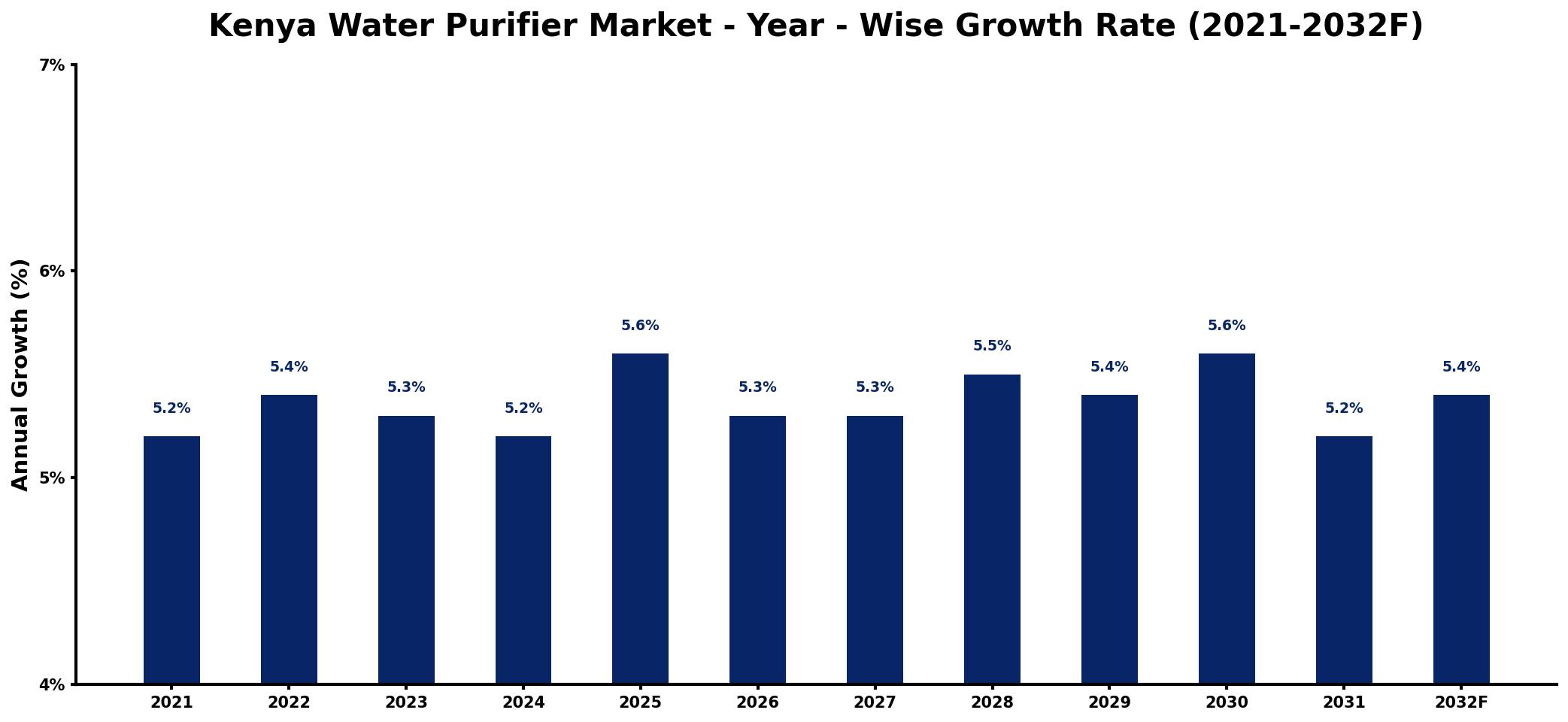
The table below presents the year‑wise growth rates along with the key drivers influencing the market
| Year | Growth Rate | Major Drivers |
| 2021 | 5.2% | Rising health awareness among consumers |
| 2022 | 5.4% | Increased investment in clean technologies |
| 2023 | 5.3% | Growing urban population demands solutions |
| 2024 | 5.2% | Expansion of retail distribution networks |
| 2025 | 5.6% | Improved government support for sustainability |
| 2026 | 5.3% | Emergence of innovative filtration technologies |
| 2027 | 5.3% | Strengthened environmental regulations drive adoption |
| 2028 | 5.5% | Surge in eco-conscious consumer preferences |
| 2029 | 5.4% | Growing presence of international brands |
| 2030 | 5.6% | Increased focus on home solutions |
| 2031 | 5.2% | Rising disposable incomes boost spending |
| 2032 | 5.4% | rising infrastructure development spending |
Note: Market size estimations and growth projections presented in this report are based on 6Wresearch's proprietary forecasting methodology, utilizing the latest available industry data, government publications, and primary research inputs.
Kenya Water Purifier Market Synopsis
In Kenya, the demand for water purifiers is particularly acute in urban areas where rapid population growth often outpaces the development of clean water infrastructure. As water sources become increasingly compromised, households are turning to advanced filtration systems to ensure their health and safety.
Supply chains are adapting to meet this burgeoning demand; however, logistical challenges remain, particularly in reaching remote rural areas where access to purified water is limited. These dynamics create both challenges and opportunities in the market, compelling manufacturers to innovate and improve distribution strategies.
Kenya Water Purifier Market Key Takeaways
- Kenya's urbanization is accelerating the demand for effective water purification solutions.
- Consumer awareness about the health risks associated with unpurified water is increasing.
- Government initiatives are supporting the development of the water purifier market.
- Logistical challenges persist, particularly in rural regions, impacting market penetration.
- Counterfeit products are eroding consumer trust and affecting market growth.
Evaluation of Restraints in Kenya Water Purifier Market
Despite the promising growth of the Kenya Water Purifier Market, significant restraints persist. Foremost among these is affordability; many high-quality water purifiers remain beyond the financial reach of average consumers, limiting widespread adoption. Additionally, distribution challenges complicate efforts to deliver these essential products to underserved rural areas. The market is further hindered by limited awareness of the benefits of using purified water, and the proliferation of counterfeit products undermines consumer confidence, exacerbating market hurdles.
Kenya Water Purifier Market Trends
Several trends are currently shaping the Kenya Water Purifier Market. There is a growing shift towards portable and solar-powered purification systems, which cater to the needs of both urban and rural consumers. Furthermore, advancements in filtration technology—such as UV and reverse osmosis systems—are becoming increasingly popular, ensuring a higher degree of water purity. The influence of digital platforms for raising awareness about water quality and purification options is also on the rise, fostering informed consumer choices.
Kenya Water Purifier Market Opportunities
The market presents significant opportunities for growth and investment, especially in the development of affordable purification solutions that can penetrate rural areas. Innovative financing models, such as pay-as-you-go systems, could facilitate access to purifiers for low-income households. Additionally, partnerships with NGOs and government initiatives focusing on clean water access could provide avenues for collaborative growth and product distribution, allowing manufacturers to tap into previously inaccessible markets.
Government Initiatives in the Kenya Water Purifier Market
The Kenyan government has implemented various initiatives aimed at enhancing access to clean drinking water. These include providing financial incentives for the production and acquisition of water purifiers and establishing quality standards that ensure consumer safety. The government is also involved in research and development to foster innovative purification technologies, alongside collaborations with international organizations to fund projects focused on improving water access in both urban and rural areas.
Future Insights of the Kenya Water Purifier Market
Looking ahead to 2026-2032, the Kenya Water Purifier Market is poised for sustained growth, driven by the ongoing urbanization and increasing public health awareness. With government support and innovative solutions emerging, the market is expected to embrace advancements in technology that offer greater efficiency and affordability. As consumer preferences evolve, manufacturers who adapt quickly to these changes will find themselves well-positioned to lead in this dynamic landscape.
Kenya Water Purifier Market Latest Developments (2025 - 2026)
Recent developments in the Kenya Water Purifier Market indicate a shift towards greater collaboration between private manufacturers and governmental bodies to address clean water challenges. Initiatives are being launched to improve distribution channels and raise awareness about the importance of water purification. Furthermore, advancements in technology are increasingly focusing on affordability and efficiency, making water purification systems more accessible to a broader audience.
Kenya Water Purifier Market - Key Attractiveness of the Report
- 10 Years of Market Numbers
- Historical Data Starting from 2022 to 2025
- Base Year: 2025
- Forecast Data until 2032
- Key Performance Indicators Impacting the Market
- Major Upcoming Developments and Projects
Key Highlights of the Report:
- Kenya Water Purifier Market Outlook
- Market Size of Kenya Water Purifier Market, 2025
- Forecast of Kenya Water Purifier Market, 2032
- Historical Data and Forecast of Kenya Water Purifier Revenues & Volume for the Period 2022-2032F
- Kenya Water Purifier Market Trend Evolution
- Kenya Water Purifier Market Drivers and Challenges
- Kenya Water Purifier Price Trends
- Kenya Water Purifier Porter's Five Forces
- Kenya Water Purifier Industry Life Cycle
- Historical Data and Forecast of Kenya Water Purifier Market Revenues & Volume By Type for the Period 2022-2032F
- Historical Data and Forecast of Kenya Water Purifier Market Revenues & Volume By Point-of-use Filters for the Period 2022-2032F
- Historical Data and Forecast of Kenya Water Purifier Market Revenues & Volume By Under The Counter Filters for the Period 2022-2032F
- Historical Data and Forecast of Kenya Water Purifier Market Revenues & Volume By Counter Top Filters for the Period 2022-2032F
- Historical Data and Forecast of Kenya Water Purifier Market Revenues & Volume By Pitcher Filters for the Period 2022-2032F
- Historical Data and Forecast of Kenya Water Purifier Market Revenues & Volume By Faucet-mounted Filters for the Period 2022-2032F
- Historical Data and Forecast of Kenya Water Purifier Market Revenues & Volume By Others for the Period 2022-2032F
- Historical Data and Forecast of Kenya Water Purifier Market Revenues & Volume By Point-of-entry Filters for the Period 2022-2032F
- Historical Data and Forecast of Kenya Water Purifier Market Revenues & Volume By Category for the Period 2022-2032F
- Historical Data and Forecast of Kenya Water Purifier Market Revenues & Volume By Ro Filters for the Period 2022-2032F
- Historical Data and Forecast of Kenya Water Purifier Market Revenues & Volume By Uv Filters for the Period 2022-2032F
- Historical Data and Forecast of Kenya Water Purifier Market Revenues & Volume By Gravity Filters for the Period 2022-2032F
- Historical Data and Forecast of Kenya Water Purifier Market Revenues & Volume By Others for the Period 2022-2032F
- Historical Data and Forecast of Kenya Water Purifier Market Revenues & Volume By Application for the Period 2022-2032F
- Historical Data and Forecast of Kenya Water Purifier Market Revenues & Volume By Residential for the Period 2022-2032F
- Historical Data and Forecast of Kenya Water Purifier Market Revenues & Volume By Light Commercial for the Period 2022-2032F
- Kenya Water Purifier Import Export Trade Statistics
- Market Opportunity Assessment By Type
- Market Opportunity Assessment By Category
- Market Opportunity Assessment By Application
- Kenya Water Purifier Top Companies Market Share
- Kenya Water Purifier Competitive Benchmarking By Technical and Operational Parameters
- Kenya Water Purifier Company Profiles
- Kenya Water Purifier Key Strategic Recommendations






































