Kenya Whiskey Market Size, Share & Growth Rate
The Kenya Whiskey Market was estimated at USD 479 Million in 2025 and is projected to reach USD 620 Million by 2032, growing at a CAGR of 3.8% from 2026 to 2032. This growth trajectory reflects the rising interest in whiskey, driven by an expanding middle class and urbanization trends that have fostered a taste for premium spirits. Moreover, the increasing availability of both imported and locally crafted brands has further stimulated consumer demand.
Kenya Whiskey Market Growth Rate Analysis (2021-2032)
The Kenya whiskey market has shown a steady growth pattern, with rates of 4.3% in both 2021 and 2022, reflecting consistent consumer demand and a burgeoning interest in premium spirits. This stability continued into 2023 as the market maintained the same growth rate before seeing a slight increase to 4.5% in 2024 and 2025. The expansion can be attributed to increasing disposable incomes, a younger demographic embracing whiskey culture, and improved distribution channels. Notably, growth is projected to peak at 4.9% in 2026, driven by rising investments in local distilleries and digital marketing strategies. Fluctuations in growth rates toward 2028 suggest evolving consumer preferences that necessitate adaptability within the industry.
Kenya Whiskey Market Year-wise Growth Rate and Key Drivers
This graph highlights how the Kenya Whiskey Market has steadily grown over the past five years, supported by major growth factors.
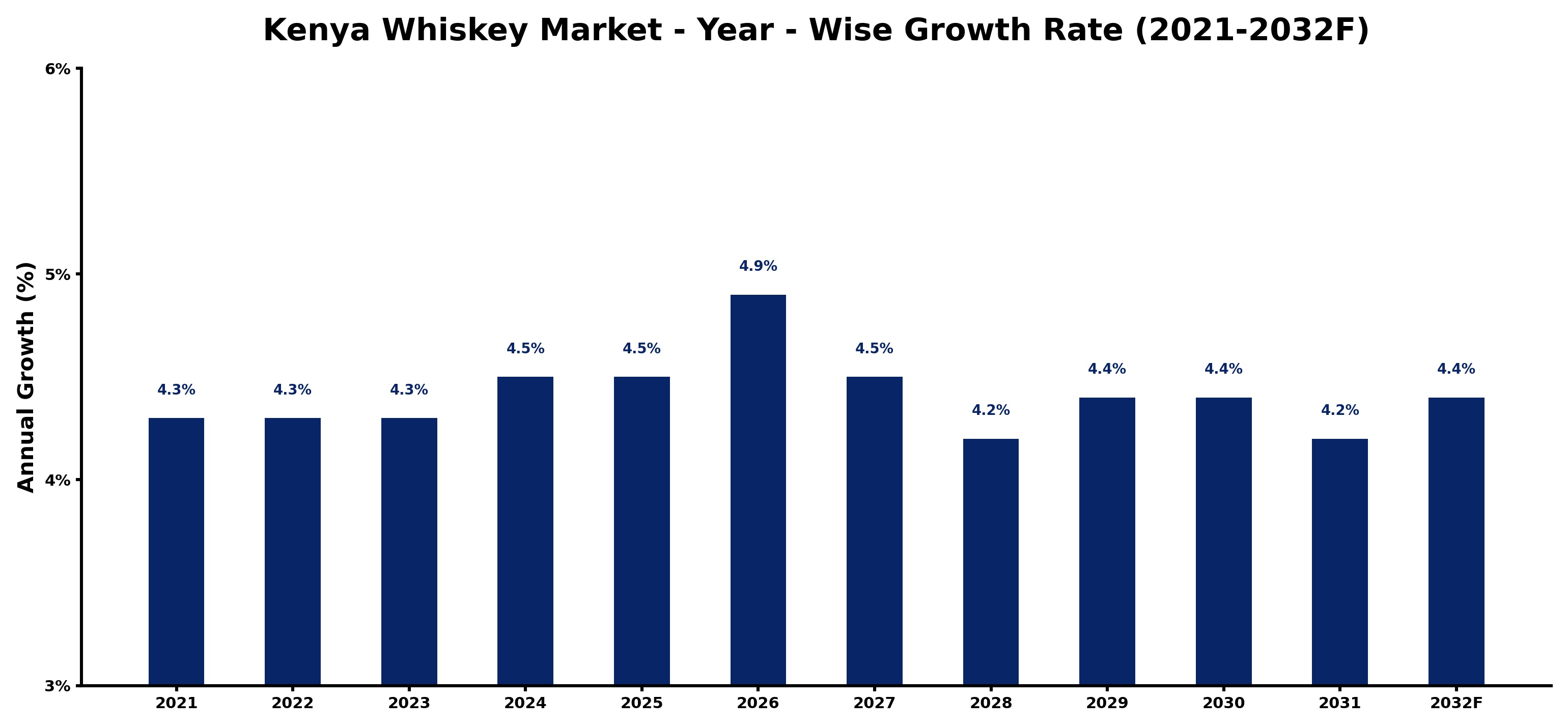
The table below presents the year‑wise growth rates along with the key drivers influencing the market
| Year | Growth Rate | Major Drivers |
| 2021 | 4.3% | Increased consumer spending power |
| 2022 | 4.3% | Growing popularity of whiskey cocktails |
| 2023 | 4.3% | Rise of premium whiskey brands |
| 2024 | 4.5% | Expansion of local distilleries |
| 2025 | 4.5% | Increased tourism driving sales |
| 2026 | 4.9% | Innovative marketing strategies adopted |
| 2027 | 4.5% | Social media influence on consumption |
| 2028 | 4.2% | Whiskey tasting events gaining traction |
| 2029 | 4.4% | Collaborations with local bars increased |
| 2030 | 4.4% | E-commerce platforms enhancing reach |
| 2031 | 4.2% | Whiskey education programs expanding interest |
| 2032 | 4.4% | Sustainability trends influencing production |
Note - Market size estimations and growth projections presented in this report are based on 6Wresearch's advanced forecasting approach, validated with industry datasets as of June 2026.
Kenya Whiskey Market Synopsis
Recently, the Kenya whiskey market has enjoyed notable momentum, characterized by an influx of diverse offerings appealing to various consumer segments. However, as the market matures, it faces challenges from regulatory pressures and competition that threaten to moderate this growth.
Looking ahead, the market is expected to evolve with changing consumer preferences towards premiumization and innovation in flavors and packaging. This shift will likely further segment the market and create new growth avenues.
Kenya Whiskey Market Key Takeaways
- The market is experiencing steady growth driven by rising disposable incomes.
- Urbanization and changing lifestyles are reshaping consumer preferences towards premium whiskey.
- Local producers are gaining traction, competing effectively with established international brands.
- Government regulations and taxation remain significant factors impacting market pricing and entry.
- Consumer education and awareness initiatives are crucial for increasing whiskey's market share.
Evaluation of Restraints in Kenya Whiskey Market
The Kenya whiskey market faces several significant restraints that impede its potential growth. The high tax burden imposed on alcoholic beverages is a primary concern, as it directly inflates retail prices, making whiskey less accessible to average consumers. Additionally, the complex regulatory framework concerning licensing and distribution adds layers of difficulty for both new entrants and existing players in the market. Furthermore, cultural inclinations towards traditional beverages, such as locally brewed spirits and beer, pose a competitive challenge to whiskey's appeal. Lastly, the threat of counterfeit products further complicates consumer trust and market dynamics.
Kenya Whiskey Market Trends
Emerging trends within the Kenya whiskey market reveal a strong shift towards premium and aged whiskeys, reflecting a growing consumer sophistication and willingness to invest in high-quality products. Flavored whiskies are also gaining traction as consumers seek new taste experiences. Notably, social media and digital marketing are playing pivotal roles in educating consumers and enhancing brand visibility. Additionally, sustainability practices are becoming increasingly relevant, with brands exploring eco-friendly packaging and sourcing to appeal to socially-conscious consumers.
Kenya Whiskey Market Opportunities
The burgeoning interest in whiskey among Kenyan consumers presents substantial growth opportunities for both local and international brands. The expanding middle class, with increasing disposable incomes, is willing to explore premium products, creating a ripe environment for innovative offerings. Strategic partnerships between local distilleries and international brands can further enhance market penetration, while educational initiatives can boost whiskey's appeal among less familiar consumer segments. Additionally, tapping into e-commerce channels represents a crucial pathway to reach tech-savvy consumers.
Government Initiatives in the Kenya Whiskey Market
The Kenyan government plays an essential role in regulating the whiskey market through the Ministry of Agriculture, Livestock, Fisheries, and Cooperatives, emphasizing quality control and compliance with trade regulations. Recent initiatives aimed at promoting responsible consumption are being balanced with efforts to support local producers. Policies regarding taxation are continuously under review to foster a more competitive marketplace. Furthermore, the government encourages investments in the beverage sector, creating a conducive environment for growth and development.
Future Insights of the Kenya Whiskey Market
Looking forward to 2026-2032, the Kenya whiskey market is poised for dynamic evolution. The anticipated growth of consumer incomes and the proliferation of urban lifestyles will likely drive increased whiskey consumption. Moreover, as consumers become more educated about whiskey varieties and production methods, the demand for premium offerings will expand. Innovations in flavor profiles and experiential marketing are expected to shape the future landscape, enabling brands to stand out in a competitive environment. Consequently, the market's resilience against economic fluctuations will depend on its ability to adapt and meet evolving consumer preferences.
Kenya Whiskey Market Latest Developments (May 2025 - June 2026)
In the recent months, the Kenya whiskey market has seen a surge in new product launches, with both local and international brands introducing innovative flavors and packaging options to capture the attention of consumers. The rise of digital marketing strategies has strengthened brand visibility and consumer engagement, while local distilleries are increasingly focusing on craftsmanship and quality to differentiate themselves. Furthermore, initiatives aimed at curbing counterfeit products have become a priority, as stakeholders collaborate with government authorities to enhance market integrity.
Kenya Whiskey Market - Key Attractiveness of the Report
- 10 Years of Market Numbers
- Historical Data Starting from 2022 to 2025
- Base Year: 2025
- Forecast Data until 2032
- Key Performance Indicators Impacting the Market
- Major Upcoming Developments and Projects
Key Highlights of the Report:
- Kenya Whiskey Market Outlook
- Market Size of Kenya Whiskey Market, 2025
- Forecast of Kenya Whiskey Market, 2032
- Historical Data and Forecast of Kenya Whiskey Revenues & Volume for the Period 2022-2032F
- Kenya Whiskey Market Trend Evolution
- Kenya Whiskey Market Drivers and Challenges
- Kenya Whiskey Price Trends
- Kenya Whiskey Porter's Five Forces
- Kenya Whiskey Industry Life Cycle
- Historical Data and Forecast of Kenya Whiskey Market Revenues & Volume By Product Type for the Period 2022-2032F
- Historical Data and Forecast of Kenya Whiskey Market Revenues & Volume By American Whisky for the Period 2022-2032F
- Historical Data and Forecast of Kenya Whiskey Market Revenues & Volume By Irish Whisky for the Period 2022-2032F
- Historical Data and Forecast of Kenya Whiskey Market Revenues & Volume By Scotch Whisky for the Period 2022-2032F
- Historical Data and Forecast of Kenya Whiskey Market Revenues & Volume By Canadian Whisky for the Period 2022-2032F
- Historical Data and Forecast of Kenya Whiskey Market Revenues & Volume By Others for the Period 2022-2032F
- Historical Data and Forecast of Kenya Whiskey Market Revenues & Volume By Distribution Channel for the Period 2022-2032F
- Historical Data and Forecast of Kenya Whiskey Market Revenues & Volume By On-trade for the Period 2022-2032F
- Historical Data and Forecast of Kenya Whiskey Market Revenues & Volume By Off-trade for the Period 2022-2032F
- Kenya Whiskey Import Export Trade Statistics
- Market Opportunity Assessment By Product Type
- Market Opportunity Assessment By Distribution Channel
- Kenya Whiskey Top Companies Market Share
- Kenya Whiskey Competitive Benchmarking By Technical and Operational Parameters
- Kenya Whiskey Company Profiles
- Kenya Whiskey Key Strategic Recommendations






































