Kenya Yeast Extract Market Size, Share & Growth Rate
The Kenya Yeast Extract Market was estimated at USD 1067 Million in 2025 and is projected to reach USD 1532 Million by 2032, growing at a CAGR of 5.3% from 2026 to 2032. This growth trajectory is largely fueled by an increasing consumption of processed foods, particularly snacks, soups, and sauces, where yeast extract serves as a natural flavor enhancer. The rising demand for clean-label ingredients, combined with a cultural shift towards healthier eating, underpins this expansion.
Kenya Yeast Extract Market Growth Rate Analysis (2021-2032)
The Kenya Yeast Extract market has shown resilient growth, with a recorded increase of 6.5% in 2021, followed by 6.1% in 2022. This moderate decline in growth rate can be attributed to supply chain constraints and rising raw material costs. However, the market rebounded with a 6.4% growth in 2023 as consumer demand for plant-based products surged, spurred by health-conscious trends. Forecasts indicate steady growth of approximately 6.2% to 6.3% through to 2026, supported by increased investments in food processing technology and infrastructure improvements. As the market stabilizes, emerging digital platforms are enhancing distribution channels, facilitating further expansion and reinforcing Kenya's position in the regional market.
Kenya Yeast Extract Market Year-wise Growth Rate and Key Drivers
This graph highlights how the Kenya Yeast Extract Market has steadily grown over the past five years, supported by major growth factors.
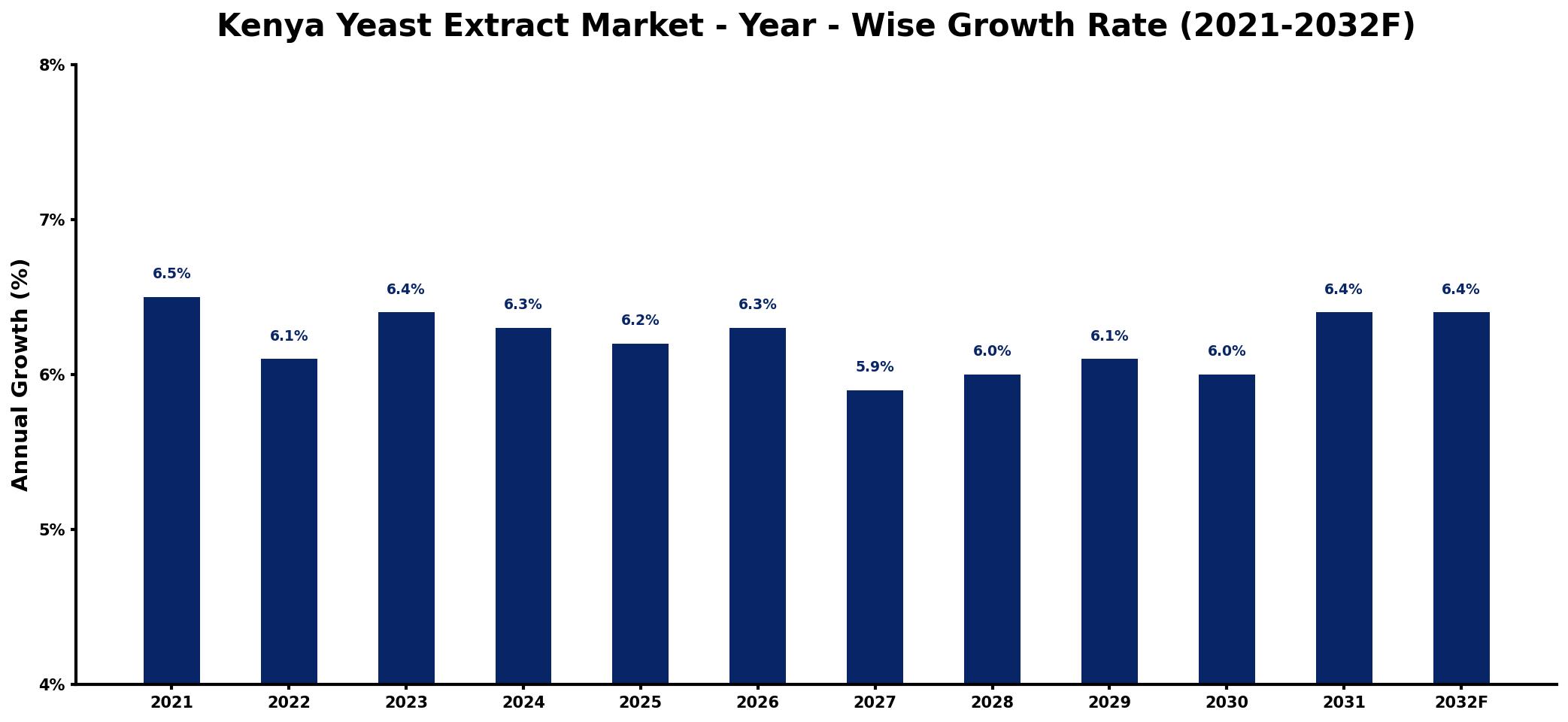
The table below presents the year‑wise growth rates along with the key drivers influencing the market
| Year | Growth Rate | Major Drivers |
| 2021 | 6.5% | Rising demand for natural flavors |
| 2022 | 6.1% | Growth in health food sector |
| 2023 | 6.4% | Increased consumer awareness nutrition |
| 2024 | 6.3% | Expansion of food processing facilities |
| 2025 | 6.2% | Higher investments in food innovation |
| 2026 | 6.3% | Emerging trends in plant-based diets |
| 2027 | 5.9% | Growing popularity of savory snacks |
| 2028 | 6.0% | Surge in gourmet cooking interest |
| 2029 | 6.1% | Increased use in food service |
| 2030 | 6.0% | growing downstream application demand |
| 2031 | 6.4% | increased overall sector activity |
| 2032 | 6.4% | enhanced product quality standards |
Note: Market size estimations and growth projections presented in this report are based on 6Wresearch's proprietary forecasting methodology, utilizing the latest available industry data, government publications, and primary research inputs.
Kenya Yeast Extract Market Synopsis
Consumer preference for natural and organic ingredients is the most potent force shaping the Kenya yeast extract market at this moment. As awareness of health issues related to artificial additives grows, manufacturers are actively seeking alternatives like yeast extract, which aligns with this trend.
Additionally, the growing food processing sector in Kenya has opened avenues for the use of yeast extract across various applications. This trend is catalyzed by an upsurge in local food production and processing, further enhancing market demand for this versatile ingredient.
Kenya Yeast Extract Market Key Takeaways
- The market is projected to grow significantly, reaching USD 1532 Million by 2032.
- Yeast extract is increasingly favored for its natural flavor-enhancing properties over synthetic alternatives.
- Consumer shifts towards healthy and organic food options are propelling market expansion.
- Government policies are encouraging the use of locally sourced ingredients in food processing.
- The market faces challenges with limited local production capacity and high import costs.
Evaluation of Restraints in Kenya Yeast Extract Market
Despite its promising growth, the Kenya yeast extract market is stymied by several key restraints. Chief among these is the limited local production capacity, which results in a heavy reliance on imports. High import costs further complicate this scenario, leading to price volatility that can deter potential buyers. Moreover, variability in quality standards presents an additional layer of complexity, as consumers increasingly demand consistency and reliability in the ingredients they choose. Lastly, the logistics required for maintaining quality—specifically cold chain management—adds further challenges, which can impede market growth.
Kenya Yeast Extract Market Trends
Several trends are currently reshaping the Kenya yeast extract market. One notable trend is the increasing focus on sustainability, with consumers opting for products that have lower environmental impacts. Manufacturers are responding by sourcing raw materials locally and employing environmentally friendly production methods. Additionally, the burgeoning snack industry is driving innovations in yeast extract applications, resulting in a diverse range of flavor profiles that cater to evolving consumer tastes.
Kenya Yeast Extract Market Opportunities
The Kenya yeast extract market presents numerous growth opportunities for investors and manufacturers alike. The rising demand for processed foods, combined with an increasing focus on health-conscious options, creates a fertile ground for new product development. Furthermore, investment in local production facilities could mitigate the current import dependency, leading to enhanced product availability and reduced costs. With consumer preferences continually evolving, there is ample space for innovative applications of yeast extract across a variety of food categories.
Government Initiatives in the Kenya Yeast Extract Market
The Kenyan government plays a pivotal role in the yeast extract market by supporting the food processing industry. Policies are geared towards promoting the use of locally sourced ingredients, which not only helps in sustaining local agricultural producers but also reduces import dependency. Regulatory bodies enforce safety and quality standards, ensuring consumer protection and promoting trust in locally produced yeast extract. Additionally, various incentives are offered to attract investments in processing facilities, aimed at enhancing local employment and boosting food security in the region.
Future Insights of the Kenya Yeast Extract Market
Looking ahead to 2026-2032, the Kenya yeast extract market is poised for robust growth, driven by an ever-increasing demand for natural ingredients in processed foods. As consumer awareness around health and wellness continues to rise, businesses that prioritize transparency and sustainability are likely to thrive. The expansion of local production capabilities and ongoing government support will serve to strengthen the market landscape, presenting abundant opportunities for stakeholders to capitalize on emerging trends.
Kenya Yeast Extract Market Latest Developments (2025 - 2026)
Recent industry developments indicate a concerted effort among local producers to enhance their yeast extract offerings. There has been a notable increase in partnerships with agricultural producers to secure a stable supply of raw materials. Moreover, companies are innovating in the areas of product formulation to cater to diverse consumer preferences, with several launching new product lines that incorporate yeast extract in novel ways.
Kenya Yeast Extract Market - Key Attractiveness of the Report
- 10 Years of Market Numbers
- Historical Data Starting from 2022 to 2025
- Base Year: 2025
- Forecast Data until 2032
- Key Performance Indicators Impacting the Market
- Major Upcoming Developments and Projects
Key Highlights of the Report:
- Kenya Yeast Extract Market Outlook
- Market Size of Kenya Yeast Extract Market, 2025
- Forecast of Kenya Yeast Extract Market, 2032
- Historical Data and Forecast of Kenya Yeast Extract Revenues & Volume for the Period 2022-2032F
- Kenya Yeast Extract Market Trend Evolution
- Kenya Yeast Extract Market Drivers and Challenges
- Kenya Yeast Extract Price Trends
- Kenya Yeast Extract Porter's Five Forces
- Kenya Yeast Extract Industry Life Cycle
- Historical Data and Forecast of Kenya Yeast Extract Market Revenues & Volume By Technology for the Period 2022-2032F
- Historical Data and Forecast of Kenya Yeast Extract Market Revenues & Volume By Autolyzed for the Period 2022-2032F
- Historical Data and Forecast of Kenya Yeast Extract Market Revenues & Volume By Hydrolyzed for the Period 2022-2032F
- Historical Data and Forecast of Kenya Yeast Extract Market Revenues & Volume By Form for the Period 2022-2032F
- Historical Data and Forecast of Kenya Yeast Extract Market Revenues & Volume By Powder for the Period 2022-2032F
- Historical Data and Forecast of Kenya Yeast Extract Market Revenues & Volume By Paste for the Period 2022-2032F
- Historical Data and Forecast of Kenya Yeast Extract Market Revenues & Volume By Flakes for the Period 2022-2032F
- Historical Data and Forecast of Kenya Yeast Extract Market Revenues & Volume By Application for the Period 2022-2032F
- Historical Data and Forecast of Kenya Yeast Extract Market Revenues & Volume By Food & Beverages for the Period 2022-2032F
- Historical Data and Forecast of Kenya Yeast Extract Market Revenues & Volume By Animal Feed for the Period 2022-2032F
- Historical Data and Forecast of Kenya Yeast Extract Market Revenues & Volume By Pharmaceuticals for the Period 2022-2032F
- Historical Data and Forecast of Kenya Yeast Extract Market Revenues & Volume By Others for the Period 2022-2032F
- Kenya Yeast Extract Import Export Trade Statistics
- Market Opportunity Assessment By Technology
- Market Opportunity Assessment By Form
- Market Opportunity Assessment By Application
- Kenya Yeast Extract Top Companies Market Share
- Kenya Yeast Extract Competitive Benchmarking By Technical and Operational Parameters
- Kenya Yeast Extract Company Profiles
- Kenya Yeast Extract Key Strategic Recommendations






































