Kuwait Bulletproof Vest Market Summary
The kuwait bulletproof vest market was estimated at USD 761 Million in 2025 and is projected to reach USD 1326 Million by 2032, growing at a CAGR of 9.5% from 2026 to 2032.
Kuwait Bulletproof Vest Market Year-wise Growth Rate and Key Drivers
This graph highlights how the Kuwait Bulletproof Vest Market has steadily grown over the past five years, supported by major growth factors.
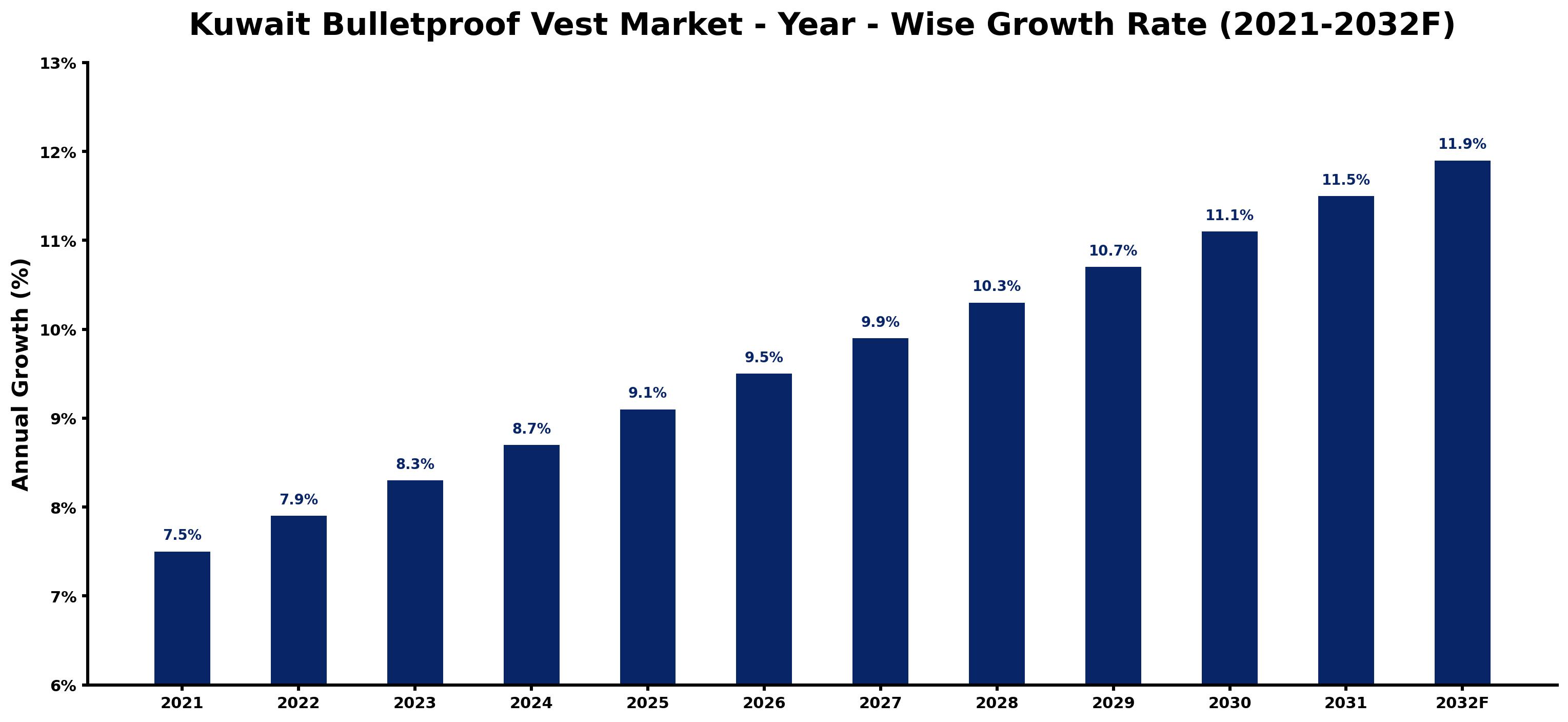
The table below presents the year wise growth rates along with the key drivers influencing the market
| Year | Growth Rate | Major Drivers |
| 2021 | 7.5% | Private security firms in Kuwait report increased interest in personal protective equipment. |
| 2022 | 7.9% | Military contracts for enhanced body armor lead to competitive market expansion opportunities. |
| 2023 | 8.3% | Local manufacturers begin producing bulletproof vests tailored for Kuwait's climate and terrain. |
| 2024 | 8.7% | Increased awareness of personal safety boosts the civilian market for protective gear. |
| 2025 | 9.1% | Emerging threats prompt corporate entities to invest heavily in employee safety measures. |
| 2026 | 9.5% | Trade partnerships with defense suppliers strengthen the supply chain for bulletproof apparel. |
| 2027 | 9.9% | Technological advancements in materials enhance the effectiveness and comfort of vests. |
| 2028 | 10.3% | Regional security concerns escalate, pushing demand for advanced personal protection systems. |
| 2029 | 10.7% | Integration of smart technologies into protective gear attracts high-end consumer interest. |
| 2030 | 11.1% | Kuwait's construction sector flourishes, creating higher demand for worker safety equipment. |
| 2031 | 11.5% | Public events and gatherings increase, necessitating improved personal security solutions. |
| 2032 | 11.9% | Local regulations mandate enhanced safety standards, driving innovation in bulletproof vest design. |
Note - Market size estimations and growth projections presented in this report are based on 6Wresearch's advanced forecasting approach, validated with industry datasets as of June 2026.
Kuwait Bulletproof Vest Market Synopsis
The Kuwait Bulletproof Vest Market is projected to reach 9.5% and witness significant growth during the forecast period (2026-2032). This growth is driven by an increasing need for enhanced security measures in response to rising threats in the region. The vulnerabilities associated with Kuwait's geographical positioning, bordering conflict-ridden countries, have necessitated a stronger emphasis on protective equipment. As security concerns escalate, both governmental and private sectors are investing in advanced protective gear, underscoring the critical role that bulletproof vests play in personal safety and security operations.
Kuwait Bulletproof Vest Market Growth Drivers
Several factors are contributing to the growth of the Kuwait Bulletproof Vest Market. One of the primary drivers is the heightened awareness regarding personal safety amid increasing terrorist activities in the region. This awareness is prompting security agencies and private companies to procure high-quality bulletproof vests. Furthermore, the influx of foreign investments and initiatives to bolster national security are also compelling factors driving demand.
- The geopolitical climate in the Middle East has intensified the need for enhanced protective gear, particularly in Kuwait, which serves as a strategic base for various operations.
- Government initiatives aimed at upgrading security protocols have resulted in increased procurement of advanced bulletproof vests and related protective equipment.
- Ongoing training programs for security personnel further stimulate demand, as these initiatives are often accompanied by a need for reliable personal protective gear.
- Rising awareness of workplace safety regulations among private enterprises is leading to significant investments in bulletproof vests for employees in high-risk sectors.
- The technological advancements in materials used in bulletproof vests such as Kevlar and advanced composites have made these products more appealing and effective, driving market growth.
Kuwait Bulletproof Vest Market Challenges and Restraints
Despite the promising growth prospects, the Kuwait Bulletproof Vest Market faces several challenges. Economic fluctuations could impact government spending on defense and security, which ultimately affects procurement budgets for protective gear. Additionally, the price sensitivity of certain sectors may lead to resistance against higher-priced advanced bulletproof vests. Moreover, the market is occasionally challenged by the availability of counterfeit products that undermine the safety and effectiveness of authentic protective gear.
- Economic downturns could result in reduced budget allocations for security, limiting the procurement of bulletproof vests.
- Price sensitivity within certain sectors may constrain purchasing decisions, especially among smaller organizations.
- The presence of counterfeit products in the market can mislead consumers and introduce severe safety risks, damaging public trust in protective gear.
- Rapid advancements in technology necessitate continuous upgrades in product offerings, which could pose a challenge for manufacturers to keep pace.
- Changing regulations and standards in protective equipment may create compliance issues for manufacturers and suppliers, affecting market dynamics.
Kuwait Bulletproof Vest Market Investment Opportunities
The evolving landscape of the Kuwait Bulletproof Vest Market presents multiple investment opportunities. With the anticipated increase in demand, manufacturers and suppliers can consider collaborations with security agencies to innovate and enhance product offerings. Additionally, focusing on research and development to create lighter, more durable vests can capture substantial market interest. Furthermore, tapping into emerging sectors such as private security firms and various industries requiring enhanced personnel safety is vital for growth.
- Investment in R&D for advanced materials can lead to the development of higher-quality, lightweight bulletproof vests that meet evolving safety standards.
- Establishing partnerships with government and military organizations can provide a steady revenue stream and enhance reputation in the market.
- Expanding distribution networks to reach remote and underserved regions can create new sales opportunities for bulletproof vests.
- Marketing initiatives targeting private companies, especially in high-risk industries, can open new avenues for sales and brand recognition.
- Investing in training programs for end-users can strengthen customer relationships and ensure the effective use of protective gear.
Kuwait Bulletproof Vest Market Government Investment and Initiatives
The government of Kuwait has recognized the importance of bolstering national security through various investment initiatives. Increased allocations for defense spending are being directed toward modernizing equipment, including bulletproof vests for military and law enforcement agencies. Moreover, public sector investments are aimed at enhancing training facilities and capabilities, which directly influences the demand for quality protective gear. Initiatives promoting collaborations between the government and local manufacturers are also being explored to reduce dependencies on imports and enhance domestic production capacities.
Kuwait Bulletproof Vest Market Latest Developments (May 2025 - June 2026)
Recent developments in the Kuwait Bulletproof Vest Market indicate a growing trend toward innovation and enhancement of protective gear. Manufacturers are increasingly focusing on integrating advanced technologies, such as smart fabrics and ballistic protection systems, into their offerings. Additionally, collaborations between security agencies and private entities have intensified, emphasizing the necessity for comprehensive training programs that include the use of bulletproof vests. Furthermore, numerous local and regional exhibitions are showcasing the latest advancements in protective equipment, providing a platform for stakeholders to exchange insights and foster partnerships.
Kuwait Bulletproof Vest Market - Key Attractiveness of the Report
- 10 Years of Market Numbers
- Historical Data Starting from 2022 to 2025
- Base Year: 2025
- Forecast Data until 2032
- Key Performance Indicators Impacting the Market
- Major Upcoming Developments and Projects
Key Highlights of the Report:
- Kuwait Bulletproof Vest Market Outlook
- Market Size of Kuwait Bulletproof Vest Market, 2025
- Forecast of Kuwait Bulletproof Vest Market, 2032
- Historical Data and Forecast of Kuwait Bulletproof Vest Revenues & Volume for the Period 2022-2032
- Kuwait Bulletproof Vest Market Trend Evolution
- Kuwait Bulletproof Vest Market Drivers and Challenges
- Kuwait Bulletproof Vest Price Trends
- Kuwait Bulletproof Vest Porter's Five Forces
- Kuwait Bulletproof Vest Industry Life Cycle
- Historical Data and Forecast of Kuwait Bulletproof Vest Market Revenues & Volume By Type for the Period 2022-2032
- Historical Data and Forecast of Kuwait Bulletproof Vest Market Revenues & Volume By Soft Vest for the Period 2022-2032
- Historical Data and Forecast of Kuwait Bulletproof Vest Market Revenues & Volume By Hard Vest for the Period 2022-2032
- Historical Data and Forecast of Kuwait Bulletproof Vest Market Revenues & Volume By Purpose for the Period 2022-2032
- Historical Data and Forecast of Kuwait Bulletproof Vest Market Revenues & Volume By Military for the Period 2022-2032
- Historical Data and Forecast of Kuwait Bulletproof Vest Market Revenues & Volume By Civilian for the Period 2022-2032
- Kuwait Bulletproof Vest Import Export Trade Statistics
- Market Opportunity Assessment By Type
- Market Opportunity Assessment By Purpose
- Kuwait Bulletproof Vest Top Companies Market Share
- Kuwait Bulletproof Vest Competitive Benchmarking By Technical and Operational Parameters
- Kuwait Bulletproof Vest Company Profiles
- Kuwait Bulletproof Vest Key Strategic Recommendations






































