Kuwait High Strength Steel Market Size, Share & Growth Rate
The Kuwait High Strength Steel Market was estimated at USD 1237 Million in 2025 and is projected to reach USD 2144 Million by 2032, growing at a CAGR of 8.2% from 2026 to 2032. This growth trajectory is primarily fueled by the flourishing construction and infrastructure sectors in Kuwait, where high-strength steel is increasingly recognized for its durability and structural integrity. As the country embarks on ambitious development projects, the demand for high-strength materials has surged, further solidifying the position of high-strength steel in various applications.
Kuwait High Strength Steel Market Year-wise Growth Rate and Key Drivers
This graph highlights how the Kuwait High Strength Steel Market has steadily grown over the years, supported by major growth factors.
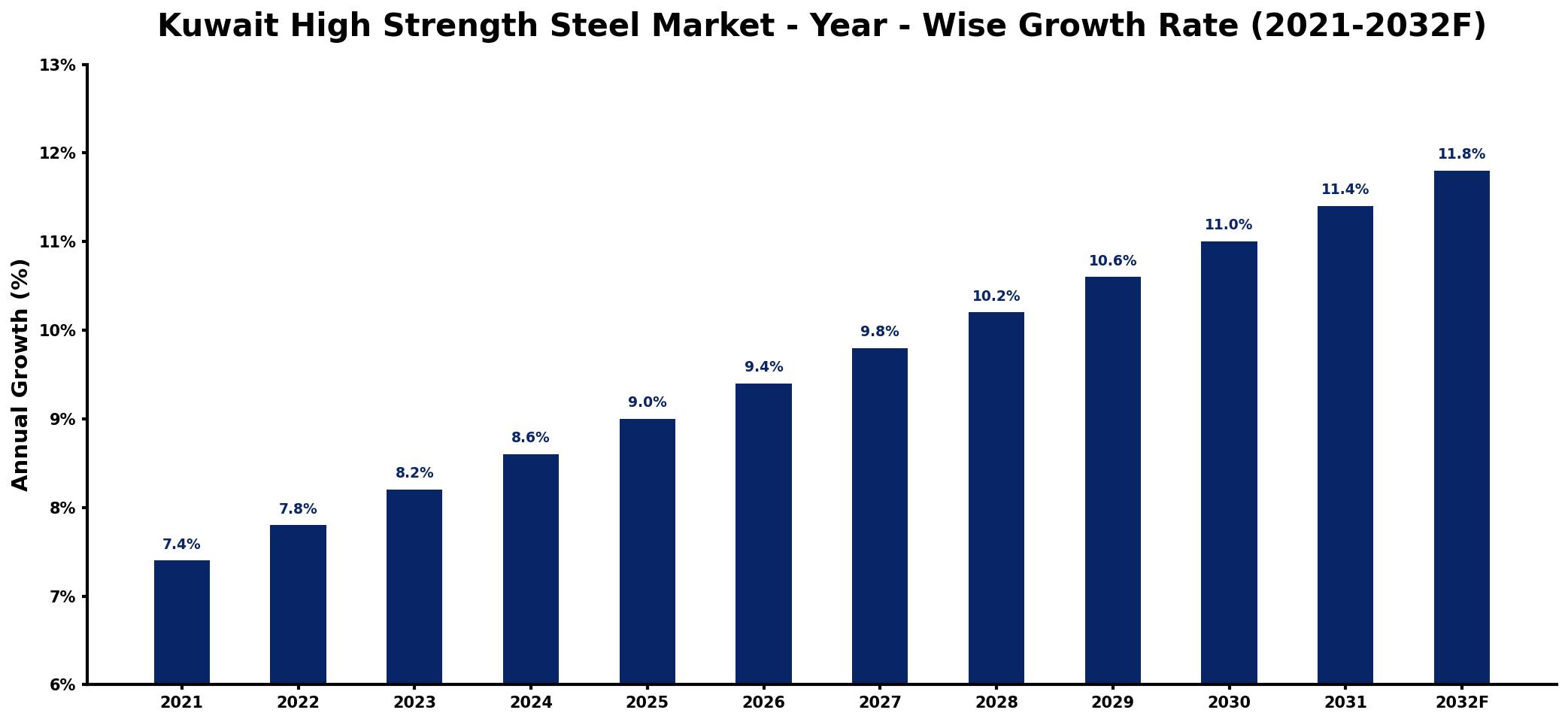
The table below presents the year‑wise growth rates along with the key drivers influencing the market
| Year | Growth Rate | Major Drivers |
| 2021 | 7.4% | Infrastructure projects demand surge |
| 2022 | 7.8% | Energy sector investment growth |
| 2023 | 8.2% | Construction industry expansion continues |
| 2024 | 8.6% | Automotive sector demand increase |
| 2025 | 9.0% | Manufacturing capabilities enhancement efforts |
| 2026 | 9.4% | Renewable energy projects initiation |
| 2027 | 9.8% | Government spending on infrastructure |
| 2028 | 10.2% | Technological advancements in manufacturing |
| 2029 | 10.6% | Transportation sector growth initiatives |
| 2030 | 11.0% | Urbanization trends driving demand |
| 2031 | 11.4% | Export opportunities in regional markets |
| 2032 | 11.8% | Sustainability initiatives promoting investments |
Note: Market size estimations and growth projections presented in this report are based on 6Wresearch's proprietary forecasting methodology, utilizing the latest available industry data, government publications, and primary research inputs.
Kuwait High Strength Steel Market Synopsis
The most significant force shaping the Kuwait High Strength Steel Market today is the rapid expansion of the construction industry, which is essential to the nations vision for infrastructural progress. The rise in high-rise buildings, bridges, and large-scale industrial projects underpins the increasing requirement for advanced steel alloys.
Additionally, stringent building codes mandated by the Kuwaiti government necessitate the use of high-strength materials, pushing stakeholders towards compliant options that offer enhanced performance. This regulatory environment is catalyzing a proactive shift towards adopting high-strength steel across various sectors.
Kuwait High Strength Steel Market Key Takeaways
- The market is driven by the construction boom and infrastructure development.
- Government regulations mandate the use of high-strength materials in building projects.
- Innovative product development is vital to keep pace with changing industry demands.
- Fluctuations in raw material prices pose challenges to maintaining profit margins.
- The local manufacturing sector is encouraged through government policies and incentives.
Evaluation of Restraints in Kuwait High Strength Steel Market
While the Kuwait High Strength Steel Market is on a promising growth trajectory, it faces significant restraints that could inhibit its potential. Foremost among these is the competition from alternative materials, such as composite materials and pre-fabricated solutions that offer lighter weights or cost advantages. The volatility in raw material prices, often driven by global supply chain disruptions, adds another layer of complexity that affects pricing strategies and profitability. Furthermore, to remain competitive, there is an urgent need for continuous innovation to address evolving industry requirements without compromising cost-effectiveness, which can strain resources and investment capabilities.
Kuwait High Strength Steel Market Trends
One current trend is the growing emphasis on sustainability in construction, prompting the steel industry to innovate towards eco-friendly production processes. This trend aligns with the global shift towards reducing carbon footprints and enhancing material recyclability. Another emerging trend is the integration of smart technologies in steel applications, such as smart monitoring systems for infrastructure projects, which can significantly enhance durability and reduce maintenance costs.
Kuwait High Strength Steel Market Opportunities
Investment opportunities are plentiful in the Kuwait High Strength Steel Market, particularly in local manufacturing capabilities. As the government pushes for greater reliance on domestically produced materials, there is a substantial opportunity for companies to establish or expand facilities that meet local demand. Additionally, partnerships with construction firms looking for innovative steel solutions can open new revenue streams and foster collaborative product development efforts.
Government Initiatives in the Kuwait High Strength Steel Market
The Kuwaiti government is actively promoting the use of high-strength steel through various policies aimed at enhancing infrastructure quality. These initiatives include establishing quality standards for materials used in construction and imposing import tariffs to support local manufacturing. Furthermore, incentives for domestic production are being introduced to ensure that construction projects use materials that provide structural integrity and longevity, effectively ensuring the nations investments in infrastructure are sound and sustainable.
Future Insights of the Kuwait High Strength Steel Market
Looking ahead to the period from 2026 to 2032, the Kuwait High Strength Steel Market is poised for significant expansion. The ongoing commitment to infrastructure development and urbanization projects will likely sustain high demand. Advances in material science and steel manufacturing processes promise to enhance product offerings, catering to increasingly sophisticated consumer needs. Moreover, the regulatory focus on safety and quality will continue to drive demand for high-strength steel, reinforcing its critical role in Kuwaits economic and structural development.
Kuwait High Strength Steel Market Latest Developments (2025 - 2026)
Recently, the industry has seen heightened activity as construction projects ramp up across Kuwait. The focus has shifted towards innovations in high-strength steel formulations that enhance performance while reducing environmental impact. Additionally, collaborative efforts between government entities and private stakeholders have intensified, aiming to align local production capabilities with international standards to boost export potential.
Kuwait High Strength Steel Market - Key Attractiveness of the Report
- 10 Years of Market Numbers
- Historical Data Starting from 2022 to 2025
- Base Year: 2025
- Forecast Data until 2032
- Key Performance Indicators Impacting the Market
- Major Upcoming Developments and Projects
Key Highlights of the Report:
- Kuwait High Strength Steel Market Outlook
- Market Size of Kuwait High Strength Steel Market, 2025
- Forecast of Kuwait High Strength Steel Market, 2032
- Historical Data and Forecast of Kuwait High Strength Steel Revenues & Volume for the Period 2022-2032F
- Kuwait High Strength Steel Market Trend Evolution
- Kuwait High Strength Steel Market Drivers and Challenges
- Kuwait High Strength Steel Price Trends
- Kuwait High Strength Steel Porter's Five Forces
- Kuwait High Strength Steel Industry Life Cycle
- Historical Data and Forecast of Kuwait High Strength Steel Market Revenues & Volume By Product Type for the Period 2022-2032F
- Historical Data and Forecast of Kuwait High Strength Steel Market Revenues & Volume By Dual Phase Steel for the Period 2022-2032F
- Historical Data and Forecast of Kuwait High Strength Steel Market Revenues & Volume By Bake Hardenable Steel for the Period 2022-2032F
- Historical Data and Forecast of Kuwait High Strength Steel Market Revenues & Volume By Carbon Manganese Steel for the Period 2022-2032F
- Historical Data and Forecast of Kuwait High Strength Steel Market Revenues & Volume By Other Product Types for the Period 2022-2032F
- Historical Data and Forecast of Kuwait High Strength Steel Market Revenues & Volume By Application for the Period 2022-2032F
- Historical Data and Forecast of Kuwait High Strength Steel Market Revenues & Volume By Automotive for the Period 2022-2032F
- Historical Data and Forecast of Kuwait High Strength Steel Market Revenues & Volume By Construction for the Period 2022-2032F
- Historical Data and Forecast of Kuwait High Strength Steel Market Revenues & Volume By Yellow Goods and Mining Equipment for the Period 2022-2032F
- Historical Data and Forecast of Kuwait High Strength Steel Market Revenues & Volume By Aviation and Marine for the Period 2022-2032F
- Historical Data and Forecast of Kuwait High Strength Steel Market Revenues & Volume By Other Applications for the Period 2022-2032F
- Kuwait High Strength Steel Import Export Trade Statistics
- Market Opportunity Assessment By Product Type
- Market Opportunity Assessment By Application
- Kuwait High Strength Steel Top Companies Market Share
- Kuwait High Strength Steel Competitive Benchmarking By Technical and Operational Parameters
- Kuwait High Strength Steel Company Profiles
- Kuwait High Strength Steel Key Strategic Recommendations






































