France High Strength Steel Market Top 5 Importing Countries and Market Competition (HHI) Analysis
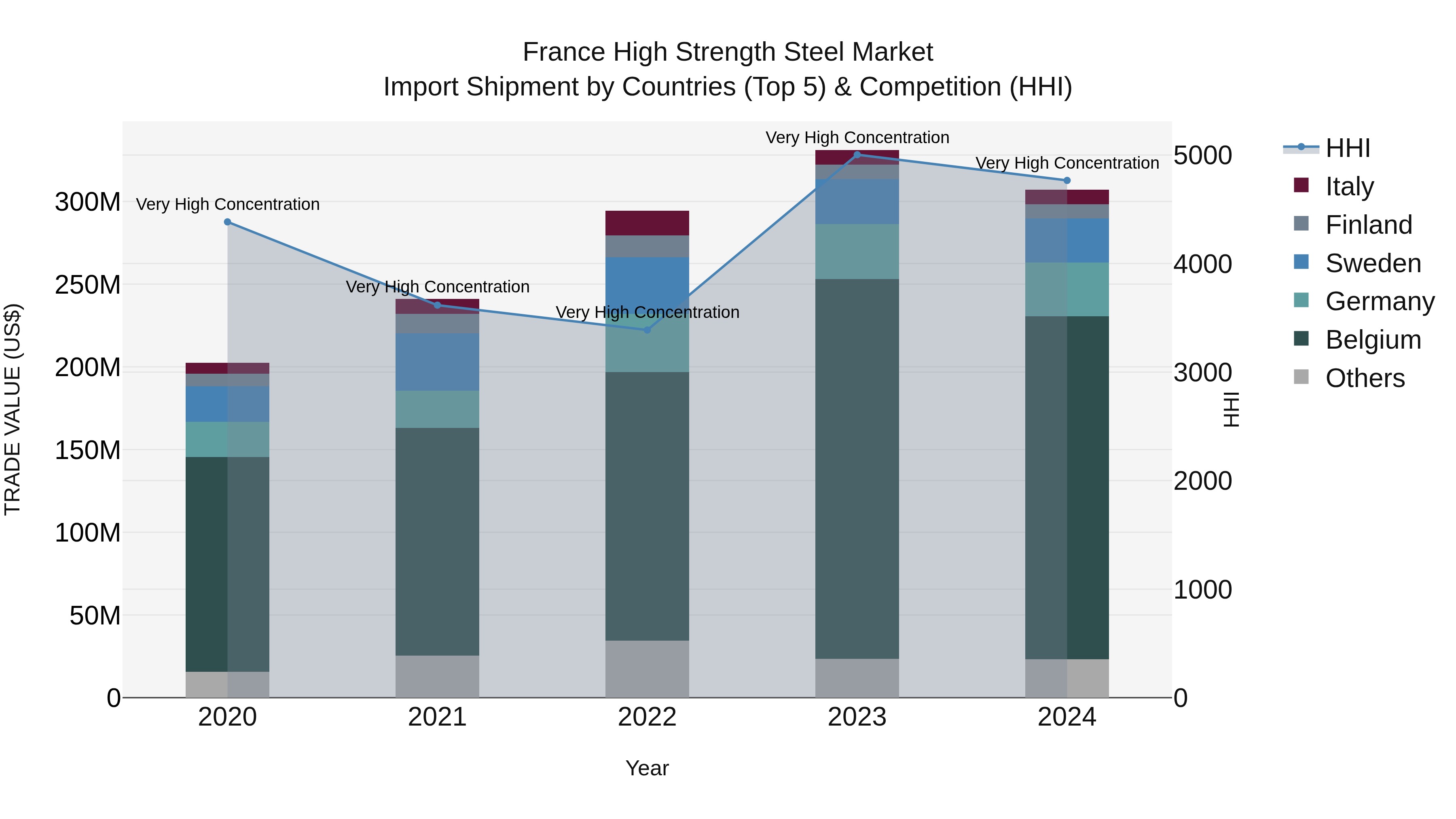
France continues to be a key importer of high strength steel, with top exporting countries including Belgium, Germany, Sweden, Italy, and Finland in 2024. Despite a high Herfindahl-Hirschman Index (HHI) indicating concentration, the market has shown strong growth with a compound annual growth rate (CAGR) of 11.0% from 2020 to 2024. However, there was a slight decline in growth rate from 2023 to 2024 at -7.19%. The consistent import demand from these countries underscores the importance of high strength steel in various industries within France.
France High Strength Steel Market Overview
The high strength steel market in France is experiencing steady growth propelled by increasing demand from automotive, construction, and manufacturing sectors. High strength steel offers superior mechanical properties, including high tensile strength, toughness, and corrosion resistance, making it suitable for lightweight and durable applications. In the automotive industry, high strength steel is extensively used in body structures, chassis components, and safety features to meet stringent crash safety standards and reduce vehicle weight. Technological advancements leading to the development of advanced high strength steel grades are driving market growth in France.
Drivers of the market
The High Strength Steel market in France is witnessing growth due to increasing demand for lightweight, high-strength materials in automotive, construction, and infrastructure projects. High strength steel alloys, such as advanced high-strength steel (AHSS) and ultra-high-strength steel (UHSS), offer advantages such as improved crashworthiness, fuel efficiency, and structural performance. The growing emphasis on lightweighting, energy efficiency, and sustainability drives the adoption of high strength steel in France. Moreover, advancements in steel metallurgy, alloy development, and processing techniques contribute to market expansion by improving material properties, formability, and weldability. Additionally, collaborations between steel producers, end-users, and regulatory agencies further stimulate market growth by addressing industry challenges, promoting material innovation, and ensuring compliance with quality and safety standards.
Challenges of the market
The France High Strength Steel Market faces challenges related to material development, cost competitiveness, and market acceptance. One significant challenge is advancing steel metallurgy and processing technologies to develop high-strength steel grades that offer superior mechanical properties, lightweighting benefits, and corrosion resistance for various applications such as automotive, construction, and infrastructure. Moreover, addressing cost concerns and price competitiveness compared to alternative materials such as aluminum and composites poses challenges for steel manufacturers in terms of production efficiency and material cost reduction. Additionally, generating market acceptance and adoption for high-strength steel solutions amidst competition from alternative materials and changing industry trends requires collaborative efforts among stakeholders to demonstrate performance advantages and value proposition.
Government Policy of the market
Regulations concerning construction standards, building codes, and material specifications impact the high-strength steel market in France. Government policies promote the use of high-strength steel grades in structural engineering, automotive manufacturing, and infrastructure projects to enhance structural integrity, reduce material usage, and improve overall performance.
Key Highlights of the Report:
- France High Strength Steel Market Outlook
- Market Size of France High Strength Steel Market, 2024
- Forecast of France High Strength Steel Market, 2031
- Historical Data and Forecast of France High Strength Steel Revenues & Volume for the Period 2021-2031
- France High Strength Steel Market Trend Evolution
- France High Strength Steel Market Drivers and Challenges
- France High Strength Steel Price Trends
- France High Strength Steel Porter's Five Forces
- France High Strength Steel Industry Life Cycle
- Historical Data and Forecast of France High Strength Steel Market Revenues & Volume By Product Type for the Period 2021-2031
- Historical Data and Forecast of France High Strength Steel Market Revenues & Volume By Dual Phase Steel for the Period 2021-2031
- Historical Data and Forecast of France High Strength Steel Market Revenues & Volume By Bake Hardenable Steel for the Period 2021-2031
- Historical Data and Forecast of France High Strength Steel Market Revenues & Volume By Carbon Manganese Steel for the Period 2021-2031
- Historical Data and Forecast of France High Strength Steel Market Revenues & Volume By Other Product Types for the Period 2021-2031
- Historical Data and Forecast of France High Strength Steel Market Revenues & Volume By Application for the Period 2021-2031
- Historical Data and Forecast of France High Strength Steel Market Revenues & Volume By Automotive for the Period 2021-2031
- Historical Data and Forecast of France High Strength Steel Market Revenues & Volume By Construction for the Period 2021-2031
- Historical Data and Forecast of France High Strength Steel Market Revenues & Volume By Yellow Goods and Mining Equipment for the Period 2021-2031
- Historical Data and Forecast of France High Strength Steel Market Revenues & Volume By Aviation and Marine for the Period 2021-2031
- Historical Data and Forecast of France High Strength Steel Market Revenues & Volume By Other Applications for the Period 2021-2031
- France High Strength Steel Import Export Trade Statistics
- Market Opportunity Assessment By Product Type
- Market Opportunity Assessment By Application
- France High Strength Steel Top Companies Market Share
- France High Strength Steel Competitive Benchmarking By Technical and Operational Parameters
- France High Strength Steel Company Profiles
- France High Strength Steel Key Strategic Recommendations






































