United Kingdom (UK) High Strength Steel Market Size, Share & Growth Rate
The United Kingdom (UK) High Strength Steel Market was estimated at USD 175 Million in 2025 and is projected to reach USD 216 Million by 2032, growing at a CAGR of 3.1% from 2026 to 2032. This upward trajectory is driven primarily by the surge in infrastructure development and the automotive industry's ongoing push for lightweight materials. Additionally, innovations in steel manufacturing technologies and a rising emphasis on sustainability are further fueling this market's growth.
United Kingdom (UK) High Strength Steel Market Year-wise Growth Rate and Key Drivers
This graph highlights how the United Kingdom (UK) High Strength Steel Market has steadily grown over the years, supported by major growth factors.
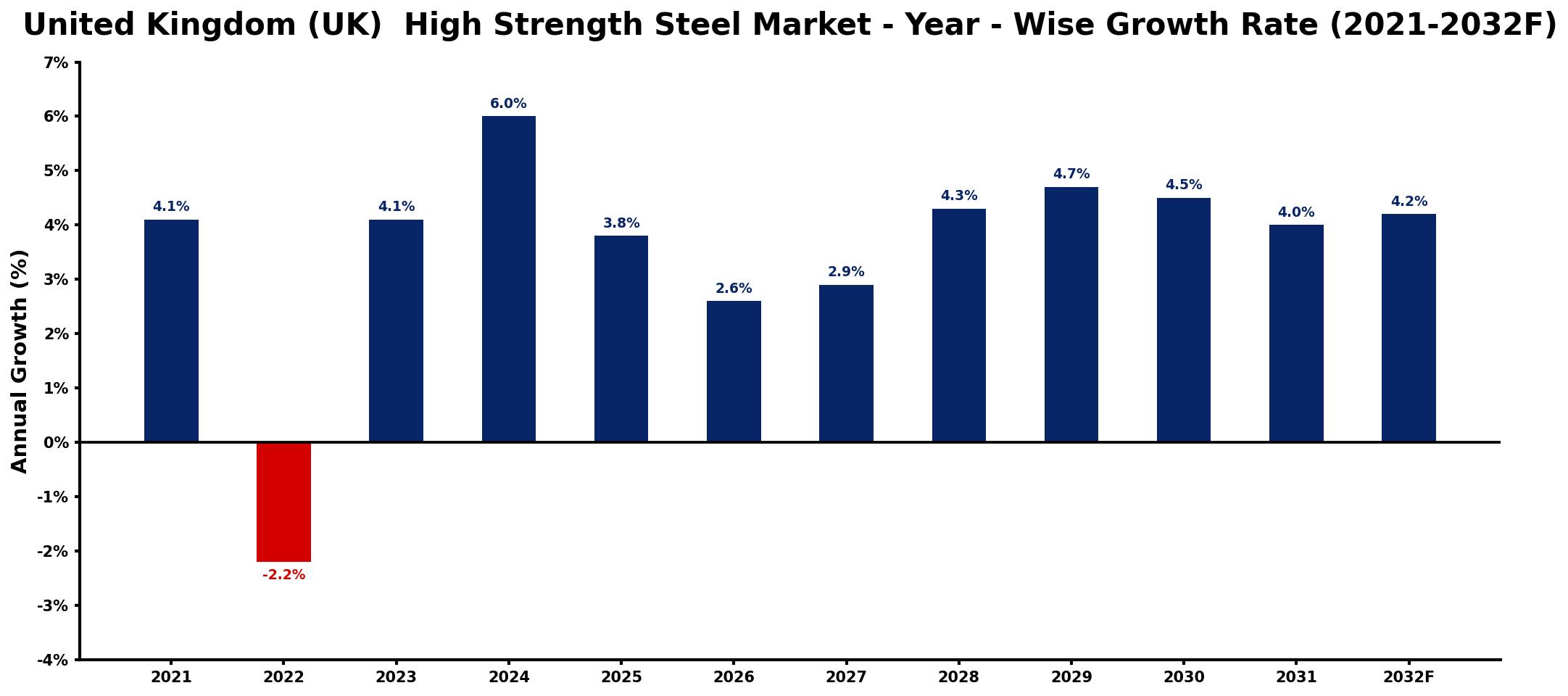
The table below presents the year‑wise growth rates along with the key drivers influencing the market
| Year | Growth Rate | Major Drivers |
| 2021 | 4.1% | Construction sector recovery drives demand |
| 2022 | -2.2% | Manufacturing output experiences slowdown |
| 2023 | 4.1% | Infrastructure projects increase market activity |
| 2024 | 6.0% | Automotive sector expansion drives sales |
| 2025 | 3.8% | Renewable energy investments boost applications |
| 2026 | 2.6% | Transportation infrastructure upgrades require materials |
| 2027 | 2.9% | Technological advancements enhance production efficiency |
| 2028 | 4.3% | Urbanization trends stimulate construction projects |
| 2029 | 4.7% | Aerospace industry growth increases usage |
| 2030 | 4.5% | Global trade agreements enhance exports |
| 2031 | 4.0% | Defense spending drives procurement needs |
| 2032 | 4.2% | Sustainability initiatives promote material innovations |
Note: Market size estimations and growth projections presented in this report are based on 6Wresearch's proprietary forecasting methodology, utilizing the latest available industry data, government publications, and primary research inputs.
United Kingdom (UK) High Strength Steel Market Synopsis
The most significant force currently shaping the UK high strength steel market is the increasing demand for materials that combine strength with lightness, particularly in the automotive sector. As manufacturers strive to enhance fuel efficiency and reduce carbon footprints, high strength steel has emerged as a pivotal solution, enabling vehicle weight reduction without compromising safety.
Moreover, the construction industry is also a major driver, where the need for robust materials that facilitate design flexibility is paramount. As infrastructure projects ramp up, high strength steel's role in offering exceptional performance while meeting stringent regulatory standards becomes even more crucial.
United Kingdom (UK) High Strength Steel Market Key Takeaways
- High strength steel is essential for enhancing fuel efficiency in the automotive industry.
- Construction and infrastructure developments are pivotal to market growth, demanding durable materials.
- Advancements in steel manufacturing technologies are significantly influencing product competitiveness.
- Regulatory frameworks focusing on sustainability are reshaping market dynamics.
- Research and development initiatives are vital for driving innovation in alloy formulations.
Evaluation of Restraints in United Kingdom (UK) High Strength Steel Market
Despite the promising outlook, several restraints hinder the full potential of the UK high strength steel market. Cost-effectiveness remains a significant concern, as high strength steel materials often come at a premium compared to conventional alternatives. Furthermore, challenges related to material versatility can limit their applicability in certain sectors. Fluctuating global steel prices add another layer of complexity, impacting manufacturers' ability to plan for long-term investments in innovation and production.
United Kingdom (UK) High Strength Steel Market Trends
Several current and emerging trends are shaping the UK high strength steel market. A notable shift is the growing focus on sustainable manufacturing practices, leading to a rise in demand for recycled steel and eco-friendly production processes. Additionally, the automotive sector's trend towards electrification is driving interest in advanced materials that can optimize performance while reducing vehicle weight. Furthermore, collaborations between academia and industry are fostering innovations in alloy technology, enhancing the material's overall performance capabilities.
United Kingdom (UK) High Strength Steel Market Opportunities
The UK high strength steel market is ripe with opportunities for growth and investment. The expanding renewable energy sector presents significant potential, as high strength steel is increasingly utilized in wind turbine manufacturing and other green technologies. Furthermore, ongoing urbanization and infrastructure projects create a consistent demand for robust building materials. Companies that focus on developing innovative steel alloys and sustainable production techniques are well-positioned to capitalize on these trends.
Government Initiatives in the United Kingdom (UK) High Strength Steel Market
UK government policies are increasingly focused on enhancing the competitiveness of the high strength steel market. Regulatory frameworks aim to promote higher manufacturing standards, quality assurance, and environmental sustainability in steel production. Initiatives such as funding for research and development, technology transfer programs, and collaborative projects with various industries are being implemented to accelerate the adoption of high strength steel across key sectors, including construction and renewable energy.
Future Insights of the United Kingdom (UK) High Strength Steel Market
Looking ahead to 2026-2032, the UK high strength steel market is poised for sustained growth. Continued advancements in alloy development will likely lead to improved performance characteristics, further entrenching high strength steel as a material of choice across multiple industries. Additionally, as regulatory pressures to reduce carbon emissions intensify, the demand for lightweight yet robust materials will only increase. Companies that can innovate rapidly and adapt to these trends will capture significant market share.
United Kingdom (UK) High Strength Steel Market Latest Developments (2025 - 2026)
Recent developments in the UK high strength steel market indicate a marked shift towards sustainable production practices and enhanced material capabilities. Industry stakeholders are increasingly engaging in research collaborations aimed at developing new steel alloys that meet both performance and environmental standards. There is a growing emphasis on automating manufacturing processes to improve efficiency and reduce costs, while several large infrastructure projects are beginning to incorporate high strength steel to meet their structural requirements.
United Kingdom (UK) High Strength Steel Market - Key Attractiveness of the Report
- 10 Years of Market Numbers
- Historical Data Starting from 2022 to 2025
- Base Year: 2025
- Forecast Data until 2032
- Key Performance Indicators Impacting the Market
- Major Upcoming Developments and Projects
Key Highlights of the Report:
- United Kingdom (UK) High Strength Steel Market Outlook
- Market Size of United Kingdom (UK) High Strength Steel Market, 2025
- Forecast of United Kingdom (UK) High Strength Steel Market, 2032
- Historical Data and Forecast of United Kingdom (UK) High Strength Steel Revenues & Volume for the Period 2022-2032F
- United Kingdom (UK) High Strength Steel Market Trend Evolution
- United Kingdom (UK) High Strength Steel Market Drivers and Challenges
- United Kingdom (UK) High Strength Steel Price Trends
- United Kingdom (UK) High Strength Steel Porter's Five Forces
- United Kingdom (UK) High Strength Steel Industry Life Cycle
- Historical Data and Forecast of United Kingdom (UK) High Strength Steel Market Revenues & Volume By Product Type for the Period 2022-2032F
- Historical Data and Forecast of United Kingdom (UK) High Strength Steel Market Revenues & Volume By Dual Phase Steel for the Period 2022-2032F
- Historical Data and Forecast of United Kingdom (UK) High Strength Steel Market Revenues & Volume By Bake Hardenable Steel for the Period 2022-2032F
- Historical Data and Forecast of United Kingdom (UK) High Strength Steel Market Revenues & Volume By Carbon Manganese Steel for the Period 2022-2032F
- Historical Data and Forecast of United Kingdom (UK) High Strength Steel Market Revenues & Volume By Other Product Types for the Period 2022-2032F
- Historical Data and Forecast of United Kingdom (UK) High Strength Steel Market Revenues & Volume By Application for the Period 2022-2032F
- Historical Data and Forecast of United Kingdom (UK) High Strength Steel Market Revenues & Volume By Automotive for the Period 2022-2032F
- Historical Data and Forecast of United Kingdom (UK) High Strength Steel Market Revenues & Volume By Construction for the Period 2022-2032F
- Historical Data and Forecast of United Kingdom (UK) High Strength Steel Market Revenues & Volume By Yellow Goods and Mining Equipment for the Period 2022-2032F
- Historical Data and Forecast of United Kingdom (UK) High Strength Steel Market Revenues & Volume By Aviation and Marine for the Period 2022-2032F
- Historical Data and Forecast of United Kingdom (UK) High Strength Steel Market Revenues & Volume By Other Applications for the Period 2022-2032F
- United Kingdom (UK) High Strength Steel Import Export Trade Statistics
- Market Opportunity Assessment By Product Type
- Market Opportunity Assessment By Application
- United Kingdom (UK) High Strength Steel Top Companies Market Share
- United Kingdom (UK) High Strength Steel Competitive Benchmarking By Technical and Operational Parameters
- United Kingdom (UK) High Strength Steel Company Profiles
- United Kingdom (UK) High Strength Steel Key Strategic Recommendations






































