Kuwait Mechanical Seal Market Size, Share & Growth Rate
The Kuwait Mechanical Seal Market was estimated at USD 1383 Million in 2025 and is projected to reach USD 2345 Million by 2032, growing at a CAGR of 7.8% from 2026 to 2032. This growth trajectory is largely driven by the robust industrial activities in key sectors such as oil and gas, chemical processing, and water treatment. As industries increasingly prioritize efficient and eco-friendly sealing solutions, demand for high-quality mechanical seals is expected to surge, further propelling market expansion.
Kuwait Mechanical Seal Market Year-wise Growth Rate and Key Drivers
This graph highlights how the Kuwait Mechanical Seal Market has steadily grown over the years, supported by major growth factors.
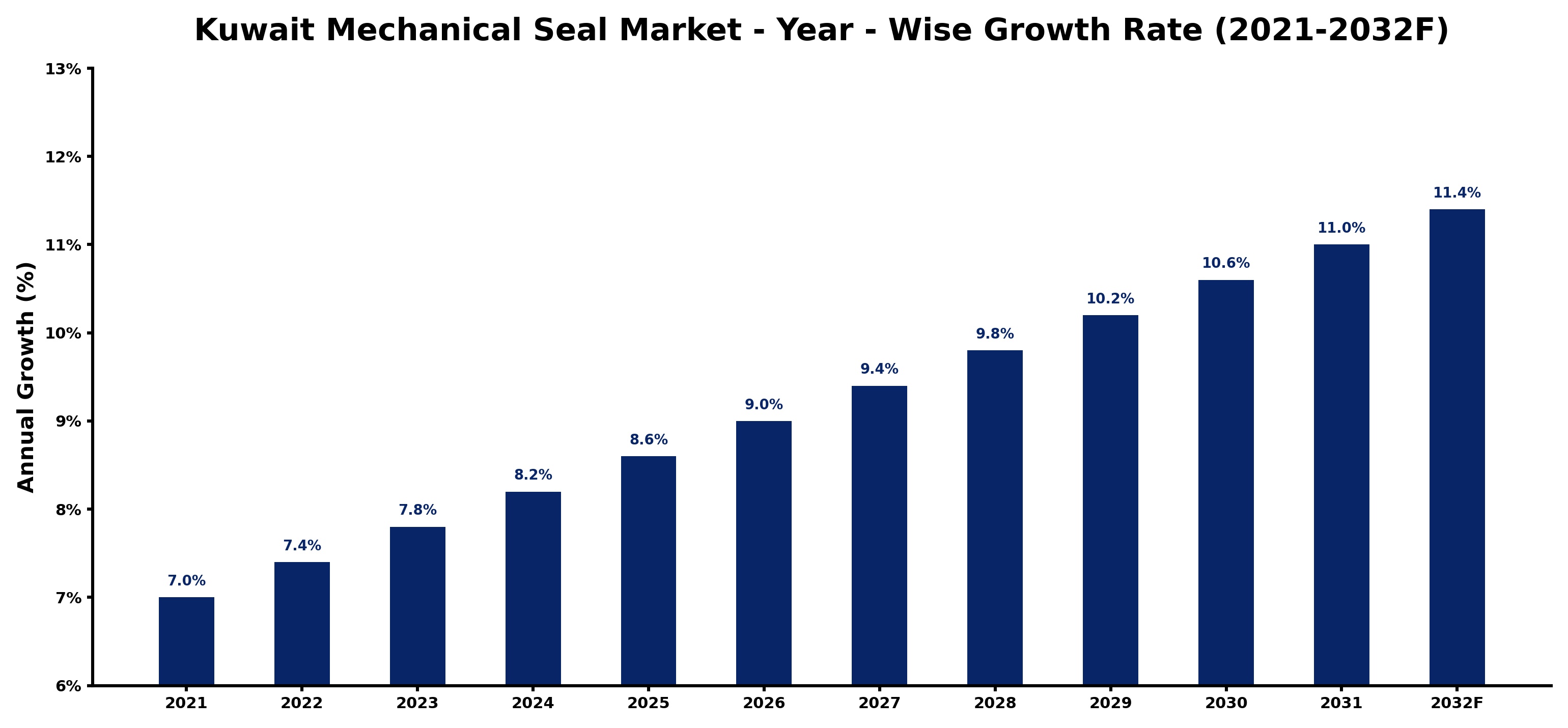
The table below presents the year‑wise growth rates along with the key drivers influencing the market
| Year | Growth Rate | Major Drivers |
| 2021 | 7.0% | Rising electricity demand across industries |
| 2022 | 7.4% | Growing renewable energy integration projects |
| 2023 | 7.8% | Increasing industrial automation investments |
| 2024 | 8.2% | Expansion of transportation and logistics networks |
| 2025 | 8.6% | Rapid growth in telecom and data center sectors |
| 2026 | 9.0% | Rising electricity demand across industries |
| 2027 | 9.4% | Growing renewable energy integration projects |
| 2028 | 9.8% | Increasing adoption of advanced technologies |
| 2029 | 10.2% | Increasing adoption of advanced technologies |
| 2030 | 10.6% | Growing urbanization and commercial development |
| 2031 | 11.0% | Government infrastructure modernization initiatives |
| 2032 | 11.4% | Government infrastructure modernization initiatives |
Note - Market size estimations and growth projections presented in this report are based on 6Wresearch’s advanced forecasting approach, validated with industry datasets as of June 2026.
Kuwait Mechanical Seal Market Synopsis
In recent years, the Kuwait Mechanical Seal Market has witnessed a notable uptick in demand fueled by an expanding industrial landscape. The oil and gas sector, a critical pillar of the economy, continues to drive significant requirements for advanced sealing technologies.
Moreover, the emphasis on sustainability and compliance with stringent safety regulations has prompted industries to adopt high-performance sealing solutions. The combination of these factors positions the market for sustained growth in the foreseeable future.
Kuwait Mechanical Seal Market Key Takeaways
- The market is set to expand significantly, driven by rising industrial activities and demand from major sectors.
- Technological advancements are leading to the adoption of innovative sealing solutions that enhance operational efficiency.
- Environmental regulations are encouraging industries to utilize sustainable mechanical seal materials.
- The shift towards customized sealing solutions is addressing the specific needs of various industrial applications.
- Investment opportunities in the market are robust, supported by ongoing infrastructure development in Kuwait.
Evaluation of Restraints in Kuwait Mechanical Seal Market
Despite the promising growth outlook, the Kuwait Mechanical Seal Market faces several restraints. Intense competition among both local and international manufacturers could pressure profit margins. Additionally, fluctuating oil prices may impact investment levels in the oil and gas sector, a primary consumer of mechanical seals. The need for continuous innovation to meet evolving industry standards also presents a challenge, alongside potential regulatory hurdles and concerns about the availability of skilled labor in the region.
Kuwait Mechanical Seal Market Trends
Emerging trends in the Kuwait Mechanical Seal Market are largely shaped by advancements in technology and evolving customer demands. Companies are increasingly focusing on the development of eco-friendly materials that align with sustainability initiatives. The integration of IoT and digital technologies in monitoring seal performance is on the rise, allowing for predictive maintenance that minimizes downtime and operational costs.
Moreover, the customization of seals to meet specific operational requirements is becoming more prevalent, responding to the unique challenges faced by industries. Such trends signify a shift towards more innovative and tailored solutions in the mechanical seal sector.
Kuwait Mechanical Seal Market Opportunities
The Kuwait Mechanical Seal Market presents several avenues for investment and growth. As the nation continues to prioritize infrastructure projects and industrial expansion, there is an increasing demand for high-quality mechanical seals. Companies focusing on innovative sealing solutions or those that enhance operational efficiency stand to benefit significantly. Furthermore, Kuwait's strategic position in the Middle East creates export opportunities to neighboring markets, further broadening the scope for investment and growth within this sector.
Government Initiatives in the Kuwait Mechanical Seal Market
Government policies in Kuwait are geared toward fostering a conducive environment for industrial growth, including the mechanical seal sector. Initiatives such as the Kuwait Vision 2035 strategy emphasize diversifying the economy and supporting local manufacturing. Through incentives, subsidies, and regulatory frameworks, the government aims to enhance technological capabilities and attract foreign investments, ensuring that the mechanical seal market evolves in line with broader economic goals.
Future Insights of the Kuwait Mechanical Seal Market
Looking ahead, the Kuwait Mechanical Seal Market is expected to sustain its growth momentum through 2026-2032. The ongoing expansion of industrial and manufacturing activities, particularly within the oil and gas sector, will continue to drive demand for mechanical seals. With rising energy needs and significant investments in infrastructure, industries will increasingly adopt advanced sealing solutions to enhance efficiency and reduce operational costs. Technological innovations in materials and designs will play a crucial role in shaping the market landscape in the coming years.
Kuwait Mechanical Seal Market Latest Developments (May 2025 - June 2026)
Recent developments in the Kuwait Mechanical Seal Market indicate a robust push toward innovation. Companies are actively investing in research and development to enhance seal performance and durability. There is a noticeable trend towards the adoption of digital technologies, with many businesses exploring IoT capabilities for real-time performance monitoring. Furthermore, partnerships between local manufacturers and international firms are emerging, aimed at leveraging technological advancements and expanding market reach.
Kuwait Mechanical Seal Market - Key Attractiveness of the Report
- 10 Years of Market Numbers
- Historical Data Starting from 2022 to 2025
- Base Year: 2025
- Forecast Data until 2032
- Key Performance Indicators Impacting the Market
- Major Upcoming Developments and Projects
Key Highlights of the Report:
- Kuwait Mechanical Seal Market Outlook
- Market Size of Kuwait Mechanical Seal Market, 2025
- Forecast of Kuwait Mechanical Seal Market, 2032
- Historical Data and Forecast of Kuwait Mechanical Seal Revenues & Volume for the Period 2022-2032F
- Kuwait Mechanical Seal Market Trend Evolution
- Kuwait Mechanical Seal Market Drivers and Challenges
- Kuwait Mechanical Seal Price Trends
- Kuwait Mechanical Seal Porter's Five Forces
- Kuwait Mechanical Seal Industry Life Cycle
- Historical Data and Forecast of Kuwait Mechanical Seal Market Revenues & Volume By Type for the Period 2022-2032F
- Historical Data and Forecast of Kuwait Mechanical Seal Market Revenues & Volume By Cartridge Seals for the Period 2022-2032F
- Historical Data and Forecast of Kuwait Mechanical Seal Market Revenues & Volume By Balanced and Unbalanced Seals for the Period 2022-2032F
- Historical Data and Forecast of Kuwait Mechanical Seal Market Revenues & Volume By Pusher and Non-Pusher for the Period 2022-2032F
- Historical Data and Forecast of Kuwait Mechanical Seal Market Revenues & Volume By Conventional Seals for the Period 2022-2032F
- Historical Data and Forecast of Kuwait Mechanical Seal Market Revenues & Volume By Others for the Period 2022-2032F
- Historical Data and Forecast of Kuwait Mechanical Seal Market Revenues & Volume By Industry for the Period 2022-2032F
- Historical Data and Forecast of Kuwait Mechanical Seal Market Revenues & Volume By Metal & Mining for the Period 2022-2032F
- Historical Data and Forecast of Kuwait Mechanical Seal Market Revenues & Volume By Food& Beverage for the Period 2022-2032F
- Historical Data and Forecast of Kuwait Mechanical Seal Market Revenues & Volume By Oil & Gas for the Period 2022-2032F
- Historical Data and Forecast of Kuwait Mechanical Seal Market Revenues & Volume By Energy & Power for the Period 2022-2032F
- Historical Data and Forecast of Kuwait Mechanical Seal Market Revenues & Volume By Aerospace for the Period 2022-2032F
- Historical Data and Forecast of Kuwait Mechanical Seal Market Revenues & Volume By Marine for the Period 2022-2032F
- Historical Data and Forecast of Kuwait Mechanical Seal Market Revenues & Volume By Construction & Manufacturer for the Period 2022-2032F
- Historical Data and Forecast of Kuwait Mechanical Seal Market Revenues & Volume By Others for the Period 2022-2032F
- Kuwait Mechanical Seal Import Export Trade Statistics
- Market Opportunity Assessment By Type
- Market Opportunity Assessment By Industry
- Kuwait Mechanical Seal Top Companies Market Share
- Kuwait Mechanical Seal Competitive Benchmarking By Technical and Operational Parameters
- Kuwait Mechanical Seal Company Profiles
- Kuwait Mechanical Seal Key Strategic Recommendations






































